In case you missed it, Paul Sherrod and the Jack and Cassie Sherrod homestead were featured on WRAL’s Tar Heel Traveler recently!

Photo courtesy of wral.com.
In case you missed it, Paul Sherrod and the Jack and Cassie Sherrod homestead were featured on WRAL’s Tar Heel Traveler recently!
Photo courtesy of wral.com.
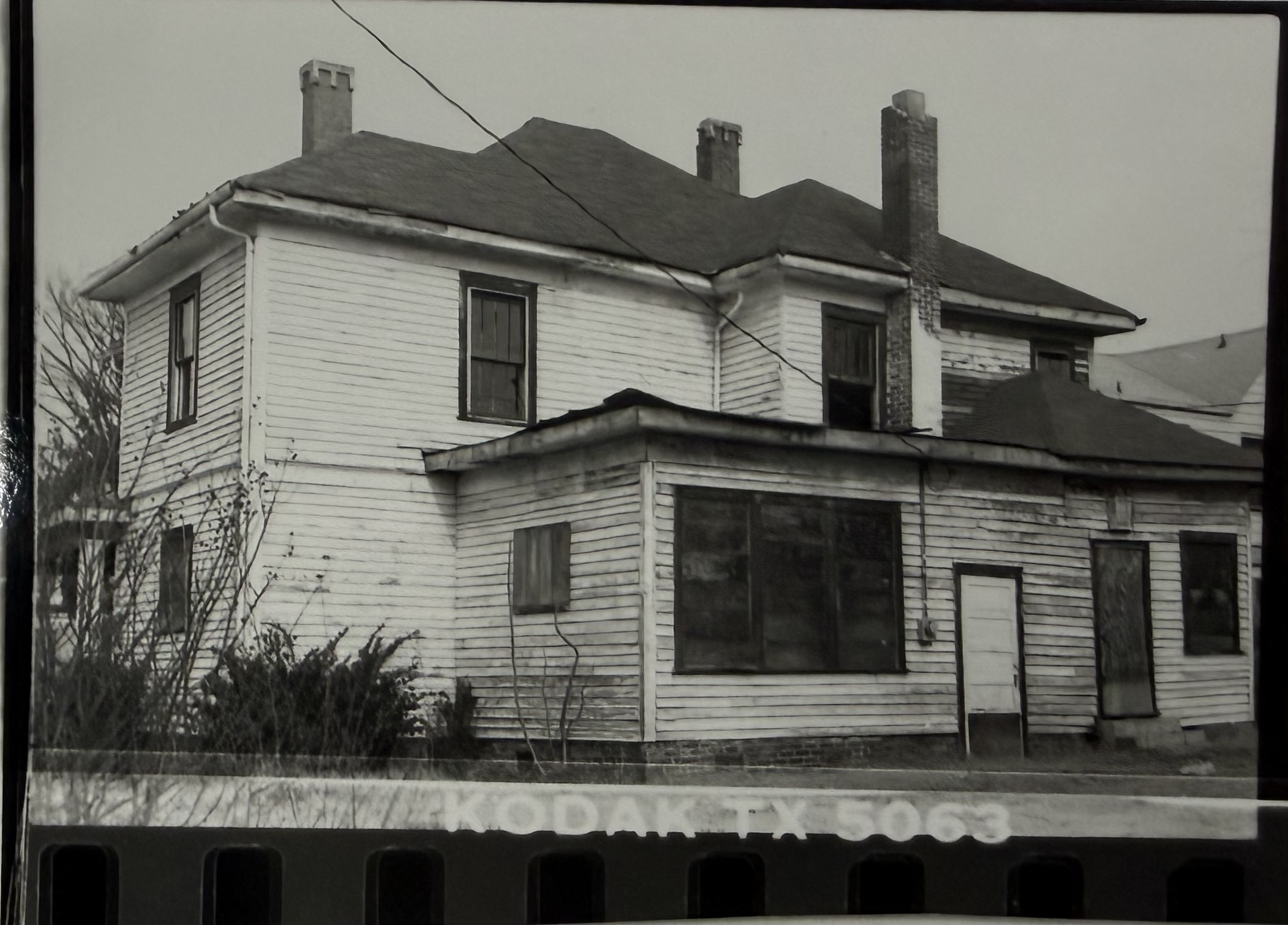
Here is 619 East Green Street, the Charlie Thomas house, in the 1980s when photographed for the National Register application for East Wilson. The small attached cinderblock building, Bea’s Flower Shop, was demolished a few years later.

I photographed the house in 2017 when I first featured it in this series. The photo below, taken in October 2025, shows the toll of eight more years.

Two months later, I photographed 619 again.

I do not begrudge a renovation that returns a decaying house to livable condition, and I understand the hard choices that must be made when updating and making efficient a house more than 100 years old, but I am saddened by the loss of architectural detail here. The original bracketed, turned porch posts replaced by plain four-by-fours are a particular loss, as are the reduced-size windows.
N.88.2.505-507, Lewis Thomas House, 619 E. Green Street, East Wilson Historic District, Wilson, Wilson County, Survey and National Register Branch, State Historic Preservation Office.
The two hundred-sixth in a series of posts highlighting buildings in East Wilson Historic District, a national historic district located in Wilson, North Carolina. As originally approved, the district encompasses 858 contributing buildings and two contributing structures in a historically African-American section of Wilson. (A significant number have since been lost.) The district was developed between about 1890 to 1940 and includes notable examples of Queen Anne, Bungalow/American Craftsman, and Shotgun-style architecture. It was listed on the National Register of Historic Places in 1988.

In the nomination form for the East Wilson Historic District, described as: “ca. 1922; 2 stories; two-bay, side-hall, gable front house with intact turned porch posts.”
In the 1922 Hill’s Wilson, N.C., city directory: Foster Hugh (c) carp h 411 E Green. Also: Foster Maggie (c) dom h 411 E Green
In the 1925 Hill’s Wilson, N.C., city directory: Foster Hugh T (c) carp h 411 E Green
In the 1928 and 1930 Hill’s Wilson, N.C., city directories: Foster Hugh T (c; Mollie M) carp h 411 E Green
In the 1930 census of Wilson, Wilson County: at 411 East Green Street, Hugh Foster, 31, carpenter,
In the 1940 census of Wilson, Wilson County: at 411 East Green, Hallie Armstrong, 48, pool room operator; wife Julia, 29; and lodgers Annie M. Brown, 39, of Mooresville, Iredell County, hospital nurse; Jeanett M. Lee, 24, of Mount Olive, Wayne County, hospital nurse; and Lawrence Peacock, 27, of High Point, sewer project laborer.
In the 1950 census of Wilson, Wilson County: at 411 East Green, widow Julia Armstrong, 39, born in Kentucky, and lodgers Mary Rose, 29; Anne Everette, 2; Herbert Rose Jr., born in July; Edward Harris, 20, construction company bricklayer; McDonald Hayes, 33, electric power company laborer; Josephine Hayes, 28, cotton picker on farm; and Willie Mack Hayes, 15, cotton picker on farm.

Wilson Daily Times, 23 February 1968.
Photo by Lisa Y. Henderson, May 2024.
On 29 October 1892, Hardy Tate purchased for $700 from George D. and Ella M. Green a 1/3-acre lot on Green Street between Green and H.C. Phillips.
The first house Tate erected on this lot burned to the ground under suspicious circumstances shortly after completion in 1896. Tate replaced it with this house, whose number bounced from 610 to 612 before settling at 611.

Tate died in 1938. Undertaker Columbus E. Artis and his first wife, nurse Ada D. Artis, bought the house from the Tate family. In 1951, Artis remarried.

Wilson Daily Times, 28 July 1951.
It appears that C.E. and Ruby Barbour Artis began to take in roomers in the 1960s. Artis, photographed here in the driveway, owned the house until his death in 1973, and Ruby Artis remained for several years after.
Per the 12 April 1975 Daily Times, Ruby Artis was issued a permit to “alter boarding house 611 E. Green.”
This ad for apartments in the house ran in the Daily Times in the early 1980s.

Wilson Daily Times, 3 September 1981.

Wilson Daily Times, 14 April 1983.

Wilson Daily Times, 5 July 1983.

Wilson Daily Times, 5 November 1983.
The house was demolished in the early 2000s.
N.87-12-279-280, Hardy Tate House, 611 E. Green Street, East Wilson Historic District, Wilson, Wilson County, Survey and National Register Branch, State Historic Preservation Office.
The two hundred-fifth in a series of posts highlighting buildings in East Wilson Historic District, a national historic district located in Wilson, North Carolina. As originally approved, the district encompasses 858 contributing buildings and two contributing structures in a historically African-American section of Wilson. (A significant number have since been lost.) The district was developed between about 1890 to 1940 and includes notable examples of Queen Anne, Bungalow/American Craftsman, and Shotgun-style architecture. It was listed on the National Register of Historic Places in 1988.

As described in the nomination form for the East Wilson Historic District: “ca. 1913; 1 story; Alonzo Phillips house; two-room, central-hall house with hip-roofed porch; Phillips was a house painter.” The house was originally numbered 608 (and may also have been referred to as 610). It has been demolished.
On 5 July 1923, H.A. [Hiram Abiff] Faulk filed a deed for sale of land to Roddrick Taylor and wife Mary J. Taylor, for $10 and valuable consideration, a house and lot on the north side of East Green Street and known as No. 607 (old city No. 608) E. Green, lot measuring 70′ x 120′. The lot was bordered on either side by the properties of William Hargrave and Walter Hines.

Wilson, N.C., city directory (1928).
In the 1930 census of Wilson, Wilson County: at 607 East Green, renting for $20/month, bricklayer Jessie Holden, 35; wife Beatrice, 38, private maid; and stepdaughter Jeroline Wood, 20.
But also in the 1930 census of Wilson, Wilson County: renting at $20/month, barber Roderick Taylor, 45, wife Mary J., 39, and children Edna G., 8, Mary J., 4, and Roderick Jr., 1. [In the 1920 census, laborer Robert Taylor, 36, and wife Mary G., 29, were also listed at 610. This was prior to Roderick and Mary J. Taylor’s purchase of the house, and the names are slightly off, but this appears to be them.]

In the 1940 census of Wilson, Wilson County: at 607 East Green Street, barber Roderick Taylor, 58; wife Mary J., 50; and children Edna G., 18, a college bookstore clerk, Mary J., 14, and Roderick Jr., 12.

Wilson Daily Times, 5 August 1947.
Roderick Taylor Sr. died 4 August 1947 in Wilson. Per his death certificate, he was born 16 March 1882 in Wilson to Henry Taylor and Rachel Barnes and worked as a barber. Informant was Mary J. Taylor, 607 East Green St., City.

Wilson Daily Times, 12 September 1952.
N.87-12-351-353, Alonzo Phillips House, 607 E. Green Street, East Wilson Historic District, Wilson, Wilson County, Survey and National Register Branch, State Historic Preservation Office.
The two hundred-fourth in a series of posts highlighting buildings in East Wilson Historic District, a national historic district located in Wilson, North Carolina. As originally approved, the district encompasses 858 contributing buildings and two contributing structures in a historically African-American section of Wilson. (A significant number have since been lost.) The district was developed between about 1890 to 1940 and includes notable examples of Queen Anne, Bungalow/American Craftsman, and Shotgun-style architecture. It was listed on the National Register of Historic Places in 1988.

As described in the nomination form for the East Wilson Historic District: “ca. 1922. 2 stories. Catherine Clark house; gable front house with side hall and intact classical porch posts; Clark was a school teacher.”
The house was numbered 607 prior to 1922 and may have been built as early as about 1900 by Catherine Clark’s mother, Sarah Hill Clark.
On 3 January 1898, for $180, the Vicks sold Sarah Clark a lot on Green Street bordering Jonah Williams and Millie Bryant. The deed was registered 9 January 1899 in Deed Book 50, page 474. Sarah Clark and her husband Rhoden Clark, natives of Scotland Neck, Halifax County, North Carolina, were married at the time, but she bought this lot in her name only. Rhoden Clark died a few years later.
In the 1908 Wilson, N.C., city directory: Clark Sarah, h 607 e Green; also, Clark Catherine, dressmkr h 607 e Green
In the 1910 census of Wilson, Wilson County: Sarah Clark, 45, school teacher; daughters Catherine, 22, Letha, 19, and Bettie, 17; granddaughter Ruth Jenkins, 8; and servant Mary Jenkins, 26.

Wilson, N.C., city directory, 1912.

Wilson, N.C., city directory, 1916.
In the 1920 census of Wilson, Wilson County: at 607 Green, widow Sarah Clark, 28 [sic], and daughters Lena, 20, Bettie, 17, and Kathryn, 24, a teacher.
Sarah Hill Clark died 27 January 1927 in Wilson. Per her death certificate, she was 64 years old; was born in Scotland Neck, N.C., to James Hill and Evelyn Barnes; lived at 606 East Green; and was buried in Rountrees Cemetery (probably, Vick Cemetery.) Catherine Clark was informant.

Wilson, N.C., city directory, 1930.
In the 1930 census of Wilson, Wilson County: at 607 Green, owned and valued at $8000, Katherine Clark, 30, teacher, and sister Aleatha Clark, 24, a seamstress. Both women died in the mid-1930s, and the house was converted to upstairs and downstairs apartments.
In the 1940 census of Wilson, Wilson County: undertaker Talmer Hunter, 29, and wife Naomie, 27 a nurse, renting for $24/month; laborer Sidney Tomlinson, 27, wife Luney, 26, and son Alton, 18 months, renting for $8/month; Randolph Hunter, 7; Ethel Baptist, 40; Shorty Baker, 27; and Thomas Pender, 14.
In the 1950 census of Wilson, Wilson County: (downstairs) widow Jane White, 48, laundry checker; son-in-lsw Bruce Sutton, 28; daughter Lucille, 20, and their sons William E., 2, and Bruce Jr., 1; (upstairs) Charlie K. Clark, 60, day work mowing lawns, and son Donald, 7.
N.88.2.466-467, Catherine Clark House, 606 E. Green Street, East Wilson Historic District, Wilson, Wilson County, Survey and National Register Branch, State Historic Preservation Office.
The two hundred-third in a series of posts highlighting buildings in East Wilson Historic District, a national historic district located in Wilson, North Carolina. As originally approved, the district encompasses 858 contributing buildings and two contributing structures in a historically African-American section of Wilson. (A significant number have since been lost.) The district was developed between about 1890 to 1940 and includes notable examples of Queen Anne, Bungalow/American Craftsman, and Shotgun-style architecture. It was listed on the National Register of Historic Places in 1988.

As described in the nomination form for the East Wilson Historic District: “ca. 1908; 1 story; William Hargrove house; triple-A house with bracketed, chamfered porch posts and cut-out balustrade; asphalt shingled; Hargrove was a blacksmith.”

Originally numbered 606, the Hargrove house is second only to the Samuel H. and Annie M. Vick house in longevity on the block.
In the 1908 Hill’s Wilson, N.C., city directory: Hargrove Wm blksmith 206 S Goldsboro h 606 E Green
In the 1910 census of Wilson, Wilson County: at 606 Green, blacksmith William Hargrove, 43; wife Louvenia, 40; daughters Bessie, 17, and Willie L., 13; and boarder John Howard, 18.

In the 1912 Hill’s Wilson, N.C., city directory: Hargrove Wm blksmith h 606 E Green
In the 1920 census of Wilson, Wilson County: at 606 East Green, Luvenia Hargrove, 40, widow, and daughter Willie, 20, public school teacher.
In the 1930 census of Wilson, Wilson County: at 605 East Green, Luvenia Hargrove, 60, widow, and daughter Willie, 29, public school teacher.
In the 1940 census of Wilson, Wilson County: at 605 East Green, owned and valued at $1000, Louvenia Hargrove, 74, widow; son-in-law McDuffie Smith, 42, shoeshine parlor operator; and daughter Willie, 48, teacher.
In 1942, McDuffie Smith registered for the World War II draft in Wilson County. Per his registration card, he was born 12 July 1899 in Durham, N.C.; lived at 605 East Green; his contact was Luvenia Hargrove, 605 East Green; and he was self-employed.
In the 1950 census of Wilson, Wilson County: at 605 East Green, shoeshine parlor manager McDuffie Smith, 51; wife Willie H., 53, city grammar school teacher; and mother-in-law Luvenia Hargrove, 80, widow.
Luevenia Hargrove died 22 February 1958 in Wilson at her home at 605 East Green. Per her death certificate, she was born 27 February 1869 in Edgecombe County to Joshua Bulluck and Harriet Hines and was buried in Bulluck cemetery, Edgecombe County. Informant was Mrs. Willie Smith, 605 East Green.

McDuffie Smith of 605 East Green died 17 July 1971. Willie Hargrove Smith died 12 years later. Her nephew, William Hines Macklin, remained at 605 East Green.

Wilson Daily Times, 4 May 1983.
William H. Macklin died 13 March 1991 in Wilson.
On 7 November 1994, the Wilson Daily Times published a list of boarded-up houses that included 605 East Green, described as needing “minor repairs.”
The house was renovated and remains occupied today.
N.87-12-354-359, William Hargrove House, 605 E. Green Street, East Wilson Historic District, Wilson, Wilson County, Survey and National Register Branch, State Historic Preservation Office.
The J.D. and Eleanor Reid house has been in distress for decades, as shown in these photos taken for the East Wilson Historic District nomination process.


N.87-12-269-271, Judge D. Reid House, 600 E. Green Street, East Wilson Historic District, Wilson, Wilson County, Survey and National Register Branch, State Historic Preservation Office.
The two hundred-second in a series of posts highlighting buildings in East Wilson Historic District, a national historic district located in Wilson, North Carolina. As originally approved, the district encompasses 858 contributing buildings and two contributing structures in a historically African-American section of Wilson. (A significant number have since been lost.) The district was developed between about 1890 to 1940 and includes notable examples of Queen Anne, Bungalow/American Craftsman, and Shotgun-style architecture. It was listed on the National Register of Historic Places in 1988.


As described in the nomination form for the East Wilson Historic District: “ca. 1913; 2 stories; Dr. William Michner [sic] house; L-plan Queen Anne structure with cutaway front-facing bay; Michner was a physician.”
Prior to Dr. William A. Mitchner’s purchase of this house, it was numbered 605. Primitive Baptist elder Jonah Williams likely built the house around 1910. His daughter, teacher Clarissa Williams, inherited it and lived there with her niece’s family.
Earnestine Ford died 10 November 1916 in Wilson. Per her death certificate, she was five months old; was born in Wilson to Curtis Ford of Dillon County, S.C., and Mamie Battle of Wayne County, N.C. Curtis Ford, 605 East Green Street, was informant.
In the 1920 census of Wilson, Wilson County: Clarcy Williams, 50; roomer Curtis Ford, 37, house carpenter; [niece] Mamie Ford, 24, and her children Lear L., 4, and Quincey B., 2.
Williams died in October 1921. Her estate consisted of a house and lot (at 605 East Green Street) worth about $3000 and an estimated $100 in personal property. Her heirs at law were her nieces and nephews Mamie Ford, Fanny Battle, Clinton Battle, and Glynn Battle.
In the 1925 Wilson, N.C., city directory:

In the 1928 Wilson, N.C., city directory:

In the 1930 census of Wilson, Wilson County: at 604 East Green, physician William Mincher [sic], 55, divorced; mother Lucy, 65, widow; and nephew Hubert, 30, tobacco factory laborer.
In the 1940 census of Wilson, Wilson County: at 604 East Green Street, Dr. W.A. Mitchner, 53, born Johnston County; wife Marie, 40, born Wake County; and mother Lucy Mitchner, 80, born in Johnston County.
Dr. Mitchner died in 1941, and his mother in 1946.

Wilson Daily Times, 5 November 1941.


Wilson Daily Times, 25 April 1946.
Marie Mitchner began to take lodgers into the large home, including members of her family.

In the 1950 census of Wilson, Wilson County: at 604 East Green, widow Marie R. Mitchner, 49, and lodgers Doris Raynor, 36, city social worker, and Mary A. Huggins, 24, elementary teacher in city schools.

Wilson Daily Times, 7 January 1956.

Wilson Daily Times, 21 April 1962.
Marie Mitchner died 30 April 1971 in Wilson. Per her death certificate, she was born 24 December 1899 in Henry Person and Dora Radley; was a widow; lived at 604 East Green Street; and was a retired teacher.
604 East Green Street was converted into apartments after Mitchner’s death, and tenants cycled in and out well into the 1990s. In January 2003, Wilson City Council accepted donation of the property by its owner, Jean Tedder. It was later demolished.
N.87-12-274-278 [N.80.11.904], Dr. William Michner House, 604 E. Green Street, East Wilson Historic District, Wilson, Wilson County, Survey and National Register Branch, State Historic Preservation Office.

