convict leasing

The hire of Walter Mitchell.

Convict leasing never took hold in Wilson County the way it did in the deeper South (or even western North Carolina), but it nevertheless was a system of forced penal labor available to those who wanted and could afford to take advantage of it.

Below, in November 1896, Paul Lee Woodard and William Woodard Jr. agreed to pay the Wilson County Commissioners six dollars per month to lease Walter Mitchell, “a prisoner in the County Jail,” for one year. If Mitchell failed to “do his duty,” he could be returned to county custody. The arrangement meant (1) the county was relieved of the expense of feeding and otherwise looking after Mitchell for a year, and (2) the Woodards gained cheap labor that they could work hard and completely control. As for Mitchell, he was possibly spared roadwork under harsh conditions, but was also removed from what nominal protections were afforded by being under the county’s “care.” Either way, he received no pay for his labor.
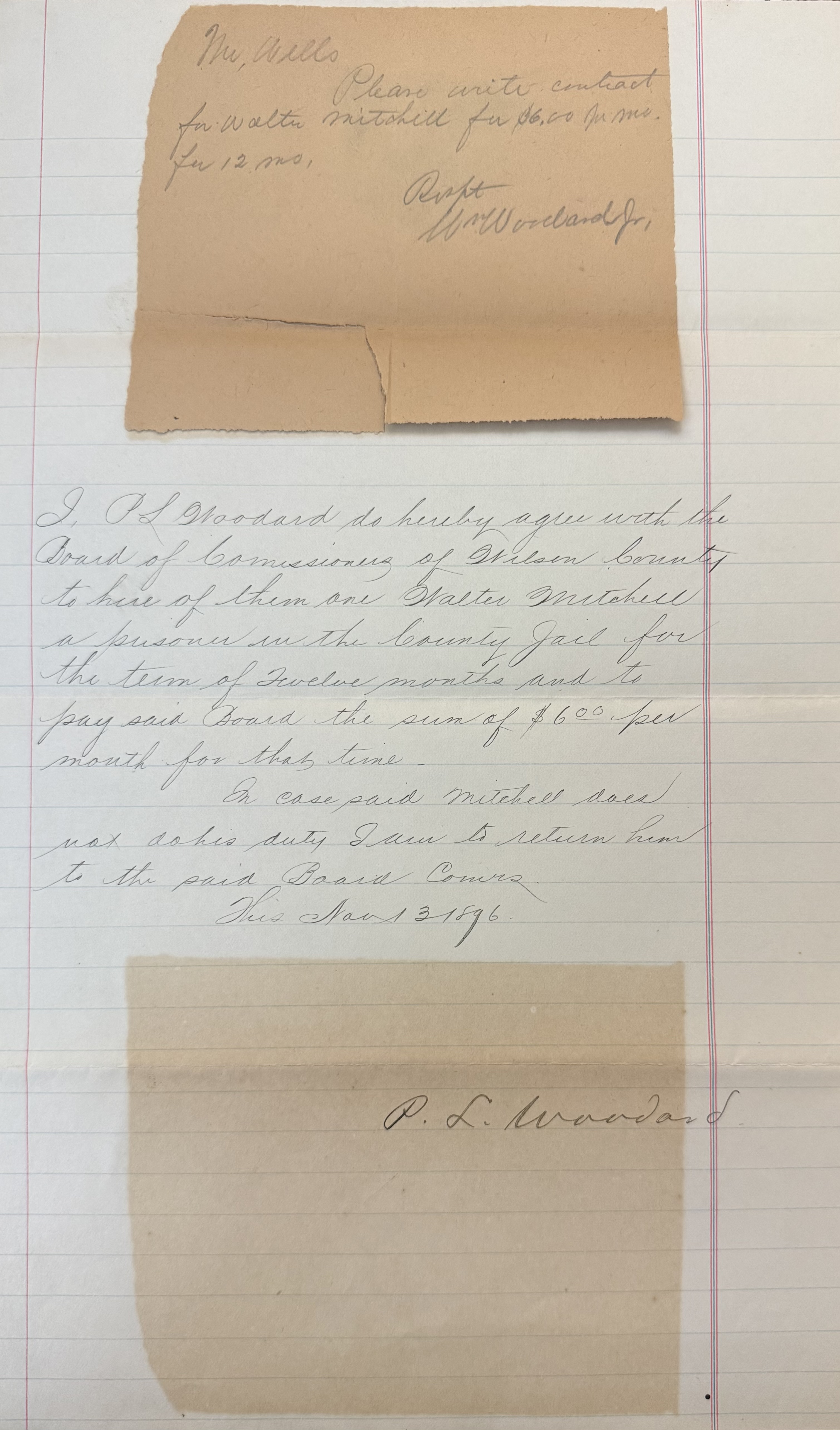
Hire of Prisoner (1896), Miscellaneous Records, Wilson County Records, North Carolina State Archives, Raleigh.

Sentenced to shovel dirt on the Western road.

Wilson Advance, 30 May 1884.

Justice was merciless in 1884. In a single week of May of that year, Inferior Court, which handled low-level misdemeanors and minor civil matters, heard 23 cases. Two black men were convicted and sentenced to the state penitentiary. As a practical matter, as revealed in this news brief, that meant brutal work on the Western North Carolina Railroad under North Carolina’s convict leasing system. Between 1870 and 1890, roughly 65% of North Carolina’s prison population, disproportionately black men, was forced to cut through mountain rock, lay tracks, and blast tunnels under lethal conditions. They faced frequent cave-ins and landslides, rock-blasting accidents, and outbreaks of serious disease.

Ephraim Perry was sentenced to serve two years for stealing a shovel, and Nathan Herring got five for taking a clock out of the “colored Methodist church,” i.e. Saint John A.M.E. Zion.

——

  • Ephraim Perry — this possibly was the 26 year-old farm laborer Ephraim Perry listed in the 1870 census of Sparta township, Edgecombe County. In 1892, several years after his release from incarceration, Perry was arrested in Asheville on suspicion of theft.
  • Nathan Herring

Podcast recommendation: Sugar Land.

An impassioned, but disrespected, community advocate; an abandoned cemetery filled with unmarked graves of African-Americans; historic racism; frustratingly opaque government response.

There’s nothing new under the sun.

“In 2018, construction crews building a new school in Sugar Land, Texas, discovered a long-forgotten cemetery containing 95 graves. Two years ago, we set out to tell the story of these 95 people – who were they? What happened to them? In the process, we learned that theirs is a story about power – who gets it and how they wield it.”

Sound familiar?

Listen to and follow Sugar Land on NPR or wherever you get your podcasts.