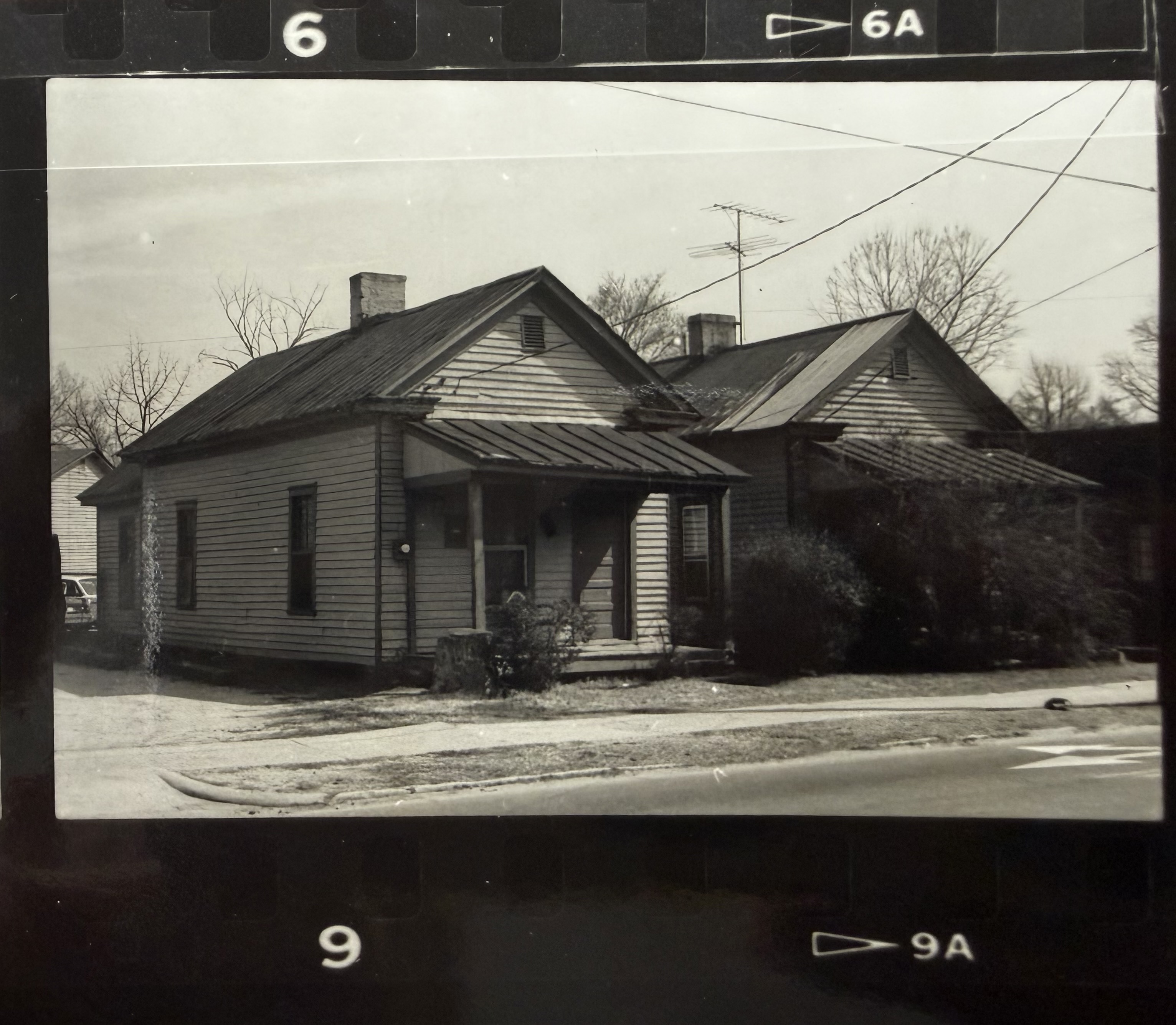
Houses

Plantation House Series: James Reddick Barnes house.

The James Reddick Barnes house, built between 1850 and 1860, stands well back off the road in Saratoga township, southeast of Wilson. It is not registered with the National Register of Historic Places.

In the 1860 slave schedule, James R. Barnes reported enslaving 41 people and controlling another 32 as trustee for minors. (Though unnamed in the census, those minors included the Isaac Scarborough heirs.) In June 1856, two people he jointly owned with others, Cate and Sherard, were sold at auction at a toll house on White Oak Swamp. As high bidder, Barnes was able to buy them back.

In 1950 and 1960, the Wilson Daily Times ran articles on historic Wilson County houses, most of which had anchored plantations. The James R. Barnes house was featured twice.

Wilson Daily Times, 10 January 1950.

Ten years later, the house’s history had stretched a bit. Now the claim was that the house itself, rather than the land, had passed through seven generations from John Barnes. However, Barnes died in 1789 and his grandson Reddick Barnes in 1835, and great-grandson James Reddick Barnes actually built the house. (Also note the incorrect suffixes added to the names of the owners, i.e. III, IV, and VI. They are the result of the reporter’s incorrect interpretation of the owner’s generation of ownership, as spelled out in the 1950 Times article.)

Wilson Daily Times, 8 January 1960.


927 Carolina Street, revisited.

I first posted about 927 Carolina Street here.

927 Carolina in April 2022.

927 and 929 next door were demolished circa 2023.

Is a $225,000 shotgun house what East Wilson needs? This two bedroom/two bath/no storage house costs more than $200 a square foot. In comparison, new three-bedroom construction off Airport Road and Raleigh Road Parkway runs about $170/square foot. Not only is this being built in an area of the city that desperately needs affordable housing, it’s even more expensive than housing in higher-income neighborhoods. And who is this artificially generated image (with a white fence and mature landscaping that I can guarantee you are not in place) and shots of Whirligig Park and Warbirds stadium being pitched to? Obviously, the market will settle any debate about the price of 927 Carolina Street, but if this price point for this product is the victor, East Wilson is really in trouble.]

927 Carolina Street is on the eastern end of the former property of Sallie Lipscombe, which was surveyed and platted in 1920.

927 and 929 Carolina were the last standing of this row of shotgun houses. Detail of the 1930 Sanborn fire insurance map of Wilson, N.C., page 27.

Gentrification tries Pettigrew Street.

One of the minor surprises I got while researching residential patterns in Wilson was the revelation that the southern block of Pender Street — between Nash and Barnes Streets — was an all-white block into the 1930s. The block’s west side was industrial, but its east side (at the bottom in the 1930 Sanborn map detail below) was lined with small bungalows and duplex shotgun houses.

Most of the houses are long gone, but the double shotguns at 113 and 115 stood until about 2023. The historic union hall at 121 was erected in the 1950s. This property, plus two lots fronting Barnes Street, have been bundled for sale. Purchased for $35,000 in the summer of 2023, the asking price is now an eye-watering $425,000.

Photo by Lisa Y. Henderson, May 2026.

A tour of Jones Land.

I spent a beautiful afternoon with Grover L. Jones Jr. and his eldest daughter, Gronna Jones. The Joneses descend from one of Wilson County’s largest free families of color — one that I’ve blogged about over and over and over. Mr. Jones is a western Wilson County griot, and I was thrilled when Gronna offered to drive us around to some of the family’s landmarks, all on or within a mile or so of today’s Saint Rose Church Road.

Mr. Jones’ grandparents, John A. Jones and Betty Hinnant Jones, built this house around 1912. Mr. Jones himself was born in the “little room” at the south end of the house.

While the house was under construction, the Joneses lived in the upstairs loft of this tobacco barn.

This 1927 Dodge has been parked here all of Mr. Jones’ life. He’s 88.

John A. Jones planted these massive oaks — a white and three swamp whites — that now tower over his grandson. A gnarled pecan tree leans away from one end of the house.

Just down the road stands the church John A. Jones attended — Rising Sun Missionary Baptist.

Per John Jones’ 1962 obituary, he was founder of Rising Sun. Rev. Buchanan H. Edwards was its pastor during much of the first half of the 1900s and preached Jones’ funeral.)

Wilson Daily Times, 16 September 1962.

Rising from the rear of the church structure is a two-story addition. A Masonic lodge, whose name and number have been forgotten, met upstairs. (I’m trying to identify it further.)

The tenants who lived in this house farmed for the Joneses, mostly raising tobacco and corn.

Saint Rose United Holy Church, which Betty Hinnant Jones attended, stands north of the Jones house. The original wooden building was moved to the Green Pond area of Wilson County to house another church.

Two family cemeteries lie across the road. The Jones family cemetery, holding the remains of John and Betty Jones and some of their children and grandchildren, is relatively new.

The nearby Sane Williams cemetery is much older, with graves dating back to the 1890s. The predominant family buried here is Jones, but other surnames appear on the 65+ graves. Sane Williams (or Williamson) and John A. Jones owned adjoining property, and Mr. Jones pointed out the property of neighboring landowners Johnny Finch and Henry Coleman.

The Henry Coleman farm, known as The Kingdom, lies off Old Raleigh Road, but is a straight shot through the woods from the cemeteries. Below, one of the cemeteries in The Kingdom. The old Jones Hill cemetery, also known as Old Fields cemetery, which holds graves of Joneses, Powells, and related 19th century families, has grown up in scrub trees again.

Mr. Jones confirmed the site of the Jones Hill School, which he attended from first through sixth grade. His teachers were Ethel Moye Coley and Alice Shaw. (He attended Sims School for seventh grade, then Williamson High School briefly before the brand-new Springfield High School opened in 1951.)

This abandoned store was once located on the other side of I-95, very close to the school. In order to gain licensing to sell beer, however, the building was moved down the road to this location.

I didn’t get photos, but we also rode over to Sims, past Flat Rock Church of Christ, the remnants of Sims School, and the house in which Mr. Jones’ maternal grandmother Lillie Taylor Jones lived in the Sugar Hill neighborhood.

A very special thanks to Gronna and Grover Jones for indulging my thousand questions — and treating me to a hot dog at Best N Burger! Photos by Lisa Y. Henderson, May 2026. 

303 Elba Street, for sale.

When I first hit Wilson, I always pay my respects to my father and grandmother at Rest Haven and to the dead of Vick, Odd Fellows, and Rountree Cemeteries, and I always check on 303 Elba Street.

My family owned this little house from 1908 until 1938. My grandmother grew up here, Jack Henderson lived here when he first arrived in Wilson, and my father and his siblings were born here. It was, as the old folk say in Wide-Awake, my family’s “home house.”

Friday, for the first time since I’ve been paying attention, a For Sale sign hung out front.

If I were burning money, maybe I’d hand over $38,000 for a tiny house that needs a complete gut to be habitable. As it is, I’ll just pull up to the curb to pay homage to Hattie Henderson Ricks and Jesse and Sarah Henderson Jacobs as long as 303 stands. 

Photo by Lisa Y. Henderson, May 2026.

The Barneses sell property to the School Board.

Plat Book 4, page 51.

On 30 September 1946, Dr. B.O. Barnes and his wife Flossie H. Barnes sold the Board of Trustees of Wilson City Schools a tract bordered by North Reid Street, East Vance Street, an unopened section of North Vick Street, and an unopened section of Crowell Street. Deed Book 326, page 43.

As the Google Maps aerial below shows, the property is adjacent to land on which the former Vick Elementary School sits. (Vick had opened ten years earlier.) Ultimately, however, much of it was sold to developers who built a row of houses in the 800 block of East Vance Street.