Wilson County

The estate of Wiley Rountree (1847).

When Wiley (or Willie, as his name was sometimes spelled) Rountree made out his will on 12 May 1847, he left land for his sons Willie and Jonathan Rountree on Contentnea Creek and Hominy Swamp, directed that his personal property be sold, and specified that “it is my will and desire that my Negroes be divided as follows among my children and my granddaughter Mary Ann Rountree, that is for my girl children each to have a full share of all my Negro property, and my boys and my granddaughter … one half share of the same.”

Rountree died weeks later, and his executors (who had married two of Rountree’s daughters) published this notice in a Tarboro newspaper:

Tarboro Press, 12 June 1847.

On January 1, 1850, Larry Dew, L.D. Farmer, and Joshua Barnes divided the 23 remaining enslaved people in Rountree’s estate among his surviving heirs:

  • Lot 1, Ruffin, Packolatt, Jane, and Amos, valued collectively at $1625, and lot 3, Marion, Ruford, Jack, and Margaret, $1600, went to William Woodard, on behalf of his wife Delphia Rountree Woodard
  • Lot 2, Joseph, Henry, Clarky, and Everett, $1625, went to Willie Rountree
  • Lot 4, Bob, Temperance, Edwin, and Elizabeth, $1575, went to John G. Williams, as the administrator of recently deceased Jonathan Rountree’s estate (Williams later sold Bob and Elizabeth to James J. Taylor for $750 and $492, and Temperance, her son Edwin, and an unnamed child to John Batts for $615. Bob and Temperance were a married couple. Thus, they and their older children Marion and David were separated from each other.)
  • Lot 5, Davy, Israel, and Adaline, $1550, and Lot 6, Haywood, Edwin, Zilphy, and Mary, $1550, went to Nancy Rountree

——

  • Ruffin
  • Packolatt
  • Jane
  • Amos
  • Bob, Temperance, Marion, Dave, Edwin, Elizabeth

In 1866, Bob Rountree and Tempy Horn registered their 30-year cohabitation in Wilson County. [Note that Temperance declined to adopt Rountree or Batts as her maiden name. Horn was the name of the enslaver who sold her to Wiley Rountree.]

In 1866, Merion Rountree and Jane Barnes registered their seven-year cohabitation in Wilson County.

On 27 August 1866, David Rountree and Nancy Farmer registered their twelve-year cohabitation in Wilson County.

In the 1870 census of Wilson township, Wilson County: Robert Rountree, 62, farm laborer; wife Temperance, 49; Ann, 21, farm laborer; and Dora, 1.

In the 1870 census of Wilson township, Wilson County: farm laborer David Rountree, 35; wife Nancy, 33; and children Winnie, 12, Jonas, 11, Allen, 9, Tillie, 4, Laurence, 5, and Angeline, 1.

On 25 April 1872, Robert Rountree, son of Robert and Tempy Rountree, married Pricey Williamson, in Wilson County.

In the 1880 census of Wilson township, Wilson County: Robert Rountree, 82; wife Tempy, 68; daughter-in-law Priscilla, 30, and her son Willie, 7.

In the 1880 census of Wilson township, Wilson County: David Rountree, 46; wife Nancy, 45; and children Winnie, 21, Lawrence, 14, Jennie, 12, Dinah, 10, Sarah, 8, David, 6, Charlie, 4, and Jonas, 20, and Bettie, 1.

  • Ruford
  • Jack
  • Margaret
  • Joseph
  • Henry
  • Clarky
  • Everett
  • Israel
  • Adaline
  • Haywood
  • Edwin
  • Zilphy
  • Mary

An inquiry into the death of Will Brown.

We read of the murder of Will Brown here. Below, the conclusion and transcripts of the coroner’s inquest. 

Frank Tart shot Brown near the railroad near Stantonsburg. Witnesses to the crime included five black and three white men. Two years earlier, Otto King, who was found to be an accessory after the fact to Brown’s killing, and his brother Lum King had been involved in a non-fatal shooting that also involved gambling, and Otto King himself was murdered in 1924.

Bob Hall, being duly sworn says I was up the RR on Saturday afternoon near sunset. While up the road I saw Will Brown, Frank Tart, Otto King, Will Edwards, Josh Fleming, gambling playing skin. I saw standing around the gambling crowd. Columbus King & Hagans. I staid there not over 15 minutes. Will Edwards owed me $2.00 and I went for that. As soon as I could get it, I left. While I was there, Will Brown seem to be winning the money. I saw Frank Tart change his pistol from his hip pocket and put it into his side pants pocket. Did not hear pistol shot as I had left before the shooting occurred. /s/ Bob Hall

Peter Ward, being sworn says that Frank Tart and Otto King came to my house Saturday night about 8 o’clock. Staid there until about 9:30 and on leaving told me told me that they were going to Gray Tart. Otto King come to Stantonsburg with me said that he wanted to see Josh Fleming. That Josh had his pistol. I come to Stantonsburg, and Otto come with me. I do not know that he got out of the buggy. [Illegible] Lum told me that Frank Tart shot a man. I told him [illegible] Lum that Frank Tart was at my house. Peter (X) Ward

Josh Fleming, being sworn says that “at or about the time of the killing I was about 150 years from the scene of the homicide at the time. I heard the pistol shot. I saw Columbus King and Otto King come running from the direction of the place of the homicide and from the direction I heard the pistol shot. I asked Otto King who it was shot and Otto King said that Frank Tart had shot a fellow Will, but did not know what Will. Columbus King and Otto King both come to the stable where Frank Tart’s horse was, got the horse and buggy and drove off. I came back to Stantonsburg after the policeman Mr. Stancill. I went back with the crowd to the scene of the homicide. I saw a man shot by the name of Will Brown. /s/ Josh (X) Fleming

Josh Fleming, called to the stand later, says that previous to the shooting was in the woods with Frank Tart, Will Edwards, Otto King, Will Brown gambling. Louis Hagans, Columbus King was there but did not see them gamble. Will Brown was principal winner. I saw Will Brown have as much as twenty-two dollars. Josh (X) Fleming

Richard Stancil, being duly sworn says that Josh Fleming came for me and said that Frank Tart had shot a man down the Rail Road and I hurried as quickly as I could and when I got to the place where the shooting occurred I found no one there but the shot man Will Brown. He was lying near the Rail Road track. He was not dead at the time and I had him carried to the doctors office. /s/ Richard Stancil

Will Edwards being duly sworn says he was with Josh Fleming, Frank Tart, Otto King and William Brown gambling playing skin. Will Brown beat the boys out of the money and he got up and started towards the R.R. He had I know twenty dollars when Brown left the game busted. Mr. Ernest Hartley (white), Bob Hall, Louis Hagans, and Columbus King were on the grounds while the gambling was going on but did not gamble any. I was about 100 yards from the scene of the shooting. Heard the shot. Did not see any pistols. Do not know who shot Will Brown. When I heard the shot I was on R.R. in the woods going  towards home when the shot was fired, but left immediately for home. Will (X) Edwards

Ernest Hartley, being duly sworn says at the time of the shooting I was in the E Road about 30 years from the scene of the shooting. Did not know any one there except Will Brown the shot man. I was out hunting and come up to a crowd. They moved towards the R.R. and stopped and seemed to talking together. I saw one low chunky dark man take hold of Will Brown. About that time heard pistol shot. The pistol was in the hands of a tall yellow negro. Immediately after the pistol fired, saw the black negro bending over Will Brown as if her was searching Will Brown pockets. The crowd dispersed and I left for home. I was near Sunset when it occurred as well as I remember. I work with Mr. Ben Paschall at saw mill so did Will Brown. I think Brown was paid off Saturday afternoon. He had I think $7.00 or $8.00. I think he had some money on his person before being paid off.  /s/ Ernest Hartley

Columbus King, being duly sworn says I was down the Rail Road about 20 yards from the scene of the homicide. Heard the pistol shot. My brother Otto King came running towards me and said, “Let’s us go, Frank Tart has shot a man.” I asked my brother where Frank was — and my brother Otto say, “come on, I know where he is.” Me and my brother got Frank Tart’s horse and buggy and drove off towards Saratoga but when we got as far as Toisnot Swamp, Frank Tart came out of the woods and got on the buggy and put me out. They went on towards home, and I got in with George Edwards and rode home with him. I saw in the crowd when the shooting occurred Josh Fleming, Frank Tart, Otto King. I saw one white man at the scene of the shooting. Think he had on a brown hat.  Columbus (X) King

Dr. H.H. Powell, being duly sworn says that he came in his office about 7:30 Saturday February 14 1914. Found a man who was shot, and the bystanders said his name was Will Brown. He had a bullet wound in forehead. Penetrated the skull from which wound the brain was discharging. He was thus in a dying [illegible.] Died about 8:30. /s/ H.H. Powell

Punctuation added for clarity. Coroner’s Inquest (1914), Miscellaneous Records, Wilson County Records, North Carolina State Archives.

To have and to hold said land, no. 9.

Abstracts of deeds recording the purchase of real property by African-Americans during the first fifty years of freedom (or earlier):

  • Pursuant to a Superior Court writ dated 21 June 1869 against Sarah Rose in favor of A.G. Brooks, on 6 September 1869 Wilson County sheriff B.F. Briggs auctioned off a 68-acre parcel of land in Cross Roads township adjacent to B.H. Tyson, Clary Raper, Benajah Scott and others. William Hawley was the high bidder at $50. (William Hawley had married Sarah Rose’s daughter Nancy Rose in 1867.) Deed book 3, page 145.
  • On 28 December 1871, for $500, R.J. and Sallie Taylor sold Thomas Brantley part of the “old Carpenter tract” on “the road” and measuring about 100 acres. Deed book 6, page 386.
  • On 1 January 1872, for $500, R.J. and Sallie Taylor sold George Rountree part of the “old Carpenter tract” bounded by Taylor, Tom Brantley, and “the road” and measuring about 100 acres. Deed book 5, page 506.
  • On 26 February 1872, for $300, Moses Adams bought Thomas Brantley and wife for “a part of the old Carpenter tract” deeded to Thomas Brantley by R.J. Taylor. The property was adjacent to Thomas Brantley, Hilliard Ellis, and George Rountree and contained about 58 acres. Deed book 13, page 417. Adams bought the property on credit, and if he timely paid the Brantleys $240.25 by 1 December 1873, the mortgage deed was void. If not, the land would be sold for cash at auction. Deed book 6, page 58.
  • On 3 March 1873, for $625, David and Edny Peel of Wayne County, N.C., sold Albert Adams of Wilson County a tract adjoining William Hawley, Mabrey Renfrow, Jesse H. Peel, and Sandy Run, containing 173 acres. Deed book 7, page 357.
  • Moses Hagans died intestate on about 20 March 1873, leaving a widow Treasey Hagans. On 17 April 1873, Thomas and Lucinda Brantley and Treasey Hagans agreed that the Brantleys would convey to Hagans as her dower about nine acres adjoining Ellick Eatmon. (Lucinda Brantley was Moses and Theresa Lassiter Hagans’ daughter. Moses Hagans’ estate was meager, and the conveyance apparently was made to provide Treasey Hagans some security.) Deed book 7, page 541.

To have and to hold said land, no. 8.

Abstracts of deeds recording the purchase of real property by African-Americans during the first fifty years of freedom (or earlier):

  • On 8 April 1857, Noah Lynch gave a mortgage deed to Oswald Lipscomb and Edward A. Sherman, acting as the firm Lipscomb and Sherman, on a one-quarter-acre lot in the Town of Wilson at the corner of Spring and Green Streets. Lynch had purchased the lot from B.H. Bardin and J. Sauls on credit, and Lipscomb and Sherman had agreed to take over payments. If Lynch failed to repay Lipscomb and Sherman, the mortgage deed was cancelled. Deed book 1, page 268.
  • On 17 November 1866, for $101.50, W.T. Brewer sold Elijah Cox a 50-acre tract on the west side of Cabin Branch adjoining Zillah Lucas, Thomas Woodard, and others. The tract had been drawn by Obedience Tomlinson in the division of the land of Thomas Tomlinson Sr. Deed book 3, page 457.
  • On 15 May 1869, for $400, E.G. and Martha Clark sold Hardy Farmer and Wiley Short a lot on the east side of the Wilmington & Weldon Railroad adjoining Redmond Batts, Bailey Batts, and Guilford Horne and containing about 120 acres. Deed book 3, page 557.
  • On 12 November 1869, for $1275, R.J. Taylor and wife sold brothers Hilliard Ellis and Warren Rountree 245 acres on Little Swamp adjacent to Stephen Lipscomb and others. Deed book 3, page 467.
  • On 2 January 1870, Joshua and Matilda Barnes sold Hardy Farmer and Wiley Short an eight-acre lot on the east side of the Wilmington & Weldon Railroad adjoining Jordan Winstead and others. Deed book 5, page 479.
  • On 23 December 1870, for $150, John Williamson sold Alfred Jackson a six-acre tract on the east side of the Wilmington & Weldon Railroad adjoining Zilpha Privett, Washington Dew, and others. Deed book 5, page 293.

Pvt. Roosevelt Batts recovers in the South Pacific.

Wilson Daily Times, 19 May 1945.

——

In the 1930 census of Black Creek township, Wilson County: farmer Amos Batts, 29; wife Elizabeth, 29; and children Arlettie, 10, James, 8, Roosevelt, 7, and Amos Lee, 5.

In the 1940 census of Black Creek township, Wilson County: widow Elizabeth Batts, 42, farmer, and sons James H., 19, Rosevelt, 16, and Leander, 12. [Amos Leander Batts died while in service.]

Roosevelt Batts registered for the draft in 1940.

In the 1950 census of New York, New York County, New York: Roosevelt Batts, 25, and wife Hattie Margaret, 25, secretary, roomers in 331 Quincy Street.

Roosevelt Batts died 17 September 1986 and was buried in Calverton National Cemetery, Calverton, New York.

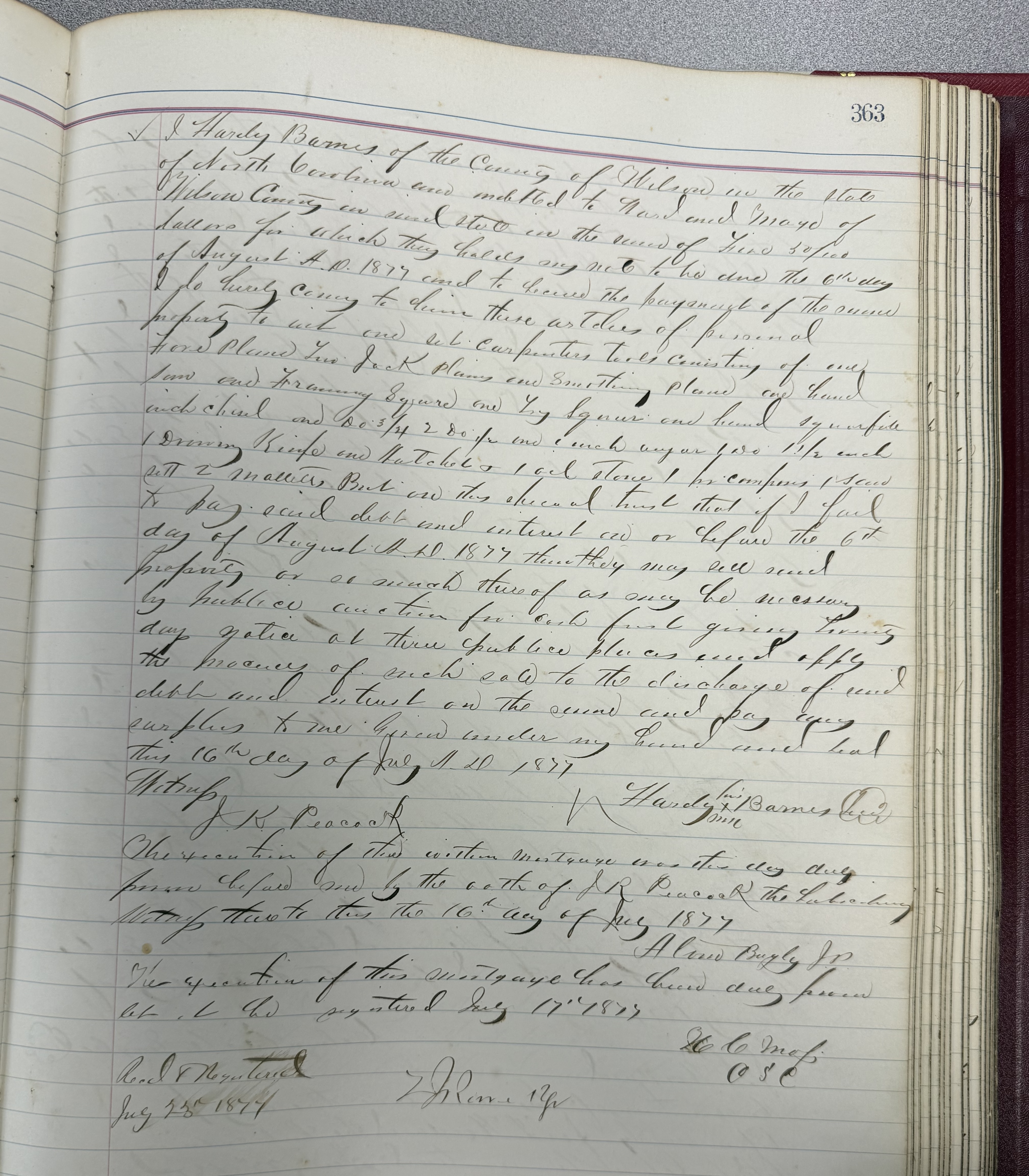
Hardy Barnes pledges his carpenter’s tools.

Hardy Barnes owed the general merchandise firm of Ward and Moye $5.50 due 6 August 1877. To secure the debt, he pledged a set of carpenter’s tools consisting of a fore plane, two jack planes, a smoothing plane, a hand saw, a framing square, a try square, a hand square file, chisels of several sizes, several augers, a drawing knife, a hatchet, an oilstone, a pair of compasses, and two mallets. If Barnes failed to pay the money, the firm could sell off his tools to cover the debt.

Deed book 13, page 363, Wilson County Register of Deeds Office, Wilson.

——

Probably, in the 1870 census of Saratoga township, Wilson County: Watson Stanton, 65, farm laborer, born in Virginia; wife Rosa, 53; and children Richard, 15, Adeline, 13, Feribee, 8, and Louisa, 21; Cherry Rogers, 80, midwife; and Hardy Barnes, 20, carpenter’s apprentice.