Barnes

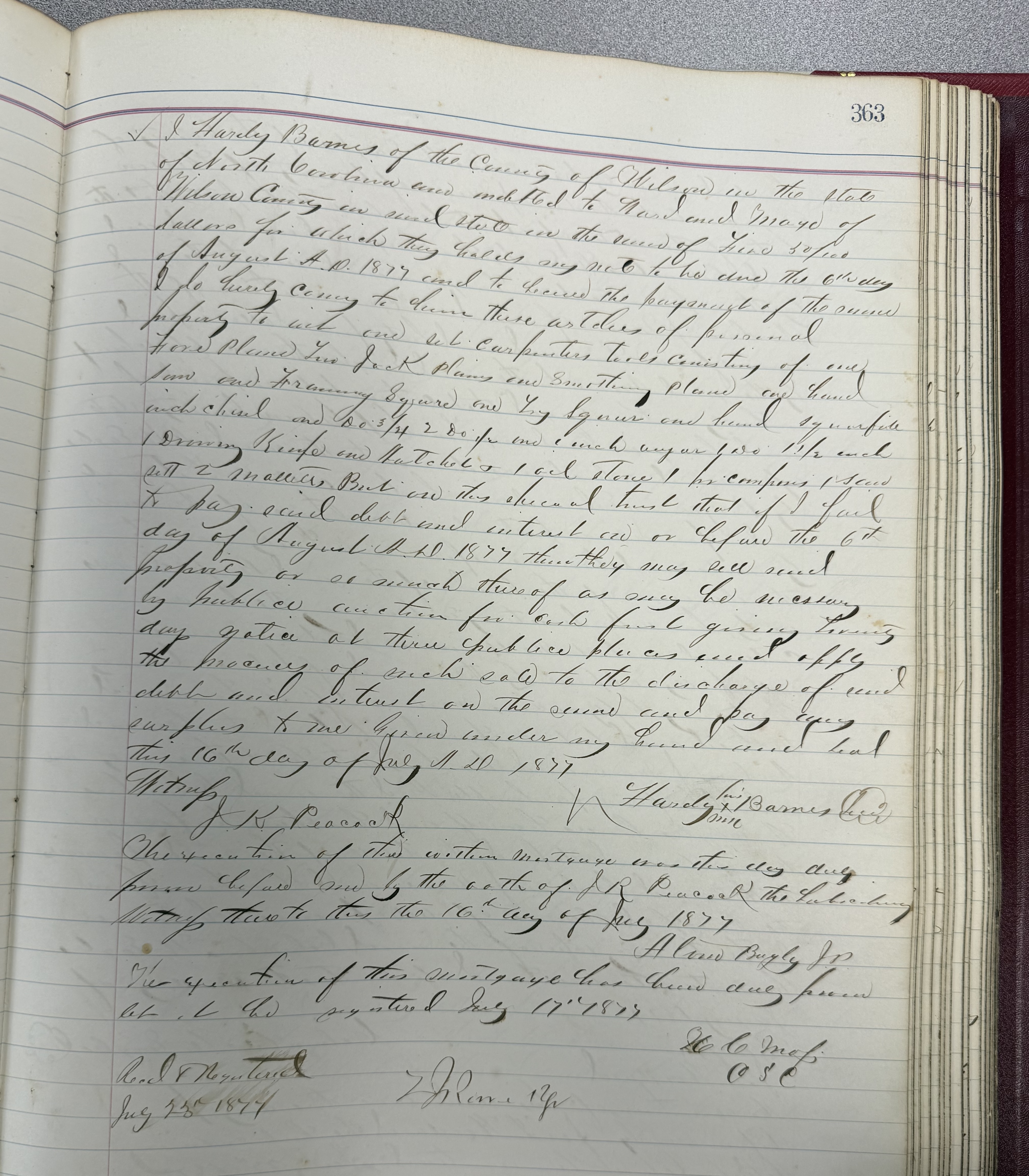
Hardy Barnes pledges his carpenter’s tools.

Hardy Barnes owed the general merchandise firm of Ward and Moye $5.50 due 6 August 1877. To secure the debt, he pledged a set of carpenter’s tools consisting of a fore plane, two jack planes, a smoothing plane, a hand saw, a framing square, a try square, a hand square file, chisels of several sizes, several augers, a drawing knife, a hatchet, an oilstone, a pair of compasses, and two mallets. If Barnes failed to pay the money, the firm could sell off his tools to cover the debt.

Deed book 13, page 363, Wilson County Register of Deeds Office, Wilson.

——

Probably, in the 1870 census of Saratoga township, Wilson County: Watson Stanton, 65, farm laborer, born in Virginia; wife Rosa, 53; and children Richard, 15, Adeline, 13, Feribee, 8, and Louisa, 21; Cherry Rogers, 80, midwife; and Hardy Barnes, 20, carpenter’s apprentice.

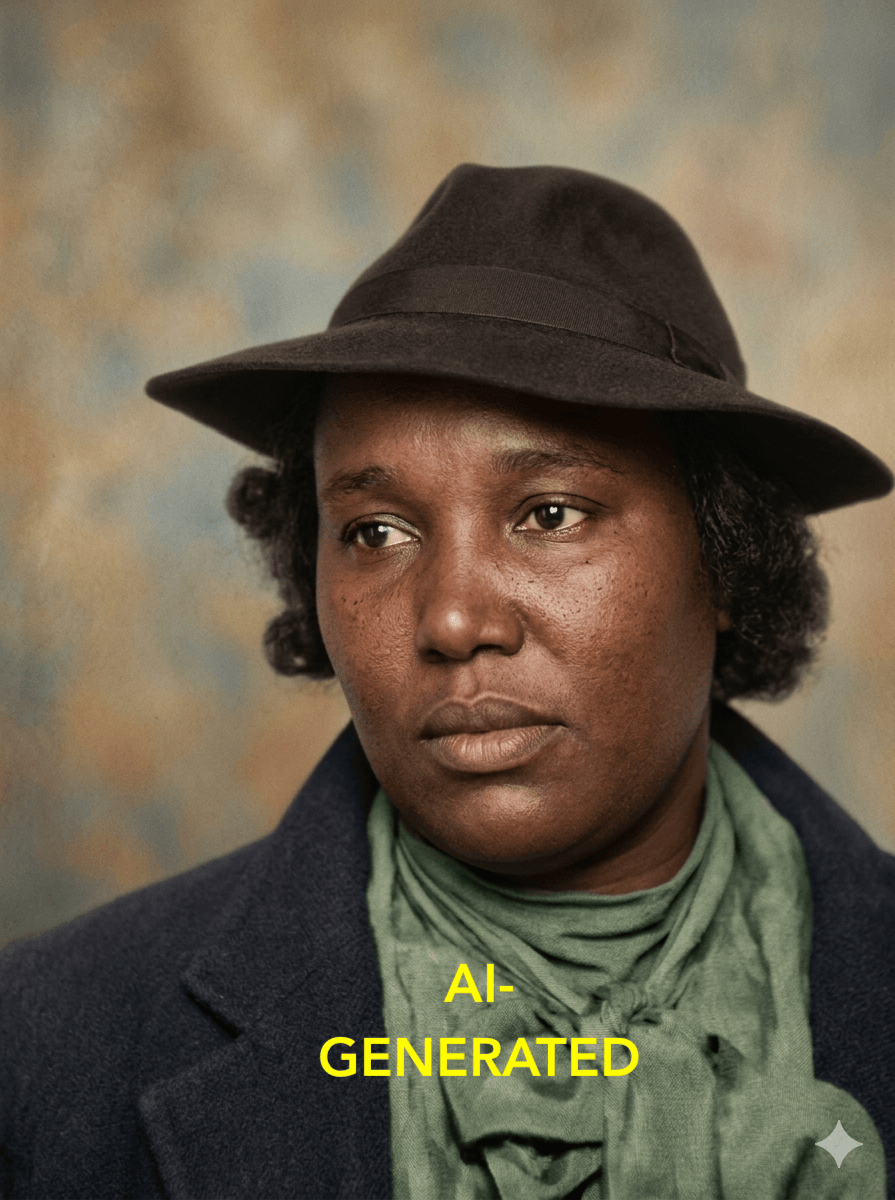
Henry Barnes, as imagined.

I am ambivalent about using artificial intelligence to restore photographs. Or, more specifically, I’m concerned about manipulated photographs supplanting original images and further blurring the line between reality and misinformation. However, the allure of AI-enhanced images is strong, as I often contend with blurry, poorly lit photographs in unnatural sepia or black-and-white tones. Photographs whose condition sometimes exacerbates the distance between us and our ancestors.

I have been experimenting with ChatGPT lately, feeding it queries and images to be restored and colorized. The results are somewhat haphazard, with many images weird and off-putting. Other times, the images are breathtakingly sharp and … alive. Black Wide-Awake exists to resurrect forgotten lives, and I believe these images are valuable to help us connect with the men and women we read about in these posts. From time to time, I’ll share the better ones here, clearly marked as AI-generated.

——

Henry Barnes (1884-1947), farmer.

The obituary of Jennette Barnes (reveals a mystery).

Wilson Daily Times, 4 April 1947.

Jennette Barnes‘ obituary adds two interesting bits of information to the profile already posted: (1) she had a brother named Joseph Jones, and (2) she was a member of Evansdale Methodist Church.

Evansdale Methodist?

Evansdale United Methodist anchors the old Evansdale community south of today’s Beddingfield High School. As mainline churches go in Wilson County, it is relatively young, having been established in 1913. Did Evansdale United Methodist admit black people to full membership during Jennette Barnes’ lifetime?

On 7 February 1930, Evansdale Methodist appears in a list of “colored churches” holding services in Wilson County.

Wilson Daily Times, 7 February 1930.

However, in every similar listing that year — they ran weekly — Evansdale Methodist appears under “County Churches.” And a 1963 history of Evansdale United Methodist discloses that the pastor from 1929 to 1931 was Rev. J. Vincent Knight. The February 7 paper, it appears, contained a typesetting error, and one that probably caused significant consternation.

So, we’re back to square one. Was there another Methodist church — a black one — in the Evansdale community? As far as I know, there have been no standard Methodist churches in Wilson County founded for or by black people. All nineteenth and early twentieth century references to “colored Methodist” churches related to African Methodist Episcopal Zion or African Methodist Episcopal churches (of which there were once many more than there are now.) Barnes’ obituary notes that she was funeralized at Saint John A.M.E. Zion. Was Evansdale also A.M.E. Z.?  I’ll keep searching.

Private Tom Barnes, Company B, 14th Heavy Artillery.

Within weeks of the Confederate surrender, Tom Barnes voluntarily enlisted in United States Army in New Bern, North Carolina. 

Barnes joined Company B of the 14th Heavy Artillery, United States Colored Troops. The company descriptive book described him as 18 years old; five feet four inches tall; with black complexion, eyes, and hair. He was born in Wilson County and worked as a farmer. 

It’s not clear if Barnes freed himself prior to the end of the war or took off immediately after Emancipation. The muster contains a curious remark: “Enlisted previous to G.O. No. 38 C.S. Dept. of N.C. stopping recruiting & has never been mustered in until the present time.”

In May 1865, the Civil War was over, but the Union Army still needed men to secure the South, guard strategic coastal forts, and maintain order. However, because the war was winding down, the federal War Department ordered local departments to strictly regulate and taper off recruitment. Under Major General John Schofield’s Union Department of North Carolina, General Orders No. 38 (Current Series, 1865) authorized recruitment and enlistment protocols during this transitional post-surrender period.
 
G.O. Number 38 granted mustering officers in New Bern the explicit authority to accept Tom Barnes and other newly freed men into federal service in an army of occupation, even as other parts of the Union Army were preparing to demobilize. Stationed at defense sites like Fort Macon (near Beaufort, North Carolina) and the fortifications around New Bern, Company B was tasked with rebuilding and guarding North Carolina’s coast. The unit spent the rest of 1865 and early 1866 dismantling Confederate defenses, guarding government property, and protecting newly freed communities during the earliest days of Reconstruction. The 14th U.S.C.T. was formally mustered out of military service in December 1865.
 
I have not found trace of Tom Barnes after his military service.

Maggie Foster Barnes, as imagined.

I am ambivalent about using artificial intelligence to restore photographs. Or, more specifically, I’m concerned about manipulated photographs supplanting original images and further blurring the line between reality and misinformation. However, the allure of AI-enhanced images is strong, as I often contend with blurry, poorly lit photographs in unnatural sepia or black-and-white tones. Photographs whose condition sometimes exacerbates the distance between us and our ancestors.

I have been experimenting with ChatGPT lately, feeding it queries and images to be restored and colorized. The results are somewhat haphazard, with many images weird and off-putting. Other times, the images are breathtakingly sharp and … alive. Black Wide-Awake exists to resurrect forgotten lives, and I believe these images are valuable to help us connect with the men and women we read about in these posts. From time to time, I’ll share the better ones here, clearly marked as AI-generated.

——

Maggie Foster Barnes.

The apprenticeship of James William, Mary Ellen, Minerva S., and Laura Anderson (1895).

On 3 December 1895, Clerk of Superior Court J.D. Bardin apprenticed James William Anderson, age 4 years, 2 months, and 4 days; Mary Ellen Anderson, age 2 years and 7 days; Minerva S. Anderson, age 7 years, 7 months, and 11 days; and Laura Anderson, age 6 years, 6 months, and 4 days, to Redmon Barnes until they were 18 years old.

I have not found the Anderson children in other records. Redmond Barnes perhaps was this man.

Apprentice 1895, Miscellaneous Records, Wilson County Records, North Carolina State Archives.

Plantation House Series: James Reddick Barnes house.

The James Reddick Barnes house, built between 1850 and 1860, stands well back off the road in Saratoga township, southeast of Wilson. It is not registered with the National Register of Historic Places.

In the 1860 slave schedule, James R. Barnes reported enslaving 41 people and controlling another 32 as trustee for minors. (Though unnamed in the census, those minors included the Isaac Scarborough heirs.) In June 1856, two people he jointly owned with others, Cate and Sherard, were sold at auction at a toll house on White Oak Swamp. As high bidder, Barnes was able to buy them back.

In 1950 and 1960, the Wilson Daily Times ran articles on historic Wilson County houses, most of which had anchored plantations. The James R. Barnes house was featured twice.

Wilson Daily Times, 10 January 1950.

Ten years later, the house’s history had stretched a bit. Now the claim was that the house itself, rather than the land, had passed through seven generations from John Barnes. However, Barnes died in 1789 and his grandson Reddick Barnes in 1835, and great-grandson James Reddick Barnes actually built the house. (Also note the incorrect suffixes added to the names of the owners, i.e. III, IV, and VI. They are the result of the reporter’s incorrect interpretation of the owner’s generation of ownership, as spelled out in the 1950 Times article.)

Wilson Daily Times, 8 January 1960.


Ardelia Pender, a mother you should know.

The Afro-American (Baltimore, Md.),  30 May 1953.

——

In the 1910 census of Wilson township, Wilson County: on Saratoga Road, Jesse Barnes, 37, farmer; wife Sarah, 31, public school teacher; and children Lucresia, 16, Ned, 14, Nancy, 12, Lemon, 11, Jessie Bell, 10, Maggie May, 7, and Ardenia, 5.

In the 1920 census of Wilson township, Wilson County: on Saratoga Road, farmer Jesse Barnes, 46; wife Sarah, 47; and children Ned, 23, Nancy, 22, Lemon, 20, Jessie Belle, 18, Maggie, 15, Ardenia, 13, Frank, 11, James, 6, and Mildred, 3.

On 17 September 1924, Jonah Pender, 24, of Wilson, married Ardenna Barnes, 20, of Wilson, daughter of Jesse R. Barnes, in Wilson. Presbyterian minister A.H. George performed the ceremony, and James O. Bunn, Mack Jones, and Rosa J. Hussey witnessed.

Comodore Pender died 17 December 1925 in Wilson. Per his death certificate, he was born 25 November 1925 in Wilson to Jonah Pender and Ardena Barnes; lived at 718 Viola; and was buried in Barnes Cemetery, Wilson.

In the 1930 census of Wilson township, Wilson County: on Lane Street, Johnnie Pender, 29, tobacco factory laborer; wife Ardena, 24; and children Robert L., 5, Therado [Theodore], 4, Henry T., 3, Louvena, 18 months, and Katie, 1 month.

In the 1940 census of Wilson township, Wilson County: widow Ardelia Pender, 33, tobacco factory laborer, and children Robert, 16, grocery store delivery boy, Theodore, 15, Henry, 13, and Luvenia, 11.

Theodore Pender died 4 November 1944 in Goldsboro, Wayne County. Per his death certificate, he was born 25 November 1925 in Wilson to Jonah Pender and Ardelia Barnes; was single; lived at 1016 Robinson [Roberson]; and worked for J.C. Penney Company.

In 1945, Richard Henry Terry Pender registered for the World War II in Wilson County. Per his registration card, he was born 31 August 1927 in Wilson County; lived at 1016 Robertson [Roberson] Street; his contact was Ardelia Pender; and worked for Bissette Drug Company, Nash Street.

In the 1950 census of Wilson township, Wilson County: at 1016 Roberson, widow Ardelia Pender, 45, and children Richard, 23, operates washer at laundry, Luvenia, 20, Katie, 17, Dorothy, 15, Jessie, 16, grocery store clerk, Paul, 15, grocery store clerk, Harry, 12, and James, 11.