Greene County NC

The notorious John Shallington.

John Shallington was hanged on 12 April 1878 in Greene County, North Carolina, for the murder of his step-daughter Serena (or Lorena) Thompson. According to news accounts, Shallington and Thompson had been in a relationship (consensual?) for two to three years, and he had shot her in a fit of jealousy. Shallington fled and was on the lam for several weeks, pursued by both black and white vigilantes before being arrested in Wilson County.

An “esteemed correspondent,” apparently enthralled with Shallington’s person and exploits, provided breathy details — his ownership during his enslavement in Wilson County; his reputation for violence, craftiness, and superhuman strength; his physical description; his impassiveness at trial. As later reported, Shallington was hanged in front of a crowd of 2000 people in Snow Hill after asking from the gallows to be baptized.

Goldsboro Messenger, 11 April 1878.

The estate of William Felts (1854).

William Felts (Phelps?) made out his will in Greene County in 1853 and died early the following year in Edgecombe County. Jonathan Ellis was appointed guardian of Felts’ minor children and in that capacity handled the estate the children inherited . For the next few years, Ellis filed with the county court (first Edgecombe County, then Wilson after its founding) accounts of the moneys received for the lease and sale of Felts’ property. When Ellis died in December 1856, Ellis’ administrator Reuben Bynum carried out his duties to the Felts’ heirs.

On 23 March 1854, the account showed that Garry P. Felts hired from the estate a man named Frank, a boy named Joe, and a girl named Allie, and was credited for taking care of a woman named Elvy and her two young children. (Though this document is titled “an account of sale,” the prices of both the land and the enslaved people establish these were prorated annual lease prices.)

On 1 January 1855, Ellis hired out Elvira and her three children, Joe, Alley, and Ben to [Garry] Patrick “Felphs.” Frank was not mentioned. Ben’s hire rate suggests that he was very young, but able to be of some use.

On 1 January 1856, Ellis rented out a girl and two boys, whom he did not bother to mention by name.

On 1 January 1857, the estate paid Garry P. Felts $28 to keep Elva and her four children, and Felts in turn paid the estate $91 to hire Ben, Allie, and Joe. (Notice that Elvy was giving birth to a child every year during this period.)

On 7 March 1857, Ellis (Bynum?) held another sale — or, judging by the rates — rehire. William Felts’ son-in-law Richard Edmundson picked up the leases of the children.

I have not been able to trace forward Frank, Elvira, or her children Ben and Allie.

However, in the 1880 census of Speights Bridge township, Greene County: Joseph Phelps, 48, farmer; wife Yeaster, 30; and children Lou, 12, Patrick, 10, McDallis, 4, and George W., 3.

On 24 May 1890, Joseph Phelps, 55, of Speights Bridge township, married Margaret Speight, 35, daughter of Penny Speight, at Joseph Phelps’ house near W.A. Darden’s in Greene County.

On 16 June 1891, Patrick Phelps, 20, and Mandy Burney, 18, applied for a marriage license in Greene County, but did not return it.

In the 1900 census of Speights Bridge township, Greene County: farmer Joe Phelps, 60; wife Margaret, 30; and sons Patrick, 30, ditcher, and Mack, 25, and George, 20, farm laborers.

On 16 January 1901, Mack Phelps, 24, married Mary Woodard, 22, in Greene County.

Lula Edwards died 12 November 1929 in Gardners township, Wilson County. Per her death certificate, she was 66 years old; was born in Greene County to Joe Phelps of Edgecombe County and Easter Speight of Greene County; was the widow of Ben Edwards; worked in farming; and was buried in Herrings Cemetery. Lacy Edwards was informant.

On 11 March 1930, Mack Phelps, 54, of Greene County, son of Joseph and Easter Phelps, married Monora Ruff, 39, of Greene County, daughter of David and Litha Smith, in Snow Hill township, Greene County.

George Phelps died 13 December 1937 in Bull Head township, Greene County. Per his death certificate, he was 56 years old; was born in Greene County to Joe Phelps; was the widower of Alice Strawberry Phelps; and was a farmer.

Mack Phelps died 27 February 1964 at Mercy Hospital, Wilson. Per his death certificate, he was born 5 October 1889 in Greene County to Joe Phelps and Easter Speight; lived at 1510 Atlantic Street Extension; was a widower; and was buried in Rest Haven Cemetery. True Miller Artis, Wilson, was informant.

——

William Felts Estate Records (1854), Wilson County, North Carolina Estate Files 1663-1979, http://www.familysearch.org

Willie Swinson would rather be working.

Wilson Daily Times, 26 October 1984.

——

In the 1920 census of Bullhead township, Greene County, N.C.: farmer Wesley Swinson, 40; wife Adie, 36; and children Henry, 16, Wesley Jr., 15, Willie, 13, Harrish, 11, Addie, 7, Sarah, 5, and Iola, 3 months.

On 22 July 1933, Willie Swinson, 27, of Wilson, son of Wesley Swinson and Addie [no maiden name given], married Isadelle Turner, 20, of Wilson, son of Jasper and Madie Turner, on East Green Street, Wilson. A.M.E. Zion minister I. Albert Moore performed the ceremony in the presence of David Henderson, Maggie Mae Best, and Mable Boney.

In the 1940 census of Wilson, Wilson County: at 921 Atlantic, rented for $13/month, Wesley Swinson, 59; wife Addie, 53; and children John H., 35, Willie, 30, Iola, 20, Odessa, 18, and Doris, 15.

In 1940, Willie Lee Swinson registered for the World War II draft in Wilson County. Per his registration card, he was born 1 August 1907 in Greene County, N.C.; lived at 921 Atlantic Street; his contact was wife Isadell Swinson; and he worked for Boyd Clark at Carolina Warehouse.

In the 1950 census of Wilson, Wilson County: at 921 Atlantic, Wesley Swinson, 61, plumber helper; wife Addie, 67; and son Willie, 41, chauffeur for local tobacco buyer.

Willie Swinson died 24 January 1986 in Portsmouth, Virginia. Per his death certificate, he was born 1 August 1907 in North Carolina to Wesley Swinson and Addie Sutton; was married to Isidell Sutton; and worked as a floorman for Clark Warehouse.

Snaps, no. 106: Stephen Edwards.

Stephen Edwards (1887-1924).

——-

On 21 December 1899, Charity Bullock, 18, of Greene County, North Carolina, daughter of John and Bettie Bullock, married Stephen Edwards, 21, of Wilson County, son of Charles and Ella Edwards, in Moyeton, Stantonsburg township, Wilson County. Witnesses were Hattie Edwards, Con Bullock and Johny Fort of Moyeton.

In the 1900 census of Speights Bridge township, Greene County: in the household of Peter Joyner, step-daughter Charity Edwards, 25, and her husband Stephen, 21, a farm laborer.

In the 1910 census of Speights Bridge township, Greene County: farm laborer Stephen Edwards, 31; wife Charity, 29; and children Lonnie, 9, John H., 7, Charity, 4, William, 2, and Mary, 7 months.

In the 1920 census of Speights Bridge township, Greene County: farmer Stephen Edwards, 45; wife Shady, 35; and children Louzie, 13, Willie, 11, Marie, 9, Bettie, 6, Charlie, 4, Roscoe and Oscar, 3, Ida Belle, 2, and Lucy May, 4 months, plus sister Ettie Edwards, 23.

Stephen Edwards died 16 May 1924 in Walstonsburg, Greene County. Per his death certificate, he was born 15 July 1877 in Greene County to Charles Edwards of Hyde County and Ella Ward of Greene County; was married to Charity Edwards; worked as a farmer; and was “poisoned from drinking inferior whiskey.”

Photo courtesy of Ancestry.com user Vern Bullock.

Conjure doctor Henderson charged with selling poison.

Wilson Daily Times, 23 May 1930.

We first encountered George Henderson (no relation) here, when I wondered what kind of doctor he was, as he was also described as a laborer.

In 1930, Henderson was arrested after allegedly selling poison to George Gay, a young white Greene County man who was charged with killing his wife, Mollie R. Windham Gay.

Gay went to trial less than a month later. Witnesses testified that Gay said he was tired of his wife, that he didn’t like her because she was slow, that he could have her killed for $6.01, that a Negro conjure doctor in Wilson would do it. A “young divorcee” testified Gay had told her he had been to see “his girl” and, when she criticized him for not staying home with his wife, Gay had said she wouldn’t be in his way much longer. His brother-in-law testified that Gay had purchased ingredients for an abortifacient (whiskey, camphor, quinine, and “capsules”) and given them to his wife. And on and on. For his part, Gay testified that his wife was in delicate health after having four pregnancies in six years, with two babies dying, and admitted that he had taken her to Wilson to see Henderson, whom he called a “praying doctor.” (Others described him as a liquor dealer and conjure doctor.) Gay asserted that his wife had asked him if arsenic might relieve her troubles and hinted at committing suicide. Gay said he had never been alone with her in her sick room, and Gay’s sister testified her sister-in-law had said the year before that she would kill herself before she would have another child. 

Henderson was released just before Gay’s trial. Gay was acquitted. 

The roots of many Wilson County Artises, no. 4: Adam T. Artis, part 1.

I have blogged many times about siblings Cain Artis, William M. Artis, Walter S. Artis, Alberta Artis Cooper, Columbus E. Artis, Josephine Sherrod Artis, and June S. Artis — but not specifically about their father Adam Toussaint Artis, a free-born farmer who bought and sold hundreds of acres of farm and woodland in Nahunta township, Wayne County, North Carolina. Artis had five wives over his long life, and more than 25 children. Many of his thousands of descendants, including me, have ties to Wilson.

In this first post, a look at Adam T. Artis’ early years, relationships, and wealth-building.

——

Adam Toussaint Artis was born 19 July 1831, most likely in the Bullhead area of northwestern Greene County, North Carolina, or the Nahunta area of northeastern Wayne County, North Carolina. His mother Vicey Artis was a free woman of color, and his father Solomon Williams was an enslaved man. [Artis’ middle name, pronounced “too-saint,” is both fascinating and mysterious. How had his mother, an unlettered woman who spent her entire life in deep rural eastern North Carolina, heard of Toussaint Louverture, who died a few years before she was born?]

Detail of 1850 census, Greene County, North Carolina.

In the 1850 census of Greene County, North Carolina: at #428, Adam, 18, Jane, 17, and Charity Artess, 13, appear in the household of white farmer Silas Bryant. Though no bonds or other indenture documents survive, it is most likely that the Artis children were involuntarily apprenticed to Bryant until age 21 by the Greene County Court of Pleas and Quarter Sessions. Next door, at #429, probably living on Bryant’s land, were their mother and siblings Vicy, 40, Zilpha, 22, Louis, 8, Jonah, 7, Jethro, 5, and Richard Artis, 1.  I have not been able to identify Solomon Williams’ whereabouts during slavery.

In the mid 1850s, Adam Artis began a relationship with an enslaved woman named Winnie. They had two children together, Cain, born about 1854, and Caroline, born about 1856.

On 29 September 1855, Adam Artis bought ten acres in Wayne County, North Carolina, from John Wilson, husband of his sister Zilpha Artis Wilson. Artis mortgaged the property to Wilson in exchange for its $124 purchase price.

Detail, Nash County marriage register.

On 10 October 1855, Adam Artis married Lucinda Jones in Nash County, North Carolina. Jones’ father Jacob Ing was bondsman, William T. Arrington witnessed, and justice of the peace D.A.T. Ricks performed the ceremony. [In the 1850 census of Nash County: Jacob Ing, 64, white, farmer; Easter Jones, 55, John Jones, 20, [his wife] Dolly Jones, 21, Matthew Jones, 18, and Lucy Jones, 16, all mulatto.]

Lucinda Jones Artis died circa 1859.

Detail of 1860 census, Davis district, Wayne County, North Carolina.

The 1860 census of Davis district, Wayne County, tells a nuanced story. This entry contains the sole census reference to Adam Artis’ skills as a carpenter, probably gained during his apprenticeship to Bryant. The $200 in personal property he claimed probably consisted mostly of the tools of his trade, and the $100 value of real property reflects his early land purchases. Artis was a widower in 1860; Kerney, Noah and Mary Jane were his children by Lucinda Jones Artis. (Artis’ elder children, Cain and Caroline, as enslaved people, are not named in any census prior to 1870.) Jane Artis was Artis’ sister; her one month-old infant may have been daughter Cornelia. I’ve included two lines of the next household to highlight a common pitfall — making assumptions about relationships based on shared surnames. Celia Artis was not related to Adam Artis. At least, not in any immediate way. (Ultimately, nearly all Artises trace their lineage to a common ancestor in 17th-century Tidewater Virginia.) Adam’s brother Jesse Artis testified directly to the matter in the trial in Coley v. Artis: “I don’t know that Tom [son of Celia and Simon Pig Artis] and I are any kin. Just by marriage.”)

Adam Artis was 30 years old at the start of the Civil War, a farmer and carpenter who had already begun to build some wealth. Unlike many free men of color, he may have avoided conscription by the Confederacy to build breastworks at Fort Fisher near Wilmington. However, Artis had been forced to pay taxes on his crops to the Confederate government. (The reference to “Wife” on the assessment below suggests that she was acting in his absence, which could hint that he had been conscripted.) Artis likely had to turn over stock and provisions to Union soldiers foraging in Wayne County, but after the war did not file a claim with the Southern Claims Commission to recoup any losses.

Assessment of Adam Artis’ crop of cured fodder,Confederate Papers Relating to Citizens or Business Firms, 1861-1865 (NARA M346), http://www.fold3.com.

In an 1863 Confederate tax assessment of David district, Wayne County, John Coley, as administrator, reported that H. Woodard Lewis’ estate included Winney, age 29, Cane, age 9, and Caroline, 7. This, of course, was Adam Artis’ first set of children and their mother, who remained enslaved until the end of the Civil War.

On 8 April 1867, Jacob Ing made out a will that provided in part, for bequests to “Mary Reynolds, wife of Benjamin Reynolds, Elizabeth Boon wife of Jesse Boon, Selah White, wife of James White, Sally Reynolds, wife of William H. Reynolds, William C. Jones, Matthew Jones, also old Chaney Freed woman (formally my house servant) also Lucinda Artist (dead) to her Children if any surviving (all colored).” Ing died a few years later, and Augustus K., Noah, and Mary Jane inherited about a hundred dollars each. In 1872, Adam Artis filed a guardianship application in order to manage his children’s estates until they reached the age of majority.

——

Adam T. Artis’ elder children:

  • Cain Artis adopted his father’s surname in adulthood and farmed his own land in northwest Wayne County.  He married first Annie Thompson, then Margaret Barnes. By 1890, he had bought a house in Wilson, and in 1900, he and his second wife sold land to Mount Hebron Masonic Lodge for its cemetery. (Adjoining land passed through Margaret Barnes Artis to her heirs, who eventually sold it to the city of Wilson to establish Rest Haven Cemetery.) The 1912 city directory shows Cain Artis a small grocery with Wiley Oates just outside city limits on East Nash road. He died of tuberculosis in Wilson in 1917.
  • Caroline Coley married Madison Artis, son of Calvin and Serena Seaberry Artis in Wayne County in 1878. Caroline and Madison Artis appear in the 1880 census of Wayne County, but I have not found them after.
  • Augustus K. Artis,who was known as Gus, Gustus, and Kerney, was born about 1857. Some time between the birth of daughter Lena in 1882 and 1893, Gus and wife Mary Rebecca Morgan migrated to the Little Rock, Arkansas, area. The city’s 1914 directory lists him as a laborer at J.W. Vestal & Son, a nursery. He died of heart disease 2 June 1921 in Brodie township, Pulaski County, Arkansas, and was buried in a “fraternal cemetery” there.
  • Noah Artis, born in 1856, remained in northeastern Wayne County, where he farmed, until shortly before his death. He had a daughter Cora P. Artis Exum in 1890 with his cousin Lucinda Artis, daughter of Richard and Susannah Hall Artis, then married Patience Mozingo.Their children were Nora Artis Reid, Pearl Artis, Pauline Artis Harris, Rena Belle Artis Foster, William N. Artis, and Bessie Artis Taylor. Noah Artis died in 1952 in Wilson.

Noah Artis (1856-1952).

  • Mary Jane Artis, born about 1858, married Henry Artis, son of Warren and Percey Artis. (Though all of Wayne County Artises are probably ultimately related, the exact kinship between Adam Artis and Warren Artis, whose parents are believed to have been Absalom and Clarkey Artis, is unknown.) Mary Jane remained in the Nahunta area of Wayne County all her life and died 20 June 1914 in Goldsboro, Wayne County. Her and Henry’s children were Armeta Artis, Alonzo Artis, Lucinda Artis, Calonza Artis, John C. Artis, Mattie Artis Davis and May Artis.

Will of Jacob Ing, Wills, Nash County Records, North Carolina State Archives; Estates Records, Wayne County Records, North Carolina State Archives; Marriage Records, Register of Deeds Office, Wayne County Courthouse, Goldsboro NC; Nash County Marriage Records, North Carolina Marriage Records, 1741-2011, http://www.ancestry.com; photo courtesy of W. Waheed.

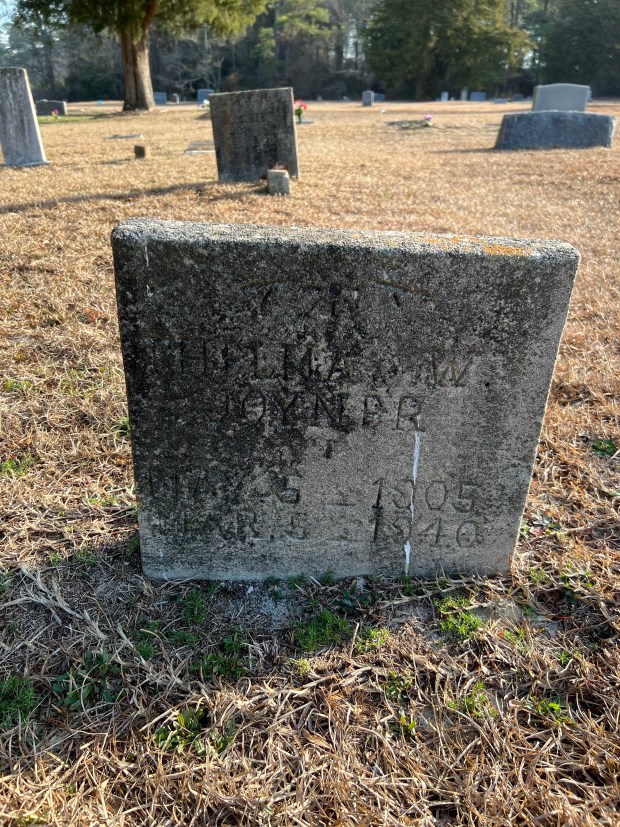
Cemeteries, no. 31: Saint Delight community cemetery.

Saint Delight Community Cemetery lies perhaps four miles inside Greene County from Wilson County’s Stantonsburg, but it is the final resting place of many Wilson County residents with roots in the Speights Bridge and Bullhead area of Greene.

Saint Delight contains more than one thousand graves within its well-kept borders. The stones marking these sites include dozens carved by Wilson marble cutter Clarence B. Best; at least two by an unknown artist whose style I have dubbed “angle-and-serif;” and two beauties of a style I have not seen before, characterized by white lettering, angular number shapes, and designs that could almost be described as dainty.

The astonishing headstone of Greene County native Adam Fields, who was both a Mason and an Elk.

Addie Edwards’ headstone. The illustration under its ornately shaped top is faded, but lovely.

The headstones of Dicie Williams, Thelma W. Joyner, and Cloudie Williams feature the angle-and-serif style of an unknown artist. I’ve seen only two other examples, both in William Chapel Cemetery.

And this fascinating work with inset glass:

Photos by Lisa Y. Henderson, February 2023.

The roots of many Wilson County Artises, no. 2: Artis Town.

A mash-up of few old posts from my personal genealogy blog, http://www.scuffalong.com.  Artis Town was not an incorporated place; rather, it was a neighborhood in which an extended family of free people of color had lived in the antebellum period, and in which one, Daniel Artis, had had bought 120 acres in 1853 upon which to settle his large family. Not all modern Artis descendants in Wilson County are linked to Artis Town, but many are, including me. Documents and DNA evidence strongly suggest that Daniel Artis was the brother of my great-great-great-great-grandmother Vicey Artis Williams.

I checked first at the Court House. I had a hazy memory of a dusty, yellowed pull-down map hanging on a wall in the Register of Deeds office outlining Greene County townships in, perhaps, the 1950s. Most county roads were then unpaved, and the map bore witness to many now-abandoned crossroads and hamlets, including “Artis Town.” But the map was gone, cast aside in a reshuffling of office space that relegated Greene County’s Register of Deeds to the basement. The two ladies on duty — blue-permed and powder-fresh — interrupted their gossip (“He’s good as gold, but when he’s mad, he’ll … he’ll CATCH”) to help, gamely pulling two or three crumbling maps from storage, but none was what I sought. “Try EMS!,” one finally suggested, “They know all the roads.”

In the dim front office of a low brick building on the northern edge of Snow Hill, I explained myself: “I’m looking for a place in the road called Artis Town. There used to be a sign. Like, a green one with white letters. And it was somewhere off Speights Bridge Road, or maybe Lane Road, but I hunted up and down this morning and couldn’t find it.” The good old boys were puzzled. “Artis Town … Artis Town …” “Well, naw, I never heard of … Mike! You know where Artis Town is?” “Artis Town. Artis Town ….” An older man walked through the door and was put to the test. “Well, I think … hmmm. Hey. Call Donald. If he don’t know, don’t nobody.” … “Hey, Pam, is Donald — wait, you’re from out that way. Do you know where Artis Town is? … Okay … okay … okay. Donald? Yeah, Artis Town. … Okay … mm-hmm … that’s what Pam said. Okay, thankee.” And sure enough, it was in a bend of Lane Road, off Speights Bridge, and there had been a sign, and it was gone.

But I asked my mother about it, too, because she taught in Greene County for two years when she first came to North Carolina, and I thought maybe she’d heard of it. Her school had been in Walstonburg and probably drew students from Speights Bridge, and … “Let me look at my gazetteer.” She has the old version from the 1980s, which, of course, I pitched once I bought the shiny new one. And I’m regretting that surely, for Artis Town is marked quite clearly on her map, and I could have saved myself some gas and tire rubber had I consulted it. (Though I would have missed out on the helpful hospitality of the fine people of Snow Hill.)

This is what happens when you throw things away. You get new maps, shiny and updated, with all the latest roads. And all the old place names gone. My mother has the 1993 edition of DeLorme Mapping’s North Carolina Atlas & Gazetteer, and there is Artis Town.

I dug my old laptop out of storage today. It took a bit of searching, but finally: photos I took in December 2004 when I was wandering the roads of Greene County with no real purpose other than a penchant for what William Least Heat-Moon calls “blue highways.” Almost ten years would pass before I’d connect Artis Town with my own Artises. The ancestors, though, are patient.

I haven’t seen it for myself, but I understand that a new Artis Town sign was placed a few years ago.

[Update, 6 February 2023: Here’s the new sign.]

Photograph of sign by Lisa Y. Henderson, 23 December 2004.

The roots of many Wilson County Artises, no. 1: Solomon and Vicey Artis Williams.

Vicey Artis, a free woman of color, and Solomon Williams, an enslaved man, had eleven children together – Zilpha Artis Wilson, Adam Toussaint Artis, Jane Artis Artis, Loumiza Artis Artis, Charity Artis, Lewis Artis, Jonah Williams, Jethro Artis, Jesse Artis, Richard Artis, and Delilah Williams Exum — before they were able to marry legally. On 31 August 1866, they registered their 35-year cohabitation in Wayne County. Vicey died soon after, but Solomon lived until 1883.  The document above, listing his and Vicey’s six surviving children and heirs of their deceased children, is found among Solomon Williams’ estate papers.

In the antebellum period, Vicey Artis and her children, who were apprenticed to Silas Bryant, lived in the Artis Town area of Bull Head township, Greene County, N.C., just a few miles over the border of Wilson County. Solomon Williams presumably lived relatively close by. Before 1860, the family shifted west into the Eureka area of Wayne County (which may have been their original home territory), and Vicey died around 1868. Descendants of at least five of Vicey and Solomon’s children — most notably son Adam T. Artis — migrated into Wilson County starting around 1900, settling in and around Stantonsburg and Wilson.

We have met Jonah Williams here and here and elsewhere. We’ve also met Loumiza Artis Artis’ husband Thomas Artis. Stay tuned for more about my great-great-great-grandfather Adam T. Artis, Zilpha Artis Wilson, Jesse Artis, and Richard Artis.

[Sidenote: Artis was the most common surname among Wayne County free people of color. In the 1840, 1850 and 1860 censuses, Artis families primarily are found clustered in northern Wayne County, near present-day Eureka and Fremont. Though eastern North Carolina Artises ultimately share common ancestry stretching back to mid-17th century Virginia, the precise relationships between various Wayne County lines — not to mention other Greene and Johnston County Artis lines — is not clear. In other words, though many of today’s Artises in Wilson are descended from Vicey Artis and Solomon Williams (or Vicey’s siblings Sylvania Artis Lane and Daniel Artis), none should assume descent from this line.]

Reunions, no. 2.

I don’t often get to see my high school friends, and I can’t recall the last time we gathered in numbers. Last June, however, we came together to celebrate Thelma Braswell Forbes and lift up her daughter, Dawn Forbes Murphy. I have known all of these folks since at least elementary school (or in the case of Thomas Lofton Jr., since birth), but only recently discovered that two are actually my cousins.

Felicia Wilkes Curry (in the gray teeshirt) and I share common ancestry in the Artises of Artis Town, Greene County, N.C., and we’re just two of many of that early 19th century family to wind up in Wilson. (Now that I’m thinking about it, an Artis Town post is probably warranted here at Black Wide-Awake. Stay tuned.) 

Kimberly Bynum Deans (yellow shirt), via her great-grandfather James W. Cooper, is descended from my great-great-great-grandfather Adam T. Artis’ brother Richard Artis, which means she has Artis Town roots and is Felicia’s cousin, too. 

Among the most rewarding aspects of researching for Black Wide-Awake are discovering, uncovering, and recovering lost family connections, both my own and others’. I was particularly excited to piece together the Taylor family puzzle, which linked three of my childhood friends (and possibly me to one of them, Gregory Wilkins, via an Eatmon ancestor). Wilson County is small enough that it’s not surprising that many of us share distant common roots, but finding out just who those long-lost cousins are is always a delight.