school

County schools, no. 2: Mitchell School.

The second in a series of posts highlighting the schools that educated African-American children outside the town of Wilson in the first half of the twentieth century. The posts will be updated; additional information, including photographs, is welcome.

Mitchell School

Mitchell School was built in 1919 near Dunn’s Crossroads on land once owned by James Gray Mitchell. It was not a Rosenwald school.

The front, shot from the western end of the building.

Location: Astonishingly, this school is still standing and is remarkably intact. It is hidden in a nearly impenetrable grove of pine and sweetgum saplings in a residential stretch of Lake Wilson Road.

Description: Per The Public Schools of Wilson County, North Carolina: Ten Years 1913-14 to 1923-24, Mitchell School was a three-room school seated on two acres. I could not observe the building head-on or from all sides. Its windows and doors are boarded up, but its hipped tin roof is solid, as is the observable siding. Its entry door is under a central gable. There are two windows in the easternmost room, and a bank of windows on the southern facade.

A February 1951 report on Wilson County schools found: “The jury expressed the opinion that more instructors are needed to tutor pupils at Mitchell school …. Mitchell, a one-teacher school with an enrollment of 41 pupils, needs replacement of window panes and a grate in the stove, the group said.” Wilson Daily Times, 16 February 1951.

Banks of windows on the south-facing side.

The siding, weathered but in surprisingly good shape.

Wilson Daily Times, 17 January 1940.

——

  • James Gray Mitchell

In the 1880 census of Taylors township, Wilson County: farmer Wilson Sharp, 52, and wife Cherry, 45; Jerry Bynum, 6; farmer James Mitchel, 47, wife Rosa, 33, and son James G. Mitchel, 11.

On 24 December 1889, James Mitchell and Amanda Edwards, both 20, applied for a marriage license in Nash County, North Carolina.

In the 1900 census of Toisnot township, Wilson County: farmer James G. Mitchel, 31; wife Armanda, 30; and children Chister [Kester], 9, Regenia, 8, Henretta, 6, William R., 4, and Dewey, 2; and mother Rose, 50.

In the 1910 census of Toisnot township, Wilson County: farmer James G. Mitchell, 38; mother Rosa, 58; and children Kester R., 18, Cynthia, 14, Robert L., 12, Jimmie D., 10, and Lelia B., 8.

Jimmie Dee Mitchell registered for the World War I draft in Wilson County in 1918. Per his registration card, he was born in 1898; lived on R.F.D. #4, Elm City; and worked as a farm laborer for Jas. Grey Mitchell.

James Mitchell Jr. died 19 May 1953 in Elm City, Toisnot township, Wilson County. Per his death certificate, he was born 14 May 1869 in Wilson to James Mitchell Sr. and Rosa Parker; was a farmer; Informant was Robert L. Mitchell, Elm City. He was buried at William’s Chapel cemetery, Saratoga [sic; Elm City].

Photographs by Lisa Y. Henderson, June 2020. Many thanks to Agnes Green for pinpointing the school’s location.

For sale, the following public schools, pt. 3.

In the fall of 1951, having opened several modern — or modernized — brick buildings across the county, the Wilson County Board of Education moved to auction off its old colored school houses, some of which had been built with Rosenwald funds. For several weeks, the Wilson Daily Times ran lengthy notices identifying the properties by name and metes and bounds. Schools set for sale included Bynums, Saratoga, Yelverton, Stantonsburg, and Evansdale Colored Schools in Gardners, Saratoga, and Stantonsburg townships.

Screen Shot 2020-05-28 at 6.40.17 AM

Screen Shot 2020-05-28 at 6.40.36 AM

Screen Shot 2020-05-28 at 6.40.59 AM

Screen Shot 2020-05-28 at 6.41.48 AM

Screen Shot 2020-05-28 at 6.42.00 AM

Screen Shot 2020-05-28 at 6.42.19 AM

Wilson Daily Times, 23 October 1951.

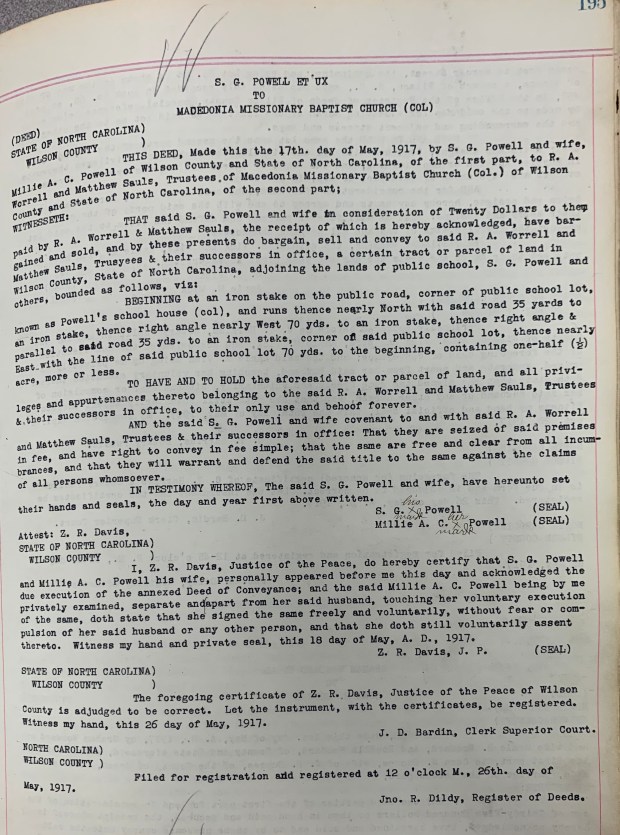
The purchase of land for Macedonia.

As we saw here, Macedonia Missionary Baptist Church is one of the few surviving early twentieth-century wooden gable-end African-American churches in Wilson County. In 1917, Macedonia trustees R.A. Worrell and Matthew Sauls acted on behalf of the church to purchase the one-half acre lot on which the church was later built. 

Note the reference to the adjoining property — the “public school lot, known as Powell’s school house (col).” Powell School predated the Rosenwald school-era. It was not listed in a recent state survey of early African-American schools in Wilson County.

——

In the 1910 census of Cross Roads township, Wilson County: on Goldsboro Road, Matthew Sauls, 43; wife Fannie, 36; and children Sylvester, 15, Nellie, 12, Maggie, 6, Dred, 4, Hattie, 2, and Bessie, 5 months.

In the 1920 census of Black Creek township, Wilson County: on W.R. Raper Road, farmer R[ichard] A. Worlds, 40; wife Rachel, 43; and children Bessie, 16, Eddie, 13, Effie, 12, Richard, 10, Iona, 7, Elnora, 6, Viola, 3, and John, 2.

Deed book 111, page 195, Register of Deeds Office, Wilson.

Hines Street school?

Screen Shot 2019-11-03 at 7.59.02 PM.png

What school is this?

The 1908 Sanborn fire insurance map of Wilson shows a two-story wooden structure with an exterior staircase on East Hines Street near South Spring labeled “School (Negro).” (South Spring Street is now Douglas Street. Thus, this building would have been facing south on Hines in the block leading up to Lodge Street.) It’s not the Episcopal parochial school, which was a one-story building next to the church at South and Lodge Streets, and I am not aware of any other private schools for African-Americans operating in Wilson at the time.

This is the sole listing in the 1908 Hill’s Wilson, N.C., city directory, which is for the Colored Graded School:

Screen Shot 2019-11-03 at 9.18.56 PM.png

By 1913, an extra story had been added to the building, and the exterior stairs removed. It was then labeled “Lodge Hall (Negro).”

Screen Shot 2019-11-03 at 8.41.36 PM.png

Sanborn fire insurance map, Wilson, N.C., 1913.

Screen Shot 2019-11-07 at 4.11.28 PM.png

Approximate location today on Hines just east of South Douglas. Aerial view courtesy of Google Maps.

A big occasion in the history of the race in this city.

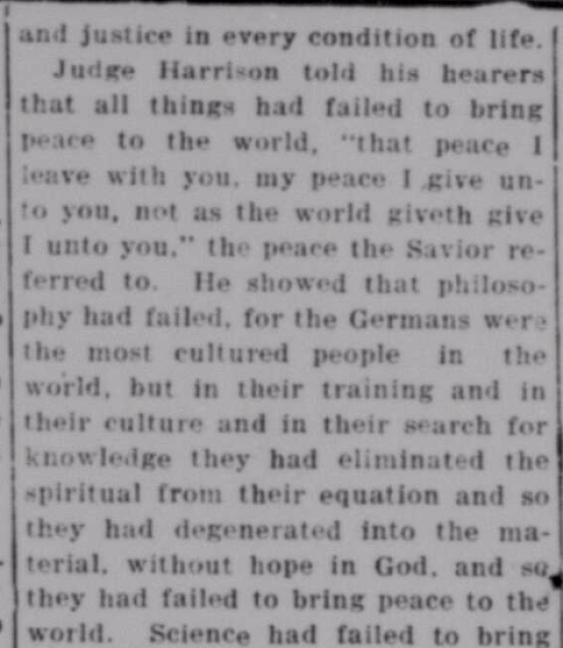
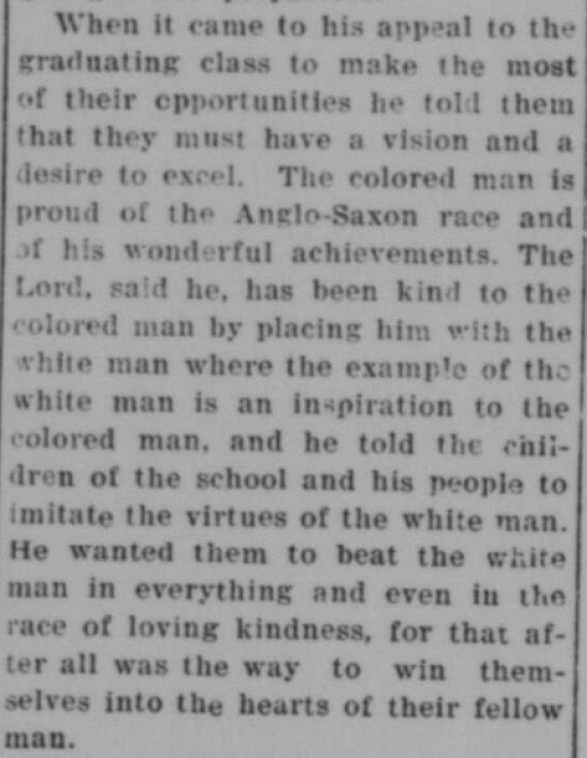
I was astonished to realize that this article memorializes the first commencement exercises at the Independent School — here called by its full and official name, the Wilson Normal and Industrial Institute. As chronicled here and here and here, a coalition of African-American parents and religious and civic leaders founded the Independent School (also known as the Industrial School) in the wake of an assault on a black teacher by the white school superintendent.

I have not been able to identify Judge William Harrison of Chicago, who delivered to the new school’s graduates a remarkably unprogressive message that seemingly flew in the face of the stand for civil rights the community had resolutely made just a year earlier. The Times reporter made no mention of the school’s genesis, preferring to focus at length on Harrison’s message of admiration for the white man’s guidance and fine example.

Screen Shot 2019-03-10 at 11.02.53 PM.png

Screen Shot 2019-03-10 at 11.03.35 PM.png

Screen Shot 2019-03-10 at 11.04.13 PM.png

Screen Shot 2019-03-10 at 11.04.45 PM.png

Screen Shot 2019-03-10 at 11.04.59 PM.png

Screen Shot 2019-03-10 at 11.05.37 PM.png

Screen Shot 2019-03-10 at 11.06.05 PM.png

Screen Shot 2019-03-10 at 11.06.24 PM.png

Screen Shot 2019-03-10 at 11.06.43 PM.png

Screen Shot 2019-03-10 at 11.07.00 PM.png

Screen Shot 2019-03-10 at 11.07.22 PM.png

Wilson Daily Times, 31 May 1919.

  • Judge William Harrison
  • Prof. S.H. Vick — Samuel H. Vick furnished a building on Vance Street to house the new school.
  • Rev. A.L.E. Weeks — Alfred L.E. Weeks was a member of the Colored Ministerial Union committee appointed to address the community’s concerns to the school board.
  • Joseph S. Jackson — Joseph S. Jackson Jr.
  • Boisy Barnes — Boisey O. Barnes.
  • Lester Mitchell — in the 1920 census of Wilson, Wilson County: on Nash Street, Annie Mitchell, 70, her children Sallie, 46, Eddie, 44, Albert, 42, Eva, 36, and Floyd, 34, plus niece Sevreane, 18, and nephew Lester, 15.
  • Willard Crawford — probably, Daniel Willard Crawford who died 16 October 1964 in Wilson. Per his death certificate, he was born 1 January 1900 in Wilson County to Daniel Crawford and Annie Whitted; was never married; and worked as a carpenter. Walter H. Whitted was informant.
  • Addie Davis — Addie Davis Butterfield.
  • Rev. R.N. Perry — Episcopal priest Robert N. Perry was also on the Ministerial Union’s committee.
  • Lillian Wilson — perhaps, in the 1920 census of Wilson, Wilson County: livery stable groom William Wilson, 51; wife Sarah, 48, and daughters Elen, 23, and Lillian, 21, both tobacco factory workers.

Farmer’s School revisited.

Field Trip to Farmers School: Rural Wilson County Education History Unearthed

By Drew C. Wilson, Wilson Times, 8 February 2019.

Shirley Pitt climbed up the steps of the old Farmers School and stepped into the past.

“My mother went here,” Pitt said. “This is our history.”

Farmers School was a two-room school north of Silver Lake in the Cliftonville community at the Wilson-Nash county line. It was one of 21 early 20th-century schools attended by members of the African-American community prior to integration.

Pitt, of Wilson, led a group of former students, children of students, neighbors and other interested people through the woods Jan. 29 to pay a visit to the school site.

Past rusty old farm implements, the group beat a new path through the woods to the building.

In the days before the visit, Pitt had gathered pictures of former students and placed them in a frame to display at the wooded pathway leading to the school.

Using hoes, men in the group chopped through years of overgrowth to clear a slender path on the cement steps leading up to the front doors.

Almost every pane in every window was broken out. Thick vines climbed up and around to a holey roof covered with years of leaves and pine straw.

Pitt organized a return to the two-room school to reconnect with an important part of Wilson County’s bygone days.

“I got on the phone and called cousins and the ones that had family here and friends that knew about Farmers School, and they all came out to celebrate today,” Pitt said.

FARMERS MILL COLORED SCHOOL

Booker T. Washington of the Tuskegee Institute and Julius Rosenwald, a philanthropist and president of Sears and Roebuck, led an effort to build more than 5,000 schools across the South between 1917 and 1932 for the purpose of providing education facilities for the African-American population. According to the North Carolina State Historic Preservation Office, Farmers School was not one of the 15 Rosenwald schools to be built in Wilson County but might have benefited from some Rosenwald funds.

It isn’t clear when the Farmers Mill Colored School first opened, but county records show that John S. Thompson sold the land for the school to the Wilson County Board of Education for $1 on Oct. 16, 1926. That land was held by Wilson County until Nov. 19, 1951, when it was sold to Alfred Barker, then resold Dec. 17, 1951, to William Johnson, highest bidder in a public auction, for $1,550.

The Farmers Mill Colored School was part of an offering the Wilson County Board of Education made at public auction of 19 African-American schools including New Vester, Jones Hill, Sims, Calvin Level, Wilbanks, Howards, Brooks, Minshews, Ruffin, Lofton, Lucama, Rocky Branch, Williamson, Bynums, Saratoga, Yelverton, Stantonsburg and Evansdale.

The property’s current owner is Cary resident Mary Lynn Thompson Whitley.

TWO TEACHERS, TWO ROOMS

Farmers School was a two-room structure with first- through third-graders taught in one room and fourth- through seventh-graders taught in the other.

Raymond Lucas, 77, of Wilson, went to the school in 1947. Lucas grew up to become the first black deputy in the Wilson County Sheriff’s Office, where he worked for more than 30 years.

“We had an old wood stove that they heated with,” Lucas said. “We lived right across the street from the school. When I was there I could get to school in about five minutes.”

Lucas remembers being one of about 15 or 20 students who attended the school at the time.

“It was real nice when we went there. Mostly everybody in the neighborhood went,” Lucas said. “It brings back a lot of memories and everything there at that school. I was really young at that time.

“A nurse would come there, one of the county nurses, Mable Ellis, and when everybody would see her coming, they would know she was coming to give a shot.”

Rhonnie Mae Arrington Jackson, 87, speaking by phone from her home in San Antonio, Texas, remembers that her room in the school didn’t have desks.

“We had a long table with some on one side and some on the other and some on the end,” Jackson said. “We didn’t have chairs. We had a long bench, and you stepped across the bench and sat down at the table.

Thelma Dorris Winstead Hall of Snow Hill and Annie Morris Winstead Woodard of Rocky Mount were twins born June 6, 1944. They went to Farmers School as 6-year-olds. They learned their ABCs, how to spell their names, how to color pictures and how to play with others.

“We learned how to give respect, manners and to love, be friendly and have friends,” Woodard said. “We couldn’t answer older people with, ‘What?’ It was ‘Yes ma’am.’ ‘No ma’am.’ ‘Sir.’ ‘Yes sir.’ ‘No sir.’ We had to be respectful to older people and use good manners.”

TIME ON THE PLAYGROUND

Jackson and her little sister, Sadie Arrington Sessoms, 85, remember all the students gathering together to wrap the maypole.

“We would have a pole standing up, and we would have some ribbons from the top of the pole coming down to reach where the children were. And there were different color ribbons, and we would walk around that pole and go under one and come out, and the other one would go under us, and we did that all the way down the pole, which made a very beautiful pole,” Sessoms said. “It was a lot of fun.”

Hall and Woodard remember that after a lesson, the children would use a little stage on one side of a classroom for skits, plays and tap dances.

As soon as the twins got into the school on the recent visit, the first place they went was up two steps onto a stage.

“We just had fun back here, and we learned,” Woodard said.

“Then we would go out in the yard and wrap the maypole. A lot of children don’t even know what that is now,” Woodard said. “We had an old pump out there. If we got thirsty, we would go down there and crank up that old pump and drink some cold water and go back to playing.”

PATHS THROUGH THE WOODS

An aerial photograph from 1936 supplied by Will Corbett, GIS coordinator for Wilson County, shows a myriad of paths in the woods leading to the school from the west and north. A large clearing adjacent to the building suggests much activity around the school.

Modern photographs enhanced by light detection and ranging, or LiDAR, technology, clearly show the walking paths and driveways leading to the school and through the adjacent cemetery.

Woodard and Hall said Farmers School had no school bus. The sisters walked with the older students to and from school every school day through a path, a shortcut through the woods that came through the cemetery. Jackson recalls the children walking through the woods eating the berries, the orange fruit of the persimmon tree and the pulp from dangling pods of the locust tree.

“I don’t know if we carried lunch to school or not,” Jackson said. “We would be real hungry and we had to go by a locust tree, and we would pull the locusts off of the tree and eat them. It was a little path where we walked going to school. They were almost like a long corn stalk. They were purple. You would pull them off the tree and break them open and eat what was inside. A lot of times that was all we had to eat, so the locusts were just like we were eating food.”

“All I know is the long walk we walked going to school,” Sessoms recalled last week. “I do remember walking around the edge of somebody’s field.”

The school had no cafeteria.

“Memories, memories, memories,” Hall said. “We had to take our lunch in a brown paper bag every day. Our friends carried sweet potatoes and fatback biscuit, peanut butter and crackers and whatever Mother fixed for us.”

COMMUNITY SCHOOL

Lucas said the school was named for the Farmer family members who lived in the area.

Sessoms and Jackson came from a family with 14 children.

“My daddy moved every year. All my daddy acted like he knew was farming,” Sessoms said. “As we got old enough to work, he had each one of us working in tobacco.”

The sisters said when they went into the school last week, it was as exciting as the first day they started at Farmers School in 1950.

“It is a wonderful, exciting feeling for me to even come back here where I started at school,” Woodard said. “It’s an excitement for me to be here just with the ones that are here, and I know it will be an excitement for me to see a lot of them I haven’t seen in years and years.”

COMMUNITY CEMETERY

There are many Farmers buried in a cemetery a short walk north of the school.

“I have a lot of relatives that are there now — grandmother, grandfather, cousins and all buried over there,” Raymond Lucas said. “It is a family grave spot.”

Paul Lucas, a New Jersey resident, drove down to take the tour of the school his family members attended.

“My brother did. My dad did. My brothers was in the last class,” Paul Lucas said. “We lived on the farm here, the Thompson farm here.” He also came to North Carolina to see the grave of his father, William Hulen Lucas. Pitt led Lucas to his father’s resting place near the school.

Jimmie Arrington of Wilson said it was an adventure seeing the school again.

“The last time I was over here was when we had a funeral,” said Arrington. “I don’t know how long it has been. It is nice to get back to where everything was started out and see what’s going on now with it. It would be nice if we could have it cleaned up and possibly do something to the school so it could be in better shape for other people to see it in the future.”

Robert Vick of the New Hope community agreed.

“I remember this school being here. When I saw someone had posted something on Facebook about coming to the school, I knew Shirley and all of the Arrington family and several of these folks. I knew their grandparents and all growing up in the community. It is interesting to see someone taking an interest in it. This ought to be preserved because it is a part of the history of this area.”

Pitt said she is planning a large reunion at the school in April.

Screen Shot 2019-02-17 at 9.02.52 PM.png

Photo of Farmer’s School by Drew C. Wilson, courtesy of Wilson Times. For additional photos of the school, please visit Wilson’s article via the link above.


Farm life, school life.

Screen Shot 2018-12-21 at 8.25.01 PM.png

Screen Shot 2018-12-21 at 8.25.26 PM.png

Screen Shot 2018-12-21 at 8.25.41 PM.png

Screen Shot 2018-12-21 at 8.26.04 PM.png

Screen Shot 2018-12-21 at 8.26.24 PM.png

Wilson Daily Times, 3 December 1936.

In 1936, African-American children at Rocky Branch, Williamson, Kirby’s, New Vester and Calvin’s Level schools — all in the rural southwest quadrant of Wilson County — responded to a survey about education and farm life. To the surprise of the writer of this article, most children indicated that would like to live on a farm (in the future?)

Back to school!

More Raines and Cox photographs of Saint Alphonsus School, these taken in 1949.

Book Week.

Your Best Friends Read Good Books.

This photo, perhaps also shot by Raines and Cox, appears to date from the 1950s.

IMG_1112.jpg

Saint Alphonsus School Drum & Bugle Corps.

[On a personal note: One day when I was 4, I followed another child out the front of Kiddie Kollege of Knowledge (formerly St. Alphonsus School) with my arms spread wide. In the inexplicable way that crazy things happen to little kids, my pinky got caught and crushed between the heavy double doors seen in the third image above. My aunt, Hattie H. Ellis, came up Carroll Street from Darden High School — she was a guidance counselor — to take me to the doctor, and I proudly showed off my little cast when I returned to school the next day.]

Top photos: many thanks to John Teel for sharing these images from the Raines & Cox collection of photographs at the North Carolina State Archives. They are catalogued as PhC_196_CW_StAlphonsusClassroom3 and
PhC_196_CW_StAlphonsusClassroom2. Bottom: courtesy of Wilson Community Improvement Association.

A charge of “negro blood.”

In January 1915, members of the Wilson County School Board considered a petition signed by 24 (ostensibly) white men and one white woman. “We the undersigned,” they wrote, “wish to protest against the attendance of any child or children in our school with negro blood in their veins as the law directs and would further ask that this matter be attended to at once.”

This is not a new issue for the Board, which lost a battle in 1909 to keep James and Jane Carter Lamm‘s children out of white schools, but won an effort in late 1914 to bar Josephus and Minnie Taylor Johnson‘s offspring.

Charles L. Coon and the Board refused to hear the petition, but agreed to rule on specific charges against specific families accused of being too black to attend white schools. Immediately, several petitioners pointed fingers at Luke Tedder’s children. The Board directed counsel for the Tedders and for the petitioners to present their cases. Instead, Tedder sent word that he would withdraw his children from Renfrow School. The matter having resolved itself, the Board adjourned.

Tedder no doubt wished to spare his family the ordeal (and humiliation) of a public dissection of his wife’s genealogy. I have written here of the Hawleys, the family into which Sally Ann Hawley Tedder was born. They and the related Rose, Ayers and Taylor families of Springhill township moved back and forth across the color line in the late 1800s. By the turn of the century, most claimed and were accorded a white identity. However, memory was long, and not all in their community were willing to overlook their remote African ancestry.

Screen Shot 2018-05-05 at 9.07.29 PM.png

Renfrow School, circa 1920s.

——

On 26 June 1867, William Hawley, son of Joseph Hair and Patsey Hawley, married Nancy Rose, daughter of Sarah Rose, at Sarah Rose’s house in Wilson County.

In the 1870 census of Spring Hill township, Wilson County: farmer William Hawley, 28, wife Nancy, 20, son Joseph, 1, and Aquilla Hawley, 17. William, Joseph and Aquilla were classified as mulatto; Nancy, as white.

In the 1880 census of Spring Hill township, Wilson County: farmer William Hawley, 39, wife Nancy, 32, and children Joseph, 10, Sally An, 7, and John, 3; all described as mulatto.

Luke Tedder, 23, son of Stephen and Betsy Tedder, married Sallie Hawley, 18, daughter of  William and Nancy Hawley, on Christmas Day 1888 in Springhill township, Wilson County. Both were classified as white. Their children were Joseph S., Victoria, William T., John H., Luke C. Jr., Lizzie, Minnie L., Eddie G., Nancy C., and James F. Tedder.

42091_343637-00607.jpg

Copies of minutes in “Education 1910-1919” folder of hanging files, Local History Room, Wilson County Public Library, Wilson; photo of school courtesy of Images of Historic Wilson County, Images of North Carolina, digitalnc.org.