London’s Primitive Baptist Church

Thank you, Freeman-Hagans family.

I was honored to be asked to speak at the Freeman-Hagans reunion last night — the first family reunion I’ve addressed beyond my own. The family is fortunate to have richly documented genealogical knowledge, so I knew I couldn’t just show up and tell the Freemans about the Freemans. As I considered topics, I remembered a passage in Mary Freeman-Ellis’ fantastic The Way It Was in which she vividly described attending services at London’s Primitive Baptist Church. As genealogy is brought to life, so to speak, by an understanding of the contexts of our ancestors’ lives, I decided to talk about the history of the church that was so central to the lives of Eliza Daniels Freeman and several of her children. My thanks to Patricia Freeman for the invitation;  to the Lillian Freeman Barbee family for sharing their table with me; and to all who welcomed me so warmly.

London Church twelve years after it was moved from its original location on Herring Avenue. A hoped-for benefactor had not materialized, and the building was beginning to break down. Wilson Daily Times, 31 March 2004.

Here’s the inspirational excerpt from Mary Freeman-Ellis’ memoir:

“… Aunt Lydia [Freeman Norwood Ricks], Uncle Lovette [Freeman], and Julius [F. Freeman Jr.] were members. Once a year, usually early spring, the church had its annual meeting. People came from near and far. A great deal of time was spent inside the church during the service. This was the annual ‘Big August Meeting,’ I used to hear Aunt Lydia say, lots of preparation occurred during the year to cleanse the heart, soul and the mind in order to be able to receive communion. The church grounds, as they were called, were set up with long wooden tables with benches to sit on. Each table was covered with a sheet then a white table cloth.

“I had never seen so much food any place before. There was fried chicken, roast beef, roast pork, potato salad, slaw and several tin tubs with iced cold lemonade. There were also several kinds of pies and cakes. This was the first time I had ever seen anybody eat only cake and fried chicken together. We tried it and it was good. People ate, greeted each other with big hugs and the preacher did his share of hugging the sisters. London Baptist Church was a primitive church; I never understood that term.

“Although the fellowship of the church grounds was a vital part of this Big August Meeting, what transpired inside was the thing that had us traumatized. For example, the services started with the pastor greeting the congregation. The membership was made up of all blacks and the women far outnumbered the men. The service continued with a long prayer, going into a song led by the pastor. There was no organ or piano. Most of the songs appeared to have anywhere from five to eight verses. I was familiar with the hymn, Amazing Grace, but had never heard it sung the way the Primitive Baptists sang it. The preacher would read off two lines as follows: ‘Amazing Grace, how sweet the sound. It saved a wreck [sic] like me.’ The congregation would follow with these same two lines. The pastor would continue with, ‘I once was lost, but now I’m found, was blind, but now I see.’ This was called ‘lining a hymn.’ The preacher took his text from the Prodigal Son. He had him going places and doing things I had never heard of before. Since we were children, we knew to keep quiet because this was a house of worship and it was good manners to sit quietly. We had also begged Aunt Lydia to take us and we did not want her to know how disappointed we were. There was very little going on for children other than eating when the time came.

“We could not get home fast enough to tell Mother and Dad about our experience, especially how hard those wooden benches were. I wanted the center of attention so I began relating each thing as it happened. Dad momentarily looked up at me for a moment with a sheepish grin on his face. He said, ‘You know you were not forced to go.'”

They have stood for several generations.

The 1 September 1936 edition of Zion’s Landmark, a Primitive Baptist journal, printed a letter from Mrs. Charlie H. Wiggins of Elm City. “It is on my mind to write,” she began. “I don’t know why.” Wiggins meandered from thoughts of a recent service at White Oak Primitive Baptist to recollections of her great-grandfather James Bullock Woodard and his family to thoughts about London Woodard:

“We, the great granddaughters and sons, are thankful we descended from such a humble, honest God-fearing Primitive Baptist ancestor. Old Uncle London [W]oodard was a slave and belonged to great granddaddy Woodard. Old Uncle London became a Primitive Baptist preacher and was the founder of London’s Church, near Wilson. His wife, Aunt Penny, was a free negro. She bought her husband from great grand daddy.

“According to Elder [R.H.] Pittman’s, of Luray, Va. writings, in London Church was the first place he ever got in the stand and preached. I have a lot of curiosity about my ancestors. This is as far back as I can go on the Woodard generations. White Oak church and London’s have stood for several generations to come and pass on. I hope they will stand for the saints to go home and hear the Holy Child Jesus talked about.”

Clipping courtesy of J. Robert Boykin III.

The colored brethren of Wilson Primitive Baptist Church.

In 1946, the Wilson Daily Times published an article by Hugh B. Johnston commemorating the history of Wilson Primitive Baptist Church. I’ve excerpted below the sections that mention the church’s African-American members.

Screen Shot 2020-05-18 at 3.33.57 PM

Wilson Primitive Baptist Church, Asheville Post Card Co., undated.

Screen Shot 2020-05-18 at 3.41.52 PM

“On April 24, 1920, the Church agreed to begin construction as soon as possible and to include a baptismal pool, memorial windows for a number of outstanding members, and a balcony for the convenience of remaining colored brethren.”

Screen Shot 2020-05-18 at 3.45.05 PM

Screen Shot 2020-05-18 at 3.45.31 PM

“A gallery for colored members ran entirely around the second story of the [1859] church, excepting the end above the tall, broad pulpit. … The Negroes in the gallery followed the same seating arrangement was the whites with regard to the sexes, and they never came into the lower part of the church except at the time of holy communion.”

Screen Shot 2020-05-18 at 3.46.43 PM

At a conference held at the Tosneot Baptist Church on Sept. 23, 1865, “a proposition was made and agreed to that all colored members that had ‘left their owners before the proclamation of freedom was made, and gone to the Yankees should be dealt with and excluded if they could not give satisfaction of their disorder.’ … [N]one of the offending members appeared … [and when they failed to appear at a postponed date,] motion was made to expel them: on which motion servants Thomas Farmer and Redic Barnes were expelled from all rights of the church.”

Screen Shot 2020-05-18 at 3.47.14 PM

“As a result of the formation of London’s Primitive Baptist Church for the convenience of the colored membership who were being served outside of regular meetings by Elder London Woodard, a conference was held at the Tosneot church on May 21, 1870, and “the following resolution was adopted by unanimous consent of the members, white and colored, that in the future, as before, the white members of the church shall have the entire control of the discipline and government of the church as this place. [This understanding was entered into the minutes] so as in after days there could not be any misunderstanding between the white and colored members of this church.”

Wilson Daily Times, 19 November 1946.

——

Some thoughts:

  • The balcony in the back of the 1920 church is visible starting at 1:29 of this Youtube video.
  • What African-Americans were members of Wilson Primitive Baptist as late as 1920? Do the church’s records exist?
  • Of the enslaved church members who audaciously took their freedom into their own hands, I have been unable to identify specifically Thomas Farmer. However, Reddic Barnes remained in Wilson County.
  • “The formation of London’s Primitive Baptist Church for the convenience of the colored membership who were being served outside of regular meetings” by London Woodard sounds like more like a recognition of a new reality: Toisnot’s black members had left to worship among themselves under a charismatic black preacher. It’s not surprising that those who remained unanimously agreed that white people would control the church.

Wilson Primitive Baptist Church, 1859-1920. The gallery for black members ran along three interior walls. Marion Monk Moore Collection, Images of North Carolina, http://www.digitalnc.org.

Memorial Service for Mrs. Ada Green Knight.

Ada Green Knight‘s funeral was held 11 March 1973 at Saint John A.M.E. Zion Church. Elder Lonnie Barnes of London Primitive Baptist Church officiated.

Screen Shot 2020-02-08 at 7.54.59 AM.png

Screen Shot 2020-02-08 at 7.55.15 AM.png

In the 1900 census of Wilson township, Wilson County: carpenter Neverson Green, 45; wife Isabeler, 35; and children Mary J., 18, Annie B., 15, Oscar, 13, Ada, 11, Ora, 9, Rose L., 6, William O., 5, Lula B., 2, and Besse, 3 months; plus boarder William Alley, 21.

In the 1910 census of Wilson, Wilson County: on Lodge Street, house carpenter Neverson Green, 49; wife Ezabell, 45 and children Ada, 22, Viola, 19, Rosa, 16, William O., 14, Lula, 12, Henry, 8, Bessie, 6, and Eva, 2. Ada, Viola and Rosa were tobacco factory laborers; William worked in a box factory.

James Henry Knight registered for the World War I draft in Wilson County. Per his registration card, he was born 2 November 1885; lived at 607 Lodge; worked horseshoeing for J.Y. Buchanan; and his nearest relative was wife Ada Knight.

In the 1920 census of Wilson, Wilson County: James Knight, 31, blacksmith; wife Ada, 29, tobacco factory worker; and children Mildred, 8, James Jr., 7, William, 4, and Robert, 2.

In the 1930 census of Wilson, Wilson County: at 603 South Lodge Street, blacksmith James H. Knight, 45; wife Ada H., 43; and children James H., Jr., 17, William, 14, Marvin, 12, Eveline, 9, and Nancy J., 10 months.

In the 1940 census of Wilson, Wilson County: retail grocer James H. Knight, 53; wife Ada Elsie, 52; and children Marvin, 22, Evelyn, 19, Nancy Doris, 10, and Joseph Frank, 8.

Ada Green Knight died 3 March 1973 in Wilson. Per her death certificate, she was born in Virginia on 13 March 1887 to Nelson Green and Isabell Thorp; resided at 502 South Lodge Street; and was a retired laborer. Informant was Nancy Doris Lucas, 502 South Lodge.

Thanks to Lisa R.W. Sloan for sharing this funeral program from a family collection.

In Memory of Mrs. Mena Townsend Faison.

Mena Townsend Faison‘s funeral was held 16 August 1981 at London Primitive Baptist Church. Elder Lonnie Barnes performed the service.

DAC669F3-E39F-4306-9A9C-F279CA8269B6.jpeg

Will Faison, 24, of Wilson, and Mena Townsend, 19, of Wilson, daughter of Louis Townsend, were married 15 August 1912 in Wilson. Missionary Baptist minister William Baker performed the ceremony in the presence of Rosa Greene, Ora Bunch and Josie Strickland.

In the 1920 census of Wilson, Wilson County: on Banks Street, tobacco factory worker Willie Banks, 31; wife Mena, 26; and children Edward, 6, Willie Mae, 4, Addie, 2, and Adell, 7 months.

Mabel Eliza Faison died 25 December 1929 in Wilson. Per her death certificate, she was 17 years old; a school girl; single; and was born in Wilson to Willie Faison and Mena Townsend. Informant was Maggie Katis.

Henry Cornelius Faison registered for the World War II draft in Wilson in 1942. Per his registration card, he was born 22 February 1921 in Wilson; lived at 504 Banks Street; his contact was Meana Faison; and he worked for Export Tobacco Company. Ethel L. Hines was registrar.

In the 1957 Newark, New Jersey, city directory: Faison William (Mena) longshoreman h 146 S 9th

Thanks to Lisa R.W. Sloan for sharing this funeral program from a family collection.

Another history of London Woodard and his church.

img-6.jpeg

img-7.jpeg

Rocky Mount Telegram, 29 January 1960.

The take-away:

  • London’s Primitive Baptist is possibly the oldest African-American church in Wilson County.
  • London Woodard was born in 1808. In 1827, James Bullock Woodard purchased him for $500 from the estate of Julan Woodard.
  • In 1828, London Woodard was baptized at Toisnot Primitive Baptist.
  • In 1866, he sought permission to preach among his people.
  • In 1870, he was “dismissed” from Toisnot so that he could pastor the church he founded. He died lass than a month later.
  • London Church appears to have become disorganized after Woodard’s death, but in 1895, Toisnot P.B. dismissed several “colored brethren and sisters” who wanted to reestablish worship at London’s. The same year Union (now Upper Town Creek) P.B. released Haywood Pender, George Braswell, Dublin Barnes, and couple Charles and Rebeckah Barnes for the same purpose.
  • London Woodard married Pennie Lassiter, born free about 1810 and possessed of considerable property, including 29 acres purchased from James B. Woodard in 1859. [Penelope Lassiter was his second wife. His first, Venus, was enslaved.]
  • London and Pennie Woodard’s children were Priscilla (1846), Theresa (1848), Hardy (1850), Haywood (1852), William (1854), and Penina (1858). “Another child was probably named Elba, born in 1844; she was working for the John Batts family in 1860.” [London and Venus Woodard had nine children; Elba was not among either set.]
  • Many “old-time colored Christians” remained members of the churches they attended during slavery. Their children and grandchildren, however, gradually formed separate congregations.

——

  • Haywood Pender — in the 1900 census of Toisnot township, Wilson County: Haywood Pender, 50, farmer; wife Feraby, 45; children Mollie, 39, and Ann, 8; and grandchildren Gold, 5, Nancy, 3, and Willie, 16. Haywood Pender died 15 July 1942 in Elm City, Toisnot township. Per his death certificate, he was born 6 October 1852 in Wilson County to Abram Sharp and Sookie Pender; was a farmer; was a widower; and was buried in Piney Grove cemetery, Elm City.
  • Dublin Barnes — in the 1880 census of Toisnot township, Wilson County: farmer Doublin Barnes, 25; wife Eliza, 21; daughter Sattena, 2; and Jane Thomas, 12, farmhand.
  • Charles and Rebecca Barnes — in the 1900 census of Wilson, Wilson County: farmhand Charley Barnes, 50; wife Rebecca, 57; and children John, 26, William, 23, Annie, 17, Tom, 18, and Corah, 12.
  • George Braswell

London Woodard, Penny Lassiter Woodard and the London Church.

On 14 February 1970, the Wilson Daily Times published a full-page article detailing the life of London Woodard, founder of London’s Primitive Baptist Church.

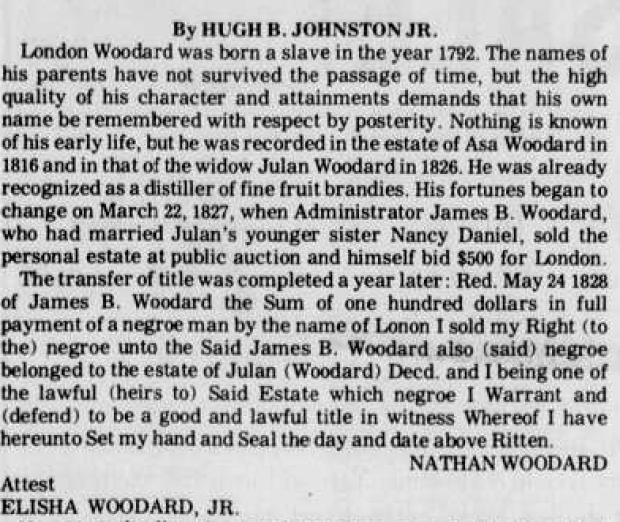
London Woodard was born enslaved in 1792. He was recorded in the estates of Asa Woodard in 1816 and Julan Woodard in 1826 (in which he was recognized as a distiller of fine fruit brandies.) In 1827, James B. Woodard bought London at auction for $500. The same year, London married Venus, a woman enslaved by Woodard. In 1828, London was baptized and appears as a member in the minutes of Tosneot Baptist Church. Venus was baptized in 1838 and died in 1845.

Screen Shot 2018-04-09 at 6.57.21 PM.png

Screen Shot 2018-04-09 at 7.02.17 PM.png

Transfer of title to “a negroe man by the name of Lonon” from Nathan Woodard to James B. Woodard, 1928.

J.B. Woodard’s second wife died in 1837, and he hired Penelope Lassiter, a free woman of color, as a housekeeper and surrogate mother to his children. Lassiter, born 1814, was the daughter of Hardy Lassiter, who owned a small farm south of Wilson. She met London, who was working as overseer, at Woodard’s. In 1852, Penny Lassiter bought 106 acres for $242 about five miles east of Wilson on the Tarboro Road.

Screen Shot 2018-04-09 at 7.07.30 PM.png

In 1854, Penny Lassiter purchased her husband London, then about 62 or 63, from J.B. Woodard for $150. In 1858 Lassiter bought another 53 acres near her first tract and purchased 21 acres in 1859. The same year, she sold a small parcel to Jordan Thomas, a free man of color [who was married to her step-daughter Rose Woodard.] In 1866, the years after he was emancipated, London Woodard bought, subject to mortgage, a 200-acre parcel of land.

Screen Shot 2018-04-09 at 7.08.58 PM.png

Screen Shot 2018-04-09 at 7.09.45 PM.png

In 1866, London Woodard was granted authority to preach “only among his acquaintances,” i.e. African-Americans. A member of Tosneot Baptist donated an acre of land to build a black church, regarded as the first in Wilson County. London Woodard was licensed to preach in 1870.

Screen Shot 2018-04-09 at 7.12.18 PM.png

Screen Shot 2018-04-09 at 7.16.21 PM.png

London Woodard preached his last sermon on 13 November 1870. The next day, he suffered a stroke and fell into an open fireplace. Despite severe burns, he was able to dictate a will before his death.

The history of London Church for the 25 years after Woodard’s death is murky. In 1895, white churches Tosneot and Upper Town Creek dismissed several African-American members in order that they might establish an independent congregation at London’s. [London Church reorganized under the umbrella of the Turner Swamp Primitive Baptist Association in 1897.]

Screen Shot 2018-04-09 at 7.17.29 PM.png

By the terms of his will, London Woodard provided for his wife Penelope; sons William, Hardy, Haywood, Howell, Elvin, Amos and London; and daughters Treasy, Rose, Pharibee, Sarah, Harriet and Penninah. (Deceased son John’s daughter was apparently inadvertently omitted.)  “A few facts” about Woodard’s children follows.

Screen Shot 2018-04-09 at 7.20.03 PM.png

Screen Shot 2018-04-09 at 7.20.37 PM.png

Screen Shot 2018-04-09 at 7.22.27 PM.png

Screen Shot 2018-04-09 at 7.23.29 PM.png

Screen Shot 2018-04-09 at 7.24.18 PM.png

Screen Shot 2018-04-09 at 7.25.39 PM.png

Receipts for payments for taxes and accounts for Penny Lassiter and London Woodard.

Screen Shot 2018-04-09 at 7.26.14 PM.png

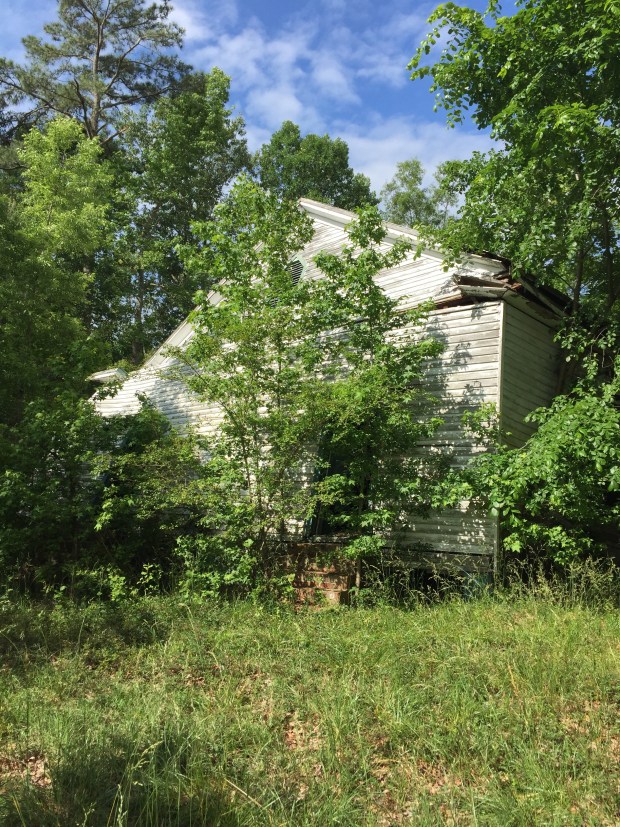
This building was moved around the corner to London Church Road. It has long been abandoned and collapsed in 2017 after suffering serious storm damage the year before.

London’s Primitive Baptist Church.

From the introduction to Hugh Buckner Johnston’s The Woodard Confederate Letters of Wilson County (1977):

“’Uncle London’ Woodard (1792-November 15, 1870) was one of the most respectable black men of his area and time. Having been married about 1817 to James Bullock Woodard’s Venus, he was purchased by this planter on May 24, 1828, and became his overseer and distiller. London was baptized into the fellowship of the Tosneot Primitive Baptist Church on August 24, 1828, and Venus on August 4, 1838. This good woman died about the end of 1845, leaving several children to mourn her loss.

“In 1846, he married Penelope Lassiter, daughter of Hardy Lassiter. She had become an indispensable part of the James B. Woodard household after the death of his first wife in 1837. ‘Aunt Pennie,’ a free woman of light color, who worked hard, saved her money, and bought land. On September 18, 1854, she also bought ‘Uncle London’ and made him a free man. He was ‘liberated to preach’ on April 21, 1866, and in the following December Mrs. Elizabeth Farmer gave him one acres upon which he soon erected ‘London’s Primitive Baptist Church‘ which is still in existence.”

——

While London Woodard may have lived essentially as a free man after his purchase by Penny Lassiter, there is no evidence that he was in fact emancipated prior to the end of the Civil War.  Thus, while Penny and their children appear as Lassiters in the 1860 census, he does not.

London’s Primitive Baptist Church was organized in 1870, weeks before London Woodard suffered burns that led to his death. Twenty-five years later, his congregation erected a simple wood-frame building on what is now Herring Avenue. That building was in use until 1992, when members moved into a new brick church. To save the landmark from demolition, descendants of Elizabeth Farmer donated a nearby site to which the structure was moved.

I took this photo of the 1895 church in May 2013, when the building, though compromised, was in relatively decent shape.

img_2167

May 2013.

Since then, a tree smashed into the chancel during a storm, dragging the front gable backwards and plunging the beadboard ceiling to the floor. All but the very front of the nave was crushed, and London’s Church cannot be saved.

IMG_9272

IMG_9274

May 2016.