Wilson County

State vs. William Horn.

To stave off responsibility for caring for poor women and their children, unwed mothers were regularly brought before justices of the peace to answer sharp questions about their circumstances.

On 17 September 1866, William Horn, Eliza Horn, Ben Horn, and Lewis Barnes posted a bond for William Horn’s appearance in court to answer a charge that he had fathered Elizabeth Morris‘ child.

Probably, in the 1860 census of Black Creek township, Wilson County: Martha Morris, 60; Elizabeth Morris, 25; and Martha Morris, 2, with Zillah Morris, 11, next door in the household of John Saunders. In the 1870 census of Wilson township, Wilson County: domestic servant Elizabeth Morris, 33, and her children Zilla A., 17, Martha, 13, Henry, 7, and Elizabeth, 1.

I have not identified William Horn or his supporters with certainty.

Bastardy Bonds, 1866, Miscellaneous Records, Wilson County Records, North Carolina State Archives.

State vs. Albert Freeman.

To stave off responsibility for caring for poor women and their children, unwed mothers were regularly brought before justices of the peace to answer sharp questions about their circumstances.

On 1 October 1866, Martha Cooper admitted to Wilson County justice of the peace William G. Jordan that she had fourteen month-old and two month-old children whose father was Albert Freeman. Jordan ordered that Freeman be arrested and taken to a justice to answer Cooper’s charge.

I have not been able to identify either Cooper or Freeman.

Bastardy Bonds, 1866, Miscellaneous Records, Wilson County Records, North Carolina State Archives.

A survey of Negro laboring classes.

In 1931, Darden High School staff and students conducted a survey of 608 African-American families in Wilson to yield “a cross section of laboring conditions and opportunities offered negroes to make a living.”

The Daily Times took comfort in the lack of transience of the population, proclaiming cheerfully that this indicated a “very decided degree of contentment due to the opportunities offered in Wilson for making a living.” I reach a different takeaway.

Wilson Daily Times, 6 May 1931.

Negro laborers wanted.

Wilson Daily Times, 2 March 1918.

Badin Aluminum Works placed this alluring ad in the Daily Times in 1918. Though working for Alcoa seemed to offer an appealing alternative to sharecropping, life in this company town had a dark side — literally, as the families of African-American workers lived segregated in Negro Town, and figuratively, as the extent and impact of industrial pollution continues to come to light.

“Badin has become a crucible for questions about the legacy of industrialization, racial capitalism, and environmental justice in the American South, and for how choices made and prejudices fomented a century ago reverberate into the present — with the added complication that Badin was a company town.” Read Emily Cataneo’s The Complicated Lgacy of Badin, North Carolina, http://www.undark.org, for more.

[I am searching for evidence that any Black Wilson County families answered this siren call.]

Clipping courtesy of J. Robert Boykin III.

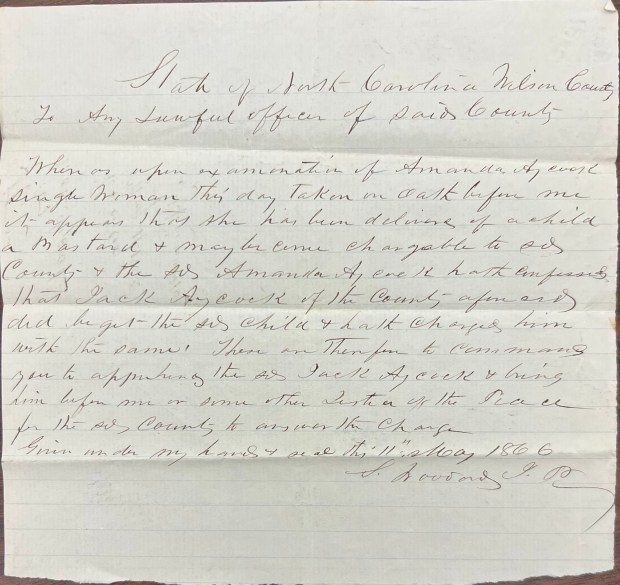
State vs. Jack Aycock.

Jack Aycock married Letha Daniel on 17 December 1866 in Wilson County. In the 1870 census of Black Creek township, Wilson County: Jackson Aycock, 23; wife Litha, 26; and daughter Kate, 1.

I have not identified Amanda Aycock.

Bastardy Bonds, 1866, Miscellaneous Records, Wilson County Records, North Carolina State Archives.

Teachers assigned to Negro schools.

Wilson Daily Times, 31 August 1949.

Just before the school year began, the Daily Times published the names of African-American teachers at Wilson County’s Black county schools — Williamson High School, Williamson Elementary, Rocky Branch, Jones Hill, New Vester, Sims, Farmers, Howard, Holden, Saratoga, Bynums, Wilbanks, Yelverton, Stantonsburg, Evansdale, Ruffin, Lofton, Minshew, Brooks, Lucama, and Calvin Level

1115 Carolina Street.

The one hundred-seventy-seventh in a series of posts highlighting buildings in East Wilson Historic District, a national historic district located in Wilson, North Carolina. As originally approved, the district encompasses 858 contributing buildings and two contributing structures in a historically African-American section of Wilson. (A significant number have since been lost.) The district was developed between about 1890 to 1940 and includes notable examples of Queen Anne, Bungalow/American Craftsman, and Shotgun-style architecture. It was listed on the National Register of Historic Places in 1988.

As described in the nomination form for the East Wilson Historic District, this building is: “ca. 1940; 1-story; bungalow with gable roof form and shingle shake veneer.”

Timothy and Grace Battle Black purchased the property at 1115 Carolina Street in 1935 and likely built this house within the next few years.

In 1939, they appeared in a list of property owners who faced sale of their properties for unpaid taxes:

Wilson Daily Times, 21 November 1939.

In the 1941 Hill’s Wilson, N.C., city directory: Black Grace (c) cook h 1115 Carolina

The Blacks divorced in mid-1944, and in July the Wilson Daily Times published a series of notices of the sale of 1115 Carolina.

Wilson Daily Times, 19 July 1944.

The sale was apparently called off, as Grace Black remained in the house three years later. In the 1947 Hill’s Wilson, N.C., city directory: Black Grace (c) cook McLellans h 1115 Carolina.

Back to school!

Wilson Daily Times, 5 October 1950.

Lula Marie McKeithan (1943-2017) was the daughter of Daniel and Naomi Jones McKeithan

[Personal note: Naomi “Ma Keit” McKeithan provided loving daycare in her home to a generation of East Wilson children, including my sister (and me, on school holidays.) Lula Marie was a recent college graduate during the time we spent in the McKeithan home at 1206 Queen Street, and continued to sing beautifully.]