Who bought all these Samuel H. Vick-related manuscripts from Swann Auction Galleries? Where is this material now?


Who bought all these Samuel H. Vick-related manuscripts from Swann Auction Galleries? Where is this material now?
The earliest black churches in Wilson were Baptist, but African Methodist Episcopal Zion missionaries quickly established a foothold in the county. Saint John A.M.E. Zion is one of the oldest black churches of any denomination in Wilson County, and the first generation of college graduates emerged from its attendant private academy. The older African Methodist Episcopal denomination did not take root as quickly or as widely in North Carolina, but at least two churches were founded in Wilson County.
As far as I know, Evansdale mystery aside, no black United Methodist congregations were ever established in Wilson County.
African Methodist Episcopal Zion churches
Founded in 1868. Present site at Pender Street purchased in 1880. Wooden church replaced by current handsome brick structure in 1914. Associated with several high-profile pastors in the 19th and early 20th centuries, including Rev. Joseph C. Price, Rev. Owen L.W. Smith, and Rev. R.A.G. Foster.
Second oldest active African Methodist Episcopal Zion church in Wilson. First sanctuary built on land purchased in 1909 on Banks Street from Rev. Smith, former consul to Liberia and A.M.E.Z. presiding elder.
In 1903, Orren and Hancey Best sold trustees a lot in Grabneck community for construction of Saint Stephen’s. Also known as South Wilson Mission. Per the 1923 report of the Wilson District of the Cape Fear Annual Conference, a 22 foot by 32 foot church was built in 1922. Church is defunct, and precise location is not clear.
Founded in 1877. Presently active at 210 West Broad Avenue, Stantonsburg. Bethel’s original site was southeast of Stantonsburg on what is now Peacock Bridge Road. Its old cemetery marks the approximate site.
In 1886, A.M.E.Z. trustees bought a lot on “Avenue Street.” Location not now known. This was likely Hardy’s Chapel. Church is defunct.
Active in 1940s. No further information.
The 1922 Sanborn fire insurance map of Wilson shows an A.M.E. Zion church at 312 Manchester Street, at the corner of East Suggs Street. The 1930 Sanborn map, however, shows this building housing a Christ Disciple Church. No other information is known.

Six miles from Wilson. No further info.
Eight miles from Wilson. No further info.
Perhaps: in 1910, the Colored Methodist Episcopal purchased a lot on Wilson Street, east of the railroad, in Elm City. No further information.
African Methodist Episcopal churches
In 1906, trustees bought a lot on Suggs Street to build an A.M.E. church. However, the church was not organized as Saint Luke until 1910. In the 1930s, the congregation moved to a storefront at the corner of Vick and Atlantic Streets and erected its current church building at that site in 1948.
On 1 September 1903, the trustees for the A.M.E. Church of Lucama paid $25 for a quarter-acre lot on Main Street in Lucama. The exact location is not clear.
A.M.E.Z. or A.M.E.? (Or maybe C.M.E.?)
Shown in the 1913 Sanborn fire insurance map on South Lodge Street, across from Imperial Tobacco. No further identification.
I am ambivalent about using artificial intelligence to restore photographs. Or, more specifically, I’m concerned about manipulated photographs supplanting original images and further blurring the line between reality and misinformation. However, the allure of AI-enhanced images is strong, as I often contend with blurry, poorly lit photographs in unnatural sepia or black-and-white tones. Photographs whose condition sometimes exacerbates the distance between us and our ancestors.
I have been experimenting with ChatGPT lately, feeding it queries and images to be restored and colorized. The results are somewhat haphazard, with many images weird and off-putting. Other times, the images are breathtakingly sharp and … alive. Black Wide-Awake exists to resurrect forgotten lives, and I believe these images are valuable to help us connect with the men and women we read about in these posts. From time to time, I’ll share the better ones here, clearly marked as AI-generated.
——


Noah Artis (1856-1952), farmer.


Journal and Guide (Norfolk, Va.), 25 July 1931.
——

Cleveland (Oh.) Gazette, 25 October 1902.
After George H. White left Congress in 1901, Democrat Claude Kitchin of Scotland Neck — organizer of the terror-dealing Red Shirts and leader of the 1898 Wilmington Massacre — was elected to represent the black-majority Second District. (Days before the massacre, he proclaimed in an rally: “We cannot outnumber the negroes … And so we must either outcheat, outcount, or outshoot them.”)
Kitchin stood for reelection eleven times, defeating all challengers, including Samuel H. Vick in 1902. With the overwhelming majority of black voters newly disenfranchised, and many of the remaining terrified to exercise the franchise, Vick garnered a paltry four votes, and Kitchin obliterated the field.

The Morning Post (Wilmington, N.C.), 29 November 1902.
Immediately after his re-election, Kitchin joined the call to remove Vick from his position as postmaster.

Newton (N.C.) Enterprise, 12 December 1902.
I surely passed Clarence B. Best‘s house-cum-atelier thousands of times in my child- and young adulthood, but I have no memory of this display of his wares in his front yard as shown in this 1980 photograph. In this era, Nash Street cut right in front of his house.


Houses, 700-1407 E. Nash Street, East Wilson Historic District, Wilson, Wilson County, Survey and National Register Branch, State Historic Preservation Office, Department of Natural and Cultural Resources, Division of Archives and Records, Raleigh.
Convict leasing never took hold in Wilson County the way it did in the deeper South (or even western North Carolina), but it nevertheless was a system of forced penal labor available to those who wanted and could afford to take advantage of it.
Below, in November 1896, Paul Lee Woodard and William Woodard Jr. agreed to pay the Wilson County Commissioners six dollars per month to lease Walter Mitchell, “a prisoner in the County Jail,” for one year. If Mitchell failed to “do his duty,” he could be returned to county custody. The arrangement meant (1) the county was relieved of the expense of feeding and otherwise looking after Mitchell for a year, and (2) the Woodards gained cheap labor that they could work hard and completely control. As for Mitchell, he was possibly spared roadwork under harsh conditions, but was also removed from what nominal protections were afforded by being under the county’s “care.” Either way, he received no pay for his labor.
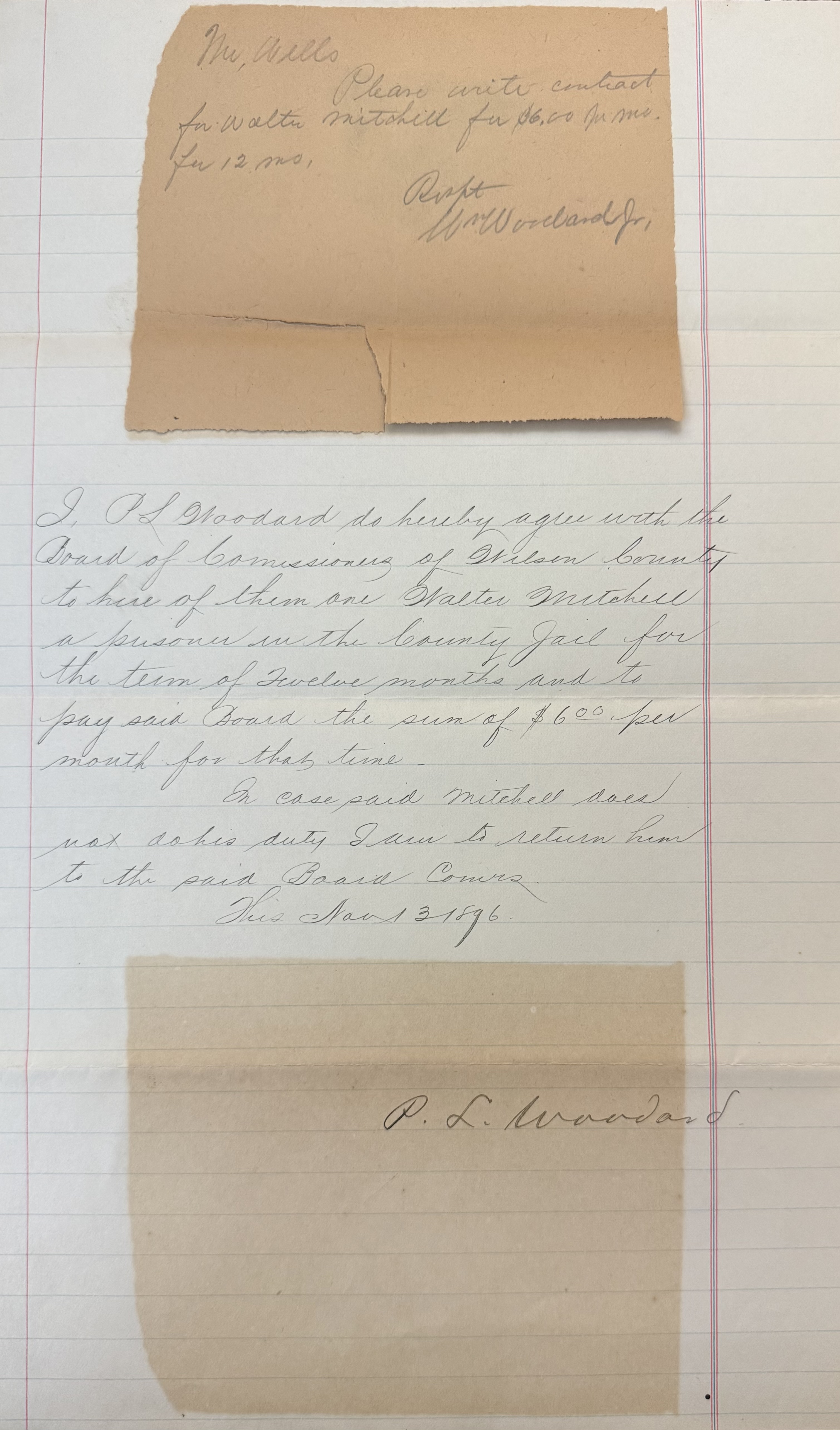
Hire of Prisoner (1896), Miscellaneous Records, Wilson County Records, North Carolina State Archives, Raleigh.
In the early 1960s, uncomfortably aware of the optics, not to mention the illegality, of a segregated water fountain at the courthouse steps, Wilson County capped the fountain’s spigots and chiseled away the letters designating who drank where. By time I was born in 1964, local government had erased the public labels of Jim Crow. Most businesses followed suit, but some could not be bothered.
Wilson was deeply socially segregated for decades after civil rights legal rulings and legislation forbade legal enforcement. This meant, in practice, that while we could go into any public establishment and see a doctor or try on clothes or order a meal the same as any white person, the environment was not always inviting, nor the experience comfortable. This was the Wilson I grew up in. I never saw the old placards and partitions, but we bought chicken and barbecue from the back entrance of Parker’s, and I never played with, much less visited, my white friends away school. Still, we shopped freely at Belk’s and Barshay’s and Flower’s, guffawed at Disney movies in floor seats at the Colony and Wilson Theatres, and saw our white dentist and doctors at their West Nash and Tarboro Street offices.
Elsewhere, however, physical vestiges of codified segregation continued to leak radiation. I documented the ghosts of Jim Crow in a short-lived pandemic era Tumblr account. But the hand-painted White Water sign on a wall at Farmer’s Warehouse, starkly visible until the building’s demolition in 2023, confronted black workers and visitors well into the 1980s. The building’s owners never thought the sign’s poisonous message damaging enough to paint over. (Or maybe they understood precisely what it signaled.)
I have never believed that the Farmer’s Warehouse sign was the last of these signs. Downtown Wilson’s brick storefronts and former factories and warehouses are in the midst of a wave of redevelopment. Many old buildings, often long disused, have been demolished. Others have been renovated for exciting new uses. Surely, as investors and developers and contraction crews have scoured their interiors, they have encountered evidence of the rigid social structures that once locked black people into (or out of) place.
Like this one.

That’s the door to the COLORED WOMEN TOILET. This five-panel door has been in storage since, it appears, about 1990. From about 1938 to at least the mid-1960s, it marked the restroom available for the few black female employees of the company that occupied this downtown building, all of whom likely all worked on the cleaning staff.
A different, unrelated company operated in the building in the 1970s and ’80s. I don’t know if they left the door where it originally hung or took it down and stored it, but they didn’t paint over its label or throw the door away.

This battered green door, still bearing stains from the oils of the countless hands that pushed through it, stands is an tangible, undeniable link to a past that many would now downplay. My deep thanks to those who shared this photograph with me and gave permission for me to publish it.

Carpenter Jerry Bullock escaped from an Edgecombe County plantation to join the United States Colored Troops in Washington, North Carolina, in June 1864. He was not a young man — 41 — and was already married with children, but dutifully served in Company E of the 37th U.S.C. Infantry.
A dozen years after his death in 1877, Bullock’s widow Martha Bullock applied for a widow’s pension, which was granted.

On 1 October 1901, Martha Bullock gave another statement about her husband and her life after his death. By then, she was living in Suffolk, Virginia:
“On this 1 day of Oct., 1901, at Suffolk, county of Nansemond, State of Va., before me, T. H. Gault, a special examiner of the Bureau of Pensions, personally appeared Martha Bullock, who, being by me first duly sworn to answer truly all interrogatories propounded to her during this special examination of aforesaid claim for pension, deposes and says:
“I am 63 years of age; housekeeping, and I reside as stated above.
“I am in receipt of a pension of eight dollars a month as the widow of Jerry Bullock who served during the War of the Rebellion in Co. E, 37 U.S.C. Inf., & who died about 23 years ago near Elm City, Wilson Co., N.C.
“I do not know what he died of. Moses Morris, Tom Gray Dixon, Hardy Dixon, Wiley Gray Dixon all knew my husband well.
“My husband was treated during last illness by Dr. Gardiner.
“My husband was about six feet tall, was light complexioned, had black hair & eyes & prior to enlistment was a carpenter.
“My husband was the son of Josh Bullock a white man. His mother was an Indian woman. My husband never went under any name except that of Jerry Bullock.
“I was raised a slave and belonged to the Peacocks of Wilson, the same county that I was born in. My husband was from Edgecombe Co., N.C.
“My father was Bob Holland. My maiden name was Martha Peacock & I was married under that name. I was never married before I married my husband.
“He had been married two or three times before we were married. Mary K. Applewhite was one of his wives & they separated. I know he had another named Sarah who belonged to a man named Bynum, but they separated & then we married.
“We had no ceremony. Colored people those days had no ceremony. He got consent of my owner & we announced ourselves as husband & wife.
“That was several years before the war. I was only about 15 years of age when we were married, but at that time he was going on pretty well in age. After our marriage we lived right on in Wilson Co. till War commenced. After War had been going on some little time my husband went to Wash. N.C. & joined the union army. Was there 3 years. He received his discharge at Wilmington, N.C. and then he went to Portland, Me., where he remained seven months.
“He said he wrote me when he was in the army but I never received any of the letters. My husband came to see me once while he was in the army. He was then on a 30 day furlough and the Regt. was then at Goldsboro, N.C. He wore a blue uniform when at home on furlough.
“After he came from Maine we remained in Wilson Co. till he died. He died in 1/2 mile of Elm City. I have had nine children, seven are alive.
“Betty my youngest was a baby when my husband died. I have never remarried since my husband died.
“Jolly Taylor visited me for several years after death of my husband. He went to Kansas when the colored people went in such numbers years ago. Taylor married some 14 or 15 yrs. ago.
“Taylor lived a mile & a half from Elm City. He never boarded in same house with me. Mr. Taylor visited me up to time of his marriage. Yes, he visited me pretty often.
“I admit that at times we had sexual relations and he used to spend the night with me but we were never married. I never had any thing to do with him after his marriage, though at times he continued to visit me. I never had any children by Taylor. No, I never went under Taylor’s name.
“Taylor was very good to me and at times gave me things — gave me money at times & at other times would give me a dress or change like that.
“I was very poor when Taylor visited me and it was my poverty that drove me to having sexual relations with him. I needed money to help me along as I had five little children and those days I had no pension.
“Taylor is principal man who used to visit me though Willis Mordecai also at times came but he had a wife so I finally made him quit coming.
“Mr. Woodward got my claim for me. I paid him fifty dollars when I received my first payment. I got $180 first payment & gave Mr. Woodward $50 out of that amount.
“My vouchers are executed by Mr. Hozier. He charges 40 cents for each voucher. He always swears me. I have never furnished my pension papers.
“From death of my husband till I moved here 2 years ago I lived right at Elm City, N.C.
“I have fully understood questions & answers have been correctly recorded.”
Martha (X) Bullock
——
A few thoughts about Martha Bullock’s testimony:
——
In the 1870 census of Joyners township, Wilson County: farmer Jerry Bullock, 56; wife Martha, 32; and children John, 15, Ichabode, 13, Anna, 11, Ross, 8, Doc, 2, and Grant, 5 months.
In the 1880 census of Toisnot township, Wilson County: widow Martha A. Bullock, 34, and children Ichabud, 20, Ross, 18, David C., 12, Ella, 7, Emma S., 5, and Bettie, 3.
In the 1870 census of Joyners township, Wilson County: farmer Jerry Bullock, 56; wife Martha, 32; and children John, 15, Ichabode, 13, Anna, 11, Ross, 8, Doc, 2, and Grant, 5 months.
Jerry Bullock died in 1877.
In the 1870 census of Joyners township, Wilson County: farm laborer Moses Morriss, 51; wife Cherry, 40; and children Calvin, 17, Morriss, 7, Jerry, 9, and Amanda, 4.
In the 1880 census of Toisnot township, Wilson County: farm laborer Moses Morris, 67; wife Cherry, 45; and children Jerry, 19, William, 16, and Amanda, 13.
Father and sons, white farmers who lived in the Elm City area .
Joshua Killebrew Bullock was a wealthy Edgecombe County planter and enslaver. In the 1860 slave schedule of Edgecombe County, he reported owning fifty black people.
The 1860 slave schedule of Wilson County lists five enslavers named Peacock — James B. Peacock, who enslaved four people; Sarah Peacock, eight; Joseph Peacock, four; C.C. [Caswell C.] Peacock, thirteen; and Lovett Peacock, six. All lived in Saratoga district (near Stantonsburg) except Lovett, who lived in Wilson district. None listed an enslaved woman born about 1837, the approximate year Martha was born.
In the 1880 census of Toisnot township, Wilson County: widow Martha A. Bullock, 34, and children Ichabud, 20, Ross, 18, David C., 12, Ella, 7, Emma S., 5, and Bettie, 3.
Jolly Taylor may first have migrated to Kansas, but by 1900 he and his family lived in Louisiana. His wife Cherry returned to Wilson County before her death in 1916.
In the 1880 census of Toisnot township, Wilson County: farm laborer Willis Mordicai, 28; wife Martha A., 24; and children Katie, 6, Mary D., 4, and Dinksy A., 1.
In the 1900 census of Toisnot township, Wilson County: farmer Willis Mordica, 53; wife Martha, 52; children Dinksy, 20, Etta, 16, Darcas, 14, and Hampton, 4; and grandsons Edgar, 2, and Fred, 3.
In the 1910 census of Toisnot township, Wilson County: farm laborer Willis Modiky, 56; wife Martha, 53; and grandsons Jessey, 14, Edgar, 13, and Fred, 12.
In the 1920 census of Toisnot township, Wilson County: on Wilson-Tarboro Road, Willis Modica, 65; wife Martha, 64; grandsons Fred, 22, and Edgar, 23, and Edgar’s wife Cora, 22.
Willis Modica died 26 June 1929 in Toisnot township, Wilson County. Per his death certificate, he was 85 years old; was born in Raleigh, Wake County, N.C., to Nowell Daniel and Millie Daniel; was married to Martha A. Modica; and worked in farming.
Probably, Sidney A. or Frederick A. Woodard, who represented a number of pension seekers, for better or worse.
Transcript of affidavit courtesy of Devontae Freeland. Thank you!

Wilson Daily Times, 7 October 1921.
Among the grocers offering fresh-picked apples were Glenn S. McBrayer, who was primarily a lawyer, and Neverson Green.