Month: October 2022

Lost neighborhoods, no. 4: Happy Hill.

I had no idea what I was looking at at first. This aerial view of Wilson was shot circa 1949, but what was the perspective?

I started with the obvious landmarks — the courthouse, the Atlantic Coast Line Railroad, and the Cherry Hotel. The hotel’s location identified the street crossing the image diagonally as Lodge Street. Hines Street had not been cut through yet — it ended at Lodge — and Renfro Bridge was 25 years in the future. The image began to make sense.

I’ve marked up the image with a few notes.

The footprint of the immense Watson’s Warehouse is now the site of Vollis Simpson Whirligig Park. The tobacco warehouses across Goldsboro Street from the park have been repurposed, but most of the warehouses visible in this image succumbed to fire in the 1980s and ’90s.
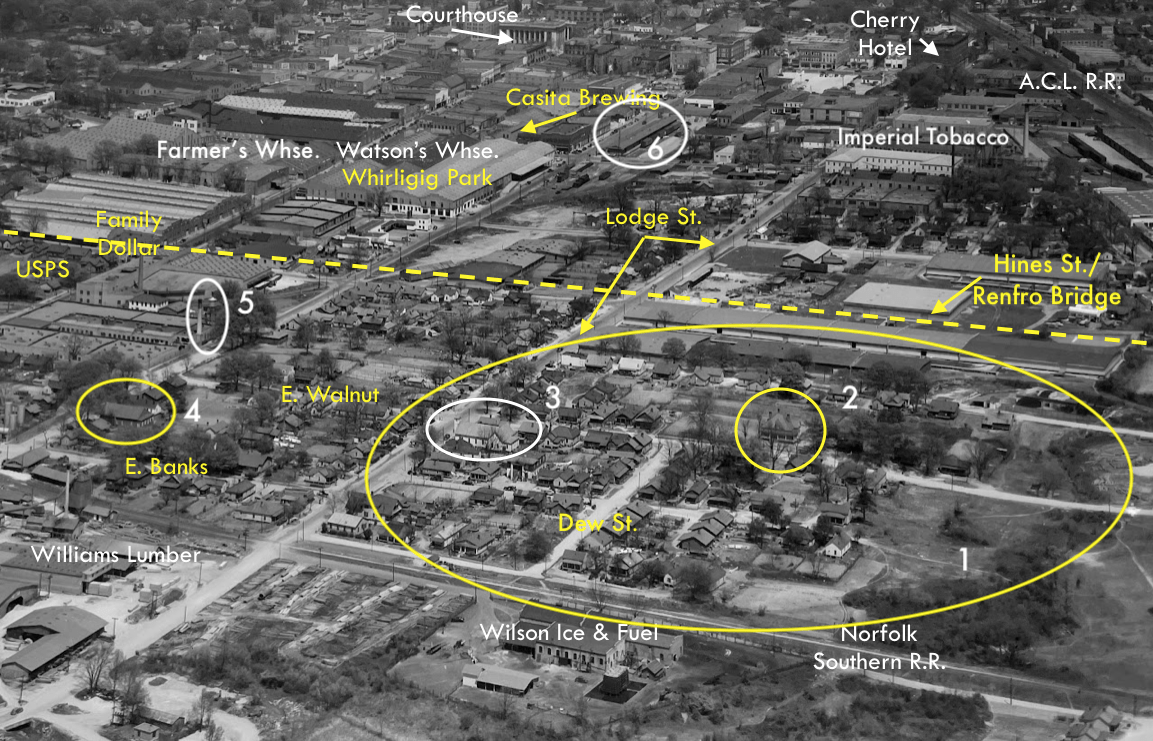
(1) The big oval (which is yellow, but should be white, as it indicates a lost or altered landscape feature) is roughly the neighborhood once known as Happy Hill. The neighborhood was razed in the 1950s to make way for the Whitfield Homes public housing project.

Whitfield Homes as shown on Google Maps. Most of these units have been demolished.

Wilson Housing Authority has largely replaced Whitfield Homes with 32 townhomes painted in cheery pastels. The pandemic delayed construction of the homes, but they opened in late summer 2022.

Eatmon Townhomes on East Walnut Street.

(2) The house at 515 East Walnut Street is one of the last remaining of the neighborhood’s original housing. Built when the block was a white residential area, the house is now owned by the General Assembly of the Church of the Lord Jesus Christ of the Apostolic Faith, whose popular Whole Truth Lunchroom stands next door. (The church bought the house and three contiguous lots from Asa and Annie Locus in 1950.)

(3) Mount Zion Holiness Church. This building has been demolished, and the church has not been active since at least the early 1970s.

Wilson Daily Times, 16 January 1935.

(4) Saint Rose Church of Christ Disciples of Christ is very much an active congregation, but in a newer edifice built along side this one.

(5) The chimney and water tower of the old British-American Tobacco Company facility on Goldsboro Street. Both remain standing, though the business is defunct.

(6) The old freight platform of the Norfolk Southern Railroad. The buildings still stand, but are not railroad property. [Who remembers what was across the street at 219 South Street, a two-story brick building was erected in 1928? The Twenty Grand Club, a nightspot torched by arsonists in 1984.] The former Norfolk Southern passenger station is at the corner of Barnes and Douglas Streets and is now home to a church and Islamic center.

This detail from a 1951 map of Wilson issued by the Chamber of Commerce helps us more clearly understand the street layout in the foreground of the Raines and Cox aerial view. Though the main railroads remain active, all the spur tracks shown were abandoned and either pulled up or paved over.

The black and white image is found among the Raines & Cox collection of photographs at the North Carolina State Archives and is catalogued as PhC_196_CW_1483_WarehouseDistrict. Other than the Google Maps image, all other photos are mine. The full map of Wilson may be found at East Carolina University Digital Collections.


Last will and testament of Fannie Rountree.

Last will and testament of Fannie Rountree.

——

In the 1870 census of Wilson township, Wilson County: farm laborer Osborn Dunstan, 37, wife Mariah, 45, and children Dora, 4, Cora, 2, Sarah, 2 months, John, 12, and Fanny, 6. [The latter two children were born prior to Mariah’s marriage to Osborne.]

In the 1880 census of Wilson township, Wilson County: farm worker Osbourn Dunston, 44, wife Mariah, 40, and children Dorah, 12, Corah, 11, Sarah, 9, Frances, 7, Hubbard, 5, Mary, 4, and Harriet, 3. Next door, in the household of farmer Henry Miller, was John Dunston, 20.

In the 1900 census of Wilson, Wilson County: Fannie Rountree, 32, cook, married 16 years.

On 11 September 1901, Sarah Dunston, 23, of Wilson, North Carolina, daughter of Osborne and Mariah Dunston, married Marshall Bells, 24, waiter, of Charleston, South Carolina, son of Calvin and Lovinia Bells, in Norfolk, Virginia.

In the 1910 census of Wilson, Wilson County: Fannie Rountree, 40, widow, cook, living alone.

In the 1916 Hill’s Wilson, N.C., city directory: Rountree Fannie dom  h 667 E Vance

In the 1920 census of Wilson, Wilson County: at 667 Vance, widow Fannie Rountree, 52, cook, and sister Sarah Rountree [sic], 35, tobacco laborer.

Fannie Rountree died 4 June 1925 in Wilson. Per her death certificate, she was about 60 years old; was born in Wilson to Benjamin Rountree and Maria Dunston; was separated; lived at 710 East Vance; and worked as a cook for Mrs. Walter Woodard. Sarah Bell was informant.

In the 1930 census of Wilson, Wilson County: at 710 East Vance, owned and valued at $3000, Sarah Belle, 55, cook.

Sarah Bell died 29 December 1930 in Wilson. Per her death certificate, she was 54 years old; was born in Wilson to Osborne Dunston and Mariah Monday; was married to William Marshall Bell. Informant was Hattie Wilkerson, 712 Brooks Street, Bryn Mawr, Pennsylvania.

202 North Vick Street.

The one hundred eighty-first in a series of posts highlighting buildings in East Wilson Historic District, a national historic district located in Wilson, North Carolina. As originally approved, the district encompasses 858 contributing buildings and two contributing structures in a historically African-American section of Wilson. (A significant number have since been lost.) The district was developed between about 1890 to 1940 and includes notable examples of Queen Anne, Bungalow/American Craftsman, and Shotgun-style architecture. It was listed on the National Register of Historic Places in 1988.

As described in the nomination form for the East Wilson Historic District: “ca. 1940; 1 story; heavily modified clipped-gable dwelling; aluminum-sided.”

——

In the 1928 Hill’s Wilson, N.C., city directory: Robinson Golden (c; Bertie) barber h 202 N Vick

In the 1930 Hill’s Wilson, N.C., city directory: Robinson Golden (c; Bertie) (Cherry Hotel Barber Shop) h 202 N Vick

In the 1930 census of Wilson, Wilson County: at 202 Vick Street, barber Golden Robinson, 30; wife Bertie, 23; and children Parthenia, 5, Gold M., 3, and Glean, 1.

In 1938, this property appeared in a list of delinquent taxpayers:

Wilson Daily Times, 1 October 1938.

In the 1941 Hill’s Wilson, N.C., city directory: Robinson Golden (c; Bertie) barber Walter S Hines h 202 N Vick

In 1943, 202 North Vick was for sale; the Robinsons had moved to Newport News, Virginia. 

Wilson Daily Times, 12 July 1943. 

In the 1947 Hill’s Wilson, N.C., city directory: Dwyer Elisha  h 202 N Vick

In the 1950 census of Wilson, Wilson County: at 202 Vick, Elisha Dwyer, 44, porter for A.C.L. Rail Road, and wife Carrie L.D., 42, English teacher at county school. Both were South Carolina natives.

Photo by Lisa Y. Henderson, September 2022.

Leslie Mercer dies after truck struck by train.

Wilson Daily Times, 16 March 1936.

——

In the 1900 census of Wilson, Wilson County: day laborer Henry Mercer, 48; wife Florence, 36; children Lesley, 18, Aderns, 14, Candis, 9, Isaac, 7, and Augustus, 2; plus boarder Jesse Farmer, 29.

On 17 June 1903, Leslie Mercer, 21, of Wilson, son of Henry and F. Mercer, married Carrie Gunner, 21, daughter of James and M. Gunner, at Henry Mercer’s residence in Wilson County. Primitive Baptist minister Jonah Williams performed the ceremony in the presence of J.D. Reid, H.S. Edwards, Jason Farmer, and E.L. Reid.

In the 1910 census of Wilson, Wilson County: on Lipscomb Road, Henry Mercer, 63, town wagon driver; wife Fourence, 45, laundress; children Lesslie, 23, brickyard laborer, Odjus, 19, market butcher, Isear, 12, brickyard laborer, Augustus, 9, Henry, 3, and Cora, 22, cook, and [grand]daughter Lucel, newborn.

On 28 May 1911, Leslie Mercer, 27, son of Henry and Florence Mercer, married Cora Barnes, 22, daughter of Maddison Barnes, in Wilson. Missionary Baptist minister William Baker performed the ceremony in the presence of Will Bullock, Jason Farmer, and [illegible] Baker.

On 25 December 1914, Leslie Mercer, 35, of Wilson, married Mary Jones, 37, of Wilson, in Wilson. Banks Blow applied for the license, and Baptist minister William Baker performed the ceremony in the presence of Blow, Isaac Cobbs Jr., and Willie A. Cobbs.

Mary Jane Jones died 21 July 1920 in Wilson. Per her death certificate, she was born April 1877 in Wake County, N.C., to Henry Mathews; was married to Leslie Mercer; worked as a stemmer for Wilson Tobacco Company; and lived at 510 Narroway Street, Wilson.

In the 1920 census of Wilson, Wilson County: Leslie Mercer, 42, tobacco factory laborer; wife Mary, 40; and son-in-law [sic] Albert Parker, 50, widower.

In the 1930 census of Wilson, Wilson County: at 712 Viola, rented for $12/month, Marrion Mercer, 32, tobacco factory laborer; wife Sarah, 28; brother Leslie Mercer, 50, tobacco factory laborer; and children Isear, 10, Marjorie, 8, and Florence Mercer, 5.

Leslie Mercer died 15 March 1936 in Wilson. Per his death certificate, he was 59 years old; was born in Wilson to Henry Mercer of Edgecombe County, N.C., and Florence Farmer of Wilson County; was married to Bertha Mercer; lived at 614 Viola; and worked as a laborer. His cause of death: intracranial hemorrhage after “auto ran over him on Green St.”

State vs. Percy Jones.

One Saturday evening in August 1911, 14 year-old Henrietta Faison tagged along with her sister Emma Faison to Walter F. Woodard’s house at the corner of North Goldsboro and Lee Streets. Emma Faison and an older woman, Fannie Rountree, were employed in the Woodards’ kitchen. Percy Jones, a farm hand employed by Woodard, was hanging around the back steps. Suddenly, he grabbed the girl and tried to force her to go off with him. She screamed.

Evidence presented to a county grand jury yielded this testimony, transcribed from court records:

“Henrietta Faison — I know Percy Jones; last Saturday night I was at Mr. Walter Woodards; Percy was sitting on back steps and he caught me by hands and said let’s go to the store; I told him to turn me loose; he put his arms around me and said I had to like he would me to, that he would give $5 or $10 to buy me a new dress; told him to turn me loose, that I would call Miss Fannie; I called Miss Fannie but she didn’t hear me; he asked me my age and went to pulling up my dress; he pulled me down to back part of Mr. Walter Woodard’s lot; he was on the out side of back gate, where he began to pull me; he told me if I hollered he would kill me, that he had a pistol in his pocket; he put his hand on my mouth and I tried to get it away when he slapped me in the face; when I began to holler he be tried to choke me; he turned me loose and jumped and run. After he began to run Sister Emma and Miss Fannie came out of the house. I then went to the house we were on the street where this took place. When he left me he went toward Mike Taylor‘s. He put his hand on known but clothes.

“Fannie Rountree — I saw Henrietta at Mr. Woodard’s Saturday night; I was in Mr. Woodard’s dining room and heard a scream; didn’t know who it was; sounded like it was on lawn; when I got out I heard it again saw Henrietta coming up toward steps; saw no one else. Asked her what was the matter; she said Percy snatched her out of gate and ran.She was screaming. Emma came out where we were. This was between 7 and 8 o’clock.

“Emma Faison — I am Henrietta’s sister; I was at Mr. Woodard’s last Saturday; I was washing dishes; heard some one screaming; it was Henrietta; said Percy had pulled her out of the yard, put his hand over her mouth and slapped her; that he had pulled up her clothes and asked her to go with him to the store; saw man running; don’t know who it was; her dress and waist was unfastened and her clothes was wrinkled; Percy had been working at Mr. Woodard’s. When I saw the man running he was half block away. Henrietta was crying when I got up with her.

“W.F. Woodard — I swore out warrant; I heard the screaming; my family was sitting on front porch — heard the screaming twice. Went on back porch, found Henrietta sobbing; asked her what was the matter; she said Percy had caught and dragged her down to back lot and told her if she hollered he would kill her; that he pulled her dress, put his hand on her mouth and she hollered. Phoned for officers, they came and I told them there the trouble. Didn’t notice condition of Henrietta’s clothes. This was a few minutes after 8.”

Jones was quickly caught and charged with assault with attempt to commit rape. He pled guilty to a lesser charge of simple assault and was sentenced to three months “on the roads,” i.e. working road maintenance on a chain gang.

A few weeks later, Jones’ lawyers, Daniels & Swindell, petitioned for a writ of habeas corpus. Under recent state law, they claimed, absent aggravating circumstances, 30 days was the maximum sentence for simple assault. Percy Jones was transported to Raleigh for a hearing before the state Supreme Court.

Wilson Daily Times, 10 October 1911.

The wait for a decision was not long. Three days later, Percy Jones was a free man.

Wilson Daily Times, 13 October 1911.

——

  • Henrietta and Emma Faison

In the 1910 census of Wilson, Wilson County: on Vance Street, widow Ellar Fason, 49, laundress, and daughters Mary, 18, laundress, Emma, 16, cook, Henretta, 13, and Flory, 10.

On 3 March 1914, John Ellis, 22, of Wilson, married Henretta Faison, 18, at Mrs. Ellar Faison’s place in Wilson. Missionary Baptist minister Fred M. Davis performed the ceremony in the presence of Ed Cox and Roscoe Yelverton.

In the 1916 Hill’s Wilson, N.C., city directory, Ella Faison, Henrietta Faison, and Mary Faison are listed at 802 Viola. Ella and Mary Faison worked as laundresses.

  • Percy Jones

On 3 July 1910, Percy Jones, 22, of Wilson, married Fannie Reid, 18, of Wilson, at the residence of Sam Miller in Wilson. Primitive Baptist minister Jonah Williams performed the ceremony in the presence of B.R. Winstead, Robert Talley, and Arthur Isom.

  • Fannie Rountree

In the 1910 census of Wilson, Wilson County: Fannie Rountree, 40, widow, cook, living alone.

Fannie Rountree died 4 June 1925 in Wilson. Per her death certificate, she was about 60 years old; was born in Wilson to Benjamin Rountree and Maria Dunston; was separated; lived at 710 East Vance; and worked as a cook for Mrs. Walter Woodard. Sarah Bell was informant.

  • Mike Taylor

Drayman Mike Taylor lived at 108 West Lee Street. Thus, Jones ran west when Faison began screaming.

Sanborn fire insurance map of Wilson (1922), page 7.

Criminal Action Papers, 1911, Wilson County Records, North Carolina State Archives.

Garbage collection comes to East Wilson — with a catch.

Wilson Daily Times, 18 August 1948.

In 1948, the city of Wilson extended garbage collection to “every house in Wilson,” which we may reasonably interpret to mean an extension to East Wilson. City manager F. Talmage Green clearly felt a way about providing this basic necessity, however.

In order to receive this public service, residents had to provide their own garbage cans. Residents, not property owners — a significant distinction in a part of town in which the overwhelming number of houses were rental properties occupied by poor or working class tenants.

Green scoffed at the observation by local N.A.A.C.P. president Isaac B. Butler some who had put their bins out had been bypassed. Instead, he warned, apparently without irony, that “improper garbage disposal is a definite health hazard” and warned that those who would (could?) not comply with the closed-container requirement could be fined ten dollars.

Studio shots, no. 201: Lula Reid Wilson.

Lula Reid Wilson (1889-1958).

——

Lula Reid married Willie Wilson on 15 September 1909 in Wayne County, North Carolina.

In the 1910 census of Nahunta township, Wayne County: Willie Wilson, 29; wife Lula, 21; and children May, 7, William, 5, Jonah, 3, and Gertrude, 11 months.

In the 1920 census of of Nahunta township, Wayne County: on Stantonsburg Road, Willie Wilson, 39; wife Lula, 30; and children William, 14, Jonah, 12, Gertrude, 10, Anna Bell, 8, Lela, 6, Woodrow, 3, and Retha, 1.

In the 1930 census of Eureka township, Wilson County: Willie Wilson, 49; wife Lula, 40; and children Anna B., 18, Lila, 15, Woodrow, 13, Retha, 10, Adam, 7, and Fred D., 6.

William Wilson died 5 March 1939 in Wilson. Per his death certificate, he was 33 years old; was born in Wayne County to Willie Wilson and Lula Reid; was married to Lillie Wilson; and worked as a farmer. Lula Wilson, 609 East Nash Street, was informant.

In 1940, Woodrow Wilson registered for the World War II draft in Wilson County. Per his registration card, he was born 1 January 1918 in Wilson County; lived in Stantonsburg, Wilson County; his contact was mother Lula Wilson, 534 East Nash Street, Wilson; and he worked for W.R. Rodgers, Stantonsburg.

In the 1950 census of Wilson, Wilson County, Lula Wilson, 60, house cleaner, widow, was a lodger at Mattie B. Coleman‘s Nash Street boarding house, otherwise known as the Orange Hotel.

Lula Reid Wilson died 6 December 1958 in Rocky Mount, North Carolina. Per her death certificate, she was born 22 November 1893 to Julius Reid and Lula Holms; was separated from Willie Wilson; and lived at 143 Narrow[ay] Street, Wilson. Her death was attributed to a malignancy of stomach caused by swallowing lye water when she was two years old.

Photo courtesy of Ancestry.com user M. Perricone.

The obituary of William Gray Taylor.

Rocky Mount Telegram, 30 September 1988.

——

In the 1910 census of Saratoga township, Wilson County: on Rocky Mount Road, Mattie Taylor, 36, and children Gray, 14, Benjamin F., 8, Lee R., 7, Mary, 6, Annie, 2, and Hilliard, 6 months.

In 1917, Gray Taylor registered for the World War I draft in Wilson County. Per his registration card, he was born 1 December 1895 in Wilson County; lived in Stantonsburg, Wilson County; worked as a farm laborer for Albert Skinner; was single; and had gray eyes and light hair. He signed his card with an X.

On 30 April 1921, William Gray Taylor, 24, of Wilson County, son of Joe Pittman and Mattie Taylor, married Fannie Hardy, 19, of Wilson County, daughter of Allice Hardy, in Wilson. [Joseph J. Pittman (1875-1922) was a white farmer in the Saratoga area.]

In the 1930 census of Saratoga township, Wilson County: farmer Gray T. Taylor, 31; wife Fannie, 25; children Julias, 5, William, 3, Rebecca, 2, and Eunice, 2 months; and lodger Johnnie Bess, 20. [The family was erroneously listed as white.]

In the 1940 census of Saratoga township, Wilson County: farm laborer Gray Taylor, 42; wife Fannie, 26; and children Julias, 19, William A., 14, Rebetha, 12, Unice, 10, Russell, 8, William Irvin, 6, Bobbie G., 5, Bobbie Gene, 3, and Wallace, 7 months.

In the 1950 census of Gardners township, Wilson County: on Gardners Road, farmer Grey Taylor, 54; wife Fannie, 43; and children Eunice, 20, Russell, 17, William, 16, Bobby Grey, 14, Bobby Jean, 12, Helen, 10, Wallace, 8, and Grace Marie, 6; and Bernice, 8, lodger.

Fannie Taylor died 3 August 1961 in Stantonsburg township, Wilson County. Per her death certificate, she was born 27 August 1909 in Wilson County to Alice Hardy and was married to Gray Taylor.

William Gray Taylor (1896-1988).