Month: April 2022

Borrowing from Wilson Home and Loan Association, pt. 2.

East Wilson’s new property owners often turned to Wilson Home and Loan Association, a savings and loan association affiliated with George D. Green, for short-term financing.

  • On 19 January 1903, Charles R. Cannon and wife Stattie E. Cannon borrowed $500 from W.H.L.A., mortgaging a lot on Viola Street adjoining Sam Gay and the Colored Primitive Baptist Church, specifically, “beginning at a stake in the N.E. corner of Sam Gay’s lot on an alley parallel to and immediately north of Green Street and running with said alley S.E. 52 feet to Elba Street thence with Elba Street S.W. 118 feet to the church lot thence with said church lot N.W. 52 feet to Sam Gay’s lot thence with Sam Gay’s line 118 feet to the beginning it being the lot of W. Barnes and wife….” The note was paid off and cancelled 3 June 1903. Deed Book 32, page 201. [Charles and Stattie Cannon later lived at 724 East Green Street.]
  • On 27 January 1903, Sarah Joyner (with the consent of her husband Washington Joyner) borrowed $400 from W.H.L.A., mortgaging a 60 foot by 120 foot lot on the north west side of Viola Street “on the east side of railroad” adjoining the lots of W.P. Mercer (now occupied by Levi Peacock), S.H. Vick, and the Procise heirs and bordered by “an old fence.” Sarah Joyner had bought the lot from George D. Green, trustee of the estate of F.I. Finch. The note was paid off and cancelled 21 November 1905. Deed Book 32, page 204. [This was 616 Viola Street.]
  • On 20 July 1903, Sam Barnes and wife Ida Barnes borrowed $400 from W.H.L.A., mortgaging a one-quarter acre lot on the south side of Viola Street adjoining Ann Bynum, William Hargrove, and Elder Phillips. The note was paid off and cancelled 27 May 1909. Deed Book 32, page 209. [This was the lot at 604 Viola Street.]
  • On 27 July 1903, Nancy Harris borrowed $300 from W.H.L.A., mortgaging a  lot on the west side of Green Street adjoining Louis Battle, J.F. Bridgers, and Short Barnes. The note was paid off and cancelled 23 February 1905. Deed Book 32, page 210.
  • On 28 August 1903, O.L.W. Smith and wife Adora E. Smith borrowed $700 from W.H.L.A., mortgaging a lot on the north corner of Church and Pender Streets adjoining another lot owned by Smith “beginning at an alley, Church Street, on Pender Street.” Deed Book 32, page 214.
  • On 1 December 1903, James White and wife Lula White borrowed $500 from W.H.L.A., mortgaging a one-quarter lot on the south side of Viola Street adjoining Charles Battle, Ann Bynum, William Hargrove, and others, and purchased by Lula White from Ann Bynum. The note was paid off and cancelled 16 November 1909. Deed Book 32, page 220.

Evidence of a prior loan against the Whites’ property on Viola Street.

  • On 7 March 1904, John W. Farmer and wife Edmonia Farmer borrowed $500 from W.H.L.A., mortgaging a quarter-acre lot on the south side of Green Street adjoining Louis Pitt, W.H. Kittrell, and others and purchased from S.H. Vick. The note was paid off and cancelled in 1909. Deed Book 32, page 225. [This is 706 East Green Street.]
  • On 7 March 1904, J.Z. Staton and wife Agnes Staton borrowed $500 from W.H.L.A., mortgaging a one-quarter lot on the south side of Vance Street adjoining C.C. Daniels, E.L. Reid, and others and running back to Elba Street.   The note was paid off and cancelled 12 November 1908. Deed Book 32, page 226.
  • On 14 March 1904, W.H. Kittrell and wife Mary Kittrell borrowed $450 from W.H.L.A., mortgaging a lot on the south side of Green Street adjoining John W. Farmer and Samuel Vick and being the lot the Kittrells bought from Samuel and Annie Vick. The note was paid off and cancelled 14 May 1909. Deed Book 32, page 227.
  • On 22 March 1905, Charles B. Gay and wife Ella J. Gay borrowed $800 from W.H.L.A., mortgaging a one-quarter acre lot on the north side of Green Street adjoining his father Samuel Gay and the Primitive Baptist Church. The lot ran 50 feet from the corner of Sam Gay’s lot to the church corner, then 210 feet down the church’s lot line to Viola Street, then 50 feet west on Viola back to Sam Gay’s lot. The note was paid off and cancelled 14 September 1910. Deed Book 32, page 251. [This was 625 East Green. It is difficult to reconcile the description of this property with that of Charles and Stattie Cannon.]

Lane Street Project: a fervent request.

We have, at most, three more organized Season 2 cleanups at Odd Fellows Cemetery — April 23, May 14, and May 21. The heat and fecundity of summer, as well as the hazardous insect and reptile life, make working in the woods more difficult than we can comfortably invite volunteers to do. For these reasons, it is critical that we maximize our time and effort in the coming weeks.

Here’s Odd Fellows on a recent April morning. The Senior Force has been putting in extra work every week and, for the first time in decades, a fifty-foot swath inside the tree line has been cleared.

In February 2020, almost a year before Lane Street Project began, I discovered a pile of headstones well back in the woods, evidence of some misguided earlier cleanup. The pile was nestled just behind an immense thicket of privet and wisteria and could only be reached by circuitous approach. This past February, I expressed hope to Castonoble Hooks that we would be able to break through the thicket and open a direct path to the headstones.

The Senior Force did it.

Circled below, Bessie McGowan‘s headstone at the edge of the pile that includes my great-grandmother Rachel Barnes Taylor‘s. The Senior Force, anchored by brothers Cass and Will Hooks, Briggs Sherwood, and Glenn Wright, demolished a seemingly impenetrable hedge to expose the interior of Odd Fellows cemetery.

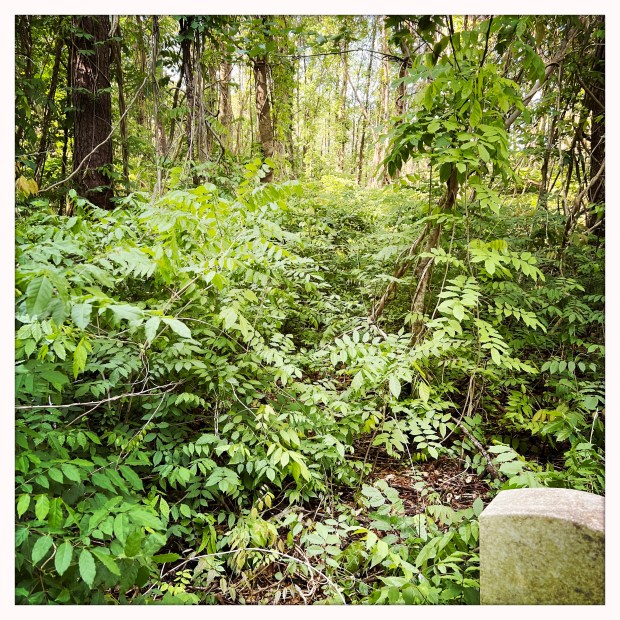
Here are Bessie McGowan’s marker and the Jurassic forest that has sprung to life behind it in the last month. Everything green you see is wisteria, an invasive vine that has largely choked off native plant species.

In January, I placed Rachel Taylor’s headstone upright against a stump.

Here it is yesterday. This is what we’re up against, folks, and we can’t do it without you.

Saturday’s going to be beautiful. Please lend a hand. Come for 30 minutes. Or three hours. Bring a hand pruner. A lopper. A rake. A lawnmower. Whatever you have. Or just yourself. If you can’t labor, come offer words of encouragement or bottles of water. Honor the ancestors. Build community. Save a sacred space.

Photos by Lisa Y. Henderson, April 2022.

The Thompson triplets.

Wilson Daily Times, 10 April 1934.

Verious, Vivian, and James Clarence Thompson were born 9 April 1934 near Bailey, Nash County, per birth records. Though their father James Clarence Thompson reported the triplets as “doing fine,” neither Verious nor James Clarence appears in the 1940 census.

——

In 1917, Clarence Thompson registered for the World War I draft in Robeson County, North Carolina. Per his registration card, he was born 3 March 1895 in Fairmont, N.C.; lived in Red Springs, N.C.; was a tenant farmer on J.D. Brice’s land near Red Springs; and was married with two children.

In the 1920 census of Red Springs township, Robeson County, North Carolina: farm tenant Clarence Thompson, 25; wife Carrie, 22; and children Bula, 6, James H., 5, Vanzy, 1, and Clifton, 2 months. 

In the 1930 census of Oldfields township, Wilson County: farmer Clarnce Thompson, 35; wife Carie, 33; and children Beulia C., 16, James H., 14, Evonie E., 11, Clifton, 9, Elmer, 8, Harden, 7, Garvester, 5, Thodrous, 3, and Earl, 1.

In the 1940 census of Black Creek township, Wilson County: farmer Clarence Thompson, 43; wife Carrie, 39; and children Vangie, 21, Clifton, 19, Elmar, 17, Hardin, 16, Garland, 14, Theolis, 13, Earl, 10, Alton, 7, Vivian, 6, and Annie Ruth, 2.

In 1940, Vanzie Thompson registered for the World War II draft in New York, New York. Per his registration card, he was born 23 September 1919 in Wilson; lived at 86 West 119th Street, New York; his nearest relative was brother James Thompson, 222 Lenox Avenue, New York, N.Y.; and he worked for Shaltdor Boiler Company.

In 1942, Harding Thompson registered for the World War II draft in Wilson. Per his registration card, he was born 20 December 1923 in Wilson; lived at 208 Pender Street, Wilson; his nearest relative was Clarence Thompson, Route 2, Wilson; and he worked for Ellen Griffin, 117 Nash Street, Wilson.

In 1942, Clifton Thompson registered for the World War II draft in New York, New York. Per his registration card, he was born 3 November 1920 in Wilson; lived at 86 West 119th Street, Apartment #7D, New York; his nearest relative was James Thompson, 290 Lenox Avenue, New York, N.Y.; and he was unemployed.

In 1945, Earl Nathaniel Thompson registered for the World War II draft in Wilson County. Per his registration card, he was born 11 November 1927 in Wilson; lived at Route 2, Wilson; his nearest relative was mother Carrie G. Thompson, Route 2, Wilson; and he worked for Clarence Thompson, Route 2.

Clarence Thompson died 3 February 1964 in Taylor township, Wilson County. Per his death certificate, he was born 3 March 1898 in Red Springs, N.C., to Foster Thompson and Carolyn [maiden name not given]; he was married to Carrie Thompson; and he was a merchant. Alton Thompson, Leaksville, N.C., was informant.

606 North Carroll Street.

The one hundred-fifty-sixth in a series of posts highlighting buildings in East Wilson Historic District, a national historic district located in Wilson, North Carolina. As originally approved, the district encompasses 858 contributing buildings and two contributing structures in a historically African-American section of Wilson. (A significant number have since been lost.) The district was developed between about 1890 to 1940 and includes notable examples of Queen Anne, Bungalow/American Craftsman, and Shotgun-style architecture. It was listed on the National Register of Historic Places in 1988.

As described in the nomination form for the East Wilson Historic District, this building is: “ca. 1922; heavily modified, brick-veneered, hip-roofer dwelling.” [Note: the house does not appear on the 1922 Sanborn fire insurance map.] The 1950 Wilson city directory reveals the original house number was 518.

In the 1928 Hill’s Wilson, N.C., city directory: Hagans Oscar (c; Bertie) lab h 518 N Carroll

In the 1930 Hill’s Wilson, N.C., city directory, 518 North Carroll Street was vacant.

Willie Batts died 19 July 1939 in Wilson. Per his death certificate, he was 58 years old; was born in Wilson County to [Thomas?] Batts and Mariah Batts; was married to Olivia Batts; lived at 518 North Carroll; and worked as a laborer.

In the 1940 census of Wilson, Wilson County: at 518 Carroll Street, rented for $12/month, widowed tobacco stemmer Olivia Batts, 61, and children Ernest, 36, farm laborer; Mary M., 21, and Rosa Lee, 20, household servants; and Henry, 16, “new worker.”

In the 1941 Hill’s Wilson, N.C., city directory: Batts Wm (c) h 518 N Carroll

In the 1947 Hill’s Wilson, N.C., city directory: Little Geo Rev (c; Lessie) pastor Mt Zion  Free Will Baptist Ch h 518 N Carroll

Rev. George Washington Little died 1 April 1957 in Wilson when his car was struck by a train on the A.C.L. railroad. Per his death certificate, he was born 12 July 1910 in Wilson County to Wash Little and Louise Barnes; was married to Lessie Little; lived at 606 North Carroll; and worked in ministry and labor.

Photo by Lisa Y. Henderson, April 2022.

Ed McCollum saves the day.

Wilson Daily Times, 21 April 1911.

——

In the 1900 census of Bennettsville, Marlboro County, South Carolina: Edward McCollum, 22, butler, and wife Sarah, 26, washerwoman, with Lawrence McRae, 10, errand boy.

On 27 September 1905, Eddie McCollum, 27, son of E. and E. McCollum, married Rosa Farmer, 20, daughter of Gray and A[rgent]. Farmer, in Wilson. Presbyterian minister Charles E. Tucker presided, and C.S. Thomas, J.J. Thorp, and H.C. Holden witnessed. 

In the 1920 census of Wilson, Wilson County: laborer Edie McColum, 38; wife Rosa, 36; and children Elvia, 8, Gladys, 5, and Edith, 4.

Argen Farmer McCollum died 20 January 1926 in Wilson. Per her death certificate, she was 4 years old; was born in Wilson to Eddie McCollum of Bennettsville, South Carolina, and Rosa Farmer of Wilson; and lived at 811 East Viola. 

Eddie McCollum died 13 May 1929 at the colored hospital in Wilson. Per his death certificate, he was born 30 March 1880 in Bennettsville, South Carolina, to Edwin McCollum and Easter Dupree; was married to Rosa McCallum; and was a day laborer for Allen Furniture Company.

Elva McCollum died 6 May 1950 in Wilson. Per her death certificate, she was born 16 August 1911 in Wilson to Eddie McCollum and Rosa Farmer; was never married; worked as a beautician; and lived at 418 North Vick Street. Gladys McCollum was informant.

604 North Carroll Street.

The one hundred-fifty-fifth in a series of posts highlighting buildings in East Wilson Historic District, a national historic district located in Wilson, North Carolina. As originally approved, the district encompasses 858 contributing buildings and two contributing structures in a historically African-American section of Wilson. (A significant number have since been lost.) The district was developed between about 1890 to 1940 and includes notable examples of Queen Anne, Bungalow/American Craftsman, and Shotgun-style architecture. It was listed on the National Register of Historic Places in 1988.

As described in the nomination form for the East Wilson Historic District, this building is: “ca. 1913; one story; L-plan cottage with turned-post porch.” [Note: per tax records, the house was built in 1925. It does not appear on the 1922 Sanborn fire insurance map.] The 1950 Wilson city directory reveals the original house number was 516.

In the 1928 Hill’s Wilson, N.C., city directory: Graham David (c; Golda) h 516 N Carroll; also Graham Theola (c) 516 N Carroll

In the 1930 Hill’s Wilson, N.C., city directory: Taylor Green (c) h 516 N Carroll; also, Taylor Green jr (c) h 516 N Carroll

In the 1940 census of Wilson, Wilson County: at 516 Carroll Street, high school janitor Green Taylor, 57; wife Rebecca, 54; stepdaughters Lillie, 26, Wauline, 18, and Julia, 11; and son Robert Taylor, 19.

In the 1941 Hill’s Wilson, N.C., city directory: Edwards Julia (c) cook Rosa R Lupe h 516 N Carroll

In the 1947 Hill’s Wilson, N.C., city directory: Edwards Julia (c) gro h 516 N Carroll h do [home ditto]

Wilson Daily Times, 8 July 1976.

Julia Edwards died 3 December 1989 in Wilson. Per her death certificate, she was born 14 February 1904 in Wilson County to John Henry Edwards Sr. and Nealie Farmer; was never married; had a fifth grade education; and operated a restaurant. Informant was Annie Edwards, Stantonsburg.

Photo by Lisa Y. Henderson, April 2022.

Dr. Reid’s invention.

Wilson Daily Times, 17 April 1911.

Though this looks like a newspaper article, the code at the bottom of this piece indicates that it was essentially an advertisement touting a device invented by Tuskegee Institute-trained veterinarian Dr. Elijah L. Reid to control frightened horses. Reid was, perhaps, at the peak of his career around this time, having moved from his native Wayne County to Stantonsburg and then to Wilson around 1905.

Read more about Dr. Reid here and here and here.

Clipping courtesy of J. Robert Boykin III.

[Update, 4/16/2022: in veterinary medicine, to drench is to administer a draft of medicine to (an animal), especially by force, i.e. to drench a horse. Thanks, Briggs Sherwood.]