
Wilson Daily Times, 25 September 1936.
Sixty-one African-American teachers and principals met with the school superintendent as school opened in the fall of 1936.
Wilson Daily Times, 25 September 1936.
Sixty-one African-American teachers and principals met with the school superintendent as school opened in the fall of 1936.
Wilson’s emergence as a leading tobacco market town drew hundreds of African-American migrants in the decades after the 1890s. Many left family behind in their home counties, perhaps never to be seen again. Others maintained ties the best way they could.
Sarah Henderson Jacobs Silver and her husband Jesse A. Jacobs Jr. left Dudley, in southern Wayne County, North Carolina, around 1905. They came to Wilson presumably for better opportunities off the farm. Each remained firmly linked, however, to parents and children and siblings back in Wayne County as well as those who had joined the Great Migration north. This post is the sixth in a series of excerpts from documents and interviews with my grandmother Hattie Henderson Ricks (1910-2001), Jesse and Sarah’s adoptive daughter (and Sarah’s great-niece), revealing the ways her Wilson family stayed connected to their far-flung kin. (Or didn’t.)
——
Tilithia Brewington King Godbold Dabney was my grandmother’s father’s first cousin. Born 1878 in Wayne County, North Carolina, to Joshua and Amelia Aldridge Brewington, she married Emanuel King in 1898. By 1910, the couple and their daughters Juanita, Elizabeth, Amelia, Maybelle, and Tilithia had settled in Norfolk, Virginia. Tilithia (pronounced “Ti-LYE-a-thy”) and Emanuel soon divorced and, by 1920, Tilithia had married railroad fireman Walter Godbold and was running a little restaurant.
Cousin Tilithia’s Strand Cafe made a deep impression on my grandmother, who laughingly recalled waiting tables during childhood visits and being dazzled by the menu offerings.

Cousin Tilithia also offered lodging. Norfolk Journal & Guide, 12 March 1921.
“I was thinking about Cousin Tilithia Godbold when I was a little girl. She had a restaurant large enough to work in and serve patrons. It wasn’t real big, but they were serving patrons, and Mama carried me up there, and we spent the night there. And whenever she’d come to Wilson she’d stay with us.
“Cousin Tilithia, she lived in Norfolk, and she married this man. That wasn’t her children’s daddy. King was her children’s daddy. Godbold was the man she married later. He lived over in Rocky Mount, and he worked in the roundhouse or something. I think he fixed the train, but he wasn’t the one on the train. And Godbold, Tilithia’s husband, he stayed there in Rocky Mount. ‘Cause Tilithia lived in Norfolk. Her and her five or six girls or whatever it was, and she was running what they call the Strand Café. And it was down on the first floor, and they lived up over it. Go out there, and it was a sleeping compartment. I was over there one time, and I remember it. I think I was about seven or eight years old. Went with Mama over there. We was just running all over the place. She had us waiting tables. I wanted to wait tables. I was wondering, I asked Mama, “Well, why come we couldn’t have a place like that?” And all that food! Look like whatever the food was – I didn’t even know what it was ‘cause we ain’t never had none. It was a whole lot of stuff, look like they had, I didn’t want it, but then I know it looked good, and we ate down there in the café.
“And another time Mama took me on the train to see her. And it was right down in South Philadelphia where we went to their house. Where they was staying. And when I moved up here to Philadelphia, Tilithia’s sister Hattie, she was telling me ‘bout how the daughters were there in Norfolk, her sister and all them. I said, well, I could remember some of them, but I don’t remember what – and I asked where some of the girls was. Some of them in Norfolk and some of ‘em, one’s dead. [Inaudible] the family. We got strayed apart.”

Norfolk Journal & Guide, 9 December 1922.

Norfolk Journal & Guide, 28 May 1927.
She and my grandmother lost touch, but Cousin Tilithia lived until 1965.

Virginian Pilot, 22 November 1965.
Interviews of Hattie H. Ricks by Lisa Y. Henderson adapted and edited for clarity. Copyright 1994, 1996. All rights reserved.

Wilson Daily Times, 7 August 1935.
This theatre for colored patrons presumably was the Ritz Theatre at 523 East Nash Street.
A few comments:

I opened an email yesterday afternoon to find this photo of freshly cut Odd Fellows Cemetery. Thank you, Jeff Barefoot! I’ve been so discouraged by the discontinuation of mowing services from this section of the cemetery, so his unexpected work is really uplifting. This is the spirit of generosity and care that will see Lane Street Program through.

Wilson Daily Times, 29 September 1936.
——
In the 1870 census of Upper Town Creek township, Edgecombe County, N.C.: farm laborer Jason Parker, 35; wife Annis, 24; and children Moses, 8, Harriet, 5, Jerry, 4, and Sophy, 1.
In the 1880 census of Upper Town Creek township, Edgecombe County, N.C.: farmer Jason Parker, 43; wife Annis, 39; and children Moses, 17, Harriet, 15, Jere, 13, Sophia, 10, Mathew, 9, Cintha, 7, Susan, 5, and Abel, 2.
On 5 March 1892, Moses Parker, 29, married Henrietta Woodard, 27, at Isaac Farmer‘s residence in Wilson County. Free Will Baptist minister Crockett Best performed the ceremony in the presence of Jordan Braswell, Jno. W. Williford, and J.G. Barnes.
On 17 June 1897, Moses Parker, 33, married Sallie Reid, 27, at William Taylor’s residence in Wilson County. Jason Parker was a witness.
In the 1900 census of Wilson township, Wilson County: farmer Mosses Parker, 40; wife Sarah, 30; and daughters Jennie, 14, and Mary, 12. (Next door, Moses’ brother Abel Parker, 21, farmer, wife Sarah, 20, son Jerry, 6 months, and boarder Thomas Horn, 60, widower, farm laborer.)
In the 1910 census of Wilson, Wilson County: at 415 Goldsboro Street, widower Moses Parker, 45, house carpenter; daughters Mary, 21, and Nera, 23, private family cook; and granddaughter Lee Parker, 4.
On 7 September 1911, Moses Parker, 47, of Wilson, married Charity Holland, 50, of Wilson, in Wilson township. Primitive Baptist minister Jonah Williams performed the ceremony at Charity Holland’s residence in the presence of John Battle, George W. Wood, and John H. Akins.
In the 1920 census of Wilson, Wilson County: at 417 Goldsboro Street, general public drayman Moses Parker, 59, and wife Charity, 64.

Wilson Daily Times, 22 June 1921.
In the 1930 census of Wilson, Wilson County: at 1004 East Nash Street, owned and valued at $1700, grocery store proprietor Moses Parker, 63; wife Charity, 60; and roomer Elizabeth Simms, 17.
Moses Parker died 23 September 1936 in Wilson. Per his death certificate, he was 73 years old; was born in Edgecombe County, N.C., to Jason Parker and Annis Parker; was married to Charity Parker; lived at 1004 East Nash Street; and worked as a carpenter.
When I stumbled upon this article, I was not sure if the terrible incident it described involved African-Americans from Wilson County. (It turns out they were not.) I did know, however, that state legislator Troy T. Barnes of Wilson co-sponsored a bill to award the victims pensions, and I knew I wanted to know more.

Wilson Daily Times, 29 March 1935.
A review of the widespread state news coverage reveals:

Indianapolis News, 11 August 1959.
——
In the 1900 census of Indianapolis, Marion County, Indiana: at 1110-12th Street, janitoress Margaret Puryear, 38, widow; daughter Mary, 13; and cousin Eugene Williams, 25; all born in North Carolina.
Eugene Hummons Williams was born 24 February 1908 in Indianapolis to Eugene Williams, 23, foundry man, born in North Carolina, resides at 915 Paca Street, and Janie Isom, 33, born in Harrodsburg, Kentucky, resides at 915 Paca Street.
In the 1910 census of Indianapolis, Marion County, Indiana: at 803 West Pratt, Eugene Williams, 35, steel works machinist; wife Jane, 25; son Eugene, 2; and sister-in-law Roberta Morse, 15.
Eugene Williams registered for the World War I draft in Indianapolis in 1918. Per his registration card, he was born 9 May 1874; lived at 805 West Pratt; was a fireman for C. & A. Potts & Company; and his nearest relative was Janie Williams.
In the 1920 census of Indianapolis, Marion County, Indiana: at 805 West Pratt, Eugene Williams, 46, steel works machinist; wife Jane, 36; and children Eugene, 11, Don C., 4, and Harlan, 6 months.
In the 1930 census of Indianapolis, Marion County, Indiana: at 918 Fayette Street, owned and valued at $4000, foundry laborer Eugene H. Williams, 53; wife Jane, 46; and sons Eugene Jr., 20, Don C., 14, and Harland D., 10.
In the 1940 census of Indianapolis, Marion County, Indiana: at 918 Fayette Street, steel plant fireman Eugene Williams, 56; wife Jane, 54; and son Harlan, 20.
Eugene Williams registered for the World War II draft in Indianapolis in 1942. Per his registration card, he was born 9 May 1878 in Wilson County, N.C.; lived at 918 Fayette Street, Indianapolis; his contact was Jannie Williams; and he worked for Heteren & Burner & Co., Indianapolis.
Eugene Williams died 9 August 1959 in Indianapolis. Per his death certificate, he was born 9 May 1876 in Wilson, North Carolina, to Moses Williams and Mary [last name unknown]; lived at 918 Fayette Street; was retired from Hetherington Steel Structure; and was married to Jane Williams.
Wilton M. Bethel‘s collection includes several large group photographs mostly taken on the campus of Saint Augustine’s, the Episcopal Church-affiliated college for African-Americans in Raleigh, North Carolina.
One of the earliest appears to be the formal portrait below of nine African-American men. In 1996, J. Robert Boykin III, who rescued the collection, sought assistance from Sarah L. Delany (of “Having Our Say” fame) to identify them.
On the top row, they are Rev. Henry Hudson (“my classmate”), a 1910 graduate of Saint Augustine’s collegiate division; Professor Charles H. Boyer (1870-1942) (“my teacher”), Saint Augustine’s professor; Rev. Charles Mail, priest at Oxford, North Carolina; Wylie B. Latham, a mail clerk in Raleigh and member of Saint Ambrose Episcopal Church; and perhaps Mr. Latham’s son.
Seated are Rev. James E. King, priest at Saint Ambrose from 1896 to 1913; “my father” the renowned Bishop Henry Beard Delany (1858-1928), first African-American Episcopal bishop in North Carolina and the second in the United States; Rev. James K. Satterwhite, Saint Aug graduate, priest at Saint Ambrose from 1913-1919 and then in Florida; and Rev. Robert N. Perry (“1st cousin of my mother, Nanny L. Logan”) and priest at Wilson’s Saint Mark’s Episcopal Church from 1905-1919.

Below, a photograph of student nurses and, perhaps, staff of Saint Agnes Hospital, established in 1896 on Saint Augustine’s campus. This image appears in Saint Aug’s 1927-28 Annual Catalogue. Bethel’s collection contains several loose snapshots of campus buildings. Did he take them for the college’s use?

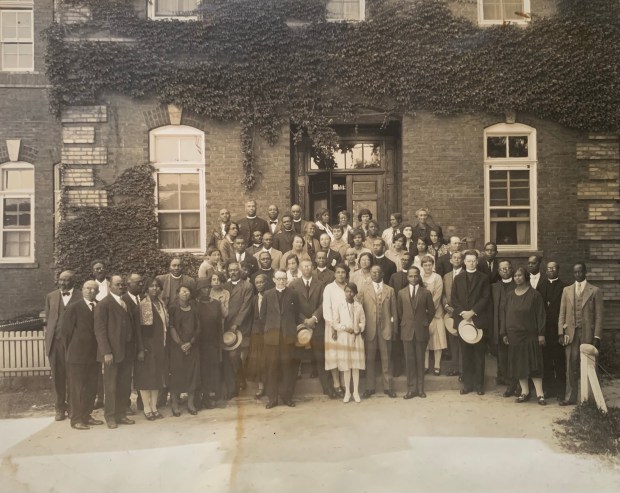
Below, a group of lay people and clergy standing in front of another presumed campus building. (Can anyone identify it?) Wilson’s John H. Clark, a longtime lay leader at Saint Mark’s Episcopal, stands furthest left. The man standing second to the right of the girl on the front row is unidentified, but appears in snapshots in Wilton Bethel’s photo album.

John H. Clark (1863-1949), Wilton Bethel’s father-in-law.
Another large group standing on the steps of Saint Augustine’s Hunter Building.

Below, an industrial arts class at Saint Augustine’s College.

Another mixed group of clergy and lay people, presumably at Saint Aug. John H. Clark is seated on the second or third row, directly behind the man on the front row with his hat on his knee.

This shot, probably dating to the late 1930s, depicts a dinner gathering of North Carolina Mutual Life Insurance employees in Goldsboro, N.C. The guest of honor, N.C. Mutual’s long-time president Charles C. Spaulding, is seated below the welcome sign, wearing a bowtie. Goldsboro was Bethel’s home office. I don’t see him in the shot; perhaps he was the night’s photographer. (Notice the folding chairs borrowed from the occasion from funeral director Lawrence T. Lightner.)

In the photo below, a bow-tied John H. Clark overlooks a large group of people gathered at one side of what appears to be a church or school building. It does not appear to have been taken in Wilson at Saint Mark’s. I am not certain, but the man on the third row, at right, standing beside a woman in white, appears to be Rev. Robert N. Perry.

Wilson’s emergence as a leading tobacco market town drew hundreds of African-American migrants in the decades after the 1890s. Many left family behind in their home counties, perhaps never to be seen again. Others maintained ties the best way they could.
Sarah Henderson Jacobs Silver and her husband Jesse A. Jacobs Jr. left Dudley, in southern Wayne County, North Carolina, around 1905. They came to Wilson presumably for better opportunities off the farm. Each remained firmly linked, however, to parents and children and siblings back in Wayne County as well as those who had joined the Great Migration north. This post is the fifth in a series of excerpts from documents and interviews with my grandmother Hattie Henderson Ricks (1910-2001), Jesse and Sarah’s adoptive daughter (and Sarah’s great-niece), revealing the ways her Wilson family stayed connected to their far-flung kin. (Or didn’t.)
——
Sarah Silver died of a massive heart attack on a train platform on 8 January 1938 while on her way from Wilson to Greensboro, North Carolina. After receiving the news via a shocking and confusing telegram, my grandmother sent word of Sarah’s death to other relatives. One went to Sarah’s widowed sister-in-law Carrie L. Henderson Borrero, who replied via letter immediately:


Sunday Jan. 9. 38
My Dear Hattie
I received your telegram to-day. 1 P.M. it was certainly a shock to me you & family certainly have my deepest sympathy & also from my family.
I did not know your mother was sick you must write later and let me know about her illness.
It is so strange I have been dreaming of my husband Caswell so much for the past two weeks he always tells me that has something to tell me & that he feels so well so I guess this is what I was going to hear about your mother.
I wish it was so that I could come to you & family but times are so different now seems as if we cannot be prepared to meet emergencies any more but you must know that my heart & love is with you & family.
I am just writing to you a short note now will write you again. Let me hear from you when you get time to write
From
Your Aunt in law
Carrie L. Borrero
322 E. 100th St. N. Y City
Letter in personal collection of Lisa Y. Henderson.
On 4 December 1869, a Wilson County Probate Court judge ordered 15 year-old Joseph Hagans, described as an orphan, to serve James S. Barnes until he was 21 years of age. Joseph’s siblings Penny, 13, Edwin, 11, George, and Sarah Hagans, 6, were placed under Barnes’ control the same day.

The Haganses were the children of Robert and Sarah Hagans. In the 1860 census of Fields district, Greene County: day laborer Robert Hagans, 31; wife Sarah, 30; and children Mary, 12, Joseph, 8, Penelope, 5, and Edwin, 1. Robert and Sarah Hagans apparently died between 1864 and 1869.
In the 1870 census of Gardners township, Wilson County: siblings Joseph, 15, Penelope, 12, Edwin, 11, Sarah, 8, and George Hagans, 6, all described as “farmer’s apprentices.” Their household is listed next to James R. Barnes, a wealthy farmer who reported owning $18,000 in real property. (This is a different James Barnes from the one who apprenticed the Hagans children. James S. Barnes died in 1871.)
Joseph Hagans was living in southern Wayne County, N.C., by 1881, when he married Mary Winn, daughter of David and Susan Winn, in the Dudley community. I have not found the younger Hagans siblings after 1870.

United States, Indenture and Manumission Records, 1780-1939, database at https://familysearch.org.