Month: March 2019

A Sears catalog house in East Wilson?

408 North Reid Street.

Reader Mela Sims identified the house at 408 North Reid Street as a Sears Honor Bilt catalog home (or facsimile) — the Barrington Model — which explains the dwelling’s unique lines among others in the neighborhood.

Screen Shot 2019-03-13 at 9.26.45 PM.png

“The Barrington retains the dignity of an old English home and has the practical interior of modern American architecture. Whether you consider economy, beauty or convenience as of first importance, The Barrington home assuredly meets these and every point of merit with satisfaction. Exterior features at once stamp the mark of quality. The well balanced projection at the front forms the entrance, leading to it is a tapestry brick terrace, which is equipped with a porch seat. Sided with wide shingles and exposed fireplace chimney.”

Thank you, Mela! Catalog page courtesy of antique-home.com. Photo by Lisa Y. Henderson, 2016.

The commencement exercise program.

The Times published the full program of commencement exercises for Wilson Normal and Industrial Institute’s first graduating class. The composition of the school’s board of directors reveals the depth of investment by East Wilson’s elite. (Even veterinarian E.L. Reid, whose brother J.D. Reid lit the match that started the public school boycott conflagration.)

Screen Shot 2019-03-11 at 11.01.29 PM.png

Screen Shot 2019-03-11 at 11.01.53 PM.png

Screen Shot 2019-03-11 at 11.02.27 PM.png

Wilson Times, 28 May 1919.

  • Harry C. Eldridge and J. Bassett Willard published Arcticania, or Columbia’s Trip to the North Pole, an Operetta in Two Acts, a “juvenile fairy spectable,” in 1916. Eldridge and Elizabeth F. Guptill published Midsummer Eve, a Musical Fairy Play for Children in 1920.
  • S.H. Vick — Samuel H. Vick, former teacher, former postmaster, real estate developer.
  • W.S. Hines — Walter S. Hines, barber.
  • W.H. Phillips — William H. Phillips, dentist.
  • N.J. Tate — Noah J. Tate, barber.
  • C.L. Darden — Camillus L. Darden, undertaker and business owner.
  • W.A. Mitchner — William A. Mitchner, physician.
  • J.W. Rogers — John W. Rogers, businessman.
  • D.C. Yancy — Darcy C. Yancey, pharmacist.
  • M.H. Wilson — in the 1920 census of Wilson, Wilson County: at 126 Pender Street, Virginia-born house contractor Mansfield H. Wilson, 60; son Samuel H., 20; and sister-in-law Lucy Richards, 40.
  • L.A. Moore — Lee A. Moore, merchant and insurance agent.
  • William Hines — barber and real estate developer.
  • E.L. Reid — Elijah L. Reid, veterinarian.
  • A.L.E. Weeks — Alfred L.E. Weeks, Baptist minister.
  • R.R. Forman — Organist, pianist and composer Allie Waling Forman (1855-1937) registered her work under the name Mrs. R.R. Forman.
  • Frederic Boscovitz composed the duet “Bella Napoli” in 1900.
  • Rogenia Barnes — in the 1910 census of Wilson, Wilson County: on Manchester Street,
  • Lillian Wilson
  • Boisey Barnes — Boisey O. Barnes, half-brother of Walter and William Hines.
  • Lester Mitchell
  • Willard Crawford
  • Addie Davis — Addie Davis Butterfield, daughter of Baptist minister Fred M. Davis Sr.
  • Jos. Rosemond Johnson — James Weldon Johnson (1871-1938) composed “Lift Ev’ry Voice and Sing” as a poem in 1900, and his brother John Rosamond Johnson (1873-1954) set it to music in 1905. In 1919, the year of the Industrial School graduation, the NAACP dubbed the song the “Negro National Anthem.”
  • R.N. Perry — Robert N. Perry, Episcopal priest.


With his willing strength he bore her gently into the house.

This notice of the events surrounding the death of Eliza Lewis, a hard-working farm wife in Old Fields township, includes details of the actions of her African-American neighbor, Essec C. Watson, to assist the stricken woman and her family. (You will note that, though praised, Watson is not given the honorific “Mr.” and is referred to by his first name later in the piece.)

Screen Shot 2019-03-10 at 10.45.03 PM.png

Screen Shot 2019-03-10 at 10.45.30 PM.png

Screen Shot 2019-03-10 at 10.45.58 PM.png

Screen Shot 2019-03-10 at 10.46.13 PM.png

Wilson Times, 18 November 1910.

——

Esec Watson, 21, of Springhill township, son of Mary Stancil, married Mary Ann Locust, 18, of Old Fields township, daughter of John and Millie Locust, on 5 May 1895 at Jno. P. Locust’s residence.

In the 1900 census of Smithfield township, Johnston County: school teacher E.C. Watson, 34; wife Mary, 25; and children Laurena, 8, Pieneta, 5, Rica, 4, and Sister, 5 months.

In the 1910 census of Old Fields township, Wilson County: farmer Esic C. Watson, 34; wife Mary, 32; children Pieneta, 14, Eureka, 12, Ila, 10, Ola, 8, and Edgar, 6; and hired man Cordie Lucas, 26.

On 24 November 1912, Peter Jones, 21, of Nash County, married Nettie Watson, 18, of Old Fields township, Wilson County, in Wilson County.

On 20 December 1914, Miley Bailey, 22, of Old Fields township, son of Will Hart and Polly Bailey, married Ila Watson, 18, of Old Fields, daughter of Essec and Mary Watson at Original Free Will Baptist minister B.H. Boykin’s place.

On 21 March 1915, Edmund Earp, 18, of Old Fields township, son of W.G. and Lucy Earp, married Ricker Watson, 17, of Old Fields, daughter of Essec and Mary Watson at  S.T. Boykin’s place.

On 23 January 1916, Walter Robinson, 21, of Old Fields township, son of Bill and Sissie Robinson, married Ola Watson, 16, of Old Fields, daughter of Essec and Mary Watson at Original Free Will Baptist minister B.H. Boykin’s place.

Pinettie Jones died 19 December 1973 in Norfolk, Virginia. Per her death certificate, she was born 26 July 1895 in North Carolina to Esse Watson and Mary [last name unknown], and was the widow of James P. Jones. Christine Shoulders was informant.


A big occasion in the history of the race in this city.

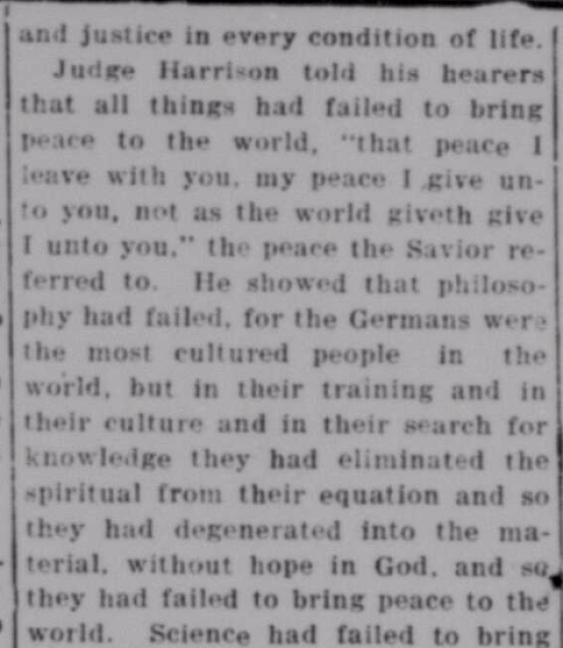
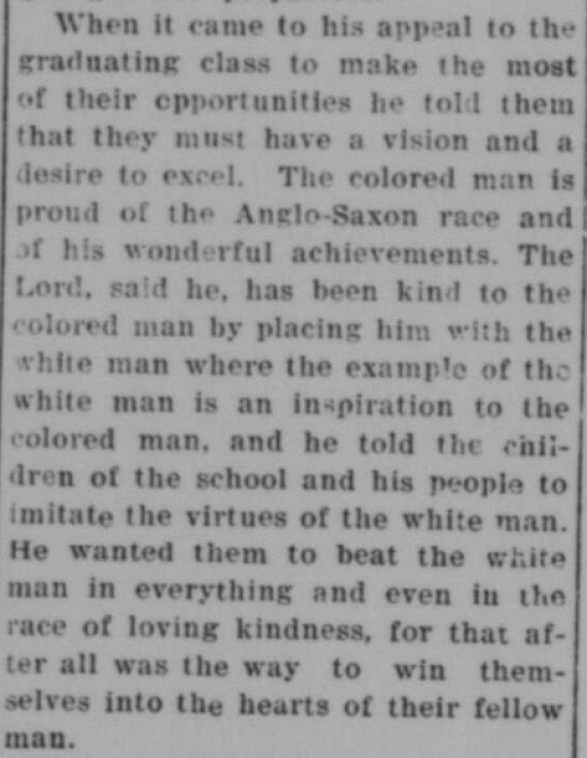
I was astonished to realize that this article memorializes the first commencement exercises at the Independent School — here called by its full and official name, the Wilson Normal and Industrial Institute. As chronicled here and here and here, a coalition of African-American parents and religious and civic leaders founded the Independent School (also known as the Industrial School) in the wake of an assault on a black teacher by the white school superintendent.

I have not been able to identify Judge William Harrison of Chicago, who delivered to the new school’s graduates a remarkably unprogressive message that seemingly flew in the face of the stand for civil rights the community had resolutely made just a year earlier. The Times reporter made no mention of the school’s genesis, preferring to focus at length on Harrison’s message of admiration for the white man’s guidance and fine example.

Screen Shot 2019-03-10 at 11.02.53 PM.png

Screen Shot 2019-03-10 at 11.03.35 PM.png

Screen Shot 2019-03-10 at 11.04.13 PM.png

Screen Shot 2019-03-10 at 11.04.45 PM.png

Screen Shot 2019-03-10 at 11.04.59 PM.png

Screen Shot 2019-03-10 at 11.05.37 PM.png

Screen Shot 2019-03-10 at 11.06.05 PM.png

Screen Shot 2019-03-10 at 11.06.24 PM.png

Screen Shot 2019-03-10 at 11.06.43 PM.png

Screen Shot 2019-03-10 at 11.07.00 PM.png

Screen Shot 2019-03-10 at 11.07.22 PM.png

Wilson Daily Times, 31 May 1919.

  • Judge William Harrison
  • Prof. S.H. Vick — Samuel H. Vick furnished a building on Vance Street to house the new school.
  • Rev. A.L.E. Weeks — Alfred L.E. Weeks was a member of the Colored Ministerial Union committee appointed to address the community’s concerns to the school board.
  • Joseph S. Jackson — Joseph S. Jackson Jr.
  • Boisy Barnes — Boisey O. Barnes.
  • Lester Mitchell — in the 1920 census of Wilson, Wilson County: on Nash Street, Annie Mitchell, 70, her children Sallie, 46, Eddie, 44, Albert, 42, Eva, 36, and Floyd, 34, plus niece Sevreane, 18, and nephew Lester, 15.
  • Willard Crawford — probably, Daniel Willard Crawford who died 16 October 1964 in Wilson. Per his death certificate, he was born 1 January 1900 in Wilson County to Daniel Crawford and Annie Whitted; was never married; and worked as a carpenter. Walter H. Whitted was informant.
  • Addie Davis — Addie Davis Butterfield.
  • Rev. R.N. Perry — Episcopal priest Robert N. Perry was also on the Ministerial Union’s committee.
  • Lillian Wilson — perhaps, in the 1920 census of Wilson, Wilson County: livery stable groom William Wilson, 51; wife Sarah, 48, and daughters Elen, 23, and Lillian, 21, both tobacco factory workers.

In the neighborhood of Watson’s land.

Screen Shot 2019-03-04 at 9.51.38 PM.png

Plat book 1, map 254.

This 1937 notice of sale of the property of John A. and Nannie K. Watson contains bits of information about land ownership by African-Americans in Taylors township, a few miles northeast of the town of Wilson.

Screen Shot 2019-03-04 at 9.58.29 PM.png

Screen Shot 2019-03-04 at 9.59.48 PM.png

Screen Shot 2019-03-04 at 10.00.53 PM.png

Screen Shot 2019-03-04 at 10.01.04 PM.png

Lots 1-4 on the plat map were known as the “Ellis and Woodard tract of Kinchen Watson.” They lay about a half-mile west of the Wilson-Nashville highway (now N.C. Highway 58) and the description of their outer perimeter begins at the corner of “the old Warren Rountree lands and the Hilliard Ellis home tract.” Warren Rountree and Hilliard Ellis were half-brothers. Both were born into slavery, but became prosperous farmers and landowners within a few years after Emancipation. The irregular pentagon of Lot 1 of the tract wrapped around a two-acre rectangle belonging to the Warren Rountree heirs, and Lot 2 excluded “a parcel of land containing one-half acre called the Ellis Chapel lot upon which stands a colored church.”

Detail of lots 1 and 2 of the Ellis & Woodard tracts.

The second tract up for auction, “the Jim Howard tract,” is marked Lot 5 on the plat map at page 251 of Plat Book 1, below.

The third tract, the “Lamm tract,” consisted of Lots 1-4 of the plat map below. These properties were surrounded by tracts belonging to African-American men whose families were connected by blood, intermarriage and historical status as free people of color. James G. “Jim,” Kenyon, Jesse and Allison (not Anderson) Howard were sons of Zealous and Rhoda Eatmon Howard, and William Howard appears to have been a grandson. Charles Brantley‘s daughter Mollie married her cousin Kenyon Howard. John and Kenyon “Kenny” Locust (also spelled Locus and Lucas) were father and son, and John’s mother was Eliza Brantley Locus.

Wilson Daily Times, 29 November 1937.

Plat Book 1, Page 251.

Per Google Maps, the area shown in the first plat today. At (A), Ellis Chapel Free Will Baptist Church; at (B), the approximate location of the Warren Rountree heirs’ two acres; at (C), the Hilliard Ellis cemetery, which is outside the Watson land; at (1) Aviation Place; at (2) Packhouse Road; at (3) N.C. Highway 58; and at (4) Little Swamp, which is a tributary of Toisnot Swamp.

Plat books at Register of Deeds Office, Wilson County Courthouse.


309 North Reid Street.

The one hundred-second in a series of posts highlighting buildings in East Wilson Historic District, a national historic district located in Wilson, North Carolina. As originally approved, the district encompasses 858 contributing buildings and two contributing structures in a historically African-American section of Wilson. (A significant number have since been lost.) The district was developed between about 1890 to 1940 and includes notable examples of Queen Anne, Bungalow/American Craftsman, and Shotgun-style architecture. It was listed on the National Register of Historic Places in 1988.

As described in the nomination form for the East Wilson Historic District, this building is: “ca. 1930; 1 story; bungalow with hip roof and engaged porch that extends around north side.”

In the 1916 Hill’s Wilson, N.C., city directory: Baines Roscoe carp h Reid cor Carolina [This is the location of 309.]

In 1918, Henry Roscoe Bain registered for the World War I draft. Per his registration card, he was born 5 September 1877; resided on Reid Street, Wilson; farmed for M.H. Lam; and his nearest relative was Minnie Baines.

In the 1920 census of Wilson, Wilson County: on Reid Street, carpenter Roscoe H. Bains, 43; wife Minnie, 44; and children Charlie, 18, and Hattie, 16.

In the 1930 census of Wilson, Wilson County: on 309 Reid Street, carpenter Rosco Baines, 52; wife Minnie, 52; and Charley, 28, auto mechanic.

In the 1940 census of Wilson, Wilson County: at 309 Reid Street, owned and valued at $2800, Roscoe Baines, 62; wife Minnie, 62; widowed daughter Hattie Perry, 36, tobacco factory hanger; and widower Charlie Baines, 38, plasterer.

In the 1941 Hill’s Wilson, N.C., city directory: Baines H Roscoe (c; Minnie) carp h309 N Reid

In the 1947 Hill’s Wilson, N.C., city directory: Baines H Roscoe (c; Minnie) carp h309 N Reid

In the 1950 census of Wilson, Wilson County: at 309 Reid, Minnie Baines, 71; husband Roscoe, 72, building contractor; and daughter Hattie Perry, 46, practical nurse at local hospital.

Wilson Daily Times, 20 May 1960.

Minnie Baines died 5 December 1963 at Mercy Hospital. Per her death certificate, she was born November 1877 in Wilson County to George Barnes and Annie [last name unknown]; resided at 309 North Reid Street; and was a widow. Informant was Hattie Evans, 309 N. Vick.

Wilson Daily Times, 29 May 1968.

Photograph by Lisa Y. Henderson, February 2019.

Influenza cases.

Screen Shot 2019-03-04 at 8.55.03 PM.png

Wilson Times, 7 January 1919.

  • Frank Mitchell, Grab Neck — in the 1920 census of Wilson, Wilson County: on Nash Street, laborer Frank Mitchell, 27, wife Alice, 23, daughter Nora M., 1, and boarder Noah Bess, 63.
  • Alex Hall, Elm City — in the 1930 census of Toisnot township, Wilson County: widower Alex Farmer, 50; his mother Saro, 80; sister Maggie, 45; and children Leaston, 18, Randolf, 17, and Annie, 8.
  • Albert Wright, South Elm City — Albert Wright registered for the World War I draft in Wilson County in 1917. Per his registration card, he was born 17 May 1890 in Clinton, N.C.; resided in Elm City; farmed for Jno. D. Bailey in Toisnot township; had a wife and four children; and had a “stiff foot.”
  • Kirby Haskins, Stantonsburg — in the 1920 census of Saratoga township, Wilson County: farmer Kirby Hoskins, 22, wife Lula, 24, and son Eddie, 7 months.
  • Maria Lipscomb, Route 1, Wilson

The collapse of the Vick empire.

A deed of trust is essentially an agreement between a lender and a borrower to give legal title to a property to a neutral third party who will serve as a trustee. The trustee holds the property until the borrower pays off the debt owed to the lender. During the period of repayment, the borrower keeps the actual or equitable title to the property and generally maintains full responsibility for the premises. The trustee, however, holds the legal title to the property and is empowered to sell the property to satisfy the debt if the borrower defaults.  Once the sale is complete, the trustee will distribute the proceeds between the borrower and the lender. The lender gets whatever funds are required to satisfy the debt, and the borrower receives anything in excess of that amount.

On a single day in April 1935, Samuel H. and Annie Washington Vick lost nearly all of their wealth, including their home. The Vicks were heavily in debt and had defaulted on their loans.  Trustee Mechanics and Farmers Bank, an offshoot of North Carolina Mutual Life Insurance Company (and one of a handful of black North Carolina banks to survive the Great Depression), offered dozens of their properties for sale. On 4 April 1935, as recorded in Deed Book 221, pages 333-341, Home Development Corporation purchased the following tracts — comprising 109 houses and lots, 4 additional vacant lots, and 2 large parcels — for $35,000:

  • Tract 1 — the house and lot at 310 [North] Pender Street.
  • Tract 2 — the house and lot at 313 [North] Pender Street.
  • Tract 2-A — the houses and lots at 401, 403, 407 and 409 Viola Street.
  • Tract 3 — “off of and south of Plank road [East Nash Street], adjoining the lands of Harry Clark and others.”
  • Tract 4 — a 19-room house on Vance Street. [This is likely the building that housed the Independent School.]
  • Tract 5-A — the house and lot at 714 East Viola Street.
  • Tract 5-B — the “Vick Home Place” at 622 East Green Street. [The Vicks regained title to this house, which remains in family hands today.]
  • Tract 5-C — the houses and an empty lot at 711, 713 and 717 East Green Street.
  • Tract 5-D — the house and lot at 716 East Green Street.
  • Tract 5-E — the house and lot at 703 East Green Street.
  • Tract 5-F — the house and lot at 709 East Green Street.
  • Tract 5-G — the houses and lots at 606, 608, 610, 612 and 614 East Vance Street.
  • Tract 5-H — the houses and lots at 630 and 632 East Vance Street.
  • Tract 5-I — the house and lot at 620 East Vance Street.
  • Tract 5-J — the house and lot at 624 East Vance Street.
  • Tract 5-K — the house and lot at 628 East Vance Street.
  • Tract 5-L — the houses and lots at 617 and 619 East Viola Street.
  • Tract 5-M — the houses and lots at 705 and 707 East Viola Street.
  • Tract 5-N — the house and lot at 623 Darden Alley [now Lane].
  • Tract 6 — the houses and lots at 701 and 703 East Vance Street.
  • Tract 7 — a 5820 square-foot lot on Viola Street.
  • Tract 8 — the house and lot at 508 East Green Street.
  • Tract 9 — the houses and lots at 509 and 511 [East] Green Street.
  • Tract 10 — the houses and lots at 503 and 505 [East] Green Street.
  • Tract 12 — the houses and lots at 529, 531 and 533 East Nash Street.
  • Tract 13 — the houses and lots at 543, 545, 547 and 549 East Nash Street.
  • Tract 25-A — the buildings and lots at 535, 537 and 539 East Nash Street.
  • Tract 25-B — the house and lot at 526 Smith Street.
  • Tract 25-C — the house and lot at 522 Smith Street.
  • Tract 25-D — the house and lot at 516 Smith Street.
  • Tract 25-E — the houses and lots at 523 and 525 Smith Street.
  • Tract 25-F — the houses and lots at 517 and 519 Smith Street.
  • Tract 14 — the house and lot at 518 East Nash Street.
  • Tract 15 — a 53′ by 153′ lot on Church Alley [now Street].
  • Tract 17 — the houses and lots at 402 and 404 Vick’s Alley [now Parker Lane].
  • Tract 18 — the house and lot at 503 South Spring [now Lodge] Street.
  • Tract 19 — a 7200 square-foot lot adjoining Louis Townsend, near Spring Street [now Lodge].
  • Tract 20 — the houses and lots at 406 and 408 Vick’s Alley [now Parker Lane].
  • Tract 21 — the houses and lots at 403, 405, 407 and 409 Vick’s Alley [now Parker Lane].
  • Tract 23 — the houses and lots at 206 and 208 South Manchester Street.
  • Tract 26-A — the houses and lots at 810 and 812 Elvie [formerly, Elliott] Street.
  • Tract 26-B — the house and lot at 1002 Elvie Street.
  • Tract 26-C — the houses and lots at 801 and 803 Elvie Street.
  • Tract 26-D — the house and lot at 811 Elvie Street.
  • Tract 26-E — the house and lot at 908 Elvie Street.
  • Tract 27 — the house and lot at 607 Stantonsburg Street [now Pender Street S.E.]
  • Tract 28 — the house and lot at 600 Stantonsburg Street [now Pender Street S.E.]
  • Tract 29 — the houses and lots at 213, 215 and 217 Stantonsburg Street [now Pender Street S.E.]
  • Tract 31-A — the houses and lots at 903 and 907 Mercer Street.
  • Tract 31-B — the house and lot at 915 Mercer Street.
  • Tract 32 — a lot on Sugg[s] Street.
  • Tract 33 — the house and lot at 700 Suggs Street.
  • Tract 34-A — the house and lot at 309 Hackney Street.
  • Tract 34-B — the houses and lots at 305 and 307 Hackney Street.
  • Tract 35-A — the house and lot at 617 Darden Alley [Lane].
  • Tract 35-B — the house and lot at 623 Darden Alley [Lane].
  • Tract 37 — the houses and lots at 109, 111, 113, 115, 117 and 201 East Street.
  • Tract 38 — the houses and lots at 108 and 110 Ashe Street.
  • Tract 39 — the houses and lots at 114, 116 and 118 East Street.
  • Tract 40 — 40 acres in Wilson township.
  • Tract 42 — the houses and lots at 400, 402 and 404 Hines Street.
  • Tract 43 — the houses and lots at 500 and 502 East Vance Street.
  • Tract 44 — the house and lot at 712 East Vance and the adjoining lot.
  • Tract 45 — the house and lot at 603 Darden Alley [Lane].
  • Tract 46 — the house and lot at 504 [North] Vick Street.
  • Tract 47 — the house and lot at 504 Stantonsburg Street [now Pender Street S.E.]
  • Tract 48 — the house and lot at 515 Stantonsburg Street [now Pender Street S.E.]
  • Tract 49 — the house and lot at 201 Stantonsburg Street [now Pender Street S.E.]
  • Tract 16 — the house and lot at 519 Church Street.

Separate deeds filed the same day showed the transfer of (1) a 50-acre subdivided parcel (minus several dozen lots already sold) from trustee E.R. Merrick to Home Development Corporation for $3500 (Deed Book 221, page 332), and (2) 7 lots on Suggs, Vick, Church and Viola Streets from trustee R.L. McDougald to Home Development Corporation for $6000 (Deed Book 221, page 331). Both transactions involved land the Vicks had borrowed against.

Marked with red asterisks, this roughly six-block area shows the locations of 34 properties held in trust by Merchants and Farmers Bank and sold on 4 April 1935. Many were small shotgun houses built for rental to working-class families. Excerpt from page 32 of the 1922 Sanborn fire insurance map of Wilson, N.C. 

Negro mystery man in court.

During our conversation in February, Samuel C. Latham told me that Peter Lupe was the only black person “allowed” to sell beer on the 500 block of East Nash. This piece, floating somewhere between news and society column, supports Mr. Lathan’s observation.

John G. Thomas’ first bit of “triviata” — Attorney George Tomlinson appeared at an alderman meeting on behalf of Willie Prince to complain that the police were showing favoritism toward Lupe while harassing Prince and others and that Prince’s on-premise wine license had been revoked, but Lupe remained free to pour. City tax collector Richard R. Smiley step up to resolve part of Prince’s complaint by revoking Lupe’s license on the spot.

The second item — One Saturday night, exactly five minutes after a “negro woman” was booked on a liquor charge, Lupe bonded her out.

The third — The police arrested James Patrick on a vagrancy charge and found his pockets full of “good luck negro charms.” (Again, “jo-mo.” Was this actually a local variant on “mojo”?) Patrick explained that, in exchange for rent, he had promised to get his landlady’s boyfriend to come back. [Sidenote: Vagrancy laws essentially criminalized joblessness and were wielded to harass poor people, especially those of color. After a number of constitutional challenges, in the 1960s most vagrancy laws were replaced by statutes prohibiting more specific behavior, such as public intoxication or disorderly conduct.]

201806052148214376.jpg

Wilson Daily Times, 9 September 1940.

The obituary of Mariah Lipscomb.

Screen Shot 2019-03-02 at 10.24.08 PM.png

Wilson Daily Times, 8 December 1924.

——

In the 1870 census of Taylors township, Wilson County: carpenter Stephen Lipscomb, 49; wife Mariah, 29; and children Anna, 13, Tilitha, 12, Betha, 12, Frank, 10, Archibald, 8, Penny, 6, and Daniel, 1 month.

In the 1880 census of Taylors township, Wilson County: farmer Stephen Lipscum, 52; wife Mariah, 42; children Penny, 13, Daniel and Louvenia, 9, Mary, 5, Rosa, 4, and George, 3 months; and grandchildren Isabella, 7, James, 5, and Henryetta, 2.

In the 1910 census of Wilson township, Wilson County: farmer George Hines, 53; wife Lew, 48; children Howard, 19, Hubbard, 17, May Lillie, 12, Joseph, 10, Nora, 8, Robert, 5, William, 4, and Charlie, 2; and widowed mother-in-law Mariah Lipscombe, 72.

Lou Lipscombe Hines applied for a Social Security number or claim in May 1937. Per her application, she was born 6 May 1868 in Wilson, North Carolina, to Stephen Lipscombe and Maria Barnes.

Frank Lipscomb died 5 October 1941 at Mercy Hospital, Wilson. Per his death certificate, he was 80 years old; resided at Wilson County Home; was a widower; was a farmer; and was born in Wilson County to Stephen and Mariah Lipscomb. Johnnie Coley was informant.