National Register of Historic Places

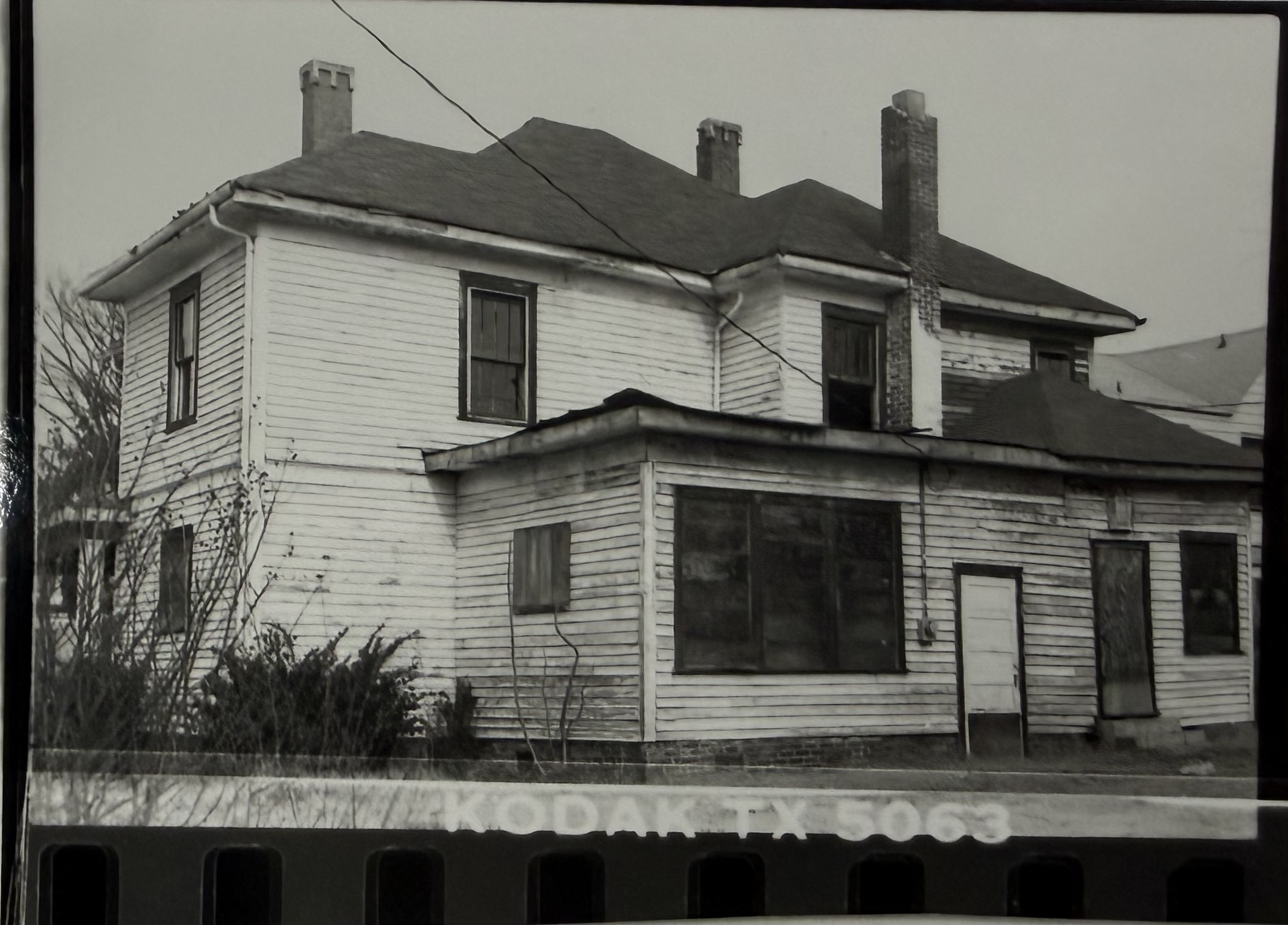
919 Atlantic Street.

The one hundred ninety-sixth in a series of posts highlighting buildings in East Wilson Historic District, a national historic district located in Wilson, North Carolina. As originally approved, the district encompasses 858 contributing buildings and two contributing structures in a historically African-American section of Wilson. (A significant number have since been lost.) The district was developed between about 1890 to 1940 and includes notable examples of Queen Anne, Bungalow/American Craftsman, and Shotgun-style architecture. It was listed on the National Register of Historic Places in 1988.

As described in the nomination form for the East Wilson Historic District: “ca. 1930; 1 1/2 stories; Donnie Hargrove house; bungalow with clipped-gable roof and matching dormer, engaged porch; partial brick veneer; Hargrove was a barber; builder was brick mason Jeff Russell; contributing garage”

——

In the 1928 Hill’s Wilson, N.C., city directory: Hobbs Hadie (c; Elsie) attndt Smith’s Filling Sta h 919 Atlanta 

In the 1930 Hill’s Wilson, N.C., city directory: Russell Jefferson E (c; Julia) brklyr h 919 Atlantic av

In the 1940 census of Wilson, Wilson County: at 919 Atlantic Avenue, owned and valued at $3000, Donna Hargroves, 35, barber shop at pool room; wife Flora, 31; and daughter Geraldine, 15.

In the 1941 Hill’s Wilson, N.C., city directory: Hargrove John (c; Flora; 2; Manhattan Billiard Parlor) barber 421 E Nash h 919 Atlantic av

In 1942, John Hargrove registered for the World War II draft in Wilson County. Per his registration card, he was born 20 October 1902 in Wilson; lived at 919 Atlantic Street; his contact was Vina Hargrove, 1110 Carolina Street, Wilson; and was a self-employed barber at 421 East Nash Street.

In the 1950 census of Wilson, Wilson County: at 919 Atlantic, barber John Hargrove, 45, barber; wife Mae B., 34, beautician; and daughter Dorothy, 20. 

104 North East Street.

The one hundred ninety-fifth in a series of posts highlighting buildings in East Wilson Historic District, a national historic district located in Wilson, North Carolina. As originally approved, the district encompasses 858 contributing buildings and two contributing structures in a historically African-American section of Wilson. (A significant number have since been lost.) The district was developed between about 1890 to 1940 and includes notable examples of Queen Anne, Bungalow/American Craftsman, and Shotgun-style architecture. It was listed on the National Register of Historic Places in 1988.

As described in the nomination form for the East Wilson Historic District: “ca. 1930; 1 story; two-room house with bungalow traits; late example of the type in the district; built as a rental property by black merchant Rufus Hilliard.”

——

In the 1930 Hill’s Wilson, N.C., city directory: Dillard Henry (c; Mary L) lab h 104 (100) N East

In the 1940 census of Wilson, Wilson County: at 101 East Street, rented for $10/month, Velma McCormick, 27, tobacco factory hanger.

In the 1941 Hill’s Wilson, N.C., city directory: McCormick Velma (c) maid h 104 N East

Photo by Lisa Y. Henderson, September 2024.

917 Atlantic Street.

The one hundred ninety-fourth in a series of posts highlighting buildings in East Wilson Historic District, a national historic district located in Wilson, North Carolina. As originally approved, the district encompasses 858 contributing buildings and two contributing structures in a historically African-American section of Wilson. (A significant number have since been lost.) The district was developed between about 1890 to 1940 and includes notable examples of Queen Anne, Bungalow/American Craftsman, and Shotgun-style architecture. It was listed on the National Register of Historic Places in 1988.

As described in the nomination form for the East Wilson Historic District: “ca. 1913; 1 story; Queen Anne cottage with double-pile, hip-roofed form, projecting front wing; remodeled with aluminum siding and metal porch posts.”

——

In the 1928 Hill’s Wilson, N.C., city directory: Turner Jasper (c; Madie) mill hd h 917 Atlanta

In the 1930 Hill’s Wilson, N.C., city directory: Bynum Dudley (c; Olie) barber h 917 Atlantic av

In the 1940 census of Wilson, Wilson County: at 917 Atlantic, barber Dudley Bynum, 49, and wife Ola, 45, laundress at Hotel Cherry.

In the 1941 Hill’s Wilson, N.C., city directory: Bynum Dudley (c; Oleona) barber Wm Hines h 917 Atlantic

In the 1950 census of Wilson, Wilson County: Oleona R. Bynum, 55; husband Dudley Bynum, 59; and lodger Cora Parker, 51, widow.

Wilson Daily Times, 24 October 1959.

Oleonia Brooks Bynum died 21 October 1959 in Chapel Hill, Orange County, North Carolina. Per her death certificate, she was born 8 June 1893 to Dennis Brooks and Mary Ann Helms; was married to Dudley Bynum; and lived at 917 Atlantic Street, Wilson.

Wilson Daily Times, 19 July 1962.

Dudley Bynum died 19 July 1962 in Wilson, Wilson County. Per his death certificate, he was born August 1889 in Wilson County to Berry Bynum and Loddie [no maiden name]; lived at 917 Atlantic Street; was a widower; was a barber; and was buried in Masonic Cemetery. Lydia B. Knight, 311 Manchester Street, was informant.

Wilson Daily Times, 15 August 1962.

Photo by Lisa Y. Henderson, September 2024.

808 East Vance Street.

The one hundred ninety-third in a series of posts highlighting buildings in East Wilson Historic District, a national historic district located in Wilson, North Carolina. As originally approved, the district encompasses 858 contributing buildings and two contributing structures in a historically African-American section of Wilson. (A significant number have since been lost.) The district was developed between about 1890 to 1940 and includes notable examples of Queen Anne, Bungalow/American Craftsman, and Shotgun-style architecture. It was listed on the National Register of Historic Places in 1988.

In the nomination form for the East Wilson Historic District, 808 and 810 East Vance Street are described as vacant lots.

In the 1930 census of Wilson, Wilson County: at 808 East Vance Street, teacher Rosa Foster, 42; children Carter, 16, Daily Times newsboy, and Naomi, 14; and two roomers Alice Jones, 36, and Mamie Key, 20, both teachers.

On 9 April 1932, Foster purchased the house from D.S. Boykin, a trustee.

When the federal census taker visited in 1940, Rosa P. Foster was operating her house at 808 East Vance Street as a teacherage. Her household included teachers Alice H. Jones, 46 (and her son James R., 23); Floreta J. Walson, 31; W. Arlene Gilmore, 30; Mary G. Harris, 33; and Mamie E. Whitehead, 33.

In 1940, Carter Washington Foster registered for the World War II draft in Wilson. Per his registration card, he was born 15 January 1914 in Wilson; resided at 808 East Vance; worked as county farm agent at 559 1/2 East Nash Street; and was married to Estelle Duncan Foster.

Wilson Daily Times, 11 April 1947.

Rosa Foster died 7 October 1954 at her home at 808 East Vance Street. Per her death certificate, she was born 24 March 1888 in Nash County, N.C., to Allison Parker and Mary [maiden name not stated]; was a retired school teacher; and was widowed. Carter Foster was informant.

Wilson Daily Times, 23 September 1958.

Photo by Lisa Y. Henderson, March 2024.

1000-1020 Robeson Street.

The one hundred ninety-second in a series of posts highlighting buildings in East Wilson Historic District, a national historic district located in Wilson, North Carolina. As originally approved, the district encompasses 858 contributing buildings and two contributing structures in a historically African-American section of Wilson. (A significant number have since been lost.) The district was developed between about 1890 to 1940 and includes notable examples of Queen Anne, Bungalow/American Craftsman, and Shotgun-style architecture. It was listed on the National Register of Historic Places in 1988.

This 2003 aerial photograph shows a neat line of ten shotgun (“endway”) houses in the 1000 block of Robeson Street, differentiated only by the materials of their roofs. By 2007, they were gone.

As described in the nomination form for the East Wilson Historic District, 1000 Robeson Street was: “ca. 1913; 1-story; shotgun with hip-roofed porch and gable returns, diamond-shaped vent in the gable; white speculator and tobacconist J.C. Hadley probably had this shotgun and #1002-1018 erected in the early 1900s.”

The 1922 Sanborn fire insurance map of Wilson shows the original 11 endway houses in the 1000 block of Robeson.

The 1928 city directory shows these residents of the block:

In the 1930 city directory, 1002, 1004, and 1006 Robeson were vacant. 1020 is listed, but was gone by 1940.

Endway houses were built as rental properties, but occasionally a resident was able to purchase one. The 1940 census of Wilson reveals that Ashley Tillery, 29, Bank of Wilson elevator operator, owned 1008 Robeson Street, which was valued at $900. His wife Mary, 28, and children Mary E., 8, Bettie, 6, Geraldine, 4, and Ashley Jr., 1, lived in the house with him. Tobacco factory laborer Willie Gardner, 46, owned 1018, where he lived alone. Rents in 1940 were $8 to 10/month, and several dwellings housed two families, each apparently occupying a bedroom.

The 1000 block of Robeson Street is now part of Freeman Place, a city-developed housing community.

2003 aerial courtesy of Wilson County GIS Website; current aerial courtesy of Google Maps.

511 East Green Street.

The one hundred ninety-first in a series of posts highlighting buildings in East Wilson Historic District, a national historic district located in Wilson, North Carolina. As originally approved, the district encompasses 858 contributing buildings and two contributing structures in a historically African-American section of Wilson. (A significant number have since been lost.) The district was developed between about 1890 to 1940 and includes notable examples of Queen Anne, Bungalow/American Craftsman, and Shotgun-style architecture. It was listed on the National Register of Historic Places in 1988.

This terribly pixelated view of 511 East Green (formerly numbered 514) is taken from a 2003 aerial photograph.

As described in the nomination form for the East Wilson Historic District, 509 [actually, 511] East Green is: “ca. 1893; 1 story; two-room house with slender chamfered porch posts; aluminum sided.” The house was demolished between 2003 and 2007.

——

In the 1928 Hill’s Wilson, N.C., city directory: McArthur Edward (c; Mabel) lab Williams Auto Co h 511 E Green

In the 1930 Hill’s Wilson, N.C., city directory: McLean Della (c) lndrs h 511 E Green

In the 1930 census of Wilson, Wilson County: at 511 East Green, rented for $16/month, widow Della McClain, 46, boarding house cook, with roomers Jessie, 30, laundress, and Bruce Campell, 20, filling station laborer

In the 1940 census of Wilson, Wilson County: at 511 East Green, barber Samuel Williams, 42; wife Emma, 36; and children Addie, 19, James, 17, Billie, 13, Samuel Jr., 11, and Dazzarine, 9.

In the 1941 Hill’s Wilson, N.C., city directory: Williams Saml (c; Emma) barber John Hargrove h 511 E Green

In the 1947 Hill’s Wilson, N.C., city directory: Stevens David L (c; Lola; Stevens & Ricks) h 511 E Green [Stevens & Ricks was a grocery at 620 East Nash.]

309 Elba Street, a requiem.

I was saddened, but not surprised,* to see this bit in the Wilson Times‘ coverage of Thursday’s Wilson City Council meeting:

309 Elba Street is one of my favorite houses in East Wilson, and I’ve written about it here, here and here, and here‘s a glimpse of it in happy times. Its charmingly quirky details made it a unique addition to the neighborhood, and I would love to know who designed and built it.

I’ve found a bit more about the house’s history. I knew it was built about 1930, and veterinarian Elijah L. Reid and family lived in it briefly around that time. Dr. Reid had owned the lot since 1908. He and his wife Ietta Staton Reid lost the house early in the Depression to Home Owners Loan Corporation, which sold it in October 1938 to Matthew James Smith for $3350. The deed carries this property description:

Deed book 246, page 573, Wilson County Register of Deeds Office, Wilson.

Smith mostly rented the house out, but was living there when he died on 27 November 1949. Per his death certificate, Smith was born 30 May 1889 in Greene County, N.C., to Robert Smith and Ella Harper; was a widower; worked in farming; and lived at “corner of Viola and Elbon Streets.” The house has remained the property of his heirs for the 75 years since.

As no one spoke on 309 Elba’s behalf at public hearing, I offer this post as eulogy.

Talk about site-built — 309 has front doors and porches facing both Elba and Viola Streets. The house is chock-a-block with Craftsman features, including a low-pitched roof, deep eaves, extended rafter tails, brackets, thick tapered porch columns, and shingled gables.

Oh! the unexpected gracefulness of the brackets supporting the oriel window.

If no one else does, I will miss 309 Elba and rue the loss of this remnant of East Wilson’s vibrant early years.

[*133 Tarboro? Yeah, I am pretty surprised about this one. The nomination report for the Wilson Central Business-Tobacco Warehouse Historic District described Tomlinson and Company building at 131-133 South Tarboro as “[t]he only surviving metal-clad building in Wilson, these paired storefronts are impressive examples of the use of metal to commercial buildings in turn of the century North Carolina. They were built circa 1895 ….” In other words, they’re among the oldest buildings in Wilson.]

Photographs by Lisa Y. Henderson, August 2022.

624 East Vance Street.

The one hundred ninetieth in a series of posts highlighting buildings in East Wilson Historic District, a national historic district located in Wilson, North Carolina. As originally approved, the district encompasses 858 contributing buildings and two contributing structures in a historically African-American section of Wilson. (A significant number have since been lost.) The district was developed between about 1890 to 1940 and includes notable examples of Queen Anne, Bungalow/American Craftsman, and Shotgun-style architecture. It was listed on the National Register of Historic Places in 1988.

Photo by Drew C. Wilson, “Suspicious hire damages vacant house,” Wilson Times, 28 December 2023.

As described in the nomination form for the East Wilson Historic District: “ca. 1922; 1 story; shotgun; altered and aluminum-sided.”

——

In the 1930 Hill’s Wilson, N.C., city directory: Boston Liston (c; Emma) hlpr h 624 E Vance

In the 1930 census of Wilson, Wilson County: at 624 East Vance, rented at $8/month, Liston Boston, 29, sawmill laborer, born in South Carolina; wife Erma Jane, 28, born in South Carolina; children Lucile, 5; Eliza, 3; Cora E., 1; and Luther, 5 months; brother-in-law Simon Burger, 20, sawmill laborer, and mother-in-law Eliza Burger, 50, widow.

In the 1941 Hill’s Wilson, N.C., city directory: Boston Liston (c; Emma; 6) carp h 624 E Vance

In the 1947 Hill’s Wilson, N.C., city directory: Sharp Tearr (c; Mamie) emp City h 624 E Vance

In the 1950 Hill’s Wilson, N.C., city directory: at 624 East Vance, Ernest Sharp, 43, road scraper, city road department, and wife Mammie, 42.

210 North East Street.

The one hundred eighty-ninth in a series of posts highlighting buildings in East Wilson Historic District, a national historic district located in Wilson, North Carolina. As originally approved, the district encompasses 858 contributing buildings and two contributing structures in a historically African-American section of Wilson. (A significant number have since been lost.) The district was developed between about 1890 to 1940 and includes notable examples of Queen Anne, Bungalow/American Craftsman, and Shotgun-style architecture. It was listed on the National Register of Historic Places in 1988.

As described in the nomination form for the East Wilson Historic District: “ca. 1930; 1 story; four-room square cottage with inset porch and bungalow type details; #s 210-200 are said to have been built as rental property by white speculator Leslie Farmer.”

——

In the 1941 Hill’s Wilson, N.C., city directory: Robinson Lonnie (c; Mary; 5) delmn M System Store h 210 N East

In the 1947 Hill’s Wilson, N.C., city directory: Robinson Lonnie (c; Mary) driver C Woodard Co h 210 N East

In the 1950 census of Wilson, Wilson County: at 210 North East, Lonnie Robinson, 40, truck driver-local wholesale grocery company; wife Mary L., 38, beautician; and children Helen R., 20, cleaning house, Walter M., 14, Kathrine C., 12, and Hosea I., 9; and granddaughter Diann, 1.

Photo by Lisa Y. Henderson, December 2023.

112 North East Street.

The one hundred eighty-eighth in a series of posts highlighting buildings in East Wilson Historic District, a national historic district located in Wilson, North Carolina. As originally approved, the district encompasses 858 contributing buildings and two contributing structures in a historically African-American section of Wilson. (A significant number have since been lost.) The district was developed between about 1890 to 1940 and includes notable examples of Queen Anne, Bungalow/American Craftsman, and Shotgun-style architecture. It was listed on the National Register of Historic Places in 1988.

As described in the nomination form for the East Wilson Historic District: “ca. 1930; 1 story; saddlebag house with rear shed extension and hip-roofed porch; late example of the type.” The house was recently renovated.

In the 1930 census of Wilson, Wilson County: at 112 East, rented at $12/month, widow Addie Ward, 37, and children Alfonso, 22, Edgear, 17, Otheara, 16, Jasper, 14, and Thelma, 10.

In the 1930 Hill’s Wilson, N.C., city directory: Ward Addie (c) h 112 N East; also, Ward Alfonso (c) hlpr 112 N East

In the 1941 Hill’s Wilson, N.C., city directory: Dunn Annie (c) cook h 112 N East

Lillie B. Dunn died 10 April 1941 at Mercy Hospital, Wilson. Per her death certificate, she was 36 years old; was born in Kinston, N.C., to Richard Dunn of Snow Hill, N.C., and Annie Gardner of Kinston, N.C.; lived on Spruce Street; was the widow of Raymond Ried; and was buried in Rountree Cemetery [probably Vick]. Annie Dunn, 112 East Street, was informant.

In the 1947 Hill’s Wilson, N.C., city directory: Dunn Annie (c) h 112 N East

Annie Dunn died 27 May 1948 at her home at 112 North East Street, Wilson. Per her death certificate, she was born 25 June 1884 in Lenoir County, N.C., to Quincey Gardner and Mariah Bryant; was the widow of Richard Dunn; and was buried in Rest Haven Cemetery. Quincey Gardner, 708 Suggs Street, was informant.

Photo by Lisa Y. Henderson, December 2023.