
And here, my friends, is the gold standard of East Wilson renovation — the old Willie G. and Ada Harris Reid house at 1013 East Nash Street.
Photo by Lisa Y. Henderson, December 2023.
And here, my friends, is the gold standard of East Wilson renovation — the old Willie G. and Ada Harris Reid house at 1013 East Nash Street.
Photo by Lisa Y. Henderson, December 2023.
In the category “East Wilson Renovations” — 10, 10, 10s across the board!!

The renovation of the house is nearly complete at 1013 East Nash Street, the Queen Anne cottage most closely associated with Willie and Ada Harris Reid, but built more than 20 years before they took occupancy. Judging by the exterior, it’s a lovely job.
Photo by Lisa Y. Henderson, October 2023.

W.L. Wooten Furniture was one of several white-owned businesses in the 500 block of East Nash Street in the pre-World War II era.

Wilson Daily Times, 13 January 1948.
Wilson Bottling Company stood at the corner of East Nash and South Vick Streets in a building originally occupied by a grocery. This stretch of East Nash Street was a small commercial district featuring several groceries and the Elks Club’s lodge building.
Here’s the area in the 1930 Sanborn map, before the Elks Club was built:

In 1930, the businesses were:
In the 1947 Hill’s Wilson, N.C., city directory:

The 1941 Hill’s Wilson, N.C., city directory reveals that George Wong operated a small restaurant at 524 East Nash. It was, perhaps, the first Chinese restaurant in East Wilson.
The directory listed Wong’s address as 122 North Tarboro Street, which was also the location of his laundry. He was apparently a new arrival to Wilson as he does not appear in the 1940 census of the town. His laundry was around the corner from the county courthouse and seems to have done well for a time.

Wilson Daily Times, 24 December 1943.

Wilson Daily Times, 5 August 1944.
However, by 1950, Wong was disabled by blindness and forced to close his shop. A few weeks after the notice below ran, National Bank of Wilson advertised the sale and removal of Wong’s building with a proviso that the building be moved and debris cleared within 30 days.

Wilson Daily Times, 3 April 1950.
The one hundred eighty-fourth in a series of posts highlighting buildings in East Wilson Historic District, a national historic district located in Wilson, North Carolina. As originally approved, the district encompasses 858 contributing buildings and two contributing structures in a historically African-American section of Wilson. (A significant number have since been lost.) The district was developed between about 1890 to 1940 and includes notable examples of Queen Anne, Bungalow/American Craftsman, and Shotgun-style architecture. It was listed on the National Register of Historic Places in 1988.

The corner today, per Google Maps.
The corner of Pender and Nash, at 101 South Pender Street [Stantonsburg Street] (also known as 600 East Nash Street), as described in the nomination form for the East Wilson Historic District: “ca. 1950; 1 story; porcelain-enameled steel gas station with clean lines and simple square form suggesting International Style; altered and in disrepair.”
The 1908 Sanborn fire insurance maps of Wilson, N.C., depict an irregularly shaped vacant brick building at the tip of the triangle formed by the intersection of East Nash Street and Stantonsburg Street (now South Pender Street). It was numbered 601-603 East Nash Street. The building shown just below it was the original location of Darden Funeral Home. The three-story building also housed C.H. Darden’s bicycle shop and general repair business. The third floor was reserved for lodge meetings. (Which lodge? The Odd Fellows and Masons had their own lodges.)

The 1913 Sanborn map shows the building modified with a wooden porch on the Stantonsburg Street side and cast-iron porches at the entrance and Nash Street side. A grocery occupied the space.

By time the 1922 Sanborn map was drawn, the street numbers had flipped from odd to even and vice-versa, and the auto repair shop at the corner was at 600 East Nash Street.

In the 1930 Hill’s Wilson, N.C., city directory: Triangle Service Station (Wm H Taylor) 600 E Nash
In the 1941 and 1947 Hill’s Wilson, N.C., city directories: Triangle Service Station (Cleveland T Barnes) filling sta 101 Stantonsburg
The Oblong Box-Style gas station described in the nomination form may date to 1950, but petroleum corporations began adopting the style in the late 1930s. I have not found photos of Triangle Service Station to determine whether it was built in the style or upgraded to it.
In the 1963 Hill’s Wilson, N.C., city directory: Sutton’s Gulf Service (Cecil E Sutton) 600 E Nash St

The Gulf gas station is just visible in this detail from a mid to late 1960s photo of the area.
The building is currently home to a carwash business.
The famous (and infamous) Orange Hotel was on the market again recently — for something north of $50K. The listing seems to be have withdrawn, though I don’t think the building sold.
While in Wilson, I took an opportunity to take a closer look.

Per the 1984 Nomination Form for recognition as a National Historic District for “Wilson Central Business District – Tobacco Warehouse Historic District,” “the two-story, weather-boarded frame building is three-bays wide and four-bays deep and is sheltered beneath a low, hipped roof of standing seam metal; interior brick chimneys with corbeled caps pierce the roof. The house’s only ornamentation is supplied by a five-bay, two-tier porch that is carried across the north faced by turned posts with small curved brackets.”
The Orange Hotel has been hard-used for most of its 116-year existence and has stood empty for the last five or so. It’s not falling down, but it’s in pretty bad shape. One of the corbel-capped chimneys collapsed and was replaced by a squat brick structure. The turned porch posts with their curved brackets are largely intact, however.


“A balustrade of slender turned balusters connects the posts on the second story; a replacement railing of ‘x’ shaped two-by-fours is on the first story. The first story entrance has a double door with a two-pane transom; a single door is on the second floor.”
The turned balusters on the second floor are also mostly in place, but the front double-door is now a plain single door.
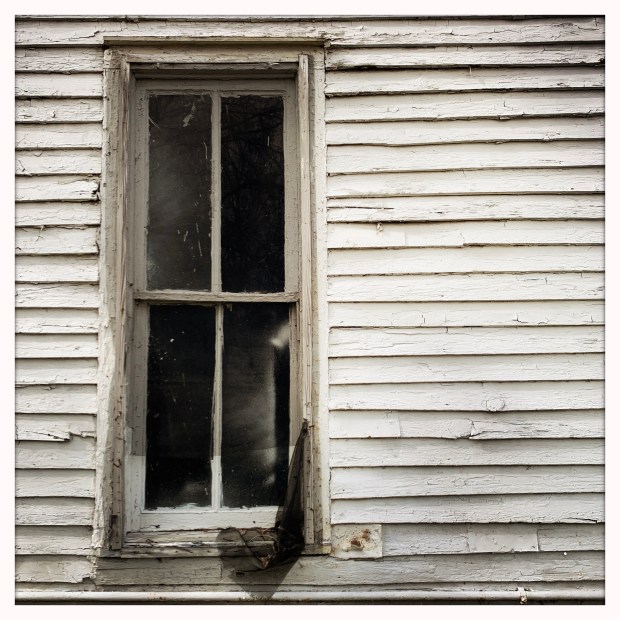
“The narrow windows contain two-over-two in plain surrounds.” These windows must be seven-feet tall.

“The rear elevation is occupied by a one-story ell.” I assume that that rickety staircase at right was added after 1984, and perhaps the shed-roofed enclosures at center as well.
Photos by Lisa Y. Henderson, February 2022.


Wilson Daily Times, 10 March 1918.
We’ve seen the Emma Gay property here. The ad above announced the sale of the lots of the subdivision laid out in Plat Book 1, page 56, Wilson Register of Deeds Office. The notice targeted two markets — “the colored man” wishing “to purchase a home close in” and “the white man” aiming to “make a safe and very profitable investment.” The latter won out as the later development of the parcel was commercial.
Clipping courtesy of J. Robert Boykin III.
