Month: November 2022

The Spell family portrait.

Photographs of formerly enslaved people are relatively rare, and I am grateful to Roy S. Spell Jr. for sharing one that his family has cherished for well over a century. His grandfather Johnnie Spell, born about 1903, is at bottom left, leaning against his grandmother Chaney Spell, who was born into slavery about 1845. Other Spell family members surround them.

We met Chaney Spell here in the interview she gave a Works Project Administration worker in the late 1930s. (Annie Finch Artis can be heard giving voice to Chaney Spell’s words in an exhibit first staged at Wilson’s Imagination Station and now permanently housed at Freeman Round House Museum.) 

——

In the 1900 census of Black Creek township, Wilson County: widowed farmer Chaney Spells, 55, sons James S., 19, Gray, 17, Walter, 16, and Charley, 13, grandchildren Unity, 14, Fannie, 10, Irvin, 7, and Chaney Farmer, 2, and boarder Harriet Killibrew, 45.

In the 1910 census of Black Creek township, Wilson County: widow Chanie Spell, 65, farmer; son Walter, 21; and grandchildren Yearnie, 20, Chanie, 13, Thomas, 5, and Louise, 3.

The Stantonsburg Hawks.

Wilson was not the only county town to field an African-American semi-pro baseball team. From 1945 into the late 1970s, the Stantonsburg Hawks successfully traveled neighboring counties for play.

John Lee Woodard (1917-1995) was the team’s founder, and players throughout its history included his son Willie Woodard, Ernest Hall and son Ernest D. Hall, Frederick Brown, Johnnie Streeter, Roy Lee Pender, Marvin R. Artis, George Artis, Tommy Rogers, Nathaniel Green Jr., William Sutton, Henry Revelle, Carter Knight, Raymond Mackey, Marvin Sessoms, Levy Daniel Jr., Melvin Hodges, Cleveland Leach, Joseph Green, Julius Green, Theodore Ward, Douglas Artis, Melvin Artis Jr., George Atkinson, and Ronnie Diggs.

I am trying to identify the Hawks’ earliest players, teammates of John L. Woodard. Do you know of anyone who played baseball with them in the 1940s?

I recognize three men in this photo — Ernest D. Hall seated at front left; Willie Lee Woodard (son of John L. Woodard, front row with glove on ground); and George Artis, second in second row. Who do you see?

[Update: Marvin Sessoms is in the middle of the front row; Johnnie Streeter is at far right in that row; and Ernest Hall Jr. (father of Ernest D. Hall) is standing third from left.]

Thanks to Tiyatti Speight for bringing this team to my attention and for the copy of this wonderful photo. Thanks as well to all the people of Stantonsburg who helped identify the players!

Teen stabs teen; goes to movie.

Wilson Daily Times, 21 October 1942.

On 11 December 1942, Willie Lucas pleaded guilty to manslaughter in the death of Hezekiah Reid. He received a sentence of three to five years in prison, but was paroled by Governor J. Melville Broughton in August 1943, having served nine months.

——

  • Willie Lucas
  • Hezekiah Reed

In the 1930 census of Wilson, Wilson County: on Westover, farmer Zion Read, 56; wife Lara, 25; and children Zoreana, 8, Hesicar, 12, William, 4, and Walter E., 0. 

Willie Reid died 20 October 1942 at Centre Brick Warehouse, Wilson. Per his death certificate, he was born 10 June  1923 in Wilson to Zion Reid and Laura Davis; was single; worked as a laborer; and was buried in Rountree Cemetery. Cause of death: “homicide — knife wound of left breast.”

Stepney Buck, a faithful newspaper worker.

In an undated manuscript titled “Early Wilson Newpapers,” James H. Evans reminisced about working for various Wilson journals between 1865 and 1882.

As he recalled his hire by Josephus Daniels at the Wilson Advance, Evans noted: “… and by the way, I have been overlooking one very faithful worker on every newspaper in town — Stepny Bush[sic], a colored man, he pulled every Washington hand press on every newspaper in the town, and it kept him very busy; he had press work every day except Sunday.”

In the 1880 census of Wilson, Wilson County: on Nash Street, Martha Vick, 30, servant; her children Thomas, 13, Lucy, 8, Peter, 3, and John, 10 months; and Stepney Buck, 50.

In the summer of 1881, a pseudonymous writer contributing news of Elm City happenings praised Buck’s work while the Advance‘s editors were away:

Wilson Advance, 1 July 1881.

A year later, Buck’s name appeared in this incomprehensible jab at future United States Congressman James E. O’Hara published in the Wilson Siftings, which Evans described as “a semi-news and humorous newspaper”:

Wilmington Weekly Star, 4 August 1882.

Eight months later, Buck was dead. On 20 April 1883, horse dealer T.H. Selby, newspaper owner/editor Josephus Daniels, bookkeeper H.R. Strong, printer J.C. Rhodes, James Lucas, and lawyer (and later United States Congressman) F.A. Woodard posted a seventy-dollar bond for the appointment of Selby as administrator of Stepney Buck’s estate. I have found nothing further about this.

Notice to colored Imperial employees.

Tobacco factory work was seasonal, and late fall meant the end of work for hundreds across Wilson County. The color line extended even to applying for unemployment benefits, and “colored claimants” who had worked at Imperial Tobacco were directed to report to Darden Funeral Home to continue their claims.

Wilson Daily Times, 20 November 1940.

Where we worked: Boykin Grocery Company.

Boykin Grocery was a major grocery wholesaler in Wilson for decades. The business moved to this handsome brick building, formerly home to Barnes-Harrell Grocery Company, in the mid-1920s, and this photograph was likely taken shortly thereafter. (The building still stands, largely unaltered except for the enclosure of the bays, at the corner of Barnes and Douglas Streets.) 

The front office staff, all clad in dark suits except the lone woman, stands in front of the first bay. To their left, six African-American men (one is barely visible on the running board) lean against two company vehicles, and a sixth leans against the building. The men standing at the cars were likely truck drivers, like Willie Forbes and Orlando Farmer.

Photo courtesy of J. Robert Boykin III. Thank you!

The former Lofton Chapel Original Free Will Baptist Church.

Even tucked away as it is behind two houses, I don’t know how I’ve missed this church the thousands of times I have driven up and down (the former) Lane Street. 

The sign out on Bishop L.N. Forbes Street identifies New Christian Original Free Will Baptist Church. What I took for a driveway leading to the building is actually the short unpaved, uncurbed, unguttered length of Graham Street. It didn’t take much sleuthing to figure out that, until recently, this was Lofton Chapel Original Free Will Baptist Church. 

The earliest reference I have found for Lofton Chapel is 1955. This building has been heavily renovated, but is decades older than that — the vinyl siding doesn’t entirely conceal its early 20th century origins. (Those lancet windows!) Strangely, the building does not appear in a 1940 aerial photograph of the site, suggesting that it was moved to this location from another at some time after. Whether it was built as Lofton Chapel, I do not know.

Aerial view of the church per Google Maps.

Top photo by Lisa Y. Henderson, November 2022.

A committee to look for a burial ground.

Late local historian Hugh B. Johnston Jr.’s file contained this note, apparently copied from volumes of city commissioners or boards of aldermen meetings that cannot now be located:

“Dec. 17, 1888 Oakview Cemetery. Gray Farmer, [illegible] Robinson, and Washington Sugg were appt. a Committee to look for a burial ground for the colored people.”

This is the earliest reference to a public African-American cemetery in Wilson and appears to presage the establishment of Oakdale (also called Oaklawn, Oakland, Oakwood, and Oakview) Cemetery in the area of present-day Cemetery Street south to the former Elvie Street School. Sugg (or Suggs) owned extensive property in the area, and the deed for his first land purchase refers to a preexisting “graveyard lot” near his property. This lot may have been developed into a city cemetery.

However, an 1895 Wilson Daily Times article mentions that county commissioners had begun to search for a “suitable burying ground for the colored people.” What had happened (or not happened) in the previous seven years?

Oakdale Cemetery, which was active until about 1920, was the predecessor of Vick Cemetery.

Thanks to J. Robert Boykin for bringing this to my attention.

101 South Pender Street.

The one hundred eighty-third in a series of posts highlighting buildings in East Wilson Historic District, a national historic district located in Wilson, North Carolina. As originally approved, the district encompasses 858 contributing buildings and two contributing structures in a historically African-American section of Wilson. (A significant number have since been lost.) The district was developed between about 1890 to 1940 and includes notable examples of Queen Anne, Bungalow/American Craftsman, and Shotgun-style architecture. It was listed on the National Register of Historic Places in 1988.

The corner today, per Google Maps.

The corner of Pender and Nash, at 101 South Pender Street [Stantonsburg Street] (also known as 600 East Nash Street), as described in the nomination form for the East Wilson Historic District: “ca. 1950; 1 story; porcelain-enameled steel gas station with clean lines and simple square form suggesting International Style; altered and in disrepair.”

The 1908 Sanborn fire insurance maps of Wilson, N.C., depict an irregularly shaped vacant brick building at the tip of the triangle formed by the intersection of East Nash Street and Stantonsburg Street (now South Pender Street). It was numbered 601-603 East Nash Street. The building shown just below it was the original location of Darden Funeral Home. The three-story building also housed C.H. Darden’s bicycle shop and general repair business. The third floor was reserved for lodge meetings. (Which lodge? The Odd Fellows and Masons had their own lodges.)

The 1913 Sanborn map shows the building modified with a wooden porch on the Stantonsburg Street side and cast-iron porches at the entrance and Nash Street side. A grocery occupied the space.

By time the 1922 Sanborn map was drawn, the street numbers had flipped from odd to even and vice-versa, and the auto repair shop at the corner was at 600 East Nash Street.

In the 1930 Hill’s Wilson, N.C., city directory: Triangle Service Station (Wm H Taylor) 600 E Nash

In the 1941 and 1947 Hill’s Wilson, N.C., city directories: Triangle Service Station (Cleveland T Barnes) filling sta 101 Stantonsburg

The Oblong Box-Style gas station described in the nomination form may date to 1950, but petroleum corporations began adopting the style in the late 1930s. I have not found photos of Triangle Service Station to determine whether it was built in the style or upgraded to it.

In the 1963 Hill’s Wilson, N.C., city directory: Sutton’s Gulf Service (Cecil E Sutton) 600 E Nash St
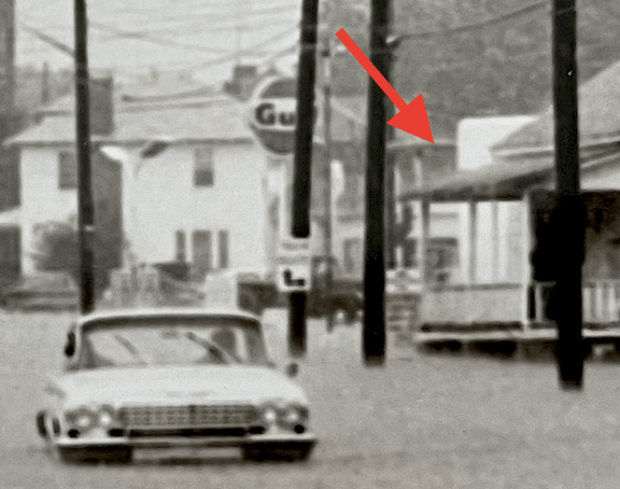
The  Gulf gas station is just visible in this detail from a mid to late 1960s photo of the area.

The building is currently home to a carwash business.

Darden band performs at mass X-ray survey.

Wilson Daily Times, 18 November 1950.

“Hundreds of Wilson county residents yesterday turned out for the opening of the mass x-ray survey which will last until December 23. Part of the crown which attended the opening in front of the county court house can be seen in the top photo. The Charles L. Coon High school band also is shown in the above picture. Colored citizens staged their own opening program at Nash and Pender streets. The Darden High school band can be seen in the bottom photo getting the mass x-ray started in that section of town. …”