Month: February 2020

Lane Street Project: another search for gravestones in Rountree and Odd Fellows cemeteries.

First: my request for the Vick cemetery survey and documentation re the decision to destroy its headstones? As yet unfilled, though the city attorney assures me it’s coming soon.

With boots and gloves and a hand pruner, I returned to Rountree/Odd Fellows/Vick cemeteries on a frosty Saturday morning to see what else there is to see.  Walking through the clear strip of Odd Fellows, I noticed immediately that someone had neatened up the stones that are usually lying higgledy-piggledy on the ground. Here, Clarence L. Carter and his daughter Omega Carter Spicer.

Picking my way toward the back edge of the cleared section, it dawned on me that this was once the main entrance to Odd Fellows. The hinges on the post to the right were the give-away. And the traces of asphalt driveway.

Standing near Irma Vick‘s headstone and looking in, I spotted this, plain as day. It’s hard to imagine how I missed it in December.

It’s the double headstone of Daniel and Fannie Blount Vick, Samuel H. Vick‘s father and mother. Daniel Vick died in 1908 (112 years to the day before my “discovery” of his grave) and Fannie Vick sometime in the late 1800s. (Is that a bullet pockmark?)

A few feet away, the headstone of Viola Leroy Vick, daughter of Samuel and Annie Washington Vick. She died as a toddler in 1897, and East Wilson’s Viola Street was named in her honor.

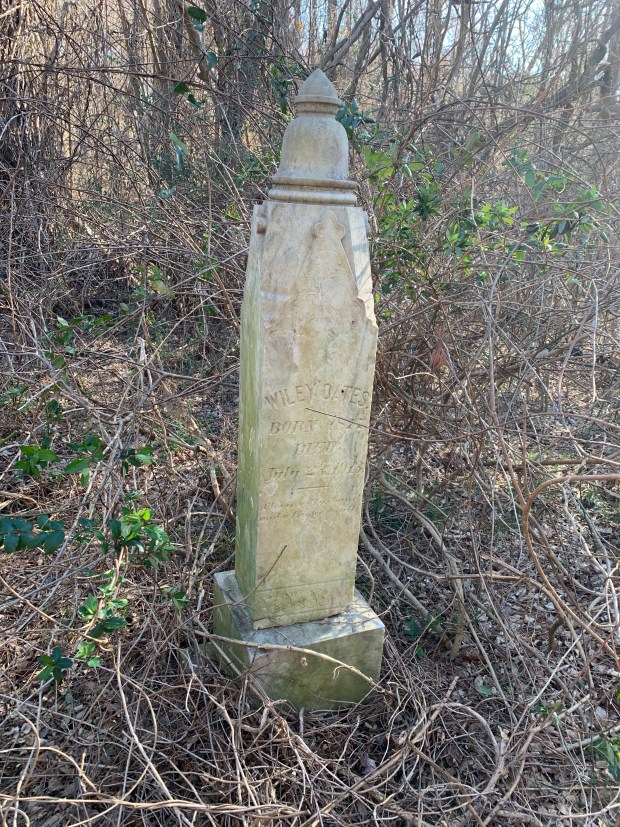
And then, perhaps 25 feet away, cocooned in honeysuckle and evil smilax, this monument loomed. Was it Sam Vick’s?

To my astonishment — no. The honeysuckle pulled off like a cape (after I wasted time hacking at the briars on the other side) to reveal that this remarkable marble headstone, which tops six feet, marks the grave of Wiley Oates. (More about him later.) Samuel and Annie Vick’s gravestones remain elusive.
I’d bought the cheapest hand pruners I could find, and they performed cheaply, but I got through to this gravestone and its companion, which appear to lie across the property line in Rountree cemetery.

The gravestone for Amos Batts’ wife, Jennie Batts, who died in 1945. Behind it in the left corner of the frame you can see the base of a pine whose diameter is at least two feet, which gives a measure of how long this cemetery has been neglected.

Here is the “canal” described in the Rountree cemetery deed. It’s a channeled section of Sandy Creek, and I imagine Rountree Missionary Baptist Church once performed baptisms here. I spent idyllic childhood afternoons exploring along the banks of this waterway perhaps a quarter-mile downstream. Sandy Creek is a tributary of Hominy Swamp, which flows into Contentnea Creek, which empties into the Neuse River at Grifton, North Carolina.

Here, I’m standing on the south bank of Sandy Creek looking down into the bowl that was once Rountree cemetery. I have not found any markers in this low-lying section, though there appear to be collapsed graves. Repeated flooding was one of the factors that led to the abandonment of cemetery. The undergrowth is starting to green up and, as the weather warms, soon these graveyards will be nearly impenetrable without sharper, heavier tools.

Daffodils are not native to eastern North Carolina and would not ordinarily be found blooming in the middle of the woods. This thick drift has naturalized from bulbs perhaps more than one hundred years old. Daffodils were commonly planted in cemeteries to symbolize the death of youth or mortality.

My exit strategy failed at the edge of barricade of wild blackberry twenty-five feet deep between me and Lane Street. I had to scramble back through the woods to gain egress at the ditch dividing Rountree from Odd Fellows. All this battling ate up my time, and I wasn’t able to explore the far end of Odd Fellows, next to Vick. Peering through the fence, though, I did see this marker for Lizzie May Barnes, daughter of H. and L. Barnes, who died in 1919.

——

  • Amos Batts died 24 March 1937 in Wilson township, Wilson County. Per his death certificate, he was 61 years old; was born in Wilson County to Thomas and Mariah Batts; was married to Jennie Batts; worked as a common laborer; and lived at 1202 East Nash Street. Informant was Jennie Batts.
  • Jennie Batts died 25 December 1945 at her home at 1202 East Nash Street, Wilson. Per her death certificate, she was the widow of Amos Batts; was 58 years old; was born in Wilson County to unknown parents; and was buried in Rountree cemetery. Eddie Batts was informant.
  • Lizzie Barnes died 3 April 1919 in Taylor township, Wilson County. Per her death certificate, she was born 11 August 1918 in Wilson County to Henry Barnes and Lena Woodard.

Cohabitation register, part 1.

In March 1866, the North Carolina General Assembly passed an act establishing a means for formerly enslaved people to ratify their marriages.  Such persons were to appear before justices of the peace, who would collect certain details of their cohabitation during slavery and record them in the County Clerk’s office. Freedmen faced misdemeanor charges if they failed to record their marriage by September, 1866, a deadline later extended to January 1, 1868.

Wilson County’s original cohabitation register is said to be held in the Register of Deeds office, but I have not found it there. Brooke Bissette, Director of Exhibits at Wilson’s Imagination Station, recently found that East Carolina University’s Joyner Library has a copy of the cohabitation register on microfilm and is creating a print volume to be shelved in the Local History and Genealogy Room at Wilson County Public Library’s main branch.

I present the register in series, with transcription:

record-image_.jpg

An example worthy of following.

The Special Collections Research Center of North Carolina State Libraries has digitized several annual reports submitted to the state’s Cooperative Extension Service by Negro County Extension Agent Carter W. Foster. Below, part 1 of a series revealing the 1942 report.

Screen Shot 2020-02-04 at 9.20.42 PM.png

Screen Shot 2020-02-04 at 9.21.01 PM.png

“… I have attempted to give you an insight of the major activities carried on by Negro farmers in the county during the year.” Foster credited farm families, county officials, home economics extension agent Jane A. Boyd, the extension staffs at North Carolina State A.&T. and North Carolina State Universities, and members of the Negro school systems for the year’s successes.

Screen Shot 2020-02-04 at 9.21.33 PM.png

Foster named Mark Sharpe the Outstanding Man of the Year.

Screen Shot 2020-02-04 at 9.21.49 PM.png

Sharpe was born and reared on the farm he was buying. His father, a life-long tenant farmer, lived with him. Their landlord had made a standing offer to sell the farm for $6000 years before. “Not being satisfied with the manner in which his father was living,” Sharpe decided to buy. He happened upon an article about Farm Security Administration loans for low-income tenants. Within days he was approved. The farm was on Highway 42 on the Wilson-Edgecombe border, and about 40 of its 51 acres were suitable for farming.

Screen Shot 2020-02-04 at 9.22.46 PM.png

The house was in fairly good condition at purchase, but was upgraded with screens, paint and a pump on the back porch, and Sharpe constructed a laying house, a smokehouse and an outhouse.

Sharpe was a young man — just 29 years old. He was the father of five, a member of the Negro Farmers Advisory Committee, and a Neighborhood Lender. “He is an example worthy of following by many tillers of the soil.”

Screen Shot 2020-02-04 at 9.22.57 PM.png

Screen Shot 2020-02-04 at 9.22.31 PM.png


Fulfilling a need: Wilson County Negro Library, 1943-1964.

program flyer.png

More great Black History Month programming from Wilson County Public Library! On 15 February 2020, local history librarian Tammy Medlin will present a history of the Wilson County Negro Library, founded by African-American women in the early 1940s. No registration necessary; please come learn more about this vital community institution.

The last will and testament of Ella Clark Gaston Hinton.

With brother John H. Clark nearby, Ella M. Hinton drafted her last will and testament on 15 August 1946. Her major asset consisted of six acres inherited from her father Harry Clark, and she was very particular about to whom it would go.

jfgjf

——

In the 1870 census of Wilson township, Wilson County: farm laborer Harry Clark, 27; wife Flora, 26; and children John, 6, Mary, 5, Ella, 3, and Henriett, 1.

In the 1880 census of Wilson township, Wilson County, farmer Henry Clark, 39, wife, Florah, 38, and children John, 16, Mary J., 14, Ella, 12, Henrietta, 9, Henry, 8, Augustin, 5, Thomas, 3, and Margaret, 10 months.

On 18 September 1884, J.A. Gaston, 25, married Eller Clark, 17, in Wilson. Witnesses were Samuel H. VickC.D Howard and Braswell R. Winstead.

John A. Gaston and Ella Clark Gaston divorced prior to November 1899, when he married Sattena Barnes.

In the 1900 census of Wilson, Wilson County: Ella Gaston, 30, divorced, and children Ralph, 10, and Albert, 2.  Also, per the 1900 census of Wilson, John and Ella’s sons Theodore, 13, Cicero, 10, George Gaston, 8, remained in their father’s household. (By 1910, they lived in Warsaw, Duplin County, North Carolina.)

On 18 December 1902, Alexander Hinton, 29, of Wilson, married Ella Clark, 31, of Wilson, in Wilson. Presbyterian minister E.A. Mitchell performed the service in the presence of Ida R. Clark and E.J. Hooker.

In the 1910 census of Wilson, Wilson County: on Nash Street, Alex Hinton, 40, college cook, and wife Ella, 39, laundress. Both reported having been married twice, and Ella reported that five of her seven children were living.

In the 1940 census of Hampton, Virginia: at 35 Tyler, Ella Hinton, 72, widow; granddaughters Edna, 21, tea room waitress, and Eloise Gaston, 13; and lodgers Jessie Wright, 75, Elliott Wyche, 32, gardener, and Rebecca Butler, 20. Ella and Edna were born in North Carolina, Eloise in Pennsylvania, Jessie and Elliott in Virginia, and Rebecca in “Africa.”

Ella Hinton died 17 May 1947 in Wilson township, Wilson County. Per her death certificate, she was born 6 June 1871 in Wilson to Harry Clark and Maude [sic; maiden name unknown]; was widowed; and was buried in Rest Haven cemetery. Albert Gaston was informant.

Williamson v. Williamson.

Isaac and Sarah Williamson lived in Old Fields township, Wilson (formerly Nash) County. In 1853, Sarah Williamson filed for divorce from her husband, citing, among other things, serious physical and emotional abuse. The Williamsons lived in a part of Wilson County that was then in Nash County. Their divorce file is replete with accusations and counter-accusations of violence, alcohol abuse, infidelity and general profligacy. It also contains several references to the Williamsons’ enslaved laborers and free colored neighbors.

The court required Isaac Williamson to sequester $2500 pending a decree in the case and was given the choice to post a bond or to hand over to the sheriff “negroes Harry, Lewis, Viney, Reuben, Ben & Margarett.” [Isaac Williamson died in 1854 or 1855, ending the proceedings.]

In her deposition, Nancy Williamson, Isaac and Sarah’s 20 year-old daughter, swore that “at another night he run mother and me out of the house and then called in a Negro fellow made him get the gun, powder and shot — the gun was loaded and he, my father took it and said if he found my mother he would drop her wherever he found her. …” “At another time my father asked a negro fellow who had a wife there, to come into the house and he did so, cursed and abused my mother — and my father would not allow my mother to say any thing to the negro but told him to say what he pleased to her.”

Neighbor Jethro Harrison testified that “I am well acquainted with Isaac Williamson the Defendant, He is a man who drinks hard — when he has not liquor at home he goes off and drinks he does not attend to his business like a man ought to. I have seen the Defendant on my bed and one morning about an hour per sun I saw him on a bed at Elijah Powell‘s a free negroe who had living with him a daughter grown and a wife & other children. …” On cross examination, Harrison stated: “… the Defendant was lying across the bed at the free negroes house with his shoes off and a quilt over him I think his clothes were not off. He was drunk or quite drinkey.”

Son-in-law Robertson Baker testified: “Some five or six years ago the Defendant and myself were riding in the night along together he had a coloured woman supposed to be a Negro riding on his horse behind him, he stopped in the path I went back and found him on the woman — I rode off and in a short time he came on with the woman behind him I saw the woman put up behind him as we started from a sale or hireing at A[illegible] At the Defendant’s request there being two Negro girls at our horses where we went to start I took one of them behind me for the purpose of getting him off home.”

Daughter Kesiah Williamson, 17, testified that Isaac Williamson told her “if I stuck up to him that I would get a negro or two but if I stuck to mother I never should have any of his property.”

Dempsey Powell was subpoenaed to testify in a deposition, but the file does not contain a record of any such statement.

——

  • Harry, Lewis, Viney, Reuben, Ben & Margarett — A document in the Williamson divorce notes that Isaac Williamson owned about 12 enslaved people. In 1864, Williamson’s youngest sons received their inheritance from their father.  Isaac Jr. took possession of Harry, Jacob, Priscilla and Wesley, and son Eli Williamson, Reuben, Margaret and child Riney, Hittie and Elias.
  • Elijah Powell — in the 1850 census of Nash County, listed next door to Isaac and Sarah Williamson: Robert Simpson, 36, farmer; Elijah Powell, 50, cooper; wife Selah [Celia Taylor], 48; and children Denis T., 22, Henry, 21, Elijah, 19, Mary, 18, Stephen, 10, Jane, 6, Jabe, 2, and Sally, 18. [Presumably, the girl on the bed was either Sally or Mary Powell.]
  • Dempsey Powell — in the 1860 census of Black Creek township, Wilson County: turpentine worker Dempsey Powell, 30, who claimed $130 personal estate; Sallie Simpson, 28; and Sallie Simpson, 9.

Many thanks to Traci Thompson for sharing these documents, which are housed in Nash County Records at the North Carolina State Archives, Raleigh.

Studio shots, no. 138: Alexander Barnes.

Screen Shot 2020-01-30 at 10.43.25 PM.png

Alexander Barnes (1879-1938), in Picture-Taking Barnes’ one-armed chair.

In the 1880 census of township, Wilson County: farmer Elias Barnes, 36; wife Margaret, 35; and sons Franklin, 6, and Alexander, 6 months.

In the 1900 census of Cross Roads township, Wilson County: farmer Elias Barnes, 60; wife Margarette, 60; and children Alexander, 20, and Sallie A., 17, both farm laborers. Living nearby, Wright Creech, 27; his first wife Lucy, 22; their children Leonora, 3, Richard, 2, and Pennina, 1; and servant Daisy Green, 8.

On 23 March 1916, in Wilson County, Alex Barnes, 36, of Old Fields, son of Elias and Margarette Barnes, married Dicy Deans, 21, of Nash County, daughter of Wiley and Mariah Deans.

In 1918, Alexander Barnes registered for the World War I draft in Wilson County. Per his registration card, he was born 28 December 1879; lived at R.F.D. #3, Lucama; his nearest relative was wife Dicey Ellen Barnes; and he farmed on C.E. Brame’s land.

In the 1920 census of Spring Hill township, Wilson County: on Smithfield and Red Hill Road, Ellic Barnes, 40; wife Dicy, 26; and children Grover T., 3, and Bessie M., 1.

In the 1930 census of Saratoga township, Wilson County: Alex Barnes, 50, widower, farm laborer.

Alexander Barnes died 26 October 1938 at Mercy Hospital, Wilson. per his death certificate, he was born 1880 in Wilson County to Laris and Margreat Barnes; lived at Route #2, Wilson; was married; and worked as a laborer. Luther Creech was informant.

Thanks to Edith Jones Garnett for sharing this photo.

Rev. Clark congratulates The Age.

img 2.jpeg

New York Age, 9 February 1935.

In 1935, Rev. Thomas G. Clark sent a congratulatory letter to mark the New York Age’s “50 years of untrammeled service to the race, nation and the world.” In it, he revealed details of his early educational struggles, and the epiphany to which Edward A. Johnson’s A School History of the Negro Race in America from 1619 to 1890 brought him. [Johnson, born enslaved in Wake County in 1860, was educated at Atlanta University and wrote A School History at the urging of a school superintendent. The book was the first by an African-American author to be approved for use in North Carolina’s public schools. (Sidenote: I won’t rest until I secure a copy.)]


Free people of color, 1860: Wilson district.

Free people of color enumerated in Wilson County’s first federal census, taken in 1860.

Wilson district (outside town limits)

#430. Silas Lassiter, 38, farmer; wife Orpie, 34; children Sallie, 12, Mary, 11, James, 9, John, 7, Elizabeth, 5, Penina, 4, Hardy, 3, Silas, 1, and George, 2 months; and Delphia Simpson, 14. Silas reported $490 in real estate and $155 in personal property.

#436. Susan Mitchel, 26, washing, and children James, 10, Annie, 7, and George, 2. Susan claimed $257 in real estate and $60 in personal property.

#442. Henry Booth, 15, in the household of white farmer James Tomlinson.

#443. Green Lassiter, 36, farmer; Mary Lassiter, 24; Matthew Lassiter, 37; and Rachel Lassiter, 30, farm laborer. Green reported $750 in real estate.

#450. Louisa Artis, 17, in the household of white farmer William T. Taylor.

#501. Elijah Powell, 23, and Josiah Blackwell, 21, laborers in steam mill, both black, in the household of white engineer John Valentine.

#544. Lucinda Jones, 8, black, in the household of white brickmason Joseph E. Beamon.

#546. John T. Farmer, mulatto, 4, in the household of white farmer John Farmer.

#592. Mahaly Artis, 30, washing, black, and daughter Sarah, 8, mulatto.

#596. Jonas Barnes, 14, mulatto, in the household of white farmer Joseph S. Barnes.

#599. Turpentine laborer Joseph Jones, 40, black; wife Zillah, 34; and children Milly, 17, Jesse, 10, Nathan, 8, and twins Frances and Lenora, 6, all mulatto.