Month: December 2016

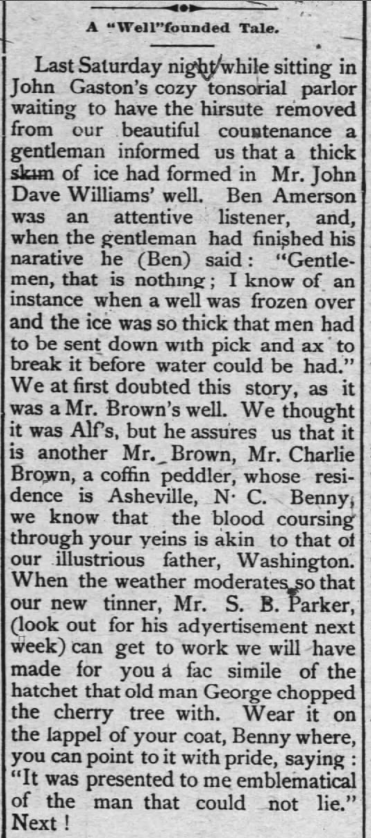
John Gaston: easy chairs, razors keen.

Barbers ranked high among black Wilson’s most prominent residents in the late 19th and early 20th centuries. Lemon Taborn, who was later joined by his wife Edmonia and daughter Carrie, was the earliest of the well-known Wilson barbers, whose clientele was exclusively white. Others in the late 1800s included Alfred Robinson, J.F. WhiteEd Mitchell, Tobias Farmer, and John A. Gaston.

In the 1870 census of Kinston, Lenoir County, North Carolina: brickmason George Gaston, 53, wife Matilda, 30, and 13 year-old sons George and John, both farm laborers.

In the 1880 census of Wilson, Wilson County: brickmason George Gaston, 60, wife Matilda, 44, and son John, 23, a farm laborer. John’s twin George Gaston, 23, barber, is listed by himself in the 1880 census of Town of Toisnot, Wilson County. George established perhaps the leading barber shop in Elm City, seven miles north of Wilson.

On 18 September 1884, J.A. Gaston, 25, married Eller Clark, 17, in Wilson. Witnesses were Samuel H. Vick, C.D Howard and Braswell R. Winstead.

When Alfred Robinson left Wilson in 1889 for his patronage postal route job, J.F. White took over his business. White did not stay long though, and by the end of the year, John Gaston and Hugh T. Ransom were advertising their partnership at the location. (City directories show that Ransom was a barber in Raleigh in 1887. He married Maggie Joyner in Wilson on Christmas Day 1889, and their marriage license notes that his parents lived in Wake County. Ransom was alive as late as 1897, when his son Hugh T. Ransom Jr. was born, but died before 1900.)

121890

Wilson Advance, 2 January 1890.

wa-71090

Wilson Advance, 10 July 1890.

wa-6491

Wilson Advance, 4 June 1891.

Gaston and Ransom seem to have parted ways shortly, and in August 1891 a local newspaper noted the addition of Ed Mitchell to the shop.

wa-8271891

Wilson Advance, 27 August 1891.

wa-1-14-1892

Wilson Advance, 14 January 1892.

Gaston continued to expand his business.

screen-shot-2016-12-22-at-1-25-03-pm

Wilson Advance, 17 November 1892.

screen-shot-2016-12-21-at-7-26-21-pm

Wilson Advance, 26 January 1893.

screen-shot-2016-12-21-at-7-33-12-pm

Wilson Advance, 22 February 1894.

Though he received a fair amount of free publicity via news briefs such as those above, Gaston was a big believer in advertising, and placed hundreds of ads in the Wilson Advance. Here, he touted two additional barbers, including one that he trained. (I have not found any other reference to Lyde (Clyde? Lloyd?) Richardson.) Noah J. Tate, curiously, is referred to as “Pate” in this and another newspaper reference, but Tate in all others. The son of Hardy and Mary Jane Tate, he and Walter Hines entered a partnership circa 1910.

wm-10311894

Wilson Mirror, 31 October 1894.

521895

Wilson Advance, 2 May 1895.

4-2-1896

Wilson Advance, 2 April 1896.

screen-shot-2016-12-21-at-7-20-10-pm

Wilson Advance, 8 April 1897.

screen-shot-2016-12-21-at-7-21-45-pm

Wilson Advance, 24 March 1898.

John A. Gaston, 44, son of George Gaston, and Sattena Barnes, 22, daughter of Doublin and Eliza Barnes, were married 9 November 1899 at the bride’s residence in Wilson. Braswell R. Winstead obtained the license; Rev. S.B. Hunter performed the ceremony at the A.M.E. Zion church; and Grant T. Foster (husband of Hugh T. Ransom’s widow Maggie), B.R. Winstead, and Samuel H. Vick were witnesses.

In the 1900 census of Wilson, Wilson County: barber John Gaston, 44, wife Satina, 30, and children Theodore, 13, Cicero, 10, George, 8, and Caroline, 2 months.

In the 1910 census of Warsaw, Duplin County: widower John Gaston, 53, barber, and son Ciseroe, 24, pressing club operator.

In 1911, a bit of unfinished business — likely related to his deceased wife’s estate — brought Gaston back to Wilson County:

wdt-1-10-1911

Wilson Daily Times, 10 January 1911.

In the 1920 census of Warsaw, Duplin County: on Bell Street, widower John Gaston, 63, barber, and son Theodore, 33, also a barber.

On 4 November 1930, John A. Gaston died in Warsaw, Duplin County. Per his death certificate, he was born about 1858 in Duplin County to George Gaston and an unnamed mother and was the widower of Satina Barnes Gaston. Cause of death: “Don’t know. Sudden death while about his work as barber. No doctor had examined him.” Theo. Gaston of Warsaw was informant.


Thursday night drunk.

Coroner’s report of the Inquest held over Dennis Williams (Col.), Dec. 19th, 1899

North Carolina, Wilson County  }

Record of the examination of witnesses at the Inquest over the dead body of Dennis Williams (col)

The examination of W.D. Crocker M.D., Arch’d Robinson, W.M. Mumford, Edmund Williamson, John Henry, Horton Wells, Jason Wells (col), Alfred Moore taken before the undersigned, Coroner of said County, this 18th day of December 1899 at the Court House in Wilson, upon the body of Dennis Williams then lying dead, to-wit Archibald Robinson, being duly sworn says:

I went down to Mr. Moore’s Thursday night a little after dark. Mr. Moore not at home, but stayed there until a little after eight, went out and hurried towards home, just as I got close to the grave yard I heard a noise sound like some one struggling, I thought at first some one was trying to scare me heard noise about 100 years from Mr. Mumfords house. Saw man laying beside road, just a got against him I turned to left but walked by his feet and look down to see if I knew him, but made no stop. I met Edmund WmSon between where man was lying and Mr. Mumfords house. Just as I crossed the bridge I met him he spoke and I spoke and I stop after I passed him to see if he could recognize him and he stop and called to me that here is a man that seemed to be drunk or hurt come back and see if we can see what is to matter with him. I came back to injured man and found that Edmond knew him and found that he was injured. I and Mr. Mumford went to the depot and let some of the [illegible] Dr. W.D. Crocker went to see him. They took him up and carried him over to a vacant house about 350 years away where the doctor dressed his wounds. The man was total unconscience and stayed so, as far as I heard. Don’t know anything more about it.    Archibald (X) Robinson

Edmund Williamson being duly sworn says:

I was acquainted with Dennis Williams. Did not recognize him that night at first, but did afterwards. There was right much blood on ground, where he was found. Do not know why he was there.   Edmund (X) Williamson.

Wash Mumford, being duly sworn says:

Dennis came up to my house drunk, Thursday night drunk, like he always came, have learn him for 20 years, came to my gate, but Dago wouldn’t let him in. I was out in yard cutting out my beef. I forbid him to come in my yard for he was drunk, he walked off to one side, leaning up against walling. About 8 or 10 minutes, talking to him self. Had some words and he walked away cursing. He was not very offensive and went off as soon as I told him to go. Went off in direction to where he was afterwards found. Heard that he was hurt about 15 minutes after he left my house. I heard him meet some one, and heard him curve some one, and heard other party say he would kill him if he cursed him, and almost immediately afterwards heard blows. Mr. Wells and my son was with me. After I found out he was hurt, took my cart, and help them carry him off and dress his would. Found a bar rail and a fence rail where he was hurt, was blood, and hair on rails.  Wash (X) Mumford

Horton Wells, being duly sworn says:

I was at Mr. Mumford, when Dennis same to his house Thursday night. I heard nothing more than Mr. Mumford testified to.  /s/ J.H. Wells

Jason Wells, being duly sworn, says:

I am barber, my business is at Lucama. Went home a little early Thursday night. I saw Dennis at depot Thursday. He was drunk. I saw him between sun set and dark, didn’t see him after I went home. Didn’t see him have any money, but heard him say he had some. I took a drink with him, some time in the day he was not drunk then. Never saw him after he was hurt.   Jason (X) Wells

Alfred Moore, being duly sworn, says:

The man was found dead about a half miles from my house.   /s/ Alfred Moore

Dr. W.D. Crocker, being duly sworn says:

I practice medicine at Lucama I saw Dennis Williams in Lucama Thursday about sun down very drunk and he spoke to me, did not know him at that time. Had him searched next morning, did n’t find any thing except some candy, When I saw him at about half past ten he was unconscience, and had one cut on head near 6 in in length, cut to skull. I couldn’t detect any fracture in skull. He had both arms broken about five in from wrist, one bone in each arm. I think the cause of his death was from the two wounds on the head. I think the wounds were made by a rail.  He was never conscience, and his pulse was very week. His folks took him home Friday and he died the next day. He also had a bruise on back of his head.  /s/ W.D. Crocker

John Henry Battle, being duly sworn, says:

I live in Lucama, work with Mr. J.L. Hays. I saw Dennis Williams, about dark Thursday night, didnt see him during day. He was going out of town, with a man called Black Jack, coming out towards Barnes cross roads. I thought Dennis was drunk. Black Jack didn’t seem to be as drunk as Dennis, but I though he was drinking, Dennis wanted to go out in the country, and Black Jack didn’t want to go. Don’t know whether he went or no, both seemed to be in good humor. Didn’t see Dennis any more until he was found hurt, and haven’t see Black Jack since.  /s/ John Henry Battle

John K. Ruffin, Coroner

——

  • Dennis Williams
  • Jason Wells — Jason Wells, 47, of Cross Roads, married Rena Reaves, 22, of Cross Roads, on 19 October 1897 in Lucama. Witnesses were Henry Odham, Joseph Newsom, and Linsey Wells. In the 1900 census of Crossroads township, Wilson County: day laborer Jason Wells, 51, wife Arrena, 30, and children Joseph E., 16, Johnie H., 11, Shelly, 2, and Carlton, 9 months. Jason Wells died 18 October 1934 in Cross Roads township. Per his death certificate: he was born in 1851 in Nash County to Dennis and Nellie Wells; was married to Rena Reaves Wells; worked as a farmer until 1931; and was buried in Lamms cemetery. Rena Reaves Wells was informant.
  • Edmund Williamson — in the 1880 census of Crossroads township, Wilson County: Edmund Williamson, 50, wife Thaney, 44, and children William, 25, Nicie, 23, Eliza, 22, Eddie, 21, Ally, 19, Pollina, 17, Dolly Ann, 15, Isaac, 12, and Raiford, 7.
  • John Henry Battle — in the 1900 census of Crossroads township, Wilson County: day laborer Columbus Battle, 24, wife Minnie, 20, and brother, John H., 23, also a day laborer.

Coroner’s Records, Miscellaneous Records, Wilson County Records, North Carolina State Archives.

Recommended reading, no. 2.

screen-shot-2016-12-12-at-1-33-17-pm

A project of North Carolina Arts Council and local partners, African American Music Trails of Eastern North Carolina (2013) is a 218-page insider’s guide to the music traditions of an eight-county region. Drawn largely from interviews with living musicians and interspersed with vivid photographs and up-close vignettes, the book devotes thirty pages to Wilson County’s rich musical history, both sacred and secular.  Highlights include the role of Reid Street Community Center (and tobacco warehouses) as music venues, shape note singing and hymn lining, and influential music teachers. The book suggests travel routes for each section and includes a 17-track CD of eastern North Carolina recordings.

A systemic coterie of dispensers of the ardent; or, his dive is a tough place.

Another blind tiger makes the news:

wdt-12-12-1911

Wilson Daily Times, 12 December 1911.

  • Jim Watson
  • Cyndia Watson
  • Coot Robbins — on 18 March 1912, Coot Robbins, 29, married Hennie Harris, 27, in Wilson.
  • Junius Peacock — in the 1912 Wilson city directory: Peacock Junius cook h[ome] Chestnut
  • Mark Sharpe — likely, in the 1910 census of Wilson, Wilson County: on Nash Road, tobacco factory laborer Mack Sharpe, 43, wife Katie, 29, and children Harvey, 12, Willard C., 10, Earnest, 8, Samson, 6, Nellie B., 3, and Elexander, 1. In the 1912 Wilson city directory: Savage Mack butler h[ome w Nash ne Lucas av


Cemeteries, no. 9: William Chapel church cemetery.

William Chapel Missionary Baptist Church is one of three extant 19th-century churches in the Elm City area, and the only one with a cemetery. The church is about three miles northwest of Elm City on William Chapel Church Road, which runs just inside and roughly parallel to the Wilson-Nash County line. The cemetery lies a few hundred feet west of the church, across from Silver Lake Cotton Gin.

screen-shot-2016-12-10-at-10-23-36-pm

Among the oldest graves at William Chapel are those of:

img_9910

img_9909

  • Alexander and Sarah P. Barnes

img_9901

  • Harriet Hines

img_9904

  • W.S. Ward

img_9915

Aerial photo courtesy of Google Maps; cemetery photos by Lisa Y. Henderson, November 2016.

At Winstead the photographer’s.

6 19 1889

Wilson Mirror, 19 June 1889.

Wmirror 1 10 1894 Winstead photog

Wilson Mirror, 10 January 1894.

Francis Marion Winstead, who was white, worked as a photographer in Wilson as early as 1880. In 1887, he opened a solo studio at the corner of Nash and Tarboro Streets. I have not been able to identify Winstead’s “nice colored waitress.”

Information about Winstead from Stephen Massengill’s Photographers in North Carolina: The First Century, 1842-1941.


Married too much.

Rev. Spurgeon David Davis, appointed in 1918 to head one of two planned alternative schools in the wake of the Charles Coon incident, was a newcomer to Wilson. A native of Maryland, he arrived in town in 1917 to head First Baptist Church (now known as Jackson Chapel First Missionary Baptist Church.) So who was he?

In the 1900 census of Baltimore, Maryland: day laborer Jarriet Davis, 50; wife Mary A., 41; children Mary V., 21, Louis B., 20, and Jarriet W., both hotel waiters, Spurgeon D., 10, and Alice D., 7; niece Ella A. Bell, 2; daughter Augusta Addison, 17, and son-in-law Roy A. Addison, 22, a schoolteacher.

In the 1910 census of Baltimore, Maryland: farm laborer Jarrett Davis, 58, wife Alice, 50; children Alice, 17, and Spurgeon, 21, “church preacher”; grandson Jarrett, 3; niece Ella Bell, 12; and sister Annie Wall, 56.

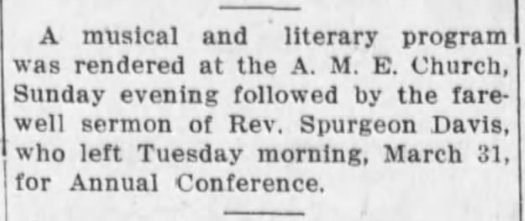
Spurgeon Davis apparently was ordained as an A.M.E. minister prior to 1910. He headed west to a post in Kansas City, Missouri:

kc-mo-sun-1-31-1914

Kansas City Sun, 31 January 1914.

But did not stay long:

sun-4-4-1914

Kansas City Sun, 4 April 1914.

Davis fetched up in Rome, Georgia, but his stay there was even shorter and considerably less welcome:

atl-con-9-26-1914

Atlanta Constitution, 26 September 1914.

This escapade called for some reinvention. Davis cut his ties with the A.M.E.’s and reemerged as a Baptist preacher …

screen-shot-2016-12-10-at-8-46-50-am

New York Age, 11 January 1917.

… and headed back South.

On 5 June 1917, Davis registered for the World War I draft in Wilson, and listed his address as 648 West Mulberry Street, Baltimore; his date of birth as 26 July 1887; and his occupation as minister employed by “So. Baptist Convention; white; travelling in South.” He also noted that he was married with two children. Wilson County’s Clerk of Superior Court transmitted the registration to Baltimore.

Shady past notwithstanding, Davis — by now, somehow, a Doctor of Divinity — was a sought-after speaker in North Carolina, as these glowing briefs demonstrate:

screen-shot-2016-12-10-at-8-43-11-am

Wilmington Morning Star, 15 April 1917.

screen-shot-2016-12-10-at-8-35-39-am

The Robesonian (Lumberton), 22 August 1918.

screen-shot-2016-12-09-at-8-25-29-pm

richmond-planet-8-2-1919

Richmond Planet, 2 August 1919.

On 23 April 1919, Davis married Nancy Jones, 27, of Wilson. Though the two obtained their marriage license in Wilson County, the ceremony, oddly, was conducted one county over by Baptist minister J.S. Brown in Rocky Mount. Wilson leading lights F.S. Hargrave and C.L. Darden were two of the official witnesses.

However, this “prince among preachers” was soon on the lam again, having hastily resigned his post in October 1919 as a bigamy scandal erupted.

no-10-30-1919

News & Observer, 30 October 1919.

A more succinct narrative appeared on 7 November in Elizabeth City, North Carolina’s Independent:

screen-shot-2016-12-10-at-8-33-34-am

Davis apparently never returned to Wilson — at least, in any long-term capacity. It is not clear who the Oklahoma wife was. Davis obtained a license to marry Ruth Olivia Jones in Lynchburg, Virginia, on 26 May 1911. The couple, however, are also listed in a District of Columbia Compiled Marriage Index with an 29 April 1912 marriage date.

screen-shot-2016-12-10-at-2-46-16-pm

Washington Times, 29 April 1912. [Note: the Davises, though white-looking, were not “white.”]

Rev. Spurgeon Davis of 139 Pender Street appears in the 1920 Wilson city directory — a volume compiled no doubt before he left town — with no spouse noted. He is not found in the 1920 federal census. However, it seems that Nancy prevailed in the skirmish, for, in the 1923 Montgomery, Alabama, city directory: Davis Spurgeon D Rev (c[olored]; Nancy E) pastor First Baptist Church h[ome] 714 High. And in the 1930 census of Montgomery, Alabama: at 714 South Ripley (an $8000 home he owned), Maryland-born Spurgeon Davis, clergyman; North Carolina-born wife Nancy, 38; and Maryland-born daughter Mary A., 10. Tragedy befell during the Depression decade, however, and in the 1940 census of Baltimore, Maryland: at 111 Railroad Street, public school principal Carrington Davis, 52; brother-in-law Douglas Smith, 45, a baseball team manager; sister Alice Smith, 45, a laundress; brother Spurgeon Davis, 49, a house man working for a private family; and nephew Jarrett Davis, 34, a gardener. (Davis was described as married, though no wife was listed in the household. In a rented house across the street at 112 Railroad, however, was North Carolina-born Nancy Davis, 44, described as divorced.) In 1942, Davis registered for the World War II draft. Per his registration card: he resided in Chattolanee, Baltimore, Maryland; he was born 28 July 1887 in Chattolanee; his contact person was Mrs. Alice Smith of Owings, Maryland; and his employer was Mrs. Horace White of Garrison, Maryland. I have not found record of his death.

From a history of Jackson Chapel First Missionary Baptist Church, a photograph of Rev. Davis. From the text: “The Reverend A.L. Weeks and the Reverend Spurgeon Davis were those to follow the Reverend [M.A.] Talley. In 1919, the mortgage on the new edifice was burned as a result of a great financial effort engineered by Reverend Davis, supported by the officers and members.” There was that, at least.

screen-shot-2016-12-10-at-1-40-10-pm

A continuation of the bad feelings.

This article captures the apparent exasperation of Wilson school officials with the sizable “element” of the African-American community that refused to send its children to public school after Superintendent Charles Coon slapped a black teacher. The “Anti-Reidies” appointed local pastors Robert N. Perry and Spurgeon D. Davis to head their new schools at such time as they were able to open. (An occasion the health department was doing its part to thwart.) The basis of black opposition to J.D. Reid is sorely understated here, and the Reidites claim of public dislike of successor Clarissa Williams misses a larger problem with Reid himself. (Reid rebounded from this setback with a key role in the establishment of Wilson’s only black-owned bank, only to fall again spectacularly.) See here for a fuller account of the Mary Euell incident and its aftermath.

The Independent School (one, not two) in fact opened a week after this article ran and operated for the next ten years.

no-10-7-1918

News & Observer (Raleigh), 7 October 1918.

His usual success attended him.

hood552

REV. J. H. MATTOCKS.

J. H. Mattocks joined the church at New Berne, N. C., in 1868. He was licensed to preach in 1872, and in November the same year was sent to the Annual Conference at Wilmington, N. C., as a delegate, and was also recommended by his Quarterly Conference as a candidate for membership. He was admitted and ordained a deacon. His first appointment was the Onslow Mission. He succeeded in organizing three churches, as follows: Young’s Chapel, on New River, Burnett’s Chapel, and Topsail Sound Mission. His salary for the first year was $16.25 collected from the people and $2.50 from the Mission Fund. In 1874 he was sent to the Redding Springs Circuit, composed of three congregations worshiping under bush arbors, with sixty members in all. He bought lots and built at each place, and also organized the Jonesville, Hudson Grove, and Pineville Churches. At the close of three years’ labor he left the circuit with thirteen hundred members. He was ordained elder in 1877, and was appointed to the Mooresville Circuit, but was soon after sent to the Henderson Circuit, which Rev. R. D. Russel had to give up on account of sickness in his family. This was a strong Baptist section. The ministers who had preceded Brother Mattocks had thought it not best to attack the Baptist doctrine, and, though they had succeeded fairly well, yet when they had large revivals the Baptists would get more than half their converts. Brother Mattocks boldly defended the Methodist doctrine, and the result was that he held nearly all of his converts and baptized them by sprinkling, which was a very unusual thing in that section. The effect of his teaching remains till this day. In 1878 and 1879 he espoused the temperance cause with great success, and was elected chaplain of the Good Templars.

In 1879 he was appointed to Clinton Chapel, New Berne. In 1871 he was appointed to Washington, where his usual success attended him, and the church was greatly improved during his administration. In 1882 he was sent to Goldsboro. The church there at that time was in a languishing condition. Rev. Mattocks remained three years, during which time there were 185 persons converted and 217 added to the church. In 1885 Rev. Mattocks was made presiding elder, and labored in that capacity for three years. In 1888 he was relieved of the presiding eldership at his own request and was appointed pastor of the church at Wilson. In 1891, he was transferred to the Central North Carolina Conference and appointed to Fayetteville, N. C., where he served acceptably for one year, and was next appointed to Monroe. In 1892 he was appointed Presiding Elder of the Concord District. He is a successful presiding elder. He has common sense in a large degree, is earnest and honest. He has filled all positions in his Conference — secretary, statistical secretary, recording secretary, compiler and publisher of the Minutes, and Conference steward. He has been frequently elected as fraternal delegate to other Conferences, and has been a delegate to every General Conference since and including 1880. He read a strong paper on the subject of the presiding elder system at the General Conference in 1880. He is conservative, and can always be depended upon to support sensible measures and oppose foolish ones.

From J.W. Hood, One Hundred Years of the African Methodist Episcopal Zion Church; or, The Centennial of African Methodism (1895).