Oakdale cemetery

Trustee’s sale of Suggs’ land.

201805171459159839.png

Wilson Daily Times, 12 October 1928.

Trustee J.S. Duncan posted a notice of the sale of three lots on which Daniel C. Suggs and wife Mary A. Suggs defaulted payment.

The first lot was one and a half acres between Railroad Street and the Atlantic Coast Line Railroad, adjacent to Contentnea Fertilizer Factory.

The second lot was six acres north of Contentnea [Cemetery] Street adjoining Calvin Blount, John RatleySamuel H. Vick, and “the colored cemetery.”

The third lot was at the intersection of Railroad and Suggs Streets.

The town’s property on Cemetery Street?

Screen Shot 2020-03-29 at 10.05.27 PM.png

NOTICE: I am speculating here.

This is a plat map, labeled “The Town of Wilson Property on Cemetery Street,” showing the subdivision of a parcel of land into 79 lots and several blocks of unnamed streets. I do not have access to the deed recording the city’s purchase of this tract. Moreover, the exact location of this tract today is difficult to determine. However, the date of map — October 1942, eleven months after the exhumation of graves from Oakdale cemetery — suggests to me that this is the cemetery land that the city “condemned … to build several roads through it.”

Cemetery records request update, no. 6: the removal of graves from Oakdale cemetery.

Here’s my most recent request for public records, made 25 February 2020 to the Wilson Cemetery Commission:

Under the North Carolina Public Records Law, G.S. §132-1, I am requesting an opportunity to inspect or obtain copies of the following public records related to the Old Negro Cemetery (also known as the colored cemetery, Oakdale or Oaklawn Cemetery) and Rest Haven Cemetery:

  • Any and all documents showing the identity of persons buried in the Old Negro Cemetery during the period of its active existence
  • Any and all documents related to the Old Negro Cemetery
  • Any and documents showing the identity of persons whose graves were moved from the Old Negro Cemetery to Rest Haven Cemetery in or before 1941
  • Any and all documents, including but not limited to maps, plats, surveys and photographs, showing the location of graves and grave markers in the Old Negro Cemetery at the time the City of Wilson or the Cemetery Commission moved graves from the Old Negro Cemetery to Rest Haven Cemetery in 1941
  • Any and all documents, including but not limited to maps, plats, surveys and photographs, showing the relocation of graves and grave markers to Rest Haven Cemetery from the Old Negro Cemetery in 1941

Oakdale was the cemetery located near present-day Cemetery Street. The request was spurred by this article.

The reply? The Cemetery Commission has no documents responsive to this request.

Timeline of Wilson’s African-American cemeteries.

Between 1865 and 1975, African-Americans in the town of Wilson buried their dead in at least eight cemeteries — two in the area of present-day Cemetery Street and six along what is now Lane Street. From 1895 to about 1925, five of the cemeteries operated simultaneously. They often were referred to collectively and interchangeably as “the colored cemetery.” Similarly, the three cemeteries on the eastern end of Lane Street are colloquially known collectively as “Rountree cemetery,” though Rountree is but one of the three.  I’ve created this timeline to better understand the arcs of their usage, which, at this point, are baffling.

——

1870 — Washington Suggs purchased a lot adjacent to “the grave yard lot” and the African church. Suggs’ land was south of downtown between the railroad and what is now Pender Street. [Was this an African-American cemetery? If so, when was it established? If not, where were mid-nineteenth century black folk buried? It seems to have been located in the same general area as the later Oakdale cemetery.]

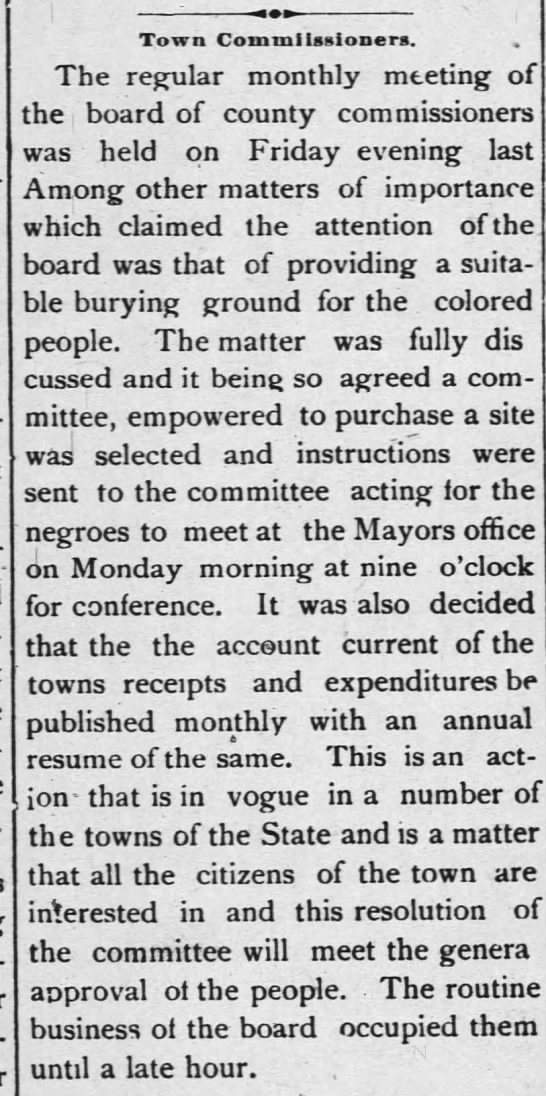
1895 — Per the 4 July Wilson Daily Times, the county commissioners took up the question of a “suitable burying ground for the colored people.” [Was there none? Or was it that the old one had been “unsuitable”?]

1897-1899 — The Funeral Register of Wootten and Stevens, Undertakers of Wilson, North Carolina, November 18, 1896-June 27, included burials of African-Americans, dozens of whom were interred in Oakdale (in one instance, called Oakwood) and generically labeled “colored” cemeteries, as well many rural graveyards.

1897 — Trustees of Rountree Missionary Baptist Church bought one acre of land “beginning at a stake on the path leading from the Plank road to the Stantonsburg road where a small branch crosses said path.” [This appears to be the half of Rountree cemetery that lies on the northwest-side of present-day Lane Street. The widening of the street for paving in the 1990s reduced the size of this lot.]

1896 — Rev. Owen L.W. Smith purchased from the Town of Wilson, in the person of Mayor John F. Bruton, lot 7, F Street, Section North, of Oakdale Cemetery (col’d). [This is the only evidence I have found of a formal layout for Oakdale.]

1897 — As reported in the 1 October 1897 issue of Wilson Daily Times, the Town of Wilson “paid on the account of Oakdale Cemetery 49.20.”

1900 — On October 8, Mount Hebron Lodge No. 42, Prince Hall Masons, purchased a lot from Cain and Margaret Artis near the Colored Graded School, Charley Battle, Cain Artis and Daniel Vick. [This is the Masonic cemetery. I was initially confused by the reference to the school, but a contemporaneous topographic map shows that Lane Street once extended parallel to Nash Street, across then-open fields, to meet Stantonsburg Street [now Pender] at the approximate location (and in the path of) today’s Black Creek Road. ]

1904 — The topographic map of Wilson shows empty spaces at the locations of Oakdale, the Masonic and Rountree cemeteries.

1906 — Trustees of Rountree Missionary Baptist Church bought one acre of land bordering a canal [Sandy Creek.]

1908 — The Wilson city directory listed Oaklawn cemetery (colored) on Cemetery Road near the Atlantic Coast Line Railway, Berry Williams, keeper.

1908 — T.M. Fowler’s bird’s-eye map of Wilson shows only a blank expanse of ground above and below Cemetery Street.

1908 — On February 17, F.W. and Mattie B. Barnes sold Samuel H. Vick ten acres in Wilson township adjacent to the Rountree church lot on what is now Lane Street. The purchase is recorded in Deed Book 81, Page 196. On an unknown date, Vick is believed to have sold Hannibal Lodge #1552, Order of Odd Fellows about two acres, upon which it established its cemetery. The lodge apparently never filed a deed for the purchase. The Vick Family Cemetery is in Odd Fellows Cemetery, with several marked graves predating Vick’s purchase of the land. Presumably, these graves were moved from elsewhere, most likely Oakdale Cemetery.

1909 — Calvin Blount‘s will referred to a one-acre lot adjacent to G.W. Sugg, Cater [Daniel C.] Sugg, and the colored cemetery.

1910 — On July 15, the Daily Times reported Henry Hagans‘ escape through the colored cemetery [Oakdale/Oaklawn] after shooting a woman.

1911 — On December 12, the Daily Times reported two commissioners had been appointed to investigate complaints about drainage problems at the colored cemetery. [This would have been Oakdale/Oaklawn.]

1912 — The Wilson city directory listed Oaklawn cemetery (colored) on Cemetery Road near the Atlantic Coast Line Railway, Blount Moore, keeper.

1913 — The town of Wilson purchased 7.84 acres from Samuel and Annie Vick adjacent to the “colored Odd Fellows cemetery track.” This parcel was the remainder of the ten acres Vick had purchased from F.W. Barnes in 1908. [After less than 20 years, Oakdale/Oaklawn was not only experiencing serious drainage issues, it also was crowded and becoming hemmed in by residential expansion.]

1916 — The Wilson city directory listed Oaklawn cemetery (colored) on Cemetery Road near the Atlantic Coast Line Railway.

1922 — The Wilson city directory listed Oaklawn cemetery (colored) on Cemetery Road near the Atlantic Coast Line Railway.

1923 — The plat map of D.C. Suggs‘ property shows a blank area labeled “colored cemetery.”

1924 — Per 1940 news article, the last burial in the Cemetery Street cemetery took place in this year.

1925 — The Wilson city directory listed Oaklawn cemetery (colored) on Cemetery Road near the Atlantic Coast Line Railway.  The Business Directory section lists only Maplewood under the “Cemeteries” heading.

1925 — A soil survey of Wilson County shows the Masonic cemetery and a combined Rountree/Odd Fellows/Vick cemetery, but not Oakdale.

1925 — Per an article published in the Daily Times on February 10, Samuel H. Vick requested that city board of aldermen provide an awning for the colored cemetery [likely, Vick] and repair roads leading to it. An alderman noted that the “old cemetery” [Oakdale] was on valuable land.

1925 — Per notice published in the Daily Times on December 2, a trustee offered for sale a lot owned by Nathan Hines south of Suggs Street “beginning at a corner near a ditch on the South East corner of the colored cemetery on Sugg Street.” [Suggs Street runs parallel to and a block north of Cemetery Street.]

1927 — Per notice published in the Daily Times on July 16, a trustee offered for sale six acres owned by D.C. Suggs and wife, north of Contentnea Street [Cemetery Street, see below] and adjoining the Calvin Blount land on the west, John Ratley and S.H. Vick on the east, and the colored cemetery and A.S. Woodard on the north.

1928 — Oaklawn is no longer listed in the Wilson city directory, and no “colored” cemetery is listed under the heading in the Business Directory section.

1930 — Oaklawn is not listed in the Wilson city directory, and no “colored” cemetery is listed under the heading in the Business Directory section.

1932 — In a notice of sale published on March 31 in the Daily Times, a lot is described as beginning at the corner of S.H. Vick and Dollison Powell‘s land on “the colored Masonic Cemetery road.”

1933 — The City of Wilson purchased 38 acres from the Jesse R. Barnes family to establish Rest Haven cemetery. See also here.

1937 — Per letter and article published on September 24 and 30 by the Daily Times, Camillus L. Darden and others requested paving of the road leading to the “negro cemetery.” [This is most likely a reference to Vick cemetery.]

1940 — On August 30, the city manager published in the Daily Times a notice of removal of graves from the abandoned cemetery on Cemetery Street, in which there had been no burials in 16 years, to “the new cemetery for the colored race, situated near the Town of Wilson, N.C., and known as Resthaven cemetery.”

1941 — On November 6, the Daily Times published a brief article on the removal of graves from the old Negro cemetery [Oakdale] to Rest Haven cemetery.

1941 — Cemetery Street had been called Contentnea Street as far back as 1922 (see above), but the change apparently was not made official until graves were moved from Oakdale to Rest Haven. The change did not take; Cemetery Street was so-called in both the 1941 and 1947 city directories and still is today.

Wilson Daily Times, 7 November 1941.

1949 — On November 7, the Daily Times reported a dispute between Harry Howell and Carl Ward, who each purchased the same plot in the colored cemetery in 1934. Howell had recently requested that the cemetery commission remove Ward’s wife from the lot and place her body in another. [This dispute likely involved Vick cemetery, but maybe Rest Haven.]

1953 — On January 8, the Daily Times reported that farmer J.J. Skinner found a stolen safe “at the old colored cemetery just outside Wilson.” Skinner, who lived nearby, had cut through the cemetery on the way to his fields. [This was likely Rountree/Odd Fellows/Vick cemeteries.]

1953 — The heirs of Harry Clark sold three tracts of land to the Cemetery Commission for the expansion of Rest Haven cemetery.

1958 — On February 10, the Daily Times reported a stolen truck abandoned on a rural road “near the old Colored cemetery one mile east of Wilson.” [This, too, was likely Rountree/Odd Fellows/Vick.]

1967 — On June 10, the Daily Times ran a photograph of dumping at “Rountree cemetery.”

1969 — On March 3, the Daily Times ran a notice seeking volunteers for a clean-up at Rountree cemetery.

1983 — Per a 19 May 1996 Daily Times article, the Cemetery Commission “heard” the city owned Vick in this year and spent $10,000 on a partial clean-up.

1985 — A man jogging on Lane Street found human bones exposed in a ditch.

1989 — On February 18, the Daily Times ran a full-length feature article on Ben Mincey‘s attempts to maintain Odd Fellows cemetery.

1990-1991 — The city cleared Vick cemetery with a bush hog and began public discussions about clean-up and maintenance.

1994-1996 — As detailed here and here, the city cleared Vick cemetery of grave markers, graded the site, and erected a single monument commemorating all buried there. The grave markers were originally to be replaced in the cemetery, but city officials later decided to store them in an unknown location.

1996-2022 — City contracted out the maintenance of Vick Cemetery, which consisted primarily of cutting grass and filling in low areas with dirt.

ca. 2003 — Gravestones removed from Vick are believed to have been destroyed.

2015 — Wilson County Genealogical Society published Wilson County Cemeteries, Vol. V: The Two City-Owned African-American Cemeteries, containing alphabetical listings of 11,472 burials in Rest Haven cemetery and 650 burials in “Rountree-Vick” cemetery. The latter were largely derived from death certificates issued in the 1940s to 1960s. Though an admirable and worthwhile effort, the Rountree-Vick list is a vast undercount and does not accurately reflect actual burial locations, as individuals may have been buried in Rountree, Odd Fellows, or Vick.

2020 — In response to Public Records Law request, the city of Wilson confirms that it cannot produce any record of the identities of those whose grave markers it removed from Vick cemetery or provide any documentation of the decision to destroy those markers.

2020 — On December 15, Lane Street Project volunteers locate the graves of Samuel H. Vick and his wife Annie Washington Vick in Odd Fellows cemetery.

2021 — Beginning the weekend of the Martin Luther King Jr. holiday, LSP volunteers begin regular clean-ups in Odd Fellows cemetery. Season 1 extends to May.

2022 — On October 21, the City of Wilson deeds Vick Cemetery to Cemetery Trustees of the City of Wilson. The transaction is recorded at Deed Book 2990, Pages 678-679. The Cemetery Commission assumes maintenance for Vick, resulting in improved appearance over the next several months as the ditch is cleared and overgrown trees and shrubs around the central monument are pruned or removed.

2022-23 — LSP clean-ups continue in Odd Fellows.

2022 — In June and July, New South Associates conducts a ground-penetrating radar (GPR) survey of Vick Cemetery.

2023 — After a public records request, on April 28, the city of Wilson releases the GPR report, which identifies at least 4,224 grave anomalies in Vick Cemetery. On May 11, at the request of LSP, Mayor Carlton Stevens arranges an open forum at which Lisa Y. Henderson shares results of the survey with the public. On June 29, New South returns to Vick Cemetery to mark graves lying on the cemetery’s borders.

2023 — Working with LSP, on August 5, faith leaders reconsecrate Vick Cemetery in a public ceremony.

The removal of graves from Oakdale cemetery.

Wilson really has not done right by its dead.

Screen Shot 2020-02-19 at 8.26.18 PM.png

Wilson Daily Times, 6 November 1941.

Some notes:

  • “the town had condemned the land to build several roads through it” — No mention of poor drainage conditions in the cemetery. Rather, a suggestion that the unnamed city alderman’s 1925 comment about the cemetery occupying valuable land had gained traction.
  • “the old negro Wilson cemetery over near Stantonsburg street” — Stantonsburg Street (now the lower section of Pender Street) ran just east of the cemetery.
  • “Dozens of graves” were moved to “the newer Rest Haven cemetery” — There were surely hundreds of people, not dozens, buried in Oakdale. Were unmarked graves left behind? Does the Cemetery Commission have records of this disinterment and reburial in Rest Haven?
  • “Most recent grave in the old cemetery that could be found was dated 1902” — This can only be true if they were not looking hard. The notice of removal of graves, published in 1940, stated that the last burials were in 1924.
  • “the cemetery is at least 50 years old.” — This roughly corroborates the founding of Oakdale as 1895, when county commissioners took up the question of a “suitable burying ground for the colored people.”

A list of known burials in the Colored Cemetery, also known as Oakdale or Oaklawn.

In 1895, county commissioners took up “a matter of importance,” the issue of “providing a suitable burying ground for the colored people” (which suggests that the old burial ground was critically unsuitable.) The location of the “new” cemetery is memorialized in the name of Cemetery Street. It was variously called the colored cemetery, Oaklawn, Oakland and, most commonly, Oakdale cemetery.

Most of the burials below were gleaned from the records of undertakers Wootten & Stevens. Oakdale accepted burials until the 1920s, but is rarely designated on death certificates. Prior to World War II, those records most often referred to “colored cemetery,” which could have been Oakdale, Rountree, Odd Fellows, Masonic or Vick cemeteries.

  • Barham, Hattie. Wilson. Died 30 April 1898, aged 22 years, of consumption. Wife of Alex Barham. Church funeral and burial at Oak Dale cemetery.
  • Barron, Alex. Wilson. Died 22 March 1899, aged 30 years, of consumption. Funeral at house. Burial in Oak Dale cemetery.
  • Battle, Turner. Wilson. Died 16 January 1899, aged 46, shot to death. Burial in Oakdale cemetery.
  • Beckham, Junius. Wilson. Died 24 September 1898, aged 9 months, of pneumonia. Burial in Colored Cemetery.
  • Best, Edward. Wilson. Died 29 May 1898. Funeral at Church. Burial in Oak Dale cemetery.
  • Best, Sylvia. Wilson. Died 17 May 1897, aged 65 years, of consumption. Mother of Ben Best. Funeral at home. Burial in Oak Dale cemetery.
  • Boykin, [no first name]. Wilson County. Died 18 November 1896, aged 8 months. Child of John Boykin. Burial in Oak Dale cemetery.
  • Bullock, Gladiss. Wilson. Died 10 October 1897, of brain fever. Funeral at home. Burial at Oak Dale cemetery.
  • Bynum, Lucy. Wilson. Died 12 November 1898, aged 75 years, of old age. Mother of Wright George Cooper and Amos Bynum. Burial in Oakdale cemetery.
  • Campbell, Fanny. Near Wilson. Colored. Died 25 August 1897, of worms, aged 4 years, 8 months. Buried in Oak Wood cemetery.
  • Cherry, Flora. Died 11 September 1898.  Funeral at church. Burial in Oakdale cemetery. “Flora Cherry was a member of the Burial Association and [was] buried by said Association.”
  • Clayton, Lucy. Died 23 September 1897, aged 1 month, 14 days. Burial in Oakdale cemetery.
  • Darden, Olive Oleta. Wilson. Died 6 April 1898, age 5 months 11 days, of bronchitis. Daughter of Charlie and Diana Darden. Funeral and burial at Oak Dale cemetery.
  • Farmer, _____. Wilson. Died 14 January 1899, of croup. Billed to John Wash Farmer. Buried in Oakdale cemetery.
  • Freeman, James. Wilson. Died 21 May 1899, age 29 years 2 months 10 days, of consumption. Buried in colored cemetery.
  • Gaffney, Andrew. Wilson. Died 6 January 1898. Billed to brother William Gotny [Gaffney]. Buried in colored cemetery.
  • Hill, Edgar. Wilson. Died 20 October 1897, age 16 years, of consumption. Son of Henrietta Hill and brother of Richard Norwood‘s wife. Funeral at home. Burial at Oak Dale cemetery.
  • Jackson, Rosa. Wilson. Died 5 July 1898, age 10 months, of cholera infantum. Child of Jos. S. Jackson.  Funeral at home. Buried colored Oakdale cemetery.
  • Jenkins, Annie Monite. Wilson. Died 20 May 1899, aged 24 years, of consumption. Daughter of Monite Jenkins. Buried Oak Dale cemetery.
  • Jones, Estelle. Wilson. Died 20 December 1896, age 9 months of fever. Buried at colored cemetery.
  • Jones, Gillie. Wilson. Died 31 October 1897, age 51 years, of bowel consumption. Wife of Alex Jones. Funeral at home. Buried at Oakdale cemetery.
  • Jordan, Ned. Wilson. Died 2 February 1898, age 65 years. Father of Charlotte Aycock. Buried in colored cemetery.
  • Lindsey, Frank. Wilson. Died 31 December 1898, age 27, of dropsy. Funeral at home. Buried at Oakdale cemetery. Billed to William Lindsey.
  • Mabry, James. Wilson. Died 15 June 1897, of consumption. Buried in colored cemetery. Bill to L.A. Moore.
  • Matthews, Tom. Wilson. Died 28 May 1899, age 37 years. Buried in colored cemetery. Billed to Town of Wilson. “Killed by Policeman George Mumford in the discharge of his duty. Coroner’s Inquest gave the above verdict.”
  • Mobley, Isaac. Wilson. Died 4 March 1899, age 21 years, of consumption. Buried in Oakdale cemetery.
  • Moore, ____. Wilson. Died 23 July 1898. Wife of Andrew Moore. Buried in colored cemetery.
  • Moore, ____. Wilson. Died 25 August 1898. Child of Henry Moore. Funeral in Methodist church. Buried in colored cemetery.
  • Moore, Lelia. Wilson. Died 6 February 1897, age 3 months, of a severe cold. Buried in Oak Dale cemetery. Billed to Bryant Moore.
  • Newkirk, Fenner. Wilson. Died 18 July 1897, age 28 years, of brain fever. Billed to Bettie Newkirk. Buried at Oak Dale Cemetery.
  • Parker, Harriet Jones. Wilson. Died 26 May 1898. Billed to Doane Herring. Burial at Oak Dale cemetery.
  • Parker, Stanley. Wilson. Died 2 August 1898, age 65, of old age. Funeral at home. Buried at Oak Dale cemetery.
  • Ransom, _____. Wilson. Died 19 February 1897 of “locked bowels.” “Was barber for long time.” Funeral at church. Buried in colored cemetery. Billed to Colored Odd Fellows. [Probably Hugh T. Ransom.]
  • Rogers, Marion L. Wilson. Died 26 April 1898, aged 5 months. Son of Wesley Rogers “who works with the American Tobacco Co.” Buried in colored cemetery.
  • Rowe, Annie Bill. Wilson. Died 16 August 1898, aged 3 months 16 days. “Child was left by her mother with Ben Parks and never came back.” Buried in old colored cemetery.
  • Sharp, _____. Rocky Mount.  Died 14 January 1899. Daughter of Sampson Sharp. “Died at Rocky Mt. & was brought to Wilson for interment.” Burial in Oakdale cemetery.
  • Sharp, Nellie. Wilson township. Colored. Died 20 December 1897, aged 58 years. Buried in Oak Dale cemetery. Billed to Wilson Sharp.
  • Simms, _____. Wilson. Died 9 May 1898, of pneumonia.  “Simms was a young man who had the misfortune to get both feet cut off by a R.R. train.” Buried in Oak Dale Cemetery. Billed to Lee Moore.
  • Stallings, Mary. Wilson. Died 15 June 1898, deranged, aged 20 years, 19 days. Funeral at home. Buried in “old section” of Oakdale cemetery. Billed to Gilbert Stallings.
  • Strickland, _____. Wilson.  Died 8 June 1899. Wife of Marcellus Strickland. Buried in colored cemetery.
  • Sugg, _____. Wilson. Died 4 April 1898, age 22, of fever. Billed to Haywood Best. Buried in Oakdale cemetery.
  • Sutton, William R. Wilson. Colored. Died 4 August 1897, aged 6 months. Child of Aider Sutton.  Funeral at church. Burial in old cemetery.
  • Thompson, Arthur. Wilson. Colored. Died 12 May 1897, of cold and measles, aged 1 year 3 months. Son of Isaac Thompson. Buried in Oak Dale cemetery.
  • Thorp, _____. Colored. Died 27 February 1897. Length 2’6″. Buried in colored cemetery. Billed to Edith Thorp.
  • Towe, _____. Wilson. Colored. Died 23 April 1899. Child of George W. Towe. Buried in colored cemetery.
  • Towe, Maggie I. Wilson. Colored. Died 15 April 1899, aged 39 years 4 months 18 days, in childbirth. Wife of Prof. G.W. Towe, a “teacher in the Col. Graded School.” Funeral in Methodist Church. Burial in colored cemetery. [Maggie Towe’s grave was moved to Rest Haven, where her headstone now stands.]
  • Vick, Viola Leroy. Wilson. Colored. Died 7 September 1897, of malarial fever, aged 2 years 10 months. Daughter of S.H. Vick. Buried in colored cemetery. [Viola Vick’s headstone was recently discovered in Odd Fellows cemetery in the Vick family plot. She was likely disinterred and reburied to that location.]
  • Wilkins, Mary. Wilson. Colored. Died 27 March 1899, age 43, of “internal tumor.” “Mary was wife of Redmond Wilkins, was in bad health for a long time, was a good woman.” Billed to Col. Mason. Buried in colored cemetery.

Which colored cemetery?

Green Mercer died 17 January 1910 at the Wilson County Home, which housed indigent people. Mercer, who was married and whose regular address was on Church Street, had been in “general bad health” for several months. Though just 69, he was described as a “very old negro” for whom no family information was available. Undertaker John W. Quinn buried Mercer in the “Wilson N.C. Colored Cemetery.”

But which colored cemetery?

By 1910, there were four in Wilson — Odd Fellows, Rountree, Masonic and the “old” cemetery, sometimes called Oaklawn or Oakdale, which was established after Emancipation near Cemetery Street south of downtown. The Odd Fellows and Masonic cemeteries seem to have been restricted to burials of lodge members and their families, and Rountree was probably intended originally for Rountree Missionary Baptist church members. (The land now known as Vick cemetery was still an undeveloped tract owned by Samuel H. Vick in 1910.)

It’s likely that Green Mercer, and other African-Americans with no ties to a masonic order or Rountree who died in Wilson up to the early 1920s, were buried in the “old” cemetery. In 1940, the city moved — or said it moved — graves from this cemetery to the newly opened Rest Haven cemetery.

S123_21-0285.jpg

——

On 24 August 1866, Green Mercer obtained a license to marry Margarett Wilkins in Edgecombe County.

In the 1870 census of Cokey township, Edgecombe County: farm laborer Green Mercer, 27; wife Margaret, 27; children Fanny, 3, Major Totten, 1, and Frederick Cotton, 54, Randal Parker, and Louisa Ruffin, 21.

In the 1880 census of Cocoa township, Edgecombe County: farmer Green Mercer, 42; wife Margarett, 37; and children Reden, 15, Fannie, 14, Tatin, 11, William, 8, and Joseph, 3.

In the 1900 census of Wilson, Wilson County, Green Mercer, 50, widower, is listed as a servant in the household of Arthur Farmer, 73.

On the agenda.

This 1925 Daily Times article detailed the business of a single February city aldermen’s meeting. First on the agenda, the Wilson Colored Hospital. The article listed the white members of the hospital’s board of trustees first, then noted its African-American members — S.H. Vick, J.D. Reid and “Permillus” [Camillus] Darden. After some discussion, the “the Board” decided to reinstate the city’s $75/month appropriation to the hospital, which had been discontinued the previous September.

Screen Shot 2018-02-13 at 7.44.47 PM.png

The trustees stated that the hospital was “a necessity among the colored people of the city, and that many of them would be without treatment but for the institution.” Alderman Daniel asked if the trustees had personal knowledge that “the affairs of the institution were properly administered.” Dr. C.A. Woodard responded that “no institution of this kind made any money, and that they understood the disadvantages under which those connected with it were laboring.” Hospital management agreed to file monthly reports to the city.  Trustee F.N. Bridgers invited the city to appoint a member to the board, and J.D. Reid noted that alderman Graham Woodard had been asked. Woodard acknowledged the invitation, but cited a busy schedule.

Screen Shot 2018-02-13 at 7.45.41 PM.png

Hospital business satisfactorily concluded, Vick broached another subject — street lights. Would “the city extend its Whiteway below the railroad to the Baptist church, at the corner of Nash and Pender Streets”? A lighted north side and dark south did not present a good look to voyagers passing through on trains. The aldermen referred the matter to the Water and Light Commission. The Business Men’s League and the J.C. Price Literary Society endorsed the project, Vick added. (Joseph C. Price “taught here fifty years ago and afterwards founded Livingstone College.”) Mayor Lucas raised another point: lighting would help the police do their job. One had been killed and another nearly so in “pistol duels in that section of the city.”

Screen Shot 2018-02-13 at 7.46.51 PM.png

Vick raised item number three — the colored cemetery. Would the city place an awning and also fix the roads so people could get in and out? Mr. Grantham of the cemetery commission responded defensively: “it was difficult to get the cemetery into a correct shape, and lay it out. The graves had been placed everywhere, and without regard to lines or streets.” Also, “there was some of the land that was worthless for the purpose, as it was a bottom. He spoke of land in the old cemetery which if the graves were removed would be worth considerable money.” Anyway, he agreed to “go over the property and work out some plan to get it in shape.”

Screen Shot 2018-02-13 at 7.47.44 PM.png

No further colored business.

Screen Shot 2018-02-13 at 7.48.29 PM.png

Wilson Daily Times, 10 February 1925.

  • Why had the city discontinued its $75/month allocation in the first place?
  • What did the J.C. Price Literary Society do? When was it founded? Who were its members?
  • When did streetlights finally cross the tracks?
  • For what purpose was an awning needed in the cemetery?
  • “Fix the roads“? What roads led to the cemetery?
  • Were there still burials in Oakdale as late as 1925? Was the question more of access to existing graves than for new ones?


Cemetery lot in Oakdale.

In 1896, Rev. Owen L.W. Smith purchased from the Town of Wilson, in the person of Mayor John F. Bruton, lot 7, F Street, Section North of Oakdale Cemetery (col’d). Oakdale was the mysterious cemetery of Cemetery Street, south of the business district.

This document raises so many questions:

  • Oakdale was a city-owned property. When was it developed? Where are records?
  • Where is “the official plat of said cemetery”?
  • O.L.W. Smith’s family, including members who died shortly after this plot was purchased, are now buried in the Masonic cemetery. Were they, and the countless other burials at Oakdale, exhumed?
  • Why and when did the cemetery close?

Deed Book 46, page 348, Register of Deeds Office, Wilson.

[UPDATE, 18 May 2018 — See here for answers.]

The first colored cemetery.

Modern conventional wisdom holds that Rountree cemetery was the first organized resting place for Wilson’s African-American dead. As I noted here though, Oakdale (also called Oaklawn) cemetery, located south of the stemmeries in Little Richmond predated Rountree.

The cemetery was established by town commissioners about 1895, and Wootten & Stevens undertakers were burying bodies there — at “colored cemetery” or Oakdale cemetery — regularly in the late 1890s.

2

Wilson Advance, 4 July 1895.

Lying hard by Stantonsburg Street, the southern route into town, the colored cemetery was a well-known landmark in turn-of-the-century Wilson.

screen-shot-2017-02-19-at-3-25-50-pm

Wilson Times, 15 July 1910.

However, the site was not propitious and, less than 15 years after it was laid out, poor drainage conditions were leading to complaints.

screen-shot-2017-02-19-at-3-22-11-pm

Wilson Times, 12 December 1911.

 The cemetery remained listed in the 1912 Wilson City directory:screen-shot-2017-02-17-at-6-24-57-pm

Though the record is not clear, it seems that burials ceased at Oaklawn by the mid-1920s. This 1923 plat of land sold for development by D.C. Suggs shows the gap the graveyard created in proposed grid of lots.

Plans_Page_06.jpg

At least some, and presumably all, the graves at Oaklawn were disinterred and moved a few miles east to Rountree or Rest Haven cemetery.

——

  • Blount Moore — In the 1912 Wilson city directory, Blount Moore was listed as keeper of Oaklawn cemetery, residing at 401 Wiggins Street. Bryant Moore, a laborer, was listed at the same address.