Hinnant

The Colored Freemasons buy land at Rocky Branch.

In April 1896, Cherry Hinnant, Henry R. Hinnant and wife Pennie Adella Hinnant, and John T. Revell sold Dock H. Hinnant, Vandorn Hinnant, and Guilford Wilder a parcel of land adjacent to the “colored Christian church,” i.e. Rocky Branch United Church of Christ, and “colored free school” number 12, i.e. the precursor to Rocky Branch School. The Hinnants and Wilder were officers and trustees of Rocky Blue Lodge #56, Prince Hall Masons.

Deed Book 43, page 442, Wilson County Register of Deeds Office, Wilson.

——

  • Dock H. Hinnant — in the 1900 census of Springhill township, Wilson County: farmer Dock H. Hinnant, 35; wife Alice, 30; and children James A., 16, John A., 15, Mary E., 10, Annie M., 8, William R., 6, and Clarence, 5.
  • Vandorn Hinnant — In the 1910 census of Spring Hill township, Wilson County: farmer Vandorne Hinnant, 48, wife Betsy J., 47, and children Ezekiel, 22, Billie, 19, Willie, 13, Oscar, 12, Luther, 10, Regest W., 9, Roland, 8, Ralon, 6, Ollion, 4, and Roy E., 2.
  • Guilford Wilder

Hinnant vs. Wilmington & Weldon Railroad Company.

A search for documents related to Daniel Vick turned up this scrap of paper in William Hinnant‘s estate file.  It’s difficult to interpret without better context clues, but it appears that Offie Battle signed over to Daniel Vick his “witness ticket” — and the fee that came with it — perhaps to pay off or pay down on a debt Battle owed Vick. More interestingly, the file also contained a summary of the testimony in the trial of Amy Hinnant, Administrator for William Hinnant, deceased, vs. Wilmington & Weldon Rail Road Company.

In May 1890, William Hinnant had been fatally injured while attempting to cross the railroad between Nash and Barnes Streets. A train engineer had, Hinnant’s widow alleged in her complaint, negligently allowed an “inexperienced, careless, and incompetent subordinate” to move an engine in a crowded, busy section of track, striking her husband.

The trial unfolded in February 1893. Amy Hinnant testified:

  • She was the wife of William Hinnant.
  • He came home for dinner [what we now call lunch] injured; Rufus Taylor was helping him walk. This was on a Monday.
  • She examined him and found his collarbone and two ribs broken on his left side.
  • He died at 10:30 on Wednesday of the same week.
  • They had been married 19 years and had no children.
  • Her husband was a good provider.
  • He was always healthy except for an occasional cold or backache.
  • They lived in a house he bought. [The house had a mortgage and since been foreclosed on due to her financial state. This testimony was struck.]
  • Her husband was 32 or 33 years old.

R.T. Stevens testified:

  • He assisted the physician in dressing Hinnant’s wounds.
  • His collarbone and two or three ribs were broken on the left side.
  • Hinnant had worked for him for 11 years before he died.
  • Hinnant drove a team for Wootten & Stevens furniture dealers and undertakers, as well as their hearse.
  • When he wasn’t driving, Hinnant worked around the shop packing and unpacking furniture, “dressing bed slats and such.”
  • The team was used for delivering furniture and hauling furniture from the depot.
  • “It required a careful sober hand to do the kind of work he was engaged in. We regarded him as a good careful sober hand.”
  • For three or four years, Hinnant had been paid $4.50 per week. He boarded and clothed himself out of his wages.
  • He guessed Hinnant was about 35 years old.

W.P. Wootten testified:

  • He was a member of the firm Wootten & Stevens (W&S).
  • Hinnant had worked for them for 11 years. He delivered furniture.
  • “His character was good and he was one of the most careful hands I ever knew. He was sober and attentive to business.”
  • Hinnant was never absent except for sickness, and he was not out as much as five days a year.
  • Hinnant’s health was good.
  • Wootten’s business was on the north side of Nash Street and west side of the Wilmington and Weldon Railroad.
  • Hinnant’s house was on the north side of Nash Street and east of the railroad.
  • W&S’ stables were on the south side of Barnes Street, which runs one block west and parallel to Nash.
  • Employees in W&S’ workshops “work by Hackney Bros’ bell” and are allowed 45 minutes for dinner. The bell rings at 12 o’clock.
  • “On the day of the accident, Hinnant carried the horses from the shop to the stable at the ringing of the bell, and put them up and fed them for dinner.”
  • Hinnant had to cross the railroad to get to his home from the stables, a distance of about three-eighths of a mile. The stables were about 300 yards from the shop.
  • Hinnant was about 35 to 40 years old.

Tom Keezer [Keyser] testified:

  • He was hauling corn from a car on the spur track, nearly opposite of where Hinnant was injured.
  • Hinnant was injured on a side track.
  • Keyzer did not witness it, but saw Hinnant immediately after when he was pulled from between the cars.
  • “A colored man by the name of Willis Pearson was switching with an engine on the side track. He was a fireman. He was running back hard against the bumpers trying to make the cars couple.”
  • Stephen Meredith was the engineer of the freight train engine. He was sitting in front of a grocery store about 20 to 30 yards from the railroad crossing when the accident happened.
  • The place where Hinnant was crossing was a regular railroad crossing and was the most direct route home for Hinnant.
  • The engine was north of the crossing.
  • Hinnant was crossing by a footpath generally used by people crossing from the north to the south side of the railroad. Leeper uses the crossing; there is no street there.
  • Keyzer did not think Pearson was ringing the bell or giving any signal.
  • After unloading corn, he crossed Barnes Street to Pettigrew Street, then to Nash Street and was crossing the railroad on Nash when the accident happened.
  • The engine was making more noise than usual.
  • Hinnant crossed between Barnes and Nash Streets, about fifty feet from Nash Street.

Orphy [Theophilus] Battle testified:

  • He was near where Hinnant was injured. He saw him going from Barnes Street across the railroad toward Nash Street on a walking path.
  • The cars were standing still, thirty to forty feet apart, when Hinnant started to cross.
  • No bell was ringing, and no whistle blowing.
  • Willis Pearson, a fireman, was shifting the cars, while engineer Meredith stood under a tree near a grocery store about sixty to seventy feet away. “The cars came back hard.”
  • William Hinnant was a sober, industrious man.
  • Nash Street is “tolerably thickly settled” and many people use the crossing.
  • Battle was sitting in a chair in front of a barber shop looking at the train switching.
  • The engine was making a lot of noise.
  • Battle’s view was obstructed when Hinnant was struck.
  • Hinnant was neither blind nor deaf.
  • Hinnant could have crossed at Barnes Street, but it would not have been as convenient.
  • Battle had been brought before the mayor several times for drunkenness, but nothing else. He drank sometimes, but was sober at the time.

The defendant declined to present evidence.

The court determined that defendant Railroad Company was not negligent; that Hinnant was guilty of contributory negligence; and that the Railroad Company could not have avoided the accident.

After securing a waiver of required security payment, Amy Hinnant appealed.

——

  • Amy Hinnant
  • William Hinnant
  • Tom Keyzer
  • Willis Pearson
  • Theophilus Battle — in the 1880 census of Town of Wilson, Wilson County: Mary Battle, 55, and sons Theophilus, 26, blacksmith, and Blount, 16.

Probate Estate Case Files, Wilson County, North Carolina 1854-1959, http://www.familysearch.org

The remarkable life of Luther Hinnant.

Washington Star, 18 November 1978.

——

In the 1910 census of Spring Hill township, Wilson County: farmer Vandorne Hinnant, 48, wife Betsy J., 47, and children Ezekiel, 22, Billie, 19, Willie, 13, Oscar, 12, Luther, 10, Regest W., 9, Roland, 8, Ralon, 6, Ollion, 4, and Roy E., 2.

In 1918, Luther Hinnant registered for the World War I draft in Johnston County, N.C. Per his registration card, he was born 12 January 1900; lived at Route 3, Kenly, Johnston County; farmed for Vandorn Hinnant; and his nearest relative was Vandorn Hinnant.

Harriet Bernice Hinnant was born 17 February 1919 in Richmond, Virginia, to Luther Hinnant, 20, farmer, of North Carolina, and Hattie Jackson, 27, of 406 Baker Street, public school teacher, of Virginia.

Evening Star (Washington, D.C.), 10 March 1919.

Luther Hinnant, 21, married Hattie M. Jackson, 27, on 21 March 1919 in Washington, D.C.

Luther Hinnant was among 90 pupils awarded diplomas for “complet[ing] the elementary course in the colored night schools” in May 1924.

Evening Star, 29 May 1924.

A summary of house transactions in the 11 July 1925 edition of the Evening Star reported that J.R. Brooks had sold Luther Hinnant the property at 729 Girard Street, N.W. [This Columbia Heights row house, the western half of a duplex, is just a few blocks north of Howard University. Its May 2024 value is $800,000+.]

In the 1930 census of Washington, D.C.: at 729 Girard Street, owned and valued at $7000, Luther Hinnant, 31, cleaner at dry cleaning establishment; wife Hattie M., 33, chambermaid; and daughters Harriet B., 11, and Mildred L., 8.

In 1930, Hinnant received a diploma from Armstrong Night High School:

Evening Star, 30 May 1930.

In the 1940 census of Washington, D.C.: at 729 Girard Street, rented for $50/month, presser Luther Hinnant, 40; wife Hattie, 42, servant; and daughters Harriet, 21, and Mildred, 18.

Richmond Afro-American, 9 August 1947.

In the 1950 census of Washington, D.C.: at 729 Girard Street, Hattie J. Hinnant, 57, beauty parlor maid; wife Luther, 52; and daughters Harriet B., 29, waitress, and Mildred L., 27, elementary teacher.

Washington Star, 22 January 1980.

Cumberland Times-News, 22 December 1992.

Luther Hinnant died 26 March 1998.

The estate of Sampson Hinnant.

Sampson Hinnant was near 60 when sold to his last enslaver in 1861. A year after freedom, he and Mary Boykin formalized their marriage. They apparently did not have children, and Hinnant died in 1878, leaving a small estate. His was one of a relative handful of estates of formerly enslaved people that entered probate in Wilson County in the decades after freedom.

Hinnant’s estate file contains only the record of the widow’s allotment paid to Mary Hinnant for one year’s support. In addition to the harvested crops on hand — potatoes, peas, wheat, “greens” — she received all their furniture, working tools, fodder, four head of cattle, five hogs, and eight barrels (of what?).

The census taker apparently missed the Hinnant household when making his rounds in 1870. Their cohabitation registration and this estate file are the only known documentation of their lives in freedom.

Estate File of Sampson Hinnant, Wilson County; North Carolina Wills and Probate Records, 1665-1998, http://www.ancestry.com.

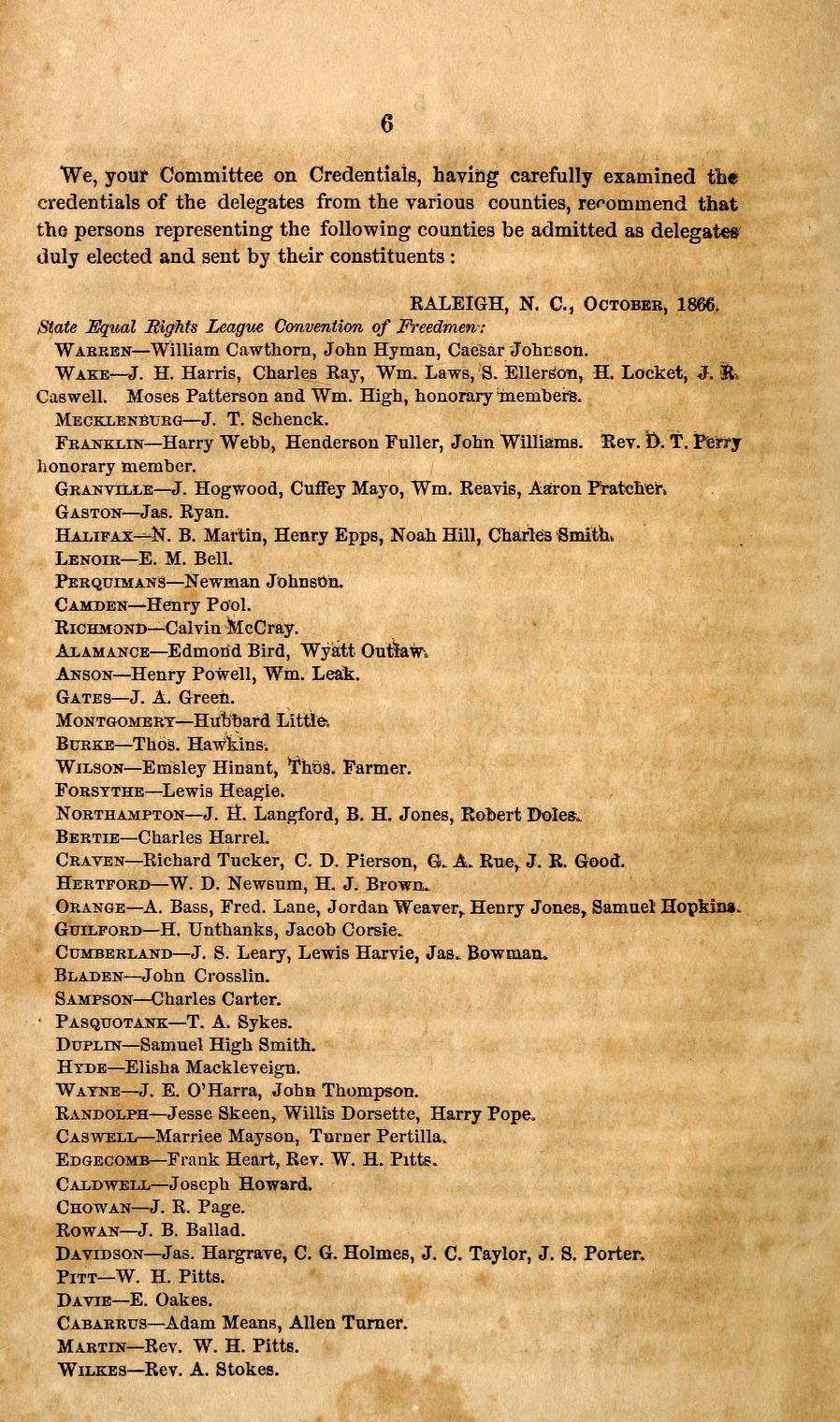
Minutes of the Freedmen’s Convention of 1866.

In October 1866, more than 100 representatives of North Carolina’s Equal Rights Leagues gathered in Raleigh for a convention. Some, like future United States Congressman James E. O’Hara of Wayne County, had been born free. Most, however, were little more than a year into emancipation.

The convention’s minutes show that Wilson County sent Ensley Hinnant and Thomas Farmer to the conference.

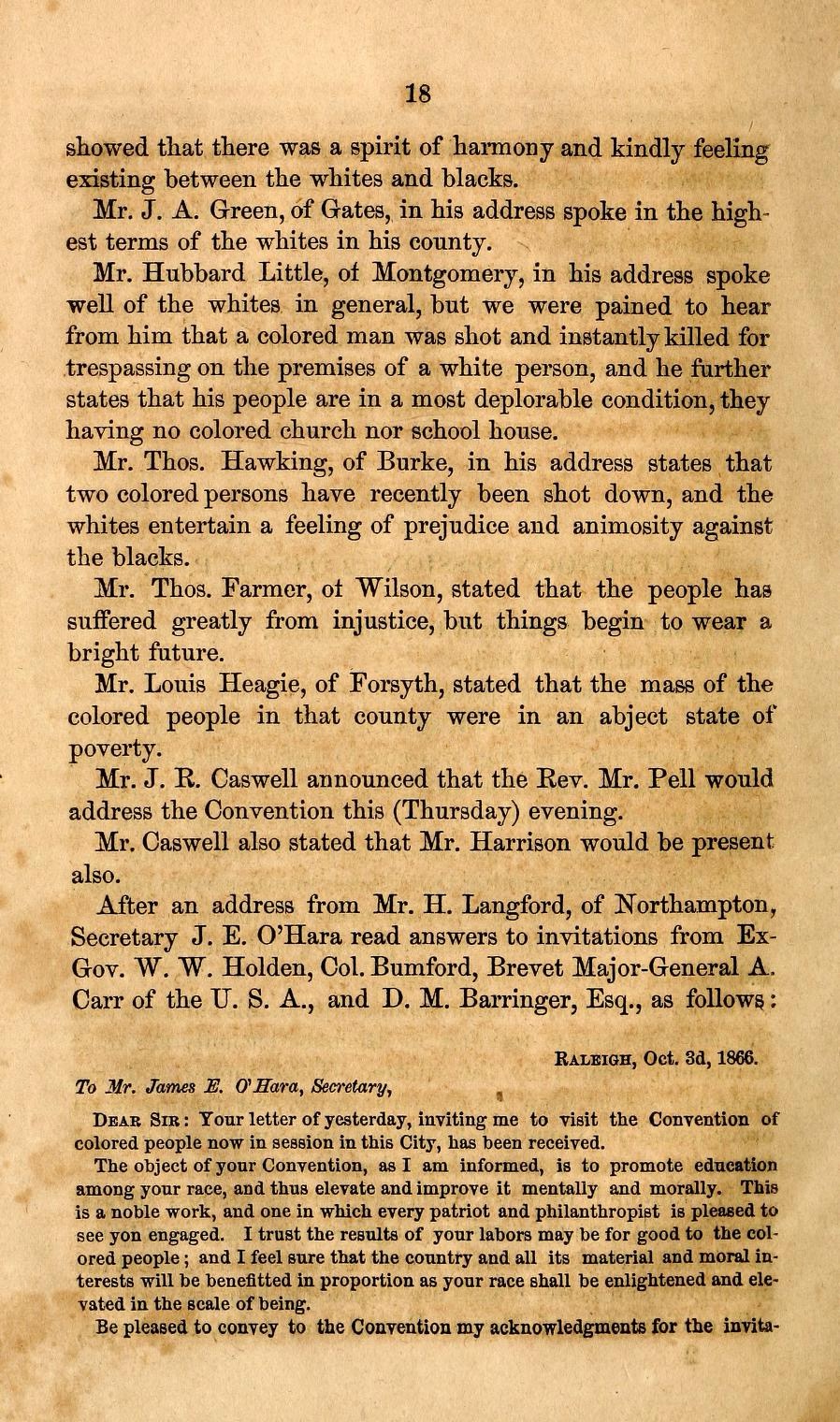
At the October 4 afternoon session, Thomas Farmer of Wilson spoke up to say that “the people has suffered greatly from injustice, but things begin to wear a bright future.”

——-

  • Ensley Hinnant

Ems Hinnant and Kate Reil registered their 11-year marriage with a Wilson County justice of the peace in 1866.

In the 1870 census of Oldfields township, Wilson County: farm laborer Emizel Hinnant, 30, and Harriet, 19, Tamer, 11, Henderson, 13, Mary, 7, Dennis, 8, and Joseph, 1.

On 29 February 1870, Jeff Powell, son of Calvin and Penny Powell, married Carolin Hinnant, daughter of Emsly and Ally Hinnant, at Zilla Locus‘ in Wilson County.

On 20 February 1895, Gray Hinnant, 42, of Oldfields township, son of Martha Williamson, married Tama Hinnant, 35, of Oldfields township, daughter M. and Alley Hinnant, both deceased, at the residence of Thamar Hinnant.

Henderson Hinnant died 7 August 1934 in Wilson township, Wilson County. Per his death certificate, he was 49 years old; was born Wilson County to Enzly Hinnant and Carolina Hinnant; was married to Margaret Hinnant; and lived on Route 3, Kenly.

  • Thomas Farmer

Two adult African-American men named Thomas Farmer appear in the 1870 census. It is not clear which, if either, was the conventioneer.

  • Equal Rights League

Just last week, the incomparable David Cecelski blogged about the unveiling of a state historical marker commemorating the Equal Justice League branch in the Edgecombe County’s Red Hill community in 1866. Cecelski spoke at the ceremony and, in the complete absence of information about Wilson County’s chapter, his words help us understand Hinnant and Farmer’s revolutionary work. To those who made the day possible, Cecelski said, “Through all your efforts, you remind us, at a time when we need reminding, of a time and a place when people who had next to nothing, who were only months out of slavery, and who were surrounded by a thousand perils, found the courage, faith, and determination to fight for a better world for their children and for us all.”

The estate of Elizabeth Hinnant (1855).

When Elizabeth Hinnant made out her will on 10 April 1854, she left to Alvin H. Atkinson “one negroe boy named Joe,” the sole person she enslaved.

At the time she dictated her will, Hinnant lived in Johnston County, but by her death Wilson County had been formed. Loverd Atkinson filed in Wilson County court the inventory of Hinnant’s property shown below. First on the list, ahead of a sorrel mare, a bay horse, and three head of cattle, was Joe.

Atkinson hired Joe out to unnamed persons for 18 days, and then until the following January.

——

On 31 August 1866, Joseph Hinnant and Roda Godwin registered their six-year marriage with a Wilson County justice of the peace.

In the 1870 census of Springhill township, Wilson County: Joseph Hinniard, 30; wife Rodah, 27; and children Vandier, 8, Zadok, 6, Roxy, 4, and James, 1.

In the 1880 census of Springhill township, Wilson County: farmer Joseph Hinnant, 45; wife Rhoda, 43; and children Vandorne, 18, Dock, 16, Rocksey, 14, James T., 12, Toby, 10, Josiah, 8, Leviser, 6, John E., 4, and Martha, 1.

In the 1900 census of Springhill township, Wilson County: James T. Hinnant, 31; mother Rhoda, 59; father Joseph, 70; and sisters Lovisa, 25, Martha, 21, and Mary, 18.

The family would not take him; Darden sold the body to Wake Forest.

Caught rifling through a money drawer, James Hinton lost a shoot-out with a storeowner northwest of Wilson. Though his family gave information for his death certificate, they refused to arrange with Darden Funeral Home for his burial. Following their suggestion, Darden sold the man’s body to the medical school at Wake Forest College.

News and Observer (Raleigh, N.C.), 23 September 1933.

Wilson Daily Times, 26 September 1933.

——

James Hinton [not John or Hinnant] died 21 September 1933 at Moore-Herring Hospital, Wilson. Per his death certificate, he was 45 years old; was born in Wendell, North Carolina; worked as a laborer; and lived at the Biltmore Hotel. Cause of death: “was dead from bullet wound when I saw him shot thru abdomen.” Allie P. Hinton, Wendell, was informant. Written in the margin: “was shot robbing a store.”

The obituary of Eveline Hinnant.

Wilson Daily Times, 7 June 1946.

——

In the 1930 census of Bailey township, Nash County: Thomas Hinnant, 50, farmer; wife Mary, 49; children Robert, 11, Thomas, 8, Jesse, 7, Bennie, 6, Evaline, 3, and Major, 1; and sister Lou Z., 80.  

In the 1940 census of Wilson, Wilson County: at 908 East Vance, widow Mary Hinnant, 54; children Robert, 21, Thomas, 19, Jessie, 17, Bennie, 16, Eveline, 14, and Major, 11; and grandchildren Festus, 16, Blossie, 12, Martha, 11, James T., 8, Clarence, 7, Samuel, 5, Mary R., 1, and George, 6 months.

Everline Hinnant died 6 June 1946 in Wilson. Per her death certificate, she was born 9 April 1926 in Wilson County to Thomas Hinnant of Wilson County and Mary Loftin of Wayne County; lived at 908 East Vance Street; and was a student. She was buried in Rest Haven Cemetery.

Irene Frances Hinnant Exum, age 102.


Irene Hinnant Exum (21 July 1918-25 June 2021). Rest in peace.

——

In the 1920 census of Springhill township, Wilson County: farmer Ezekiel Hinnant, 31; wife Annie L., 24; and daughters Bessie M., 3, and Irene, 18 months.

On 19 December 1938, Irene Hinton [sic], 20, married James Exum, 22, in Johnston County, North Carolina.

In the 1940 census of Springhill township, Wilson County: farmer Walter Exum, 23; wife Irene, 21; and daughter Velma R., 5 months.

In 1940, Walter Exum registered for the World War II in Wilson County. Per his registration card, he was born 3 July 1916 in Johnston County, N.C.; his contact was wife Irene Exum; he lived at R.F.D. #3, Kenly, Wilson, N.C.; and worked for Guy Bullock.

James Walter Exum died 19 November 1941 in Springhill township, Wilson County. Per his death certificate, he was born 19 September 1941 in Wilson County to Walter Exum of Johnston County and Irene Hinnant of Wilson County.