enslaved people

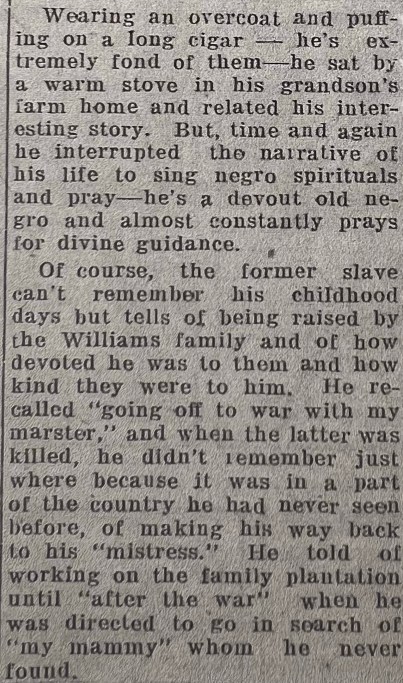
Isaac Williams, age 109, speaks of his life and times.

In December 1940, Isaac Williams made his way to Wilson to meet with a Daily Times reporter. Reportedly nearly 110 years old, Williams told of his birth in what is now Wilson County; his enslavement in Nash County; and, most recently, his long voyage to Conroe, Texas, to testify in a massive lawsuit over a $24,000,000 oil fortune due to the rightful descendants of Wilson Strickland. Descendants of 36 different men named Wilson Strickland contested the claim, including Luther E. Williams of Nash County, whose grandfather Guilford H. Williams had been Isaac Williams’ owner and was said to be a close relative of Wilson Strickland.

Wilson Daily Times, 20 December 1940.

——

In the 1940 census of Bailey township, Nash County, N.C.: Isaac Williams, 109, and wife Jennie, 51. Both were described as unable to work.

The estate of Henry Applewhite.

Henry Applewhite died intestate in 1850. The federal slave schedule recorded that year shows his widow Orpha Pike Applewhite in possession of eight enslaved people.

At November Term, 1851, Orpha Pike Applewhite, widow of Henry Applewhite, petitioned the Edgecombe County Court of Pleas and Quarter Sessions to partition the enslaved people she and her six children, Sarah, Elizabeth, Jonathan, Celia, William, and Polly, had jointly inherited. Bob, Enos, Wealthy, Mary, Sherard, Patrick, Maria, Pharba, and Penny and child Laura were to be sold if necessary to achieve equal division. Washington M. Stanton and William Barnes were appointed for this purpose.

——

In an unsourced post at afrigeneas.com: “Among the surviving papers of Henry and Orpha Pike Applewhite of the Stantonsburg area of Wilson Co., NC are the names and ages [sic] of the following negroes: Sherod, born 16 July 1838; Patrick, born 1 May 1840; Mariah, born 27 September 1844; Penny, born August 1834; Mary, born spring 1832; Enos, born 1 January 1829.”

On 31 August 1866, Patrick Applewhite and Lovenia Peacock formalized their marriage by registering their three-year cohabitation with a Wilson County justice of the peace.

In the 1870 census of Stantonsburg township, Wilson County: farm laborer Patrick Applewhite, 25; wife Lavenia, 21; son George, 6; plus Lucinda Taylor, 18, and Sarah Taylor, 1.

In the 1880 census of Stantonsburg township, Wilson County: farmer Patrick Applewhite, 38; wife Luvenia, 27; and children George, 16, and Mattie, 5; plus Riley Barnes, 34, farm laborer, and Virgil Deans, 38.

I have not been able to identify any others of the community of enslaved people held by Henry and Orpha Applewhite.

Estate File of Henry Applewhite, Edgecombe County, North Carolina Wills and Estates, 1665-1998 [database on-line], http://www.ancestry.com.

African-Americans baptized at Lower Black Creek P.B. Church, part 4.

Lower Black Creek Primitive Baptist Church, founded in 1783, was the second church organized in what is now Wilson County. (It closed its doors in 2010.) The church’s nineteenth and early twentieth-century records includes names of enslaved and freed African-American members, who worshipped with the congregation as second-class Christians even after Emancipation.

This page continues the previous “Reception to Babtism” entries from 1824 to 1831 (with other notes inserted in the second column.) It includes references to six enslaved African-Americans. (Don’t let “servant” fool you.) As Primitive Baptists did not practice infant baptism, the six were, if not adults, then nearly so, and thus were all born in the 1700s or very early 1800s. Some may have lived to see Emancipation, but even if they remained in Wilson County, I have no way to identify them further.

  • Briton(?), a servant of Patience Aycock
  • Cloah, a servant of John Barnes Senr
  • Joe, a servant of William Horn
  • Lidge, a servant of Hardy Horn
  • Haywood, a servant of John Sherrod
  • Haner, a servant of Little John Barnes

Copy of documents courtesy of J. Robert Boykin III. Originals now housed at North Carolina State Archives. 

The last will and testament of Ephraim Daniel.

Ephraim Daniel likely lived in a section of northeast Wayne County, North Carolina, that is now the Black Creek area of southeast Wilson County. (He was a member of Lower Black Creek Primitive Baptist Church.) His will, drafted and entered into probate in 1822, included these provisions:

  • “2nd I give grant and bequeath to my Wife the followin negros Simon and his wife Temperance and their two children Robbin and May.”

  • “It is further my desire that the whole of my negros not already devised to be sold at a credit of twelve months.”

Last Will and Testament of Ephraim Daniel, North Carolina Wills and Probate Records 1665-1998, http://www.ancestry.com. 

Jonathan H. Applewhite.

Jonathan H. Applewhite (1832-1910) was a son of Henry and Orpha Pike Applewhite. The Applewhites were major landholders and slaveowners in the Stantonsburg area and have been featured here.

Jonathan H. Applewhite (1832-1910).

In 1860, the federal slave schedule disclosed that he laid claim to five enslaved people housed in three cabins — an 80 year-old woman, a 37 year-old woman, a 27 year-old man, a four year-old boy, and a two year-old girl. This group does not appear to constitute a single nuclear family.

1860 federal slave schedule of Saratoga township [which included Stantonsburg], Wilson County.

The photo below depicts Jonathan Applewhite’s home near Stantonsburg, circa 1900. I do not know if this is the house in which he lived before the Civil War.

Jonathan Applewhite residence, circa 1900.

Photos courtesy of Stantonsburg Historical Society’s A History of Stantonsburg Circa 1780 to 1980(1981).

The last will and testament of John Bardin.

John Bardin likely lived in a section of northeast Wayne County, North Carolina, that is now the Black Creek area of southeast Wilson County. (He was a member of Lower Black Creek Primitive Baptist Church.) His will, drafted in September 1819, entered probate in 1823 and included these provisions:

  • to wife Nancy Bardin, a life interest in “three Negroes Abram Philis Levi
  • to daughter Eliza Barnes, a girl named Sarah
  • to daughter Nancy Amason, a girl named Penny
  • to daughter Seania Bardin, a woman named Ann
  • to son John Bardin after Nancy Bardin’s death or remarriage, Abram
  • to son Sherrard Bardin, a man named Loften
  • to son David Bardin after Nancy Bardin’s death of remarriage, Levi
  • “I leave Old Philis to the Pleasure & Discretion of my wife when she has done with her”
  • “I wish my Blind Negro Toney to live with some of the Family”
  • “I Desire that my Negro Man Carolina be sold after my Death” (and the proceeds used to pay Bardin’s debts)

John Bardin Will, North Carolina, U.S. Wills and Probate Records 1665-1998, http://www.ancestry.com.

The estate of Isaac Amason.

It’s not a common surname in Wilson County anymore, but in the early 1800s a prosperous extended family of Amasons lived in the Stantonsburg area (in what was then Edgecombe County, North Carolina). They owned extensive real property and considerable slaves, and often left estates that spent years in probate as family members bickered, and heirs and administrators died.

This post is first in a series featuring documents from Amason (Amerson) family estate files.

——

Isaac Amason was born about 1755. When he died in 1828, several of his children were young minors, resulting in a drawn-out estate settlement. At November term, 1843, the Clerk of Edgecombe County Court ordered finally ordered that notices be placed for the thirty days around the county, advertising the sale of enslaved people belonging to Amason’s estate “on a credit of six months, with interest.”

Lemuel DeBerry filed a report with the court detailing his activity pursuant to the order. He posted notices “both in and out” of the county (likely because Amason lived close to the borders of Greene, Wayne, and Pitt Counties) for more than thirty days informing the public that the sale would take place in the Town of Stantonsburg on 27 January 1844. At auction, Isaac Amason’s son David Amason paid $25.50 for “One Old Negroe Man by the Name of Lewis” and $553 for “a Young Woman & Child by the Names of Exelina & her Child,” and son Isaac U. Amason paid $7 for “One Old Woman by the Name of Phillis.”

Note that in the 1820 federal census of Edgecombe County, the last in which Isaac Amason was enumerated, he reported owning three enslaved boys under age 14; one enslaved man aged 14-25; one enslaved man aged 26-44; and one enslaved woman aged 26-44.

In the 1830 federal census, Isaac’s widow Delona [Delana] Amason reported one enslaved man aged 36-55; one enslaved girl under the age of 10; and one enslaved woman aged 36-55. It seems likely that these three people were Lewis, Exeline, and Phillis.

Delana Amason made out a will on 4 September 1841 in which, among other items, she bequeathed to her daughter Jemmima Amason “one negro man named Ned.”

I have not been able to trace forward Ned, Lewis, Phillis, or Exelina and her child.

Estate File of Isaac Amason, Edgecombe County, North Carolina Wills and Estates, 1665-1998 [database on-line], http://www.ancestry.com.

African-Americans baptized at Lower Black Creek P.B. Church, part 3.

Lower Black Creek Primitive Baptist Church, founded in 1783, was the second church organized in what is now Wilson County. (It closed its doors in 2010.) The church’s nineteenth and early twentieth-century records includes names of enslaved and freed African-American members, who worshipped with the congregation as second-class Christians even after Emancipation.

(A) the church’s location since 1876; it was originally a little closer to Black Creek (the waterway); (B) the church cemetery, which contains some interesting roughly dressed fieldstone headstones, but no known graves of enslaved people.

This page records “Reception to Babtism” from 1809 and 1823 and includes references to 13 enslaved African-Americans. (Don’t let “servant” fool you.) As Primitive Baptists did not practice infant baptism, the 13 were, if not adults, then nearly so, and thus were all born in the 1700s. Some may have lived to see Emancipation, but even if they remained in Wilson County, I have no way to identify them further.

  • Hardy, a servant
  • Kedar, a servant
  • James, a servant
  • Samuel, a servant
  • Raiford, a servant
  • Rufe, a servant
  • Ann, a servant of John Bardin
  • Lucy, a servant of Sally Barnes
  • Edward, a servant of Ephraim Daniel
  • Phillisa, a servant of John Bardin
  • Rose, a servant of Willie Fort
  • Hannah, a servant of Jesse Aycock
  • John, a servant of John Sherrod

Copy of documents courtesy of J. Robert Boykin III. Originals now housed at North Carolina State Archives. Aerial image courtesy of Google Maps.

African-Americans baptized at Lower Black Creek Primitive Baptist Church, part 2.

Lower Black Creek Primitive Baptist Church, founded in 1783, was the second church organized in what is now Wilson County. (It closed its doors in 2010.) The church’s nineteenth and early twentieth-century records include names of enslaved and freed African-American members, who worshipped with the congregation as second-class Christians even after Emancipation.

This page records baptisms “under the Care of Elder Reuben Hays” from 1803 and 1808 and includes references to nine enslaved African-Americans. (Don’t let “servant” fool you.) As Primitive Baptists did not practice infant baptism, the nine were, if not adults, then nearly so, and thus were all born in the 1700s. Some may have lived to see Emancipation, but even if they remained in Wilson County, I have no way to identify them further.

  • Dick, a servant
  • Lewis, a servant
  • Jane, a servant
  • Dick, a servant
  • Will, a servant
  • Harry, a servant
  • Beck, a servant
  • James, a servant
  • Salath, a servant

Copy of documents courtesy of J. Robert Boykin III. Originals now housed at North Carolina State Archives.

A burial ground for the enslaved?

Per unsourced notes, a slave cemetery lies adjacent to the Boykin-Lamm-Wells cemetery in Oldfields township. On an overcast November morning, I went to see what I could see. I am aware of only one verified slave cemetery in Wilson County, though there must have been many dozens. I was skeptical of this one, but also hopeful.

The cemetery, set a hundred yards or so behind a house under construction, contains 44 graves. Twenty-nine are marked with readable headstones, the earliest of which dates to 1892. Thus, there is no visible evidence that the cemetery dates to the antebellum period.

Of the remaining, several are marked with dressed fieldstone markers, such as those seen below. These graves are intermingled with those of Boykin-Lamm-Wells family members, an unlikely arrangement for the graves of enslaved people.

Stephen D. Boykin (1832-1910) was patriarch of the intermarried families buried here. He does not appear to have been a slaveowner, but his father, also named Stephen Boykin (1797-1864), was. In the 1850 federal slave schedule, the elder Boykin reported owning five enslaved people, ranging from a one month-old boy to a 35 year-old woman, and in 1860 reported 11 enslaved people, ranging from an eight-month-old girl to a 55 year-old man. If Boykin the elder is buried here, his grave is either unmarked or is marked by one of the fieldstones. If enslaved people are buried here, their graves are likely in the woods that border the cemetery on two sides.

Photos by Lisa Y. Henderson, November 2022.