Black History Month

Lane Street Project: the Black History Month Clean-ups!

Lane Street Project is a community initiative dedicated to the documentation and preservation of three African-American cemeteries. In so doing, we also work to highlight and celebrate the history and culture of East Wilson.

If you missed the MLK Weekend Kick-Off, you have two chances this month to join Lane Street Project’s Community Cemetery Clean-Ups! Our ancestors ARE Black History. What better way to honor their legacy? 
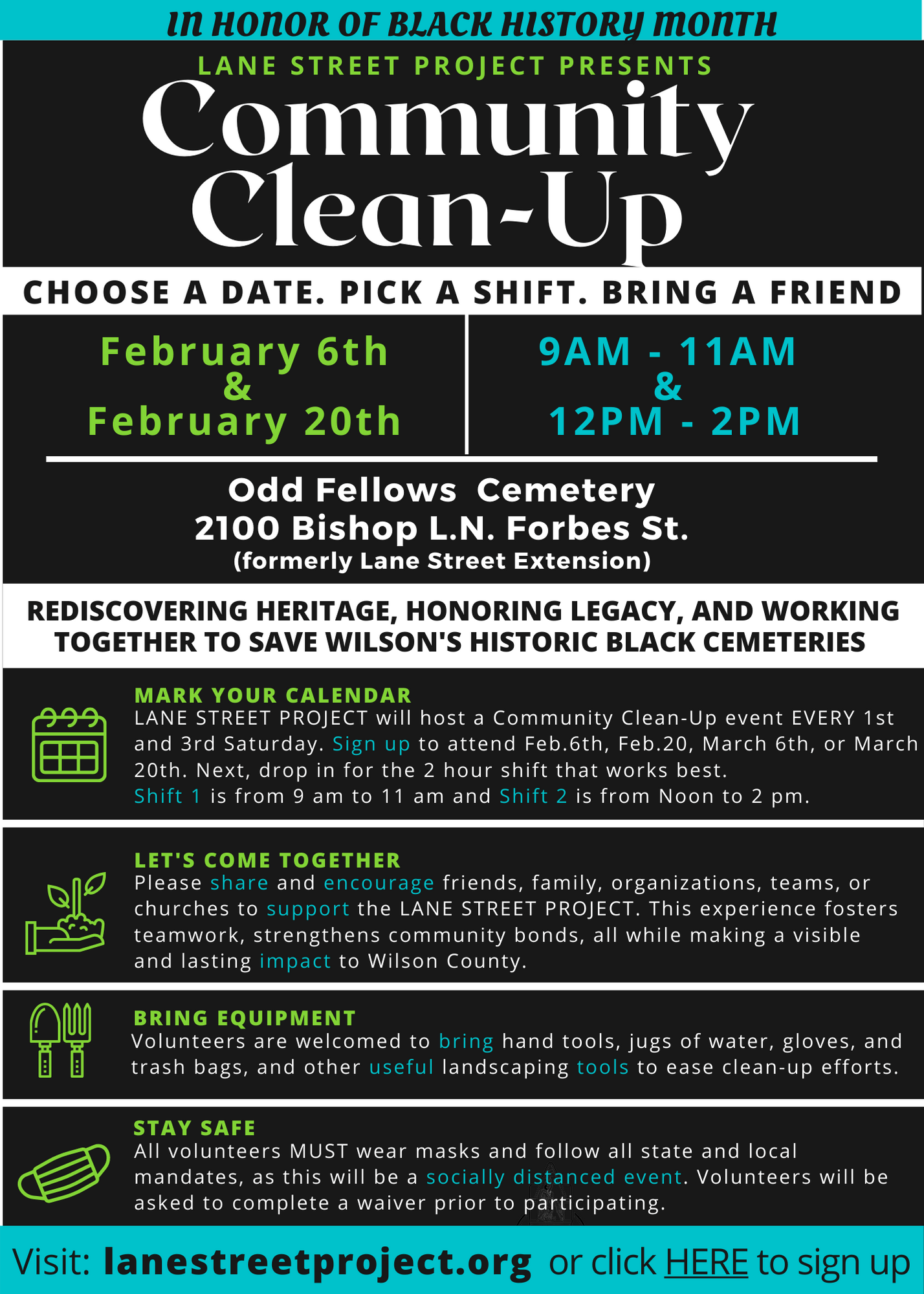
Lane Street Project invites all of Wilson to join its Community Clean-Ups at Odd Fellows Cemetery, 2100 Bishop L.N. Forbes St. Please bring hand tools, trash bags, and gloves to help clip vines and small tree limbs, rake debris, remove trash, and search for hidden headstones. Masks and social distancing required.

“Freedom’s Plow” and the “apt little boys and girls” of Saint Alphonsus.

Last year’s Black History Month surprise was the discovery that Langston Hughes spoke at Darden High School on 10 February 1949. This year’s comes courtesy of a North Carolina State University grad student, who tipped me to Hughes’ other audience that day — the children of Saint Alphonsus Catholic School.

Hughes wrote about his “little trip down South” on his regular column in the Chicago Defender. He praised the Wilson County Negro Library, its librarian, and the itinerary she devised for him. Hughes was especially charmed by the “tiny youngsters” of Saint Alphonsus, who performed his poem “Freedom’s Plow” in its entirety. (Take a peek at Freedom’s Plow if you don’t know it. Not only does it tackle weighty subjects, it is long. I add my applause for the Saint Alphonsus scholars!)

Chicago Defender, 26 February 1946.

The final stanza of “Freedom’s Plow,” which brings a word for our time:

A long time ago,
An enslaved people heading toward freedom
Made up a song:
Keep Your Hand On The Plow! Hold On!
The plow plowed a new furrow
Across the field of history.
Into that furrow the freedom seed was dropped.
From that seed a tree grew, is growing, will ever grow.
That tree is for everybody,
For all America, for all the world.
May its branches spread and shelter grow
Until all races and all peoples know its shade.
KEEP YOUR HAND ON THE PLOW! HOLD ON!

If you know anyone who attended Saint Alphonsus in 1949 and remembers Langston Hughes’ visit, please let me know!

——

Fulfilling a need: Wilson County Negro Library, 1943-1964.

program flyer.png

More great Black History Month programming from Wilson County Public Library! On 15 February 2020, local history librarian Tammy Medlin will present a history of the Wilson County Negro Library, founded by African-American women in the early 1940s. No registration necessary; please come learn more about this vital community institution.

Rev. Clark congratulates The Age.

img 2.jpeg

New York Age, 9 February 1935.

In 1935, Rev. Thomas G. Clark sent a congratulatory letter to mark the New York Age’s “50 years of untrammeled service to the race, nation and the world.” In it, he revealed details of his early educational struggles, and the epiphany to which Edward A. Johnson’s A School History of the Negro Race in America from 1619 to 1890 brought him. [Johnson, born enslaved in Wake County in 1860, was educated at Atlanta University and wrote A School History at the urging of a school superintendent. The book was the first by an African-American author to be approved for use in North Carolina’s public schools. (Sidenote: I won’t rest until I secure a copy.)]


Langston Hughes speaks for Negro History Week.

Today marks the 118th anniversary of the birth of poet, playwright and social activist Langston Hughes. To my astonishment, shortly after he celebrated his birthday in 1949, Hughes came to Wilson to deliver a lecture in the auditorium of Darden High School. The event marked a celebration of National Negro History Week, and its proceeds went to support the Wilson Negro Library‘s bookmobile fund.

Screen Shot 2020-01-17 at 10.36.20 PM.png

Screen Shot 2020-01-17 at 10.36.28 PM.png

Wilson Daily Times, 8 February 1949.

Wilson Daily Times, 9 February 1949.

Hat tip to Wilson County local historian Tammy Medlin for leading me to this story.