Civil War

General Order 135.

On 14 November 1863, General John Schofield, commander of the Department of Missouri, issued General Order 135 authorizing provost marshals in the department to recruit and enlist black soldiers to serve the Union as U.S. Colored Troops. The Ancestry.com database United States Descriptive Lists of Colored Volunteer Army Soldiers, 1864, contains enlistment and muster rolls for colored troops who enlisted in Kentucky.

There is one entry, for Henry Jones, lists a Wilson County birthplace. Jones was 25 years old and had worked as a laborer (i.e. enslaved fieldhand). He enlisted on 29 May 1865  at Piketon, Kentucky, in 1st Lt. George C. Clapp’s Company E, 121st United States Colored Infantry. Jones was 5’9 1/2″ with dark eyes, hair and skin. And “name of owner of a slave”: Jefferson Higginbotham.

32733_520307095_0290-00047

Higginbotham is not a Wilson County name. Jefferson Higginbotham may have been the Thos. J. Higginbotham, 21, listed in the 1860 census of Verona, Boone County, Kentucky, in the household of Abram Wellman. If so, he was fighting for the Confederacy even as his former chattel joined up with the Union Army. In any case, it is likely that Henry Jones ended up in Kentucky after being sold away from his birthplace in Wilson. (Had he been a runaway, he would have reported a Wilson County owner.)

Hendy Barnes volunteered to serve.

m1818_264-1083

156 years ago today, 18 year-old Hendy Barnes, undoubtedly a runaway from a Wilson County slaveholder, enlisted in Company C, 14th Regiment, United States Colored Heavy Artillery. Less than a month later, he died at a regimental hospital in Morehead City, North Carolina.

m1818_264-1088

U.S. Colored Troops Military Service Records, 1863-1865 [database on-line], http://www.ancestry.com.

Eating was just as necessary.

WDT 4 10 1911 Henry Locus

Wilson Daily Times, 10 April 1911.

——

In the 1850 census of Nash County, North Carolina: Delany Locust, 28, with Lucy, 25, Nathan, 12, Henry, 8, Goodson, 6, Nelly, 4, and Mary J. Locust, 3.

In the 1860 census of Winstead, Nash County: Delany Locus, 43, with Nathan Locus, 22.

Captain Jesse Sharpe Barnes organized the Wilson Light Infantry  in 1861. When the company was mustered in the United States Confederate Army, it became Company F, Fourth Regiment, North Carolina State Troops. Barnes died in battle on 31 May 1862 at Seven Pines, Virginia.

JS Barnes

Capt. Jesse S. Barnes.

Photograph held in Liljenquist Family Collection, see Prints and Photographs Online Catalog, Library of Congress

He works on his farm every day.

“Uncle” Wade Barnes, one of Wilson county’s oldest colored residents, paid us a visit today. He is now in his 72d year and was born in Wilson county, where he has spent most of his life. He is in good health and able to work on his farm every day. He says he can well remember when Wilson did not have a court house or jail. Uncle Wade also remembers the civil war. He was then owned by Mr. Larry Farmer and went with him to war and helped thrown up breast works for the soldiers to fight behind.

Wilson Times, 2 July 1917.

——

In the 1870 census of Gardners township, Wilson County: Silas Barnes, 49, wife Rosa, 45, and children Feribee, 20, and Wade, 23. [Note, then, that Wade would have been a teenager during the Civil War.]

In the 1880 census of Gardners township, Wilson County:Wade Barnes, 33, wife Adeline, 25, and children John, 6, Willis, 3, and Varina, 2, plus grandmother Dury Simms, 60.

On 20 August 1892, Wade Barnes, 45, son of Silas and Rose Barnes, married Julia Thompson, 26, daughter of Ben and Fereby Artis, all of Gardners township.

In the 1900 census of Wilson township, Wilson County:Wade Barnes, 53, wife Julia Ann, 36, and children Betsey, 16, Martha, 15, and Ned Barnes, 9.

In the 1910 census of Toisnot township, Wilson County: on Farmers Mill Pond Road, Wade Barnes, 64, wife Julie A., 47, son Ned, 19, daughter Betsey, 23, and grandson Frank, 14 months.

In the 1920 census of Toisnot township, Wilson County: on Washville Road, Waid Barnes, 75, and wife Julia, 56, with son Ned Barnes and family next door.

In the 1930 census of Toisnot township, Wilson County: Wade Barnes, 83, wife Juliann, 65, grandson Frank, 21, lodger Alevia Batts, 39, and sister-in-law Mary Westray, 50.

He was known at home as Barnes.

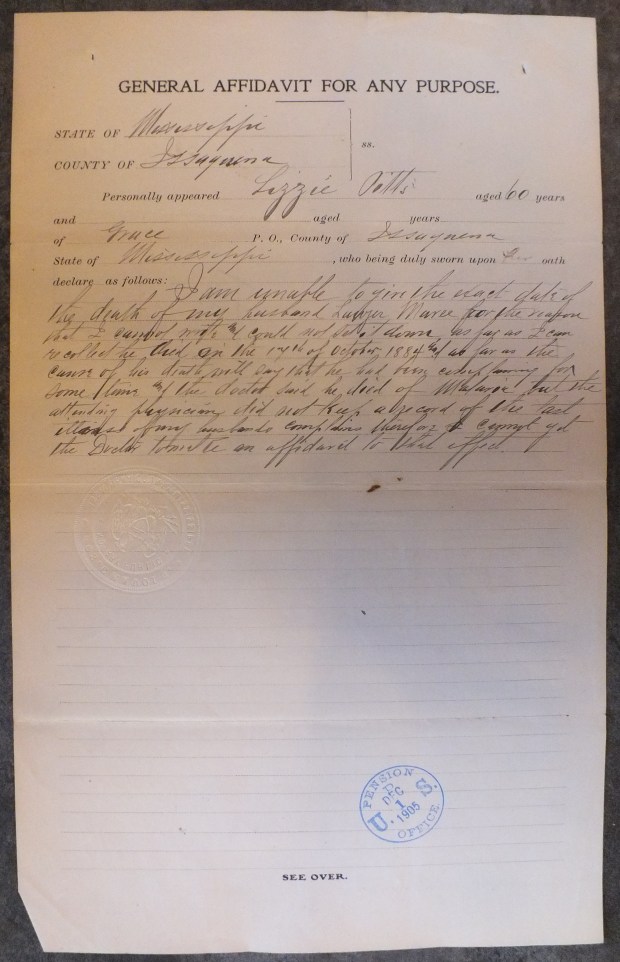
Documents from the pension application file of Eliza Taylor Maree Pitts, widow of Union army veteran Lawyer Maree of Wilson County:

DSCF6628.JPG

Eliza was living in Issaquena County, Mississippi, when she applied. She noted that her late husband Lawyer Maree had served in Company F, 14th Regiment of the United States Colored Heavy Artillery, having enlisted in Morehead City, North Carolina, in February 1865. Eliza’s maiden name was Taylor, and she and Lawyer had married in Wilson County in October 1861. Lawyer died in 1884, and Eliza remarried in 1887.

DSCF6645.JPG

The Record and Pension Division of the War Department searched its files to confirm Lawyer’s enlistment and to provide a physical description of the young soldier: age 28, 5’10”, black eyes and hair, dark complexion. However, his name did not appear on muster rolls during his period of service, nor did he have medical records.

DSCF6653

An affidavit provided additional information. Most notably, Eliza stated that “Lawyer Maree was known at home as Lawyer Barnes but enlisted under name of Lawyer Maree.” No Marees appear in Wilson County records, but in the 1870 census of Black Creek township: 35 year-old farm laborer Lawyer Barnes, his wife Lizzie, 28, and probable mother Lucy Barnes, 70.

DSCF6647.JPG

Eleven years later, Eliza was still trying. “I am unable to give you the exact date of the death of my husband Lawyer Maree,” she averred, “for the reason that I cannot write and could not set it down….”

DSCF6651.JPG

Her claim was rejected in January 1906: “Claimant is unable to show cause of death, or that same originated in service and line of duty. There is no record of any disability, and no medical or other evidence to show soldier’s death [of malaria] due to service.”

File #599,297, Application of Eliza Pitts for Widow’s Pension, National Archives and Records Administration.

Runaway railroad laborers.

Raleigh_Weekly_Std_5_27_1863_Caesar_Job_runaway

Raleigh Weekly Standard, 27 May 1863.

“Railroad companies and contractors hired slaves by the hundreds; they also purchased slaves directly, in lots of 50 or more. In fact, by the 1850s, the South’s railroad companies could be counted among the largest slaveholders in their regions. They even developed special accounting entries on their balance sheets to show the value of “the Negro Fund.” …

“… The South pursued railroad expansion as fast as the North, laying as many miles of track in the 1850s as the Midwest, even exceeding the pace of construction in much of the North. And slavery was inextricably bound to the South’s railroad boom: slaves could be moved at the will of a slaveholder quickly from one part of the South to another, and whites could use slaves as collateral on loans to build railroads or purchase new farms. What’s more, railroads opened up new cotton frontiers in the interior South, expanding the need for slavery in agricultural contexts.

But the constant moving and confusion of the railroad boom also made escape easier. …”

Excerpt from Thomas, William G., “Been Workin’ on the Railroad,” New York Times, 10 February 2012.

——

W.K. Delany was listed in the 1860 federal slave schedule of Greenville, Pitt County, North Carolina, southeast of Wilson, as the owner of 22 slaves.

White water.

tumblr_mnsga8pwUE1qd9jg8o1_540

This is the war memorial in front of the Wilson County Courthouse. It honors Revolutionary and Civil War dead. Until 1960, segregated water fountains topped the two small plinths. The “colored” fountain was on the left. You can tell because the chiseled-out section is longer.

Nos. 1394 and 2319.

From the records of the Freedmen’s Bank, New Bern branch:

Screen Shot 2015-10-18 at 10.20.34 PM

When Jeremiah Barden opened his first account, he reported that he was living up the Trent River in Jones County, working on Colonel Whitford’s land for himself (i.e. as a tenant farmer.) Barden is frustratingly elusive in census records. His birth family, however, remained back in Wilson County and appear in the 1870 census of Black Creek township: farm laborer Washington Simms, 57, and wife Exy, 47, plus Henry, 32, Gatsey, 27, Nathan, 10, Grant, 4, and Harrit Simms, 5; Waity Nelson, 18; Joseph, 14, Samuel, 12, Mary, 10, and Della Simms, 8; Ellen Barden, 1; and William Nelson, 26. They are listed in close proximity to white farmers Arthur Barden, 54, and Benjamin Barden, 42. It is a reasonable conjecture that Exy Simms and her children (but not her husband Washington) belonged to one of these Bardens prior to Emancipation, and Jeremiah adopted “Barden” as a surname as a result.

Screen Shot 2015-10-18 at 10.21.36 PM

Jere opened a second account after moving to Dawson’s Creek in Craven County in 1871. (Curiously, he marked his signature with an X this time, though he wrote his name in 1869.) Notice the detailed listing of his siblings, especially sisters. Gatsey, Mary and Della Simms and Waity and William Nelson were listed in the Simms household in 1870. Moses, 29, and Mariah Coley, 26, were in the household next door. Nearby, in Holden township, Wayne County: Jackson Barnes, 27, wife Farby, 27, and sons Benjamin, 10, Henry, 8, Frank, 7 and Joshua, 1.

I have not located Jere in any census. However, he and wife Mary were designated as living on marriage licenses of several children, including daughter Sarah Barden, who married Marshal Faison in Pamlico County in 1895; George Barden, who married Annie Allen in Pamlico County in 1907; and John Barden in Wayne County in 1925. In the first two, Jere and Mary were described as living in Pamlico. In the last, they were described as living in Craven County.

m1818_265-0758

It is likely that Jeremiah Barden ran away from Wilson County while still enslaved. On 25 April 1864 in New Bern, he enlisted in the 14th Regiment, United States Colored Heavy Artillery.

Freedman’s Bank Records, 1865-1871 [database on-line], http://www.ancestry.com; U.S. Colored Troops Military Service Records, 1863-1865 [database on-line], http://www.ancestry.com.

The Battles of Walnut Hill.

Joel Craig and Sharlene Baker’s As You May Never See Us Again: The Civil War Letters of George and Walter Battle, 4th North Carolina Infantry (2004) features the annotated missives of two sons of Amos Johnston Battle, a prominent (and peripatetic) Baptist minister who spent his last years, including the war era, in Wilson County.  The letters contain only one presumed mention of the family’s slaves — a single reference to a Church, who was charged with delivering certain items to the letter’s writer. A footnote appended to the passage states: “The boy ‘Church’ has been referred to by some as one of the Battle’s [sic] slaves. Whether this is referring to the Raleigh [North Carolina] Battle’s or the Wilson Battle’s is unclear. However, if the Rev. Battle did own slaves in the midst of the war it might mean that he was not the abolitionist as previously thought.”

… Who thought Amos J. Battle was an abolitionist?

In 1850, he and his family lived in Chowan County, North Carolina, and he is listed in neither the 1850 federal slave schedule as the owner of nine enslaved people — women aged 29, 25, 18; girls aged 13 and 2; and boys aged 14, 5, 2, and 1. Moreover, his wife Margaret H. Battle is listed with 32 slaves in 1860. (Hugh Johnston noted that Amos Battle’s “wife owned a small farm north of Wilson not far from the Barnes plantation.”) She is not listed in the 1850 slave schedule, and the sudden acquisition of that many slaves in her own name suggests inheritance.

Margaret Hearne Parker Battle’s father Weeks Parker died in January 1844 in Edgecombe County, leaving a widow and three children. (One predeceased him.) The 88 pages of his estate file span more than a decade, and Emancipation eventually intervened to prevent a final distribution. Included, however, is a listing of those slaves apportioned to daughter Margaret H. Battle and her children, apparently dating from the late 1850s: Old Ben, Old Seny, Big Hardy, Lucinda, Stephen, Turner, Hilliard, Mary, Adeline, William, Lena, Alice, William “usually called Reuben,” Little Ben, Harriet, Marina, Sally, Smith, Maria, Little Hardy, Betty, Jim, Moses, Syphax, Toney, Louis, Allen, George, Matilda, Lizzie.

Weeks Parker had executed his will on 31 July 1843. The document mentions his wife Sabra [Irwin Hearn]; son Simmons B. Parker; deceased son Dr. John H. Parker, who had migrated to Florida; and daughters Henrietta, wife of Benjamin Battle, and Margaret, wife of Amos J. Battle. [Benjamin Dossey Battle was Amos’ brother.]

Weeks designated son Simmons as his executor and trustee. He bequeathed certain slaves — Polly, Godwin, Old Ned, Winny, Hardy, Charlotte and her child Cintha, and Nelly —  to pass to Simmons after wife Sabra’s death, and mentioned that he had already given Simmons 14 slaves in a deed of gift. He also directed Simmons to sell the land and slaves in Florida inherited from son John’s estate. (And tweaked this last provision in a codicil.)

Weeks’ bequests to his daughters are curious though.  After Sabra’s death, Simmons was to hold in trust slaves Lucindy, Stephen, Turner, Lewis, George, Marina, Tony, Matilda, Caroline, William, Holly, Big Hardy, Ben, Cena, Moses, Syphax, Little Hardy, Jim, Lucy and Little Jim “for the sole and separate use and benefit of daughter Margaret H. Battle wife of Amos J. Battle during her natural life free from the management and control of her present or any future husband.”  Similarly, he directed that Simmons hold in trust after Sabra’s death slaves Barbara, Sarah, Luke, Ned, Sophia, Elick, Harrison, Milly, Jeffrey, Dorcas, Silas, Bill, Lou, Julia, Randal, Will and Abner for the benefit of daughter Henrietta Battle. Why the specific attempt to keep Amos Battle’s hands off his wife’s property? Was he in fact an abolitionist likely to try to free them? Or were Weeks’ concerns more prosaic?

Simmons and his mother went into court to have Weeks’ will admitted to probate, and the skirmishes began. The two sets of Battles teamed up to claim that they had not been notified prior to probate and that the will’s codicil had been made under undue influence. Simmons and the other trustees admitted that Battles may not have been given formal notice, but claimed that they knew anyway. They also charged Amos Battle with having taken a slave named Jim to Wilmington.  The Battles fired a second volley with a claim that Simmons was in “extreme bad health” and “great physical inability” and “utterly incapable of carrying out his duties” as a trustee. Simmons responded meekly, acknowledging that he had been shot in the chest many years before and had never recovered, a circumstance that sometimes completely debilitated him. He agreed to surrender his trusteeship. Replacement trustee Nathan Matthewson, too, stepped down, and was replaced by Benjamin Oliver of Duplin County. In one of Oliver’s reports, he advised the court that he had sold for $600 a slave named Jim “in consequence of grossly bad behavior and general bad deportment.” The buyer was Wyatt Moye. [In 1848, Moye, as Senator from Edgecombe County, introduced a bill in the Senate to “incorporate Toisnot Depot and Hickory Grove in the County of Edgecombe into a town by the name of Wilson.” The bill passed its third reading and was ratified on January 29, 1849.] With the funds received, Oliver then spent $500 to purchase Lilah from a Dr. Arrington. (She later gave birth to a son Charles.) In 1849, Oliver moved to Bladen County and resigned his trusteeship; Uriah Vaughan of Hertford County — where Margaret then lived — was appointed in his stead.

In the mid-1850s, Margaret, Amos and their children moved to the town of Wilson, where Sabra Parker bought them a house and lot. In another plaintive petition for yet another trustee, submitted in September 1856, Margaret complained that she had no other property and that the family was “dependent on their own exertions for a support” as their trust fund was inadequate. The younger children were chiefly supported by Margaret’s “exertions” [she was an innkeeper], while the creditors of her husband Amos, “who is greatly embarrassed,” tried to take her earnings at every opportunity.

Another source shines light on the Battle family’s financial situation. In 1911, Amos and Margaret’s youngest son, Jesse Mercer Battle, published memoirs titled Tributes to my Father and Mother and Some Stories of My Life. In the chapter on his mother, he recalled that his “mother’s family lived in Wilson, N.C. We lived in a large house, and it was called ‘The Battle House.’” There, to her humiliation, his mother took in boarders and other passers-through to earn money for the family’s keep. His father, though “rich in lands and negroes,” gave away his wealth to the point that his younger sons’ educations were neglected. The chapter on Amos J. Battle goes further. Amid fifty hagiographic pages limning his father’s Christlike-ness, Jesse reveals that “his money, his lands, his negroes, his stocks, his bonds, his personal property of every description went as his free will offering to the Church as a whole, and to anyone of its members individually, or to those who were not members.” (This was not offered ironically, and there is no attempt to square Battle’s slaveholding with his Christian values.)

Ah. So. And therein lies the motive for Weeks Parker’s determined attempt to keep his wealth out of pious Amos Battle’s hands.

Jesse Battle’s memoir also provides a peek at the family’s slaves and demonstrates that the thirty or so inherited from Weeks did not define the extent of Margaret’s holdings. “Negroes were my companions,” he wrote. “I played with them, and spent my time with them all day, till I was about seven years old, when I was started to school. I knew my alphabet and how to read a little. This start on my way to an education was given to me by a good old colored woman I called Mammy. (Her name was Dinah.) … This good woman remained with our family till 1865, when the Civil War ended, when she left us and moved down to Greenville, N.C., where her husband, whose name was ‘Shade,’ lived. After the emancipation of the slaves she said that she could never enjoy her ‘freedom’ as long as she lived with her master and mistress.”  Jesse elsewhere mentioned that Dinah had lived with the family at a farm called Walnut Hill, “about three miles from Wilson N.C., on the railroad toward Rocky Mount.”

Will Book F, Edgecombe County, North Carolina Probate Records, 1735-1970, familysearch.org; Estate of Weeks Parker (1844), Edgecombe County, North Carolina Estate Files, 1663-1979, familysearch.org; other sources as named.