City of Wilson

The colored firemen’s convention.

The Red Hot Hose Company of Wilson hosted the 1904 convention and tournament of North Carolina Volunteer Firemen’s Association (Colored). Southern Railway ran this notice of special round-trip rates for firemen and brass bands making the trip from various points across the state.

Screen Shot 2019-08-04 at 6.22.04 PM.png

The Morning Post (Raleigh, N.C.), 28 July 1904.

817 East Green Street.

The one-hundred-sixteenth in a series of posts highlighting buildings in East Wilson Historic District, a national historic district located in Wilson, North Carolina. As originally approved, the district encompasses 858 contributing buildings and two contributing structures in a historically African-American section of Wilson. (A significant number have since been lost.) The district was developed between about 1890 to 1940 and includes notable examples of Queen Anne, Bungalow/American Craftsman, and Shotgun-style architecture. It was listed on the National Register of Historic Places in 1988.

As described in the nomination form for the East Wilson Historic District, the house that stood at 817 East Green Street was: “ca. 1913; 1 story; I-plan cottage with intact turned-post porch.”

In the 1928 Hill’s Wilson, N.C., city directory: Winstead Arnold (c; Sybina) brklyr h 817 E Green

In the 1930 Hill’s Wilson, N.C., city directory: Peacock Junius W (c; Ethel) barber Walter S Hines h 817 E Green

In the 1930 census of Wilson, Wilson County: at 807 [sic] East Green, rented for $13/month, Junius Peacock, 30, barber, and wife Ethel, 34, maid at public school.

Junius Wesley Peacock died 28 April 1935 in Wilson. Per his death certificate, he was 35 years old; was born in Wilson County to Junius Peacock and Nora Hoskins, both of Wilson County; lived at 817 East Green; and was a barber. Informant was Ethel Peacock.

In the 1940 census of Wilson, Wilson County: at 817 East Green, rented at $14/month, George Green 32, blacksmith at repair shop, born in South Carolina; wife Martha F., 26, hospital nurse; and mother-in-law Anetta Rosser, 63 (who had lived in Whitakers, Nash County, in 1935). Also, paying $5/month, Graham Bynum, 31, building carpenter, and wife Katherine, 29, hospital nurse.

In 1940, George Willie Green registered for the World War II draft in Wilson. Per his registration card, he was born 15 October 1906 in Saint Matthew, South Carolina; lived at 817 East Green; his contact was wife Frances Rosser Green; and he worked for Bissett’s Repair Shop, 307 South Tarboro Street.

In the 1941 Hill’s Wilson, N.C., city directory: Green Geo W (c; Frances) blksmith Herbert W Bissett h 817 E Green

817 East Green was one of several dozen houses demolished on the order of Wilson City Council in 2002. Council also approved demolition of three other houses on East Green Street owned by the heirs of Walter S. Hines. (Walter Hines often rented his Green Street properties to barbers in his employ, like Junius Peacock.)

Wilson Daily Times, 21 June 2002.

Photograph by Lisa Y. Henderson, July 2019.

Studio shots, no. 115: Charles Eugene Freeman.

Screen Shot 2019-08-03 at 10.08.17 PM.png

Charles Eugene Freeman (1926-1960), probably in the 1940s. 

——

In the 1930 census of Wilson, Wilson County: at 1113 Washington Street, owned and valued at $3000, brickmason Julious F. Freman, 42; wife Hattie [Pattie], 31; and children Julious, 10, Doloris, 9, Robert P. and Richard P., 8, John C., 6, Charles E., 4, Patricia E., 3, Mary E., 1, and Rubey, 2.

In the 1940 census of Wilson, Wilson County: at 1114 Washington Street, owned and valued at $3000, brick mason Julius Freeman, 52; wife Pattie, 40; and children Julius L., 20, Doris, 19, Robert and Richard, 18, John, 16, Charles, 14, Eunice, 12, Mary, 11, Ruby, 10, Tom, 9, Dan, 8, Lillian, 6, and Henry, 2.

Charles Eugene Freeman registered for the World War II draft in 1944:

32892_620303988_0062-03517

On 20 April 1944, Charles Freeman, 18, son of Julius and Pattie Hagans Freeman, married Carrie Lee Hardy, 15, daughter of Cornelius and Carrie Hardy, in Wilson.

Screen Shot 2019-08-03 at 10.50.59 PM.png

Screen Shot 2019-08-03 at 10.51.26 PM

Wilson Daily Times, 21 March 1960.

As a World War II veteran, Charles E. Freeman received a military headstone. His mother, Pattie H. Freeman, submitted the application for the marker.

Photo courtesy of Ancestry user Delwyn Eugene Caniglia; Headstone Applications for Military Veterans, 1925-1963 [database on-line], Ancestry.com.

Tobe Bellamy, centenarian.

201907181727542123.png

Wilson Daily Times, 8 August 1986.

——

In the 1900 census of Wilson, Wilson County: day laborer Henry Bellamy, 30; wife Emma, 28; and children Arthur [Tobe], 11, Joseph, 7, Roscoe, 6, and Harry, 4.

In 1930, Tobe Bellamy led the Elk Club’s efforts to find families to receive gifts of food and candy during the Christmas season.

Screen Shot 2019-08-01 at 8.59.11 PM.png

Wilson Daily Times, 26 December 1930.

In the 1940 census of Wilson, Wilson County: fertilizer plant laborer Tobe Bellamy, 51; wife Mary, 41; adopted son Jessie, 7; and mother Emma, 75.

Emmaline Bellamy died 22 September 1947 in Wilson. Per her death certificate, she was born 15 January 1874 in Wilson County to Archie Amie and Sylvia Taylor, both of Wilson County and lived at 718 Stantonsburg Street. Tobie Bellamy was informant.

On 24 December 1954, Jesse Bellamy, 25, of Wilson, son of Tobe Bellamy and Mary Barnes, and Queen Esther Thomas, 25, of Rocky Mount, daughter of Ben Thomas and Etta Hilton. Holiness minister W.H. Holiday performed the ceremony in the presence of Allen Barnes, Walter Whitted and Mary Bellamy.

Mary Bellamy died 19 April 1967 in Wilson. Per her death certificate, she was born 15 September 1903 in Wilson County to Allen Barnes and Caroline Woodard; was a retired laborer at Watson Tobacco; was married to Tobie Bellamy; and lived at 718 South Pender Street.

Jesse Bellamy died 19 December 1972 in Wilson. Per his death certificate, he was born 18 October 1932 to Tobie Bellamy and Mary Barnes; was married to Zelma Bellamy; worked as a laborer for Export Tobacco Company; and lived at 907 Phillips Street.

In the summer of 1980, Tobe Bellamy shared his thoughts on a heatwave then baking Wilson:

Screen Shot 2019-08-01 at 9.11.58 PM.png

Screen Shot 2019-08-01 at 9.13.04 PM.png

Screen Shot 2019-08-01 at 9.13.14 PM.png

Screen Shot 2019-08-01 at 9.13.24 PM.png

Wilson Daily Times, 13 August 1980.

Tobe Bellamy died 5 August 1988 in Wilson, aged 104.

Fundraiser for Darden’s band.

Prior to serving as principal of Adams and B.O. Barnes Elementary Schools, Carl W. Hines was a mathematics and band teacher at Darden High School. In 1939, via a notice in the local paper, he invited the public to the newly opened Reid Street Community Center to a bingo fundraiser for Darden’s new band.

201907291827037195.png

Wilson Daily Times, 20 April 1939.

——

In the 1920 census of Wilson, Wilson County: barber Walter Hines, 40, wife Sara, 37, Elizabeth, 11, Walter Jr., 10, and Carl, 5.

In the 1930 census of Wilson, Wilson County: barber Walter Hines, 50, wife Sarah, 48, and children Elizabeth, 21, Walter, 20, Carl W., 16, and Clifton R., 7.

In the 1940 census of Wilson, Wilson County: Walter S. Hines, 60; wife Sarah E., 58; son Carl W., 24, teacher; son’s wife Ruth, 23, teacher; and son Ray W., 17.

In 1940, Carl Wendell Hines registered for the World War II draft. Per his registration card, he was born 7 April 1914 in Wilson; resided at 409 North Reid Street; his contact was wife Ruth Johnson Hines; and he worked for the Wilson, N.C., Board of Education at Darden High School.

201907291834164362

Wilson Daily Times, 13 December 1960.


916 Atlantic Street.

The one-hundred-fifteenth in a series of posts highlighting buildings in East Wilson Historic District, a national historic district located in Wilson, North Carolina. As originally approved, the district encompasses 858 contributing buildings and two contributing structures in a historically African-American section of Wilson. (A significant number have since been lost.) The district was developed between about 1890 to 1940 and includes notable examples of Queen Anne, Bungalow/American Craftsman, and Shotgun-style architecture. It was listed on the National Register of Historic Places in 1988.

As described in the nomination form for the East Wilson Historic District: “ca. 1922; 1 story; shotgun with gable returns; hip-roofed porch.”

In the 1930 Hill’s Wilson, N.C., city directory: Strayhorn Farris (c; Lollie) lab h 916 Atlantic

In the 1940 census of Wilson, Wilson County: at 916 Atlantic, rented at $8/month, cook Samuel Perry, 29; wife Sarah, 25; and children Devon, 5, Waldensia, 3, and Heron, 9 months.

In 1940, Samuel Perry Jr. registered for the World War II draft in Wilson County. Per his registration card, he was born 22 August 1910 in Wilson; resided at 916 Atlantic; his contact was wife Sarah Perry; and he worked for W.D. Hackney, 109 Gold Street, Wilson.

In the 1941 Hill’s Wilson, N.C., city directory: Perry Saml (c; Sarah; 4) cook h 916 Atlantic

Photograph by Lisa Y. Henderson, July 2019.

213 South Pender Street.

The one hundred-fourteenth in a series of posts highlighting buildings in East Wilson Historic District, a national historic district located in Wilson, North Carolina. As originally approved, the district encompasses 858 contributing buildings and two contributing structures in a historically African-American section of Wilson. (A significant number have since been lost.) The district was developed between about 1890 to 1940 and includes notable examples of Queen Anne, Bungalow/American Craftsman, and Shotgun-style architecture. It was listed on the National Register of Historic Places in 1988.

As described in the nomination form for the East Wilson Historic District, this house is: “circa 1913; shotgun with gable returns and hip-roofed porch.”

This house, once known as 211 Stantonsburg Street and the last remaining house on Pender Street between Nash Street and Hines Street, is now an office for the Wilson District of the A.M.E. Zion Church. [Update: This house was demolished prior to October 2019.]

In the 1930 census of Wilson, Wilson County: rented for $12/month, Paul Savage, 34; wife Hannah, 35, cook; and roomers Minnie Taylor, 11, Jim Murray, 33, tobacco factory laborer, and Annie Murray, 21, tobacco factory stemmer.

Paul Savage died 15 April 1934 at Mercy Hospital, Wilson. Per his death certificate, he was born 1891 in Edgecombe County to Albert Savage and Willie Ann Brant; was married to Annah Savage; was a tobacco factory day laborer; and was buried in Leggett, North Carolina.

In the 1940 census of Wilson, Wilson County: rented for $10/month, housekeeper Anna Savage, 46, and lodger Beatrix Wiggins, 32, housekeeper.

Photo by Lisa Y. Henderson, October 2018.

Lynching going on, and there are men trying to stand in with the white folks.

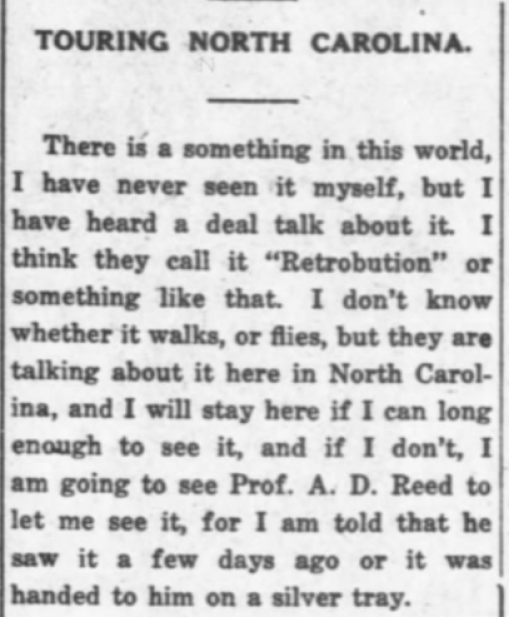
Charles Stump was the pen name of Kentucky-born journalist Charles Stewart (1869-1925). By 1914, Stewart was working for the Associated Press and the National Baptist Convention and was known as “the press agent of the Negro race.” As Stump, Stewart reported to The Broad Axe, a black Chicago newspaper, his impressions of the areas through which he traveled. His 1918 sojourn through North Carolina coincided with the boycott of Wilson Colored Graded School.

Stump misreported principal J.D. Reid‘s name as A.D. Reed, but spared no words in describing his disdain for Reid’s conduct — “It is a small man who would strike a woman, but they have it down fine in Wilson, N.C., and if it is kept up much longer there will be some going home, but which home I am not prepared to say myself …. I never want to see a white man strike one of our best women in this world, for I would just then send word to the angels to dust my wings for I will be on my way for them, and then send word to the devil to heat the furnace just a little hotter, for I have started some one to take quarters therein.” Mary Euell, on the other hand, received her full due as “a refined, cultured, christian woman” with the “dignity of a queen.”

Stump’s account contains new details of Reid’s actions and the startling news that Reed’s karmic redress included the public slap of his ten year-old daughter Thelma by white merchant W.D. Ruffin.

Screen Shot 2019-07-27 at 8.20.56 PM.png

Screen Shot 2019-07-27 at 8.21.44 PM.png

Screen Shot 2019-07-27 at 8.28.18 PM.png

Screen Shot 2019-07-27 at 8.29.10 PM.png

Screen Shot 2019-07-27 at 8.29.56 PM.png

Screen Shot 2019-07-27 at 8.30.41 PM.png

Screen Shot 2019-07-27 at 8.31.12 PM.png

Screen Shot 2019-07-27 at 8.32.23 PM.png

Screen Shot 2019-07-27 at 8.32.52 PM.png

Screen Shot 2019-07-27 at 8.33.20 PM.png

Screen Shot 2019-07-27 at 8.33.46 PM.png

Screen Shot 2019-07-27 at 8.34.25 PM.png

Screen Shot 2019-07-27 at 8.34.46 PM.png

The Broad Axe (Chicago, Ill.), 26 July 1919.

Barbershop notices.

Barbershops serving white clients charged uniform prices and operated uniform hours in the 1930s and 1940s.

Screen Shot 2019-07-28 at 8.44.52 PM.png

Wilson Daily Times, 3 July 1935.

Screen Shot 2019-07-28 at 8.04.12 PM.png

Wilson Daily Times, 29 July 1941.

Per the 1941 Hill’s Wilson, N.C., city directory:

  • Mullen’s Barber Shop (W Clarence Mullen) bsmt 113 E Nash
  • Red’s Barber Shop (John W Hawkins and O’Berry B Stevens) 113 S Goldsboro
  • Fields Nathan T barber 117 1/2 E Barnes h305 E Nash R7
  • Service Barber Shop (c; Clifton L Hardy) 113 S Tarboro
  • Taylor’s Barber Shop
  • Wm. Hines Barber Shop
  • Walter S. Hines Barber Shop
  • Cherry Hotel Barber Shop (Thos Williams; c) 317 E Nash