1940s

Private First Class Cornelius Braswell, stationed in England.

——

In the 1930 census of Upper Town Creek township, Edgecombe County, N.C.: George Braswell, 41; wife Lizzie, 35; and children Cornelius, 15, James, 13, Eloise, 10, Arthur, 8, Rena, 5, Ollin, 3, and Walter, 1.

In 1941, Cornelius Braswell registered for the World War II draft in Wilson County. Per his registration card, he was born 26 May 1914 in Wayne County, N.C.; lived on Route 3, Wilson; his contact was mother Lizzie Braswell; and he was a “prisoner until Feb. 20, 1941” at Prison Camp 406, Wilson.

Image courtesy of Veterans of World War II Wilson County, spiral-bound volume, Wilson County Public Library.

COL. WOMEN

In the early 1960s, uncomfortably aware of the optics, not to mention the illegality, of a segregated water fountain at the courthouse steps, Wilson County capped the fountain’s spigots and chiseled away the letters designating who drank where. By time I was born in 1964, local government had erased the public labels of Jim Crow. Most businesses followed suit, but some could not be bothered.

Wilson was deeply socially segregated for decades after civil rights legal rulings and legislation forbade legal enforcement. This meant, in practice, that while we could go into any public establishment and see a doctor or try on clothes or order a meal the same as any white person, the environment was not always inviting, nor the experience comfortable. This was the Wilson I grew up in. I never saw the old placards and partitions, but we bought chicken and barbecue from the back entrance of Parker’s, and I never played with, much less visited, my white friends away school. Still, we shopped freely at Belk’s and Barshay’s and Flower’s, guffawed at Disney movies in floor seats at the Colony and Wilson Theatres, and saw our white dentist and doctors at their West Nash and Tarboro Street offices.

Elsewhere, however, physical vestiges of codified segregation continued to leak radiation. I documented the ghosts of Jim Crow in a short-lived pandemic era Tumblr account. But the hand-painted White Water sign on a wall at Farmer’s Warehouse, starkly visible until the building’s demolition in 2023, confronted black workers and visitors well into the 1980s. The building’s owners never thought the sign’s poisonous message damaging enough to paint over. (Or maybe they understood precisely what it signaled.)

I have never believed that the Farmer’s Warehouse sign was the last of these signs. Downtown Wilson’s brick storefronts and former factories and warehouses are in the midst of a wave of redevelopment. Many old buildings, often long disused, have been demolished. Others have been renovated for exciting new uses. Surely, as investors and developers and contraction crews have scoured their interiors, they have encountered evidence of the rigid social structures that once locked black people  into (or out of) place.

Like this one.

That’s the door to the COLORED WOMEN TOILET. This five-panel door has been in storage since, it appears, about 1990. From about 1938 to at least the mid-1960s, it marked the restroom available for the few black female employees of the company that occupied this downtown building, all of whom likely all worked on the cleaning staff.

A different, unrelated company operated in the building in the 1970s and ’80s. I don’t know if they left the door where it originally hung or took it down and stored it, but they didn’t paint over its label or throw the door away.

This battered green door, still bearing stains from the oils of the countless hands that pushed through it, stands is an tangible, undeniable link to a past that many would now downplay. My deep thanks to those who shared this photograph with me and gave permission for me to publish it.

Pvt. I.D. Bostick, serving in France.

Wilson Daily Times, 19 May 1945.

In 1942, Ide Bostick registered for the World War II draft in Wilson. Per his registration card, he was born 2 August 1922 in Wilson; he resided at 530 Stemmery Street; his mailing address was 609 North 7th Street, Wilmington, N.C.; his contact was Isabell Bostick, 530 Stemmery; and he worked for N.C. Shipbuilding Company, Wilmington.

Image courtesy of Veterans of World War II Wilson County, spiral-bound volume, Wilson County Public Library.

A card of thanks from William Barney Reid’s family.

Wilson Daily Times, 1 August 1940.

Just two years after daughter Piccola Mae Reid died, a branch of the Reid family lost its patriarch, William Barney Reid. [Whose idea was the inclusion of “(col.)” in the notice?]

——

In the 1920 census of Wilson, Wilson County: at 300 Vick Street, carpenter Barnie Rudd, 37; wife Anna, 27; children Earl F., 6, and Pecolla, 3; and sister-in-law Irine Taybron, 23, teacher.

In the 1930 census of Wilson, Wilson County: at 300 Vick Street, building carpenter Barney Reid, 43; wife Anna, 39; children Earl, 4, Piccola, 13, and Fitzhugh, 9; and in-laws Harriot, 69, and John Tayborn, 80.

Pecola Mae Reid died 10 December 1938 in Mercy Hospital, Wilson. Per her death certificate, she was born in June 1916 in Wilson to Barney Reid and Anna Tabron; she lived at 300 North Vick Street; and she worked as county school teacher. She was buried in Wilson [likely, Vick Cemetery.]

In the 1940 census of Wilson, Wilson County: at 300 Vick Street, Barna Reid, 55, carpenter/contractor; wife Anna D., 42, teacher; son Jessie S., 19, construction helper; nephew Chester Taborn, 14; and roomers Irene Whitley, 24, Floricie Dunston, 28, both Wayne County teachers, and Clarence Artist, 24, tobacco factory laborer.

William Barney Reid died 20 July 1941 at his home at 300 North Vick Street, Wilson. Per his death certificate, he was 55 years old; was born in Wayne County, N.C., to Jesse Reid and Sallie Ann [no maiden name given]; was married to Anna Reid; worked as a carpenter; and was buried in Rest Haven Cemetery.

Pvt. Roosevelt Batts recovers in the South Pacific.

Wilson Daily Times, 19 May 1945.

——

In the 1930 census of Black Creek township, Wilson County: farmer Amos Batts, 29; wife Elizabeth, 29; and children Arlettie, 10, James, 8, Roosevelt, 7, and Amos Lee, 5.

In the 1940 census of Black Creek township, Wilson County: widow Elizabeth Batts, 42, farmer, and sons James H., 19, Rosevelt, 16, and Leander, 12. [Amos Leander Batts died while in service.]

Roosevelt Batts registered for the draft in 1940.

In the 1950 census of New York, New York County, New York: Roosevelt Batts, 25, and wife Hattie Margaret, 25, secretary, roomers in 331 Quincy Street.

Roosevelt Batts died 17 September 1986 and was buried in Calverton National Cemetery, Calverton, New York.

The affidavit of Sarah A. Coward.

Georgia Crockett Aiken died 17 August 1939 in Wilson. The following spring, Sarah A. Coward provided an affidavit attesting that Aiken’s sole heir was her niece Rachel Crockett Williams. Williams lived in New York City at the time of Aiken’s death, but by 1941 was living in the house she inherited at 120 North Pender Street.

Deed book 277, page 247, Wilson County Register of Deeds Office, Wilson.

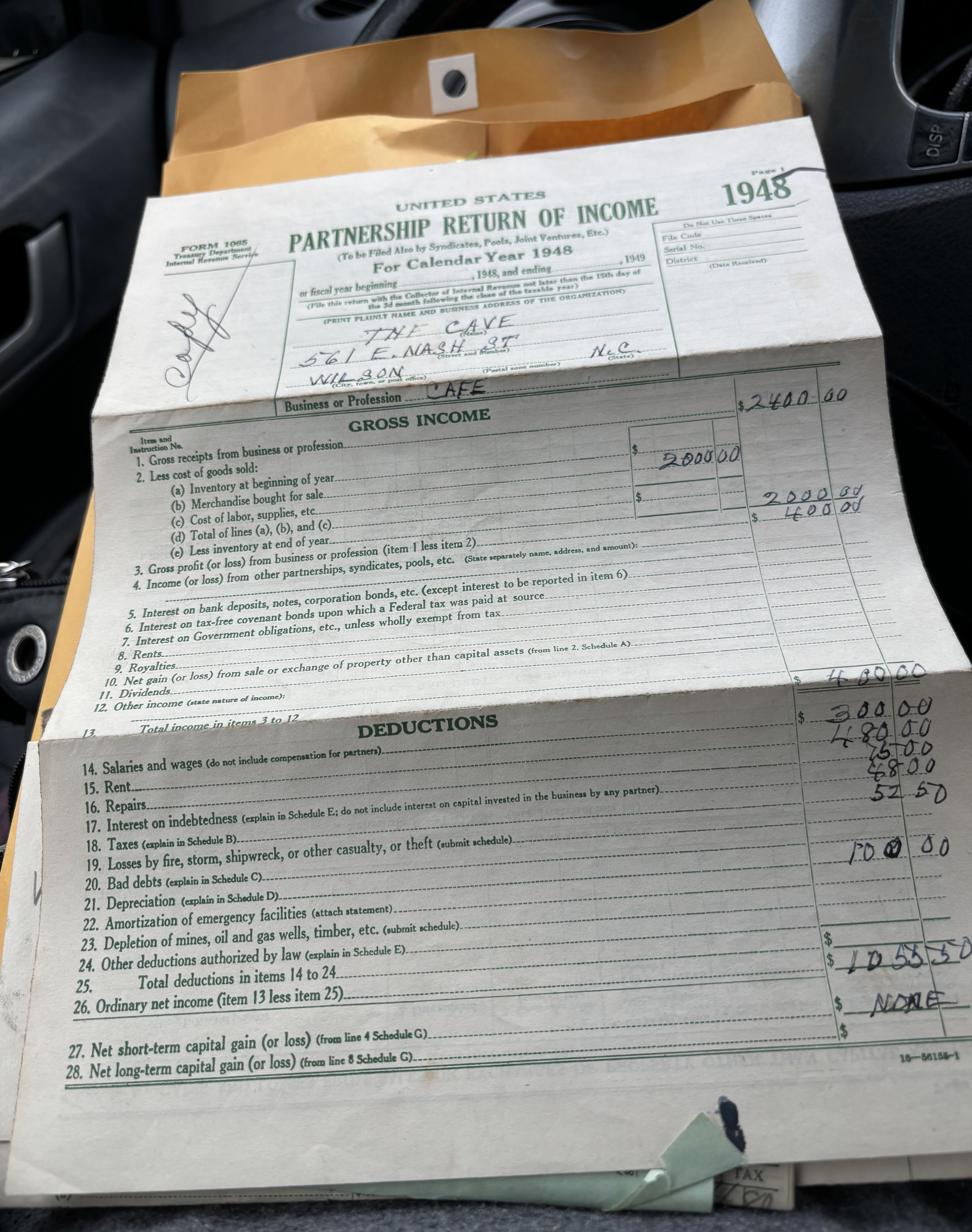
The Cave.

Me: Yeah. Now, what about the place – my daddy used to talk about a place called The Cave. Was that on –

Samuel C. Lathan: Yeah, man. That’s where I met my wife.

LYH: Really?

SCL: Yeah. I didn’t meet her there, but that’s where she and I would hang out. Now, The Cave was opened by Robert Vick.

LYH: Okay.

SCL: Robert Vick was a educator, and he was the principal of several schools, wonderful schools here. But when he came here, he brought a little New York down here.

LYH: Okay.

SCL: Because we didn’t have nothing. We had the Stop Light Grill.

LYH: Right.

SCL: But we didn’t have nothing like The Cave because The Cave had the sundaes. It had the milkshakes, it had the ice cream fancies. You know, it had all the little bar things that you would have, you know. Had good fried chicken in there and good sandwiches, you know, and brought the hoagie in, you know. Yeah, yeah, now. And Tom Woodard’s, and they had an excursion that Saturday — on that Friday night, there was a big excursion. A hayride. And the truck — was going to be two trucks would be at The Cave. Now, Robert Vick would put the things on like that. But I was sitting on my front porch because I could see – I was right across from The Cave.

Hill’s 1947 Wilson, N.C., city directory.

The Cave occupied a storefront in the two-story brick building Camillus Darden built at 561 East Nash Street.

Copy of tax return courtesy of Vicki Cowan; interview with Samuel C. Lathan copyrighted, all rights reserved.

Cpl. James Holden, also known as Harris, recuperates in England.

Wilson Daily Times, 14 July 1944.

——

In the 1920 census of Wilson, Wilson County: on Manchester Street, widow Mamie Holden, 31, tobacco factory worker, and children Daisy, 8, and James, 1.

In the 1940 census of Wilson, Wilson County: widow Mamie Holton, 51; son James Harris, 24; and nieces and nephews Daisy Mitchell, 27, and her children Gerlean, 4, Mamie, 9, Willie Jr., 12, and Thelma, 7.

In 1940, James Harris registered for the World War II draft in Wilson County. Per his registration card, he was born 2 June 1918 in Wilson; lived at 622 Suggs Heights, Wilson; his contact was mother Mamie Holden, same address; and he worked for Liggett & Meyers Tobacco Company.

Corporal Lonnie Jackson, somewhere in the Atlantic.

——

In the 1930 census of Jackson township, Nash County, N.C.: farmer Lonnie Farmer, 31; wife Jessie, 30; and children Lonnie, 9, Ruth, 7, Rubie, 5, and Robert, 3.

In 1942, Lonnie Junior Jackson registered for the World War II draft in Wilson County. Per his registration card, he was born 2 July 1920 in Wilson; lived at 519 Smith Street, Wilson; his contact was Jesse Jackson, 519 Smith; and he worked for Pridgen Grocery Store, 424 East Nash Street.

Private Lonnie Jackson.

Photo courtesy of Ancestry.com user Shaniece Ricks.