Month: February 2023

Lane Street Project: congrats to Winston-Salem’s Friends of Oddfellows Cemetery!

Wilson’s Odd Fellows Cemetery is not the only one that fell on hard times. Nor is it the only one under the care of a dedicated group of volunteers. Winston-Salem, N.C.’s Odd Fellows Cemetery is much larger than Wilson’s, and F.O.C. is a much older organization founded under different circumstances than Lane Street Project. They are a model, though, for work we may seek to undertake in Wilson, and we congratulate them on winning the 2022 Minnette C. Duffy Landscape Preservation Award!

Leaving for the turpentine districts of Georgia and South Carolina.

By 1890, North Carolina’s long-leaf pine forests had been decimated, and the state’s once-dominant share of the national naval stores production had plummeted. As highlighted in Imagination Station‘s exhibit “Journey to Wilson,” though the county was never a major player in the turpentine game, western Wilson County had a thriving naval stores industry through much of the nineteenth century. When workers began to follow the work, the Advance took notice.

Wilson Advance, 2 January 1890.

Wilson Advance, 25 December 1890.

Cemeteries, no. 31: Saint Delight community cemetery.

Saint Delight Community Cemetery lies perhaps four miles inside Greene County from Wilson County’s Stantonsburg, but it is the final resting place of many Wilson County residents with roots in the Speights Bridge and Bullhead area of Greene.

Saint Delight contains more than one thousand graves within its well-kept borders. The stones marking these sites include dozens carved by Wilson marble cutter Clarence B. Best; at least two by an unknown artist whose style I have dubbed “angle-and-serif;” and two beauties of a style I have not seen before, characterized by white lettering, angular number shapes, and designs that could almost be described as dainty.

The astonishing headstone of Greene County native Adam Fields, who was both a Mason and an Elk.

Addie Edwards’ headstone. The illustration under its ornately shaped top is faded, but lovely.

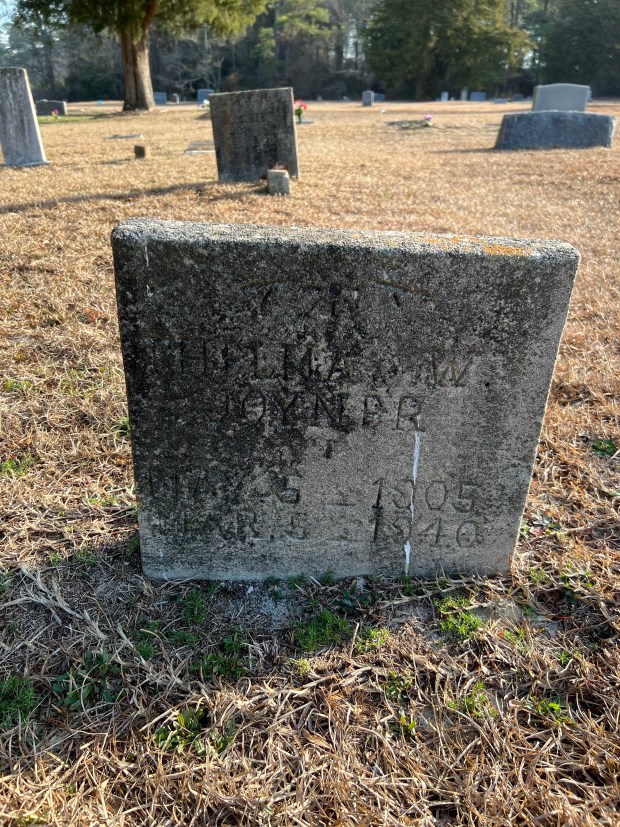
The headstones of Dicie Williams, Thelma W. Joyner, and Cloudie Williams feature the angle-and-serif style of an unknown artist. I’ve seen only two other examples, both in William Chapel Cemetery.

And this fascinating work with inset glass:

Photos by Lisa Y. Henderson, February 2023.

The will and estate of William Barden.

The second in a series documenting enslaved people held by the Bardin/Barden family, who lived in the Black Creek area in what was once Wayne County, but is now Wilson County.

——

When William Barden (1785-1837 drafted his last will and testament on 3 October 1835, he disposed of his enslaved property in two paragraphs. First, “my negro man Dred” was to be sold. Second, “all the rest of my Negroes” were to be equally divided among his children Celia Barden, James Barden, Jacob Barden, Penelope Barden Holmes, John Barden, Henry Barden, Nancy Barden, William Barden, Phebe Barden, Charity Barden, and Sally F. Barden.

William Barden died in 1837.

Immediately, on 20 March 1837, his executor hired out several enslaved people to bring in income.

A 15 May 1837 note in Barden’s estate file reveals that, even before he died, Barden authorized his son Jacob Barden “to carry out of the state and sell the negroe boy Dred.” Accordingly, J. Barden took Dred to Alabama and sold him to John Cook for $1000 — $500 down and $500 on credit.

On 6 June 1837, a committee divided the men, women, and children who had lived together as Arthur Barden’s enslaved property:

  • Ben, valued at $600, to Sally F. Barden
  • Whitley, valued at $550, to James Barden
  • Hardy, $525, to Nancy Barden
  • Tom, $500, to William Barden
  • Wilie, $425, to Jacob Barden
  • Milly, $500, to John Barden
  • Cherry and child, $550, to Pheraby [Phebe] Barden
  • Jerry, $325, to Penny Holmes
  • Mary, $325, to Henry Barden
  • Pursey and Ruffin, $425 to Lilia Barden
  • Lany and Patrick, $500, to Charity Barden

——

All William Barden’s children moved to Pontotoc and Itawamba Counties, Mississippi, within a few years of their father’s death. They undoubtedly took with them named here, pulling them hundreds of miles from the families and communities they knew and loved. I have only been able to locate what appears to be further record of one — Dred, who was sold away.

  • Dred

On 14 August 1867, Dred Cook, colored, registered to vote in Precinct No. 17, Greene County, Alabama. (John J. Cook had settled in Greene County as early as 1825.)

In the 1870 census of Mount Hebron township, Greene County, Alabama: Dred Cook, 83, farmer, born in North Carolina; presumed wife Mahala, 50, born in N.C.; and Wiley, 19, and Delia Cook, 15, both born in Alabama.

Also, in the 1870 census of Boligee township, Greene County, Alabama: Dred Cook, 83, farmer; presumed wife Haley, 50; and Wiley, 18, and Deley Cook, 15, all reported born in Alabama.

Estate File of William Barden (1837), Wayne County, North Carolina Wills and Probate Records, 1665-1998, http://www.ancestry.com.

Lane Street Project: and another one — Jack Rountree!

Yesterday, while working at Odd Fellows, Billy Foster of Foster Stone and Cemetery Care unearthed two more grave markers. One was blank, but the other was that of Jack Rountree, whose daughter Delzela Rountree is also buried at Odd Fellows. It is likely that his wife Lucille Rountree is there as well.

——

In the 1870 census of Bushy Fork township, Person County, North Carolina: farm laborer Henry Rountree, 30; wife Margaret, 20; and son Jack, 6.

On 21 October 1891, Jack Rountree, 30, parents unnamed, and Lucy Bergeron, 20, of Falkland, of Elias and [illegible] Bergeron, were married in Pitt County, North Carolina.

In the 1900 census of Falkland township, Pitt County: farmer Jack Rountree, 49; wife Lucy, 27; and children Julius, 5, Daisy E., 2, and Cora, 2 months; sisters Marcela, 23, Cora, 24, and Ella Bargeron, 26; and boarder Jacob Worthan, 18.

In the 1910 census of Wilson township, Wilson County: on Saratoga Road, farmer Jack Rountree, 53; wife Lucy, 35; and children Junius, 15, Delzel, 12, Cora Lee, 10, John H., 7, James, 6, Mable, 4, and Gollie May, 1.

Daisy L. [sic] Roundtree died 5 August 1914 in Wilson. Per her death certificate, she was born in 1898 to Jack Roundtree and Lucy Body; was single; lived on Stantonsburg Street; and was buried in Wilson [Odd Fellows Cemetery].

In the 1916 Hill’s Wilson, N.C., city directory: Rountree Jack (c) farmer h Stantonsburg rd extd

In the 1920 census of Wilson, Wilson County: on Old Stantonsburg Road, farmer Jack Rountree, 57; wife Lucile, 47; son Julius, 24, daughter-in-law Lida, 23, sons John Henry, 17, and Jesse, 16, daughters Mabel, 14, and Ola May, 10, and married daughter Cora Farmer, 19. [Her husband Paul was working in Philadelphia, Pennsylvania.]

In the 1930 census of Wilson, Wilson County: on Mason Street, Loucile Roundtree, 52; husband John H., 67, yard gardener; and children Jessie D., 26, plasterer in public buildings; Mable, 22, dressmaking; John H., 27, cotton mill mechanic; Goldie J., 19; and Bertha, 14, “adopted daughter.”

Lucile Elizabeth Rountree died 14 May 1930 in Wilson. Per her death certificate, she was born 10 May 1875 in Pitt County to Elias Barden and Lettice Davis; was married to Jack Rountree; lived on Hadley Street; and was buried in Wilson [probably Odd Fellows Cemetery].

On 16 September 1931, Jack Rountree, 60, of Wilson, son of Henry Rountree and Margaret [maiden name not given], married Catherine Waddell, 50, of Rocky Mount, daughter of Charles and Mary Small, in Wilson. A.M.E. Zion minister B.P. Coward performed the ceremony in the presence of J.L. Cooke, Clara R. Cooke, and S.A. Coward.

In the 1940 census of Rocky Mount, Nash County, North Carolina: at 1812 South Church Street, yardman Jack Rountree, 78, and wife Katherine, 62.

In the 1950 census of Rocky Mount, Nash County: at 1812 South Church Street, John H. Rountree, 88, and wife Catherine, 77.

John Henry Rountree died 21 June 1953 at his home at 1812 South Church Street, Rocky Mount, Nash County. Per his death certificate, he was born 4 March 1887 in Person County, N.C., to Henry Rountree and Margaret [maiden name not stated]; worked as a retired janitor; and was buried in Rest Haven Cemetery, Wilson. [There is no marker in Rest Haven for John or Jack Rountree.]

Catherine Waddell Rountree died 1 September 1958 at her home at 1812 South Church Street, Rocky Mount. Per her death certificate, she was born 10 July 1888 in Greene County, N.C., to Charles Small and Mary Patrick; was the widow of Jack Rountree; and was buried in Unity Cemetery, Rocky Mount.

The estate of Mary Howell Bardin.

The first in a series documenting enslaved people held by the Bardin/Barden family, who lived in the Black Creek area in what was once Wayne County but is now Wilson County.

——

Mary Howell Bardin, widow of Arthur Bardin, died about 1854. Mary Bardin’s estate file contains a document recording the 14 December 1854 division of enslaved people among her six surviving children:

  • James H. Barnes and wife Susan A. Bardin Barnes received Axey and her unnamed child.
  • John P. Bardin received Sarah and her child Wright.
  • William H. Bardin received Handy and Queen.
  • Benjamin H. Bardin received Mourning.
  • Mary B. Bardin received Caroline and Winny.
  • Jesse J. Bardin received Mariah and Jane.

——

  • Axey and child

In a post about Jeremiah Barden (Jerry Borden)’s Freedmen’s Bank accounts, I wrote: “When Jeremiah Barden opened his first account, he reported that he was living up the Trent River in Jones County, working on Colonel Whitford’s land for himself (i.e. as a tenant farmer.) Barden is frustratingly elusive in census records. His birth family, however, remained back in Wilson County and appear in the 1870 census of Black Creek township: farm laborer Washington Simms, 57, and wife Exy, 47, plus Henry, 32, Gatsey, 27, Nathan, 10, Grant, 4, and Harrit Simms, 5; Waity Nelson, 18; Joseph, 14, Samuel, 12, Mary, 10, and Della Simms, 8; Ellen Barden, 1; and William Nelson, 26. They are listed in close proximity to white farmers Arthur Barden, 54, and Benjamin Barden, 42. It is a reasonable conjecture that Exy Simms and her children (but not her husband Washington) belonged to one of these Bardens prior to Emancipation, and Jeremiah adopted “Barden” as a surname as a result.”

My hunch was right. In 1866, Washington Simms and Axey Barnes registered their 30-year marriage with a Wilson County justice of the peace. Axey, who had been enslaved by Mary Barden, was allotted to James and Susan Barnes in 1854 and adopted the Barnes surname. Her son Jerry, born about 1840, had a different owner, and adopted Barden (which became Borden) as his surname. (Their husband and father, Washington Simms, had been enslaved by Benjamin Simms II. More to come on that.)

  • Sarah and child Wright

In the 1870 census of Black Creek township, Wilson County: Alford Barden, 28; wife Mourning, 25; and children Harriss, 3, and Sarah, 1; plus Wright, 15, and Caroline Barden, 21, and Thoms Harrison, 28.

  • Handy
  • Queen

In 1866, Ben Barden and Quince Barden registered their 40-year cohabitation in Wilson County.

In the 1880 federal mortality schedule of Wilson County: Queene Barden, 74, widow, died August 1879 at home.

  • Mourning

In the 1870 census of Black Creek township, Wilson County: Alford Barden, 28; wife Mourning, 25; and children Harriss, 3, and Sarah, 1; plus Wright, 15, and Caroline Barden, 21, and Thoms Harrison, 28.

  • Caroline

In the 1870 census of Black Creek township, Wilson County: Alford Barden, 28; wife Mourning, 25; and children Harriss, 3, and Sarah, 1; plus Wright, 15, and Caroline Barden, 21, and Thoms Harrison, 28.

Also, in the 1870 census of Black Creek township, Wilson County: Caroline Barden, 21, farm laborer, and daughter Georgian, 1.

  • Winny
  • Mariah
  • Jane

In the 1870 census of Black Creek township, Wilson County: Alford Barden, 28; wife Mourning, 25; and children Harriss, 3, and Sarah, 1; plus Wright, 15, and Caroline Barden, 21, and Thoms Harrison, 28.

Estate File of Mary Barden (1852), Wayne County, North Carolina Estate Files 1663-1979, http://www.familysearch.org.

The travails of the Third N.C. Infantry.

In response to President William McKinley’s call for volunteers upon the outbreak of the Spanish-American War, the 3rd Battalion of North Carolina Volunteers mustered in on 12 May 1898 at Fort Macon, North Carolina. Seven companies, including Corporal Willie Gay‘s Company I, joined the original three in July, forming the 3rd North Carolina Regiment. Though the 3rd N.C. was alerted to prepare to ship out to Cuba, the war ended before they saw action in battle. The Regiment moved west to Knoxville, Tennessee, in September 1898, where its disillusioned members wrote the plaintive letter below to Secretary of War Russell A. Alger. In November, the 3rd was sent to Macon, Georgia — where two Wilson County men were involved in a fatal altercation — then mustered out in January 1899.

Willie Gay’s grave is marked by the only Spanish-American War headstone I have found in Wilson County for an African-American soldier. However, 3rd N.C. veteran Turner H. Utley was also buried in this cemetery.

The following letter is reported to have been sent to Secretary of War Alger by members of this regiment. The names of those who signed the letter were not given to The Journal and Tribune reporter with the copy of the letter.

Third North Carolina Regiment 
(All companies) Sept. 23, 1898,

To the Secretary of War:

Dear Sir:–We the undersigned many soldiers, heard that you had been instructed that we wanted to stay in service as garrison duty, but my dear sir, we are now pleading with mercy and deny any such report as there had been reported and we feel that our superior officers has treated us wrong to hold us in service without we knowing anything about it.

We the undersigned did not join the service for garrison duty. We only sacrificed our lives and left our homes simply for the honor of our flag and the destruction of our country and families as the war was going on at that time, but now the war is over and we do feel that we might be mustered out of service because we are getting letters from our families every day or two stating the suffering condition, and oh my God, the way that we are treated. We have to drill harder than any other regiment on the grounds and after drilling so hard, we have to work so hard. We have to cut ditches, sink holes and fill up gullies, put in water pipes. We, the 3rd N.C. regiment soldiers has not had but one pair of pants, one coat, two undershirts, one top shirt. We are in a box fit. Our food is not fit to eat, and oh my dear sir, we are bound up in a little place about 400 feet long 3 feet wide. Just think of the confinement we are under just because we volunteered freely to fight for our country.

We the undersigned many soldiers did not volunteer for garrison duty and we do not think that our honorable government will take the advantage of willing and faithful men who came to the rescue of the flag, stars and stripes. We have a great deal more to tell you but we can not express ourselves like it ought to be done.

Down at Fort Macon we was misled. The question was asked who wanted to stay in the service and go to the front if necessary, called upon them to raise hands, but the question never was asked if we wanted to do garrison duty. If they had of asked that question we never would have been in Knoxville today. Why don’t you know as a good thinking man that we don’t want to leave our wives and families to go on garrison duty. Why if so you would have had more applications in the white house than the mail box would have helt.

You know that these officers is getting a very good salary and they would go in three miles of hell after that dollar, but we who are brave men did not come for the sake of that $15.60, but we gloried in the flag and come to hold it up by the balls and shells. So as we did not get a chance to do so we hope that you will consider this matter. Look it over, give us the judgment of justice and if you do we will go home to our families who are in a suffering condition, so we will not write any more.

We the undersigned await your earliest reply. Many soldiers of the Third North  Carolina regiment. We want to go home. 

Journal and Tribune (Knoxville, Tennessee), 5 October 1898.

Photo by Lisa Y. Henderson, February 2023.

Wilson County NC African-American Genealogy, a Facebook group.

I often get queries here at Black Wide-Awake from people seeking help with finding their roots or connecting with family descended from a common ancestor. I have extensive genealogical research history, but I don’t have the bandwidth to take on projects for others. Also, I don’t live in North Carolina, where the best non-digital primary source material is located. So, I’ve created a Facebook group as a space in which to make connections with long-lost family, to post inquiries, and to share research about African-American families from Wilson County.

Please join us there.