Month: September 2022

Negro laborers wanted.

Wilson Daily Times, 2 March 1918.

Badin Aluminum Works placed this alluring ad in the Daily Times in 1918. Though working for Alcoa seemed to offer an appealing alternative to sharecropping, life in this company town had a dark side — literally, as the families of African-American workers lived segregated in Negro Town, and figuratively, as the extent and impact of industrial pollution continues to come to light.

“Badin has become a crucible for questions about the legacy of industrialization, racial capitalism, and environmental justice in the American South, and for how choices made and prejudices fomented a century ago reverberate into the present — with the added complication that Badin was a company town.” Read Emily Cataneo’s The Complicated Lgacy of Badin, North Carolina, http://www.undark.org, for more.

[I am searching for evidence that any Black Wilson County families answered this siren call.]

Clipping courtesy of J. Robert Boykin III.

Buddy Johnson and his Orchestra at the Community Center.

Wilson Daily Times, 2 September 1943.

South Carolina-born Buddy Johnson was a jump blues pianist whose orchestra began touring the South in the early 1940s. Reid Street Community Center was a popular venue on the chitlin circuit.

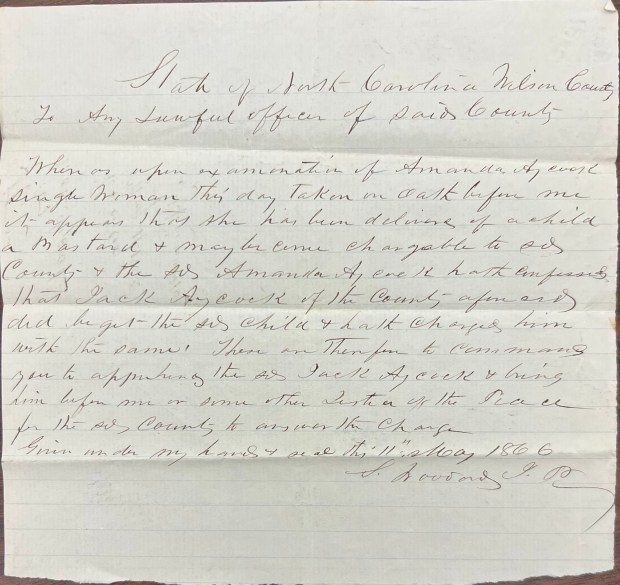
State vs. Jack Aycock.

Jack Aycock married Letha Daniel on 17 December 1866 in Wilson County. In the 1870 census of Black Creek township, Wilson County: Jackson Aycock, 23; wife Litha, 26; and daughter Kate, 1.

I have not identified Amanda Aycock.

Bastardy Bonds, 1866, Miscellaneous Records, Wilson County Records, North Carolina State Archives.

Teachers assigned to Negro schools.

Wilson Daily Times, 31 August 1949.

Just before the school year began, the Daily Times published the names of African-American teachers at Wilson County’s Black county schools — Williamson High School, Williamson Elementary, Rocky Branch, Jones Hill, New Vester, Sims, Farmers, Howard, Holden, Saratoga, Bynums, Wilbanks, Yelverton, Stantonsburg, Evansdale, Ruffin, Lofton, Minshew, Brooks, Lucama, and Calvin Level

The mission circles give thanks.

Wilson Daily Times, 16 August 1943.

In 1943, First Baptist Church hosted hundreds of delegates to the Baptist Women’s Home and Foreign Missionary convention. On behalf of the church, Nannie Barber, Nancy Wilkins, and Rev. Fred M. Davis thanked their many supporters.

Jackson Chapel First Missionary Church celebrated its 150th anniversary last month with a banquet and anniversary worship service.

As the Wilson Times noted in an August 18 article:

“U.S. Rep. G.K. Butterfield, whose grandfather, the Rev. Fred Davis, served as Jackson Chapel’s third pastor, has been a member since May 1955 and knows the church’s history by heart.

“‘I’m the oldest member in Jackson Chapel, not by age but in terms of membership. … There’s no member at Jackson Chapel who can say they’ve belonged longer than I have,’ Butterfield said. 

“The church was founded in 1872 by Andrew Joshua Jackson, who was born into slavery in Virginia and became a minister after he was freed. 

“Jackson Chapel’s congregation first met on Barnes Street, where Wilson Chapel is now, and its current location at the corner of Nash and Pender streets was built in the 1910s. While in Wilson, Booker T. Washington laid the building’s cornerstone.

“Throughout its history, the church has been a voice for East Wilson.

“‘Through the years, Jackson Chapel has been the epicenter of civic activity and spiritual activity in East Wilson,’ Butterfield said. ‘During the Depression, during the war, during the civil rights era, it was Jackson Chapel that stood tall and strong and helped lead the civil rights movement. It has been a spiritual force and a political force in Wilson County.'”

1115 Carolina Street.

The one hundred-seventy-seventh in a series of posts highlighting buildings in East Wilson Historic District, a national historic district located in Wilson, North Carolina. As originally approved, the district encompasses 858 contributing buildings and two contributing structures in a historically African-American section of Wilson. (A significant number have since been lost.) The district was developed between about 1890 to 1940 and includes notable examples of Queen Anne, Bungalow/American Craftsman, and Shotgun-style architecture. It was listed on the National Register of Historic Places in 1988.

As described in the nomination form for the East Wilson Historic District, this building is: “ca. 1940; 1-story; bungalow with gable roof form and shingle shake veneer.”

Timothy and Grace Battle Black purchased the property at 1115 Carolina Street in 1935 and likely built this house within the next few years.

In 1939, they appeared in a list of property owners who faced sale of their properties for unpaid taxes:

Wilson Daily Times, 21 November 1939.

In the 1941 Hill’s Wilson, N.C., city directory: Black Grace (c) cook h 1115 Carolina

The Blacks divorced in mid-1944, and in July the Wilson Daily Times published a series of notices of the sale of 1115 Carolina.

Wilson Daily Times, 19 July 1944.

The sale was apparently called off, as Grace Black remained in the house three years later. In the 1947 Hill’s Wilson, N.C., city directory: Black Grace (c) cook McLellans h 1115 Carolina.

The obituary of Bessie McNair Best.

Wilson Daily Times, 2 August 1949.

——

In the 1940 census of Wilson, Wilson County: at 213 Ashe Street, renting for $8/month, tobacco factory laborer Virginia McNair, 40; daughter Bessie Ward, 24, a cook; and grandchildren Grace, 8, Mary N., 5, and Willie C., 7.

Bessie McNair Best died 29 July 1949 in Norfolk, Virginia. Per her death certificate, she was born 23 August 1915 in Wilson, N.C., to William McCullum and Virginia Ward; was the widow of James Best; and was taken to Wilson for burial by C.E. Artis Funeral Home.

Clipping courtesy of J. Robert Boykin III.
Cancer instruction.

Wilson Daily Times, 6 August 1949.

The Wilson County chapter of the American Cancer Society sent Mercy Hospital nurse Sylvia Daniels to attend a training course in cancer nursing at Durham’s North Carolina College (now North Carolina Central University.)

——

Hill’s Wilson, N.C., City Directory (1947).

Clipping courtesy of J. Robert Boykin III.