Month: October 2020

Batts struck and killed on bicycle.

News and Observer (Raleigh, N.C.), 22 October 1937.

——

In the 1900 census of Gardners township, Wilson County: farmer Amos Batts, 45; wife Clara, 43; and children Martha A., 21, Mary J., 19, Pennina, 17, Vaulentine, 15, Lena, 12, Nancy, 10, Lissie, 8, John D., 5, and Amos, 2.

In the 1910 census of Cross Roads township, Wilson County: farmer Amos Batts, 56; wife Clara, 55; sons Jon, 16, and Amos, 12; and grandchildren Pearcie, 6, and Clara, 2. 

In 1917, Amos Batts registered for the World War I draft in Wilson County. Per his draft registration card, he was born in 1895 in Elm City, N.C.; lived in Black Creek, N.C.; was single; and was a self-employed farmer in Black Creek township.

In the 1920 census of Black Creek township, Wilson County: on the road east from Black Creek to Wilson, farmer Mathew Williams, 34; wife Rena, 32; sons Willie, 7, Mathew Jr., 4, and George, 2; stepson Percy Burl, 16; and brother-in-law Amos Batts, 22, farm laborer.

On 22 February 1920, Amos Batts, 25, of Black Creek, son of Amos and Clara Batts, married Elizabeth Barnes, 22, of Black Creek, daughter of Rob and Emma Barnes, at Rob Barnes’ in Black Creek. Matthew Williams applied for the license, and a justice of the peace performed the ceremony in the presence of Grant Farmer, Fred Locus, and Ernest Tucker.

In the 1930 census of Black Creek township, Wilson County: Amos Batts, 29; wife Elizabeth, 29; and children Arlettie, 13, James, 8, Roosevelt, 7, and Amos Lee, 5.

“Run over on highway with auto killing him instantly”

Amos Batts’ widow Elizabeth Batts applied for a military headstone for his grave, which was located in Jim Loach’s cemetery in Black Creek.

Confession.

In February 1938, glorified gossip columnist John G. Thomas penned a column about the guilt-soaked confession of William Mercer, who had killed Wade Farmer in the summer of 1921, then fled the state. Mercer had joined a church in his adopted home of Coatesville, Pennsylvania, and his conscience preyed on him as he stood in the choir stand.

Wilson Daily Times, 25 February 1938.

The details are difficult to pin down. When the Daily Times article broke the story of William Mercer, alias Green, on 21 February 1938, it quoted B.E. Howard, the sheriff at the time of the murder, who admitted he could barely recall the details of the incident — had the victim had been shot or stabbed? — though he thought it occurred after a “negro dance or frolic.” On the other hand, the 27 February Raleigh News and Observer reported that an argument had broken out at a church gathering, and Farmer “got in the road” of a bullet fired from Mercer’s gun.

Wade Farmer’s death certificate does not shed much light:

Per the document, Wade Farmer of Macclesfield died in Gardners township near Wilbanks in May 1922.  He was 22 years old, married to Minnie Farmer, and farmed for Essex Webb, who could provide no information about his parents. The medical certification section is so faded as to be almost unreadable, except for “198,” which was the code for “homicide by cutting or piercing instrument.” The place and date of burial and undertaker fields are similarly washed out, and the registrar did not sign it until 3 January 1923.

On 5 March 1938, the Daily Times reported that Mercer had pled guilty to Farmer’s murder, and a judge had sentenced the 42 year-old to one and-a-half to three years, saying he had been merciful because Mercer had given himself up voluntarily.

But had he really?

Wilson Times, 7 September 1934.

Just four years before Mercer’s “confession,” around the time he claimed he had gotten religion, the Times reported that he had been indicted for Wade Farmer’s May 1922 murder and was to be extradited from New Jersey. Mercer had been arrested in Bridgeton, New Jersey, forty miles south of Philadelphia.

Why, then, the framing of Mercer’s come-to-Jesus moment as the astonishing re-appearance after 17 years of a man who’d gone underground for a crime barely remembered? 

Well, in part, because the man arrested in New Jersey in 1934 and hauled back to Wilson was not William Mercer. Rather, he was Ben Faison, originally of Faison, North Carolina. Though an informant positively identified the man as Mercer, several others who “looked him over” said he was not. On 21 September, the Daily Times informed its readers that Wilson police nonetheless would hold Faison until they were satisfied of his identity. 

So, while law enforcement had never forgotten Farmer’s murder, Mercer’s apprehension was entirely the result of his own doing. He had made an apparently upstanding life for himself in Pennsylvania and had completely cut ties with Wilson in order to do so. When his mother Fannie Mercer visited him at the Wilson County jail, it was the first time she had seen her son in 17 years.

News and Observer, 27 February 1938.

Black Wide-Awake turned 5.

… last week, on October 5.

I mentioned on last year’s anniversary that I’d originally intended to create “at least three location-specific sites into which I would pour all the ‘extra’ that I uncovered in the course of my genealogical research. All the court records and photographs and newspaper clippings that did not pertain directly to my people, but documented the lives of the people who built and nurtured (or disrupted) the communities in which they lived.”

It hasn’t happened. As of today, Black Wide-Awake is an astonishing 2880 posts deep, and I feel I’ve barely scratched the surface. To honor my original intentions, though, over the next year, I will give over the blog, a week at time, to the three other North Carolina counties I know best, and maybe a fourth if I think I can do it justice. 

Stay tuned for Iredell County in November. In the meantime, as always, thanks so much for your boundless support and encouragement of Black Wide-Awake. Here’s to five more years of filling in the gaps!

Best regards,

Lisa Y. Henderson, a Mercy Baby.

Sunshine Alley.

As noted in the earlier “Lost Neighborhoods” posts, downtown Wilson was once shot through with narrow alleys packed with the tiny double-shotgun dwellings of African-American tobacco workers. The whole of Sunshine Alley ran one and a half blocks between Tarboro and Mercer Streets, in the shadow of Liggett & Meyers’ tobacco warehouse and within a block of Planter’s Warehouse, Banner, Monk-Adams, Farmers, and Watson Warehouses. The neighborhood survived a 1924 fire, but by the end of 1928 it was gone — obliterated to make way for the massive Smith’s Warehouses A and B. (You can read a whole page about Smith’s in the nomination report for the Wilson Central Business-Tobacco Warehouse Historic District, but you’ll find no mention of Sunshine Alley.)

Here’s Smith’s in the 1940 aerial of Wilson, occupying the entire block bounded by East Jones, South Goldsboro, Hines, and Mercer Streets.

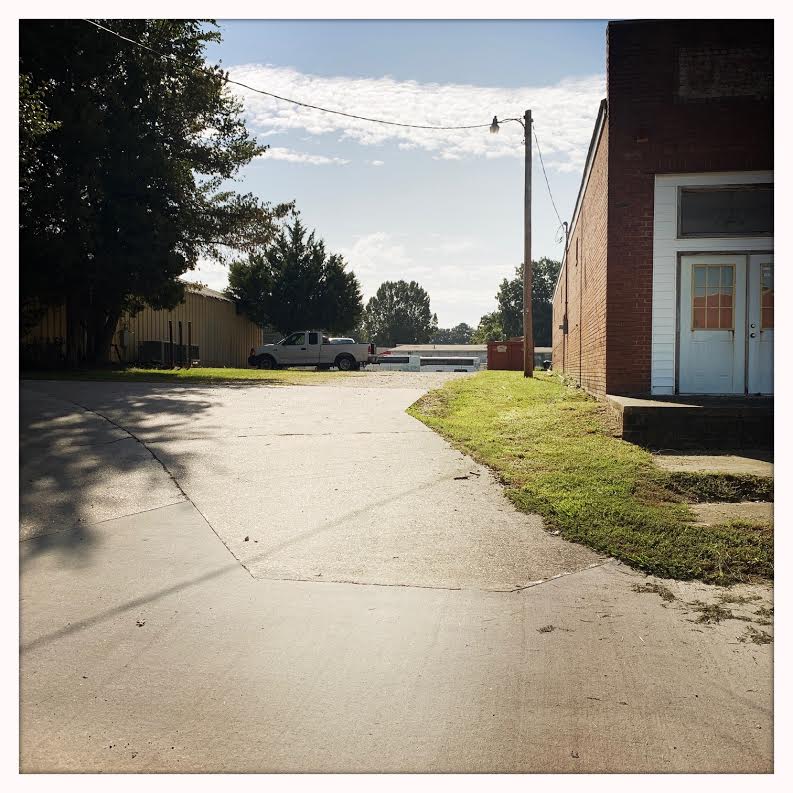
Today there’s nothing in this block but a Family Dollar store. Stand at the mouth of its driveway at Goldsboro Street. Look west:

Then east:

This was Sunshine Alley.

Photos by Lisa Y. Henderson, September 2020.

404 North Reid Street.

The one-hundred-twenty-fourth in a series of posts highlighting buildings in East Wilson Historic District, a national historic district located in Wilson, North Carolina. As originally approved, the district encompasses 858 contributing buildings and two contributing structures in a historically African-American section of Wilson. (A significant number have since been lost.) The district was developed between about 1890 to 1940 and includes notable examples of Queen Anne, Bungalow/American Craftsman, and Shotgun-style architecture. It was listed on the National Register of Historic Places in 1988.

As described in the nomination form for the East Wilson Historic District, this building is: “ca. 1922; 1 story; Alf McCoy house; Queen Anne cottage with hip roof and double-pile plan; evidence of original turned posts and patterned-tin roof.”

In the 1916 Hill’s Wilson, N.C., city directory: McCoy Alfred (c) lab h Reid betw Carolina & E Green

In the 1920 census of Wilson, Wilson County: Town of Wilson laborer Alfa McCoy, 43; wife Florence, 40; widowed mother-in-law Adline King, 78; sister-in-law Mattie Mercer, 30; and roomers Leroy Mercer, 35, Town of Wilson laborer, Silvester Mercer, 15, and Dempsey Mercer, 1.

The 1922 Wilson, N.C., Sanborn fire insurance map, detail below, shows only three houses on North Reid between Carolina and Green Streets. As indicated in the 1916 city directory, Queen Street had not been cut through yet. The house thus appears to be a few years older than estimated in the nomination form.

In the 1930 census of Wilson, Wilson County: at 404 Reid Street, owned and valued at $2000, Alford McCoy, 53, fertilizer company laborer, and wife Florance, 52, laundry. 

In the 1940 census of Wilson, Wilson County: at 404 Reid Street, owned and valued at $2000, Alfred McCoy, 72, “not able” to work, and wife Florence, 60, washing. 

Alfred McCoy died 5 November 1953 at his home at 404 North Reid Street. Per his death certificate, he was born 15 September 1875 in Edgecombe County to Alexander McCoy and Ellen [last name unknown]; was married; and worked as a laborer for the Town of Wilson. Informant was Florence McCoy

In her 3 October 1955 will, filed after her death in Wilson County Superior Court, Florence McCoy left her house at 404 North Reid Street to her neighbor John H. Jones.

Florence McCoy died 21 August 1956 at her home at 404 North Reid Street. Per her death certificate, she was born in 1883 in Nash County to Berry King and was a widow. Informant was John H. Jones, 405 North Reid Street.

William “Bill” Pharaoh Powell died 23 July 1963 at his home at 404 North Reid Street, Wilson. Per his death certificate, he was born 15 February 1891 in Wilson County to Echabud Powell and Mary Ann Lassiter; was married to Margaret H[agans] Powell; and worked as a laborer. 

Principal’s reports: Charles H. Darden High School, 1941.

High school principals were required to file annual reports with the North Carolina State Department of Public Instruction. In 1941, Edward M. Barnes filed this report for Charles H. Darden Hugh School.

The school year was 180 days long and ran from 5 September 1940 to 27 May 1941. (Compare Elm City Colored School, and Williamson High School, rural schools that only had 120-day terms.) Thirteen teachers taught at Darden — seven women and six men. These thirteen taught 331 children — 119 boys and 212 girls — in grades eight through eleven. All grades, including elementary, were housed in one building, which had restrooms, a principal’s office, a library, an auditorium, and a lunchroom.

The high school offered classes in English, general mathematics, geometry, civics, citizenship, world history, American history, Negro history, sociology, geography, general science, chemistry, biology, vocational guidance, and home economics.

The school day was divided into eight periods between 8:30 and 3:25. Lunch was at 12:15. The teachers were Rosa L. Williams, Arnold G. Walker, Cora Miller Washington, James F. Robinson, M.J. Cooper, P.K. Spellman, Spencer J. Satchell, Dolores L. Hines, John M. Miller Jr., Carl W. Hines, E.H. Foster, Marian H. Miller, and Randall R. James.

All the teachers were college graduates, and most had significant experience. 

The school had no dedicated science laboratory space, but did have lab equipment, and had numerous maps and globes. It published a newspaper, The Trojan Journal, and sponsored boys and girls glee clubs, a Verse Choir, and student patrol. 

The school graduated 27 students in the Class of 1941.

High School Principals’ Annual Reports, 1940-1941, Wayne County to Wilson County; North Carolina Digital Collection, digital.ncdcr.gov.

The obituary of Mary Price, highly respected.

Wilson Daily Times, 12 December 1928.

——

Mary Price died 11 December 1928 in Wilson. Per her death certificate, her age was unobtainable; she was a widow; she lived at 519 Church Street, Wilson; and she was born in Duplin County to Clarrissa Whitley. Informant was Thomas O. Davis, Wilson.

Clipping courtesy of J. Robert Boykin III.

Hanging tree guitars.

“Freeman Vines has been building guitars for fifty years, and no two of them are alike. While a commercial guitar company like Gibson or Fender seeks uniformity in their instruments, Vines seeks singularity. He doesn’t force his raw material into a predetermined form. Instead, he follows its lead. He closely considers the unique qualities of the wood and allows his own artistic spirit to connect with its character and its history.

“This material might be an old mule trough, a torn down tobacco barn, or a broken piano. Or it might be a hanging tree.”

That hanging tree is said to be the black walnut at which Oliver Moore was hanged in 1930, the last official lynching in Wilson County. Folklorist and photographer Timothy Duffy, founder of Music Maker Relief Foundation, has spent years with Vines, chronicling his craft. Hanging Tree Guitars emerged from Vines and Duffy’s collaboration with folklorist Zoe Van Buren.

A review at the Foundation’s digital exhibit of Vines’ work: “To meet Freeman Vines is to meet America itself. An artist, a luthier and a spiritual philosopher, Vines’ life is a roadmap of the truths and contradictions of the American South. He remembers the hidden histories of the eastern North Carolina land on which his family has lived since enslavement. For over 50 years Vines has transformed materials culled from a forgotten landscape in his relentless pursuit of building a guitar capable of producing a singular tone that has haunted his dreams. From tobacco barns, mule troughs, and radio parts he has created hand-carved guitars, each instrument seasoned down to the grain by the echoes of its past life. In 2015 Vines befriends photographer Timothy Duffy and the two begin to document the guitars, setting off a mutual outpouring of the creative spirit. But when Vines acquires a mysterious stack of wood from the site of a lynching, Vines and Duffy find themselves each grappling with the spiritual unrest and the psychic toll of racial violence living in the very grain of America.”


A branch of Toisnot Swamp.

I have a vague childhood memory of playing in a ditch that ran behind the Reid Street Community Center pool. Keith M. Harris and I — ever chasing our explorer fantasies — would dig greasy clumps of red and gray clay from its banks, dipping them in the water to coat our fingers in slip. 

A 1940 aerial image clearly shows that what I remember as a ditch was in fact a narrow branch of Toisnot Swamp. The branch ran behind and west of present-day Eastern North Carolina School for the Deaf and Longleaf Neuro-Medical Center, crossed Lipscomb Road (now Ward Boulevard), and coursed behind Reid Street Center and Vick Elementary. It then crossed Vance Street just beyond Vick Street and forked before seeming to peter out.

A modern aerial, courtesy of Google Maps, reflects the wooded course of the branch across Ward Boulevard and over to Gold Street. There, however, it disappears into underground culverts.

Here’s this waterway on the ground today. Looking west from Gold Street just below Reid, the concrete embankment and corrugated steel culvert pipe that contain the branch. The heavily polluted water of the stream is visible beyond the pipe’s opening.

Below, looking east into the park behind the Community Center. These willow oaks once grew on the banks of the “ditch” that now flows underground.

1940 aerial photo courtesy of “Wilson County Aerial Photographs, 1940,” State Archives of North Carolina Raleigh NC, http://www.flickr.com; other photos by Lisa Y. Henderson, September 2020.

The obituary of Henry Powell, light plant fireman.

Wilson Daily Times, 1 October 1928.

——

In the 1900 census of Wilson, Wilson County: brothers James Powell, 24, and Henry Powell, 22, both farm laborers.

In the 1908 Hill’s Wilson, N.C., city directory: Powell Henry (c) laborer h 136 Manchester; also, Powell James (c) laborer h 136 Manchester

In the 1910 census of Wilson, Wilson County: James Powell, 33, farm laborer; wife Martha, 28; daughters Mattie B., 4, and Charity, 1; and lodger Henry Powell, 32, farm laborer.

In the 1912 Hill’s Wilson, N.C., city directory: Powell Henry (c) fireman h East nr Nash

On 6 November 1912, Henry Powell, 34, married Sarah E. Hagans, 25, at the bride’s house in Wilson. Primitive Baptist elder Jonah Williams performed the ceremony in the presence of Dempsey Lassiter, Alus Harris, and Charles Parker.

In the 1920 census of Jackson township, Nash County: on Raleigh and Tarboro Road, farmer Henry Powell, 43; wife Sarah, 35; and children Eva, 16, Hallah, 13, Mildred, 11, John, 8, Maso, 6, Ruth, 5, Annie B., 3, Charlie L., 2, and Millie, 3, months.

Cora Miller Powell died 13 November 1926 in Jackson township, Nash County. Per her death certificate, she was born 5 September 1926 in Nash County to Henry Powell and Sarah Hagans, both of Wilson County; and was buried in Nash County. Henry Powell was informant.

Henry Powell died 29 September 1928 in Jackson township, Nash County. Per his death certificate, he was born November 1877 in Wilson County to Ichabod Powell and Mary Ann Lassiter; was married to Sarah Powell; was a farmer; and was buried in Nash County.

Sarah Powell filed for letters of administration in Nash County Superior Court on 9 October 1928. His estate was estimated at $5500, of which $4500 was land. His heirs were his wife and children Ruth Powell, Geneva Woodard, Mahala Powell, J.H. Powell, Mildred Powell, Maso Powell, Annie Belle Powell, Christine Powell, Charles L. Powell, Irene Powell, Freeman Powell, Junius Powell, and Lorenzo Powell.

Clipping courtesy of J. Robert Boykin III.