Month: November 2019

Oust him.

Wilson, N.C., July 31st 1865

J.B. Woodard

Sir, you will oust or cause to leave Mr. L.D. Farmer’s premises one negro man by the name of Warren, also his wife. Should he refuse to leave and not return, bring him to me. Call in any person to your assistance.    W.J. Bullock, Capt. L.P.Y.

——

I have not been able to identify Warren or his wife or the reason Larry Dew Farmer wanted them off his property so soon after Emancipation.

Letter transcribed in The Past Speaks from Old Letters, “a copy of the working papers found in the files of Hugh B. Johnston, Jr., acquired in the course of his lifelong avocation as a professional genealogist and local historian,” republished by Wilson County Genealogical Society, March 2003.

A public library for black citizens.

Wilson County Public Library’s Local History Room holds a copy of “A History of Public Library Service to Blacks in Wilson, N.C.,” the master’s thesis Doretta Davis Anderson submitted to the University of North Carolina’s School of Library Science in 1976. Here are early excerpts :

“The honor of first suggesting a public library for the black citizens of Wilson, North Carolina belonged to a Mrs. Argie Evans Allen. Mrs. Allen suggested the idea of establishing a library for the black community as a project for her club, the Mary McLeod Bethune Civic Club. Accepting the idea, the club then authorized Mrs. Allen to carry our the project as she saw fit.

“The first actual recorded interest in the establishment of the library appeared in a letter, written by Mrs. Allen to Mrs. Mollie Huston Lee on June 7, 1943. Mrs. Lee, at that time was supervisor of North Carolina’s Negro Public Libraries.  …

“Subsequently, Dr. D.C. Yancey donated a room over his drugstore to the club for the establishment of a library. …

“… Volunteers were solicited to man the library. The first official ‘librarian’ was Evangeline Royal, a local high school student employed to operate the library after school.”

“The following persons were appointed to become members of the library’s first board of trustees: Mrs. W.M. Freeman (Chairman); E. Hilliard (Secretary); James Whitfield (Treasurer); E.F. Battle; William Hines; Dr. D.C. Yancey; and C.W. Foster.

“Considering its relative obscurity, the library was to circulate 108 volumes during its first year of operations and collect $539.40 in donations for operating expenses.

“The following year showed a marked improvement. Aside from acquiring a new librarian, the board of trustees was able to solicit appropriations from the local city and county officials for the financing of the library. … Under the direction of Miss Pauleze Coley (Bryant), the college graduate employed by the library, circulation for the year ending June 30, 1945 totaled 3,172 volumes. …”

Proposed floor plan of Wilson County Negro Library’s location on Pender Street.

  • Argie Evans Allen
  • D.C. Yancey — D’arcey C. Yancey.
  • Evangeline Royal — in the 1940 census of Wilson, Wilson County: at 203 Pender Street, widow Ossie M. Royall, 33, an elevator girl at the courthouse; her mother Tossie Jenkins, 53, stemmer at a tobacco factory; daughters LaForest, 16, and Evauline Royall, 14; and a roomer named Ed Hart, 45, a laborer employed by the town of Wilson. Ossie and LaForest were born in Wilson; Evangeline in Battleboro [Nash County]; and Tossie and Ed in Nash County.
  • W.M. Freeman — Willie Mae Hendley Freeman.
  • E. Hilliard
  • James Whitfield
  • E.F. Battle
  • William Hines
  • C.W. Foster — Carter W. Foster.
  • Pauleze Coley (Bryant) — Elizabeth Pauleze Coley Bryant.

115 Pender Street East today. The library was housed in the storefront at left until the early 1970s, when it moved to a location on Pender south of Nash Street. Photo courtesy of Google Maps.

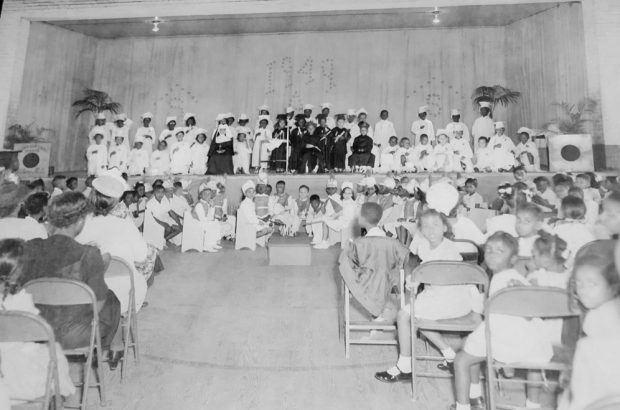
Saint Alphonsus graduates.

November is Black Catholic History Month. Accordingly, I offer these images of a 1949 kindergarten graduation celebration at Saint Alphonsus Catholic School captured by Wilson’s preeminent 20th century photographers Charles Raines and Guy Cox. Do you recognize any of the children?

Screen Shot 2019-11-15 at 2.57.33 AM.png

Screen Shot 2019-11-15 at 2.55.14 AM.png

Screen Shot 2019-11-15 at 2.57.50 AM.png

Screen Shot 2019-11-15 at 2.57.18 AM.png

Screen Shot 2019-11-15 at 2.57.05 AM.png

Daniel McClain.

Screen Shot 2019-11-15 at 2.56.52 AM.png

Screen Shot 2019-11-15 at 2.56.18 AM.png

Screen Shot 2019-11-15 at 2.56.04 AM.png

Joyce Ellis.

Screen Shot 2019-11-15 at 2.55.43 AM.png

Screen Shot 2019-11-15 at 2.55.30 AM.png

Many thanks to John Teel for sharing these images from the Raines & Cox collection of photographs at the North Carolina State Archives. They are catalogued as PhC_196_CW_1211H _StAlphonsusGraduation1 through 10.

Gratitude to Safiya Bandele for identifying the children in photos 5 and 8.

Sukey’s journey, part 2.

To the General Assembly of North Carolina

The undersigned, Respectfully Petition, the Legislature, to pass an act, in favor of Sucky Borden (a woman of colour) vesting in her, all the rights, and privileges, of a free woman Your Petitioners have long known said Suckey, and believe her to be a worthy woman, who will duly appreciate all her privileges and your Petitioners will ever pray, etc.

….

——

Twenty-six white Wayne County residents presented this petition to the state General Assembly in 1852. The only woman among them? M.A. Borden.

Maria Ann Brownrigg Borden,  proprietor of the Goldsboro Hotel, was the daughter of George and Obedience Brownrigg. In the 1850 census, she reported $20,000 in real property and 67 slaves. She and her sister Eliza Obedience Brownrigg Wright (whose husband John Wright also signed the petition) had inherited all but one of their mother’s slaves in 1841. That one person was Suckey, who went to Alfred Brownrigg. As noted earlier, Alfred Brownrigg quickly sold Suckey to their brother Edwin Brownrigg. Edwin, however, had begun registering large land grants in Sumter County, Alabama, in 1837 and died there, without heirs, in 1843. It’s not too much of a stretch to conjecture that Suckey never left North Carolina, and her ownership passed to Edwin’s sister Maria Borden after his death.

The 1852 petition to manumit Suckey Borden was successful, and the 1860 census of Goldsboro, Wayne County, North Carolina shows baker Susan Borden, 70, with Angia Capps, 60, sewer, and Catharine Carrol, 7. Borden reported owning $500 in real estate and $100 in personal estate. She is not listed in 1870 and presumably died in the intervening years. Had Susan Borden spent most of her life on a lower Edgecombe (Wilson) County plantation, enslaved by successive Brownrigg family members until one felt moved to seek her freedom?

Petition of W.H. Washington et al. to General Assembly of North Carolina, 1852; Petitions; Papers of the North Carolina General Assembly, North Carolina State Archives.


Arch Artis, a free man of color.

8301952.png

In the 30 August 1952 edition of his Daily Times column “Looking Backward,” Hugh B. Johnston transcribed a will executed in 1849 by Arch Artice, a free man of color. The will is not included in Ancestry.com or Familysearch.org databases, and I have found no evidence that it ever entered probate. Artis (the more common spelling) is not to be confused with Archibald Artis Sr. (or Jr.) of Johnston County, who was his rough contemporary, and here’s what we know of him:

In the 1850 census of Edgecombe County, Arch Artis is listed as a 55 year-old “mulatto free” and described as blind. Elisha Vick, a 48 year-old white laborer, and Elizabeth Woodard, 46, who witnessed his will, were Artis’ close neighbors.

Screen Shot 2019-11-11 at 7.19.31 PM.png

1850 federal census of Edgecombe County, N.C.

In the 1860 census of Gardners township, Wilson County, Arch Artis, 65, blind, is listed in the household of white farmer Calvin Woodard, a 32 year-old white farmer who reported owning $17,225 in personal property (which would have been mostly in the form of enslaved people. Calvin Woodard was the son of Elizabeth Simms Woodard, above, and William Woodard Sr., who died about 1850.)

On 31 October 1869, Puss Artice, daughter of Arch and Rosa Artice, married George Bynum, son of Thos. Drake and Eliza Bynum, at Arch Artice’s. [“Puss” was the nickname of Tamar Artis Bynum.]

On 6 January 1870, Jessie Woodard, son of Arch and Rosa Artice, married Pennie Bess, daughter of Harry Ellis and Selvey Bess, in Wilson County.

In the 1870 census of Gardners township, Wilson County: Archabald Artis, 70; wife Rosa, 34; Tamer Bynum, 23, and [her husband] George, 25. Though they did not register their cohabitation, this record strongly suggests that Arch Artis had a relationship spanning several decades with a woman named Rosa, who was enslaved. She, with her and Arch’s children, had belonged to members of  William Woodard Sr.’s family. (Details to come in a later post.)

Arch Artis seems to have died between 1870 and 1880.

John Artist, son of Arch and Rosa Artis, married Hannah Ellis, daughter of Jack and Margaret Ellis, on 29 February 1872 in Wilson County. (This was his second marriage. On 9 April 1867, John Artice married Pricilla Woodard in Wilson County.)

Ned Artis died 21 October 1917 in Falkland township, Pitt County, North Carolina. Per his death certificate, he was born 1831 in Wilson County to Arch Artis and Rose Artis; was single; was buried in Wilson County; undertaker was Jesse Artis; and informant was Joe Artis, Falkland, N.C.

Gray Artis, 72, of Chicod township, Pitt County, son of Arch and Rosa Artis, married Caroline Howard, 66, of Chicod township, daughter of Emily Nobles, on 22 April 1918 in Chicod township, Pitt County.

Tamar Bynum died 25 February 1923 in Wilson township, Wilson County. Per her death certificate, she was 77 years old; was born in Wilson County to Arch and Rosa Artis; was the widow of George Bynum; and had farmed. Rosa Bynum was informant.

Sukey’s journey, part 1.

Recd. of Jas. B. Woodard a negro girl Sucky in his possession as Execr. of Obedience Brownrigg decd., the legacy of Alfred Brownrigg which said girl was sold by Alfred Brownrigg to Edwin Brownrigg in as good health & Condition as he recd. her under the will of Mrs. Brownrigg, and obligates to hold him the sd. Woodard harmless in Event any difficulty should rise from the delivery of sd. negro.    Feby. 14th 1842  Jno. Wright for Edwin Brownrigg

——

Waynesboro, N.C., 15 Feb. 1842

Edwin Barnes, Esq., Tosnot Depot

Dr Sir, You will please hand Mr. Barnes the above receipt for Sucky. If it does not suit him, write out any thing to give him such as will satisfy him. I am under many obligations to you for the trouble I have put you to in this and other matters of mine. I am much in hopes yr health will speedily return.

Yours Truly, Jno. Wright

——

This note and receipt are transcribed in The Past Speaks from Old Letters, a copy of the working papers found in the files of Hugh B. Johnston, Jr., acquired in the course of his lifelong avocation as a professional genealogist and local historian, republished by Wilson County Genealogical Society in 2003. What is going on here?

Obedience Thomas Tartt Brownrigg died in 1840, likely on her plantation near White Oak Swamp in what was then Edgecombe County. She had drafted a will in April 1839, and among its many bequests were these:

  • to daughter Maria Burden [Borden] — “Tom Penny Dennis & William & Maria & Jim & Ellick
  • to son Alfred Brownrigg — “one negro girl by the name of Susan”
  • to daughter Obedience Wright — “one boy Henry one boy Lonor one negroe woman named Winny one boy Bryant one boy John also one girl named Angy & Anscy
  • also to daughter Obedience Wright — “one negro woman named Cloy one negro man named Joe and all my Table & Tea Spoons it it my Will and desire that the labor of Joe Shall Support the Old Woman Cloy her life time then Joe to Obedience Wright”

Obedience Brownrigg’s first husband was Elnathan Tartt, who died in 1796. As shown here, he bequeathed his wife an enslaved woman named Cloe [Chloe], who is surely the Cloy named above, and man named Ellic, who is probably Ellick.

Obedience’s second husband was George Brownrigg, who died without a will in 1821. An inventory of his estate included enslaved people Ellick, Chloe, Joe, Jem, Tom, Penny, Drury, Tom, Annie, Matilda, Suckey, Clara, Fereba, Sarah, Clarky, Anthony, Rachel, Mary, Nelson, Emily, Julia and Abram, and several others unnamed in a petition for division of negroes filed by his heirs in 1825. Ellick and Chloe surely are the man and woman Obedience brought to the marriage. I have not found evidence of the distribution of George Brownrigg’s enslaved property, but Joe, Tom, Penny and Susan seem to have passed to his wife Obedience. (Suckey, pronounced “Sooky,” was a common nickname for Susan.)

So, back to the receipt.

George Brownrigg bequeathed Susan “Sukey” to his widow Obedience about 1821. Obedience Brownrigg in turn left Sukey to her son Alfred Brownrigg. Alfred Brownrigg quickly sold Sukey to his brother Edwin Barnes Brownrigg. On 15 February 1842, Edwin’s representative John Wright took possession of Sukey from James B. Woodard, Obedience Brownrigg’s executor. Wright was married to Eliza Obedience Brownrigg Wright, daughter to Obedience Brownrigg and sister to Alfred and Edwin.

The note is less clear. Wright, who lived in Waynesborough (once the Wayne County seat, now long defunct) is asking someone (the unnamed “sir”) to deliver the receipt to Edwin Barnes of Toisnot Depot (now Wilson.) There were several Edwin Barneses in southeast Edgecombe (to become Wilson) County at that time.  And Edwin Brownrigg’s middle name was Barnes. Are Edwin Barnes and Edwin Brownrigg the same man, whose name was misgiven in one or the documents? In other words, should the receipt have been made out instead to the Edwin Barnes mentioned in the note? If this were the case, the note would make immediate sense. As to Sukey, I’ll explore a possible twist to her story in another post.]

Estate Records of Obedience Brownrigg, Estate Records of George Brownrigg, North Carolina Wills and Probate Records, 1665-1998 [database on-line], http://www.ancestry.com.


“It is good just to know where you came from.”

At the end of October, I had the extraordinary good fortune to develop and conduct three workshops for Gentlemen’s Agreement, an achievement program targeting African-American young men attending Wilson County high schools. Both the format and the audience were new for me. I was nervous, but I needn’t have been. The students were attentive and responsive and gratifyingly curious about the history of their hometown and the contributions of African-Americans to Wilson’s development. I am grateful to Gentlemen’s Agreement, Living the Word Ministry/North Carolina Conference of the United Methodist Church, the Wilson County Public Schools and Freeman Round House and Museum for the opportunity to introduce these young people to the idea of sankofa and to give back to the community that nurtured me.

The Rev. Maurice Barnes, left, and historical blogger Lisa Henderson, right, joined Wilson high school students for a windshield tour of African American history in Wilson. Pictured are some of the students who participated. From left are Barnes, Michael Thomas, Jaden Spruill and Christopher Richardson, all Hunt High School students, and Henderson. (Photo courtesy of Wilson Times.)

Windshield tour a reminder of Wilson’s past.

By Drew C. Wilson, 12 November 2019.

Wilson teens from three high schools took windshield tours of places in African American history recently.

“In Our Backyard: Black Genius and the Quest for Racial Equity” is a youth development and leadership program to show participants of The Gentlemen’s Agreement and other youth from Wilson’s three traditional high schools a slice of Wilson history that is often forgotten.

Lisa Henderson, curator of the Black Wide Awake blog about black history in Wilson, led the most recent tour on a bus through Wilson’s streets.

“It was an amazing opportunity for me,” Henderson said. “One of the reasons I do the blog is to create a record that anyone can access going forward and to be able to connect. What is always exciting to me is to be able to find something in the historical record and then picture where it is now or what’s there now. And Wilson has changed so much in good ways and in bad that I wanted to give these students a sense of possibilities, a sense of what has come before and what could be possible going forward.”

Henderson is a Wilson native who was born at Mercy Hospital and educated in Wilson schools.

“To be able to take the windshield tour and go down the 500 block of Nash Street and see some of the sights that we had talked about in the workshop and have them go, ‘Wow, wait, I know that place,’ or ‘Yeah, I get my hair cut there’ or ‘I go to church there’ and to understand the age of these places and the significance of these places in history is really rewarding.” 

“It showed us where people stayed and bigger places like the Mercy Hospital,” said Jaden Spruill, a senior at Hunt High School. “A lot of people don’t know these things. I personally didn’t know a lot of these things until I got into Gentlemen’s Agreement. I feel like this is important to know. If you don’t know this about Wilson, you get the history behind Wilson and you take more pride and you get more understanding about what was really going on around here before we were here.”

“I learned a lot of stuff I didn’t know about Wilson about the old places from back in the ’30s I didn’t know,” said Christopher Richardson Jr., a Hunt junior. “We heard it was just a country road past the hospital, and now they have a lot more. It is important for people to know about the past then and what can happen now.”

Michael Thomas, a Hunt sophomore, said it was a good experience. “I just learned about black history in Wilson,” he said. “It is good just to know where you come from and what your background is.”

“There was a lot that I didn’t know,” Michael added. “That strip of downtown, the 500 block of Nash Street, before you get to the railroads, there were a lot of stores there, but now it’s just empty. I could picture those roads there being jam-packed with people, and it was a good sight to see. You’ve got to know where you come from. If you are going to live here in Wilson and have an impact, you have got to know where you come from.” 

Henderson had given talks here about African American history in Wilson when the Rev. Maurice Barnes approached her to ask if she could lead a series of workshops for The Gentlemen’s Agreement program. 

“I jumped on the opportunity,” Henderson said. “The more I understood about the organization and what it is trying to do with promising young men in our school systems, any way I could help, I wanted to do it. It is important for young people to understand the past and the history of their community and have a pride in that community. Any way that I can contribute to another generation of Wilsonians knowing their past, I am happy to do it.”

“All told, for all three days, we had about 55 kids, from all three of the high schools to participate in this three-day workshop,” Barnes said. 

Similar workshops held in January and March and the windshield tours were paid for by a collaborative grant from Living the Word Ministry and the Oliver Nestus Freeman Round House Museum.

Samuel H. and Annie W. Vick family, no. 2.

This formal portrait of Samuel H. and Annie Washington Vick and their children was taken around 1913, a few years after the photograph posted here.

The woman at left does not appear to be an immediate family member. Otherwise, by my best judgment, there is daughter Elba, Sam Vick, son Robert, son Daniel (center), daughter Doris, Annie Vick, son Samuel, son George, and daughter Irma.

Photo courtesy of the Freedman Round House and African-American Museum, Wilson, N.C.