Month: December 2015

Dr. William Arthur Mitchner.

WA Mitchner.png

WA Mitchner

A.B. Caldwell, ed., History of the American Negro and His Institutions, North Carolina Edition (1921).

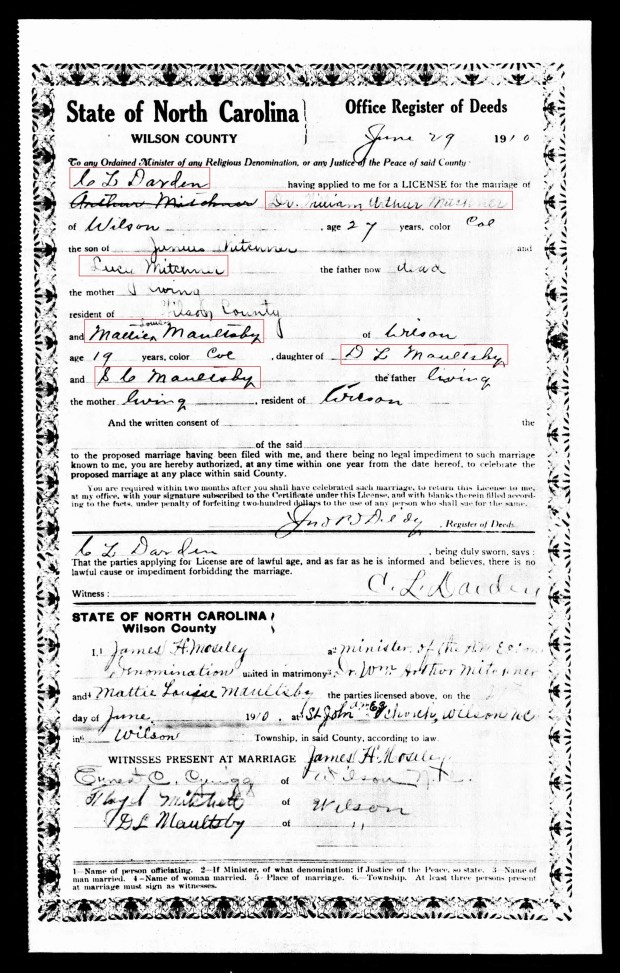
Dr. William A. Mitchner apparently moved to Wilson very shortly after graduating Leonard Medical School. In June 1910, he married Mattie Louise Maultsby, daughter of Daniel L. and Smithey C. Maultsby (who seem to have been natives of Pitt County.) Camillus L. Darden applied for the license on their behalf, and they were married at Saint John A.M.E. Zion church.

42091_343640-01614

In the 1920 census of Wilson, Wilson County, at 534 E. Nash Street: Wm. A Mitchner, 40, son Wm. M., 8, mother Lucy, 60, and nephew Hubert Mitchner, 23, a barber.

In the 1940 census of Wilson, Wilson County, at 604 E. Green Street: Dr. W. A. Mitchner, 53, born Johnston County; wife Marie, 40, born Wake County; and mother Lucy Mitchner, 80, born in Johnston County.

The East Wilson Historic District Nomination Report describes 604 E. Green, built circa 1913, as an “L-plan Queen Anne structure with cutaway front-facing bay.” The house has since been demolished.

Dr. Mitchner died 5 November 1941.

——

WDT_10_20_1911_Watson_shooting

Wilson Daily Times, 20 October 1911.

Will Jenkins, in fact, survived his wounds. In 1917, he registered for the World War I draft in Wilson. He noted that he was born in 1893 in Edgecombe County, that he was married and lived at 672 Viola Street, and that he was a lumber yard laborer.

Where did they go?: Pennsylvania death certificates, no. 2.

The second in a series — Pennsylvania death certificates for Wilson County natives:

  • Hubert Barefoot

42342_645856_0628-00555

In the 1910 census of Wilson, Wilson County, on Viola Street: 37 year-old oil mill laborer Wiley Barefoot, wife Maggie, 35, and children Linwood, 15, Mike, 14, Matha, 10, Essiemay, 3, Hubert, 4, and Angly B. Barefoot, 2. Maggie worked as a washerwoman, Linwood as a “prentice carpenter,” and Mike as an odd jobs laborer.

  • Michael Barefoot

42410_2421406272_0894-02177

Michael Barefoot was the brother of Hubert Barefoot, above. The death certificate of their father Wiley Barefoot, filed in 1952 in Wilson County, reveals their grandparents to have been Michael and Caroline Barnes Barefoot.

  • George Barnes

42342_647661_0610-01692

  • James A. Barnes

42410_1521003235_0539-03345

  • Julius Barnes

42342_1521003238_0809-01414


She left home without my consent.

WDT_9_17_1918_Floria_Faison

Wilson Daily Times, 17 September 1918.

In the 1910 census of Wilson, Wilson County, on Vance Street, 49 year-old widowed laundress Ella Fason with daughters Mary, 18, Emma, 16, Henretta, 13, and Flory Fason, 10. Ella’s husband Patrick Faison died 1900-10.

——

Six years later, Ella Faison made out a pointed will leaving all her belongings to just one of her children:

Ella Faison will

Ella Faison died 6 June 1928. Her sole heir and executrix, Ida Faison Jones, wife of Sankey Jones, survived her by only six months. Flora Faison, however, lived till 1983.

North Carolina, Wills and Probate Records, 1665-1998 [database on-line], Ancestry.com.

1109 Queen Street.

The second in a series of posts highlighting buildings in East Wilson Historic District, a national historic district located in Wilson, North Carolina. As originally approved, the district encompasses 858 contributing buildings and two contributing structures in a historically African-American section of Wilson. (A significant number have since been lost.) The district developed between about 1890 to 1940 and includes notable examples of Queen Anne, Bungalow/American Craftsman, and Shotgun style architecture. It was listed on the National Register of Historic Places in 1988.

Screen Shot 2015-12-06 at 3.01.19 PM

1105-1113 Queen Street, 1930 Sanborn Map of Wilson, North Carolina.

R.C. Henderson: Let’s go back to when I remember when we moved to 1109 Queen Street. When I was about six years old. And we had what they call a shotgun house. Three rooms. Front room, middle room, and a kitchen. And to get to the kitchen, you had to go out on the back porch and come through. Now there were some people who had a door cut in between the middle room and the kitchen, so you wouldn’t have to go out on the back porch. But they said if you cut that door somebody in your family would die. [Laughs.] So we wouldn’t cut the door. All of us slept in the middle room. And we had a laundry heater in the middle. We had to make fires every night. It was what you’d call a space heater. Laundry heater. You put, well, we used coal. Some people were afraid to use coal because it would get so hot it would turn red. And, you know, sparks would fly and sometimes things would catch on fire. And that’s what we used to heat the iron to iron clothes, too. You’d put ‘em on top of that stove. But we had to make fires every morning. Had to get up. And we had linoleum in there, so the floor’d be cold. So when you walk around, you had to walk on your heels. And then, you know, we had that little slop jar up under the big bed. See, that house didn’t have a bathroom. So the bathroom was outside. It sat in between the two houses. That was for 1109 and the one right beside it. It was probably 1107, and that’s where the Davises, Miss Alliner [Alliner Sherrod Davis, daughter of Solomon and Josephine Artis Sherrod], she lived right there at 1107. And then we had the water outside, and it was at her house. So there were two houses that had one toilet and one spigot. 

C.C. Powell owned the houses, and I don’t know how much we were paying, but we weren’t paying a whole lot. Behind the outhouse, we had built up like a little shed, like. Used to keep pigeons in there. Everybody had pigeons. The ones that go off – we’d see in the movies the ones that take little messages and all. So everybody would have pigeons. And then we had a little, I guess it was a garden. We had a victory garden in the back. I had to take a hoe and a shovel and dig up the backyard. Turn it over. Then Mama would go out there and make some rows and plant tomatoes and stringbeans and squash and stuff like that, and we used that to eat. And the icebox, it was a little small icebox, and you’d take the ice and put it in the top, and then there was a little hole so when the ice’d melt, it would run down. You’d have to have a little water container underneath. You’d have to empty that everyday. If not, the water would run out on the floor, out on the back porch. And it would always be so clear and just cold. We had to go to the ice house out there on Herring Avenue. And I would ride the bicycle out there to get it.

Young Rederick 01

R.C. Henderson, age about 10, sitting outside a house on Queen Street. (It is likely 1107 as the door on 1109 was on the opposite side of the porch. Otherwise, the houses were identical.)

1109 Queen

Early 1980s.

Hattie Henderson Ricks: That’s there on Queen Street. The endway house. There was grass where was in between the two houses, ours and Ellick Obey. The Joneses, Celie Mae, lived on the same side. Jesse Knight was in the house on this side. On that side there, a fellow that worked out to the hospital, his wife he got married and lived in there. She didn’t stay in there no time, and then somebody else moved in there. Martha Winley’s house was first, then mine was second, then Ellick Obey was next. Then Sis and her mama and the two children was next. Two, three, four houses. They call her Sis. I don’t know what her name is. But she was grown and had two children. And her brother was crippled. She was working, and her mama stayed home and looked after the children. They didn’t have a father there.

Screen Shot 2015-12-06 at 8.21.34 PM

Excerpt from 1940 census of Wilson, Wilson County, showing households at 1109, 1107, 1105, 1111 and 1113 Queen Street.

1105-1113 Queen Street were demolished in the mid-1980s. A duplex apartment was erected in their place:

IMG_7862

Across the street, however, are two remnants of the old 1100 block of Queen Street.

IMG_7863

IMG_7861

Adapted from interviews of R.C. Henderson and Hattie H. Ricks by Lisa Y. Henderson; color photographs by Lisa Y. Henderson; all rights reserved.

In consideration.

NORTH CAROLINA

WILSON COUNTY

I, ISABELLA ARTIS, of the County of Wilson, State of North Carolina, being of sound mind, but considering the uncertainty of life, do hereby make and declare this to be my last will and hereby revoking and declaring numb and void all other wills and testaments heretofore made by me.

FIRST: My executor hereinafter named shall give my body a decent burial, and erect a suitable tombstone or monument at my grave, collect all debts due my estate, and out of the first moneys coming to into my estate, he shall pay all of my just debts, funeral expenses and costs of administering my estate.

SECOND: I give, devise and bequeath to my husband, J.E. Artis, that parcel or land together with the house thereon situate in which I now love, located on Banks Street, in the Town of Wilson, and adjoining the heirs of Mary Bunch and others, and having a frontage of approximately fifty feet on Banks Street, and a depth of about one hundred and ten feet, and being the identical lot devised to me by the will of James Holden.

TO HAVE AND TO HOLD the above described real estate to him, the said J.B. Artis, for the term of his natural life, and no longer, and upon his death to the following persons in fee simple absolute forever, in shares as designated: To my brother-in-law, Ed Holden, a one-half interest; to my step-children Verdie May Artis and James Clifton Artis, a one-fourth interest each.

I devise and bequeath this property in the above manner in consideration of the love and affection my husband, J.E. Artis, has exhibited towards me and that I hold for him, and in consideration of the fact that the house in which I now live was largely paid for by the said J.E. Artis; and I give Ed Holden, my brother-in-law, one-half interest in the remainder after death of J.E. Artis, in consideration of the many favors and accommodations he has rendered me, and because he is a brother of my first husband, who originally owned the property.

THIRD: All of my personal property of every description, I give to my husband, J.E. Artis.

FOURTH: I hereby constitute and appoint my husband, J.E. Artis, my lawful executor to all intents and purposes to execute this, my last will and testament, according to the true intent and meaning of the same, and every part and clause thereof.

IN WITNESS WHEREOF, I, the said Isabella Artis, do hereunto set my hand and seal, this the 14th day of September, 1938.

Witness as to Mark: C.E. Simons, M.D.

Signed, sealed, published and declared by the said Isabella Artis, to be her last will and testament, in the presence of us, who at her request and in her presence, and in the presence of each other, do subscribe our names as witnesses.  Bessie L. Edwards, Leon Ward, Julie McNeal

——

Isabella Artis died four days after making her will.

S123_1186-0812

In the 1900 census of Wilson township, Wilson County: 24 year-old brickmason James Holden, wife Isbella, 35, daughter Ether, 1, and brother Jesse, 7.

James Holden, son of Anderson and Rachell Whitfield Holden and a native of Johnston County, died of consumption, i.e. tuberculosis, on 8 August 1918 in Wilson.

On 17 June 1919, Isabella Holden, 36, married Zeke Artis, 35, in Wilson.

The 1940 census of Wilson, Wilson County, shows James E. Artis, 50, living at 407 Banks Street with his new wife, Molly. “Ezekial” Artis died in Goldsboro, Wayne County, on 15 July 1964.

North Carolina, Wills and Probate Records, 1665-1998 [database on-line], Ancestry.com.


He has forged free papers.

Fifty Dollars Reward.

Made his escape from me, on Friday evening the 4th of the present month, near Stantonsburg, a negro man, named ALLEN, (calls himself Allen Woodard) he is about 30 years of age, of a tolerable size, yellow complexion, a pretty good House Carpenter and a very ingenious negro. He formerly belonged to Wm. Dickinson, decd. – and has lately been confined in the Newbern gaol, was removed thence to Snow Hill, had his trial and was whipped – his back is pretty much scared [sic]. It is said he has forged free papers, with which he has passed as a free man. It is probable he will lurking about Newbern as he carried a white woman there, with whom he was intimate, as it was said.

The above reward will be given to any person who will deliver him to me, or lodge him in Tarborough gaol.  DANIEL DICKINSON.  Edgcomb County, 2 miles above Stantonsburg, May 8th, 1822.

Newbern Sentinel, 18 May 1822.

The W.H. Applewhite plantation.

Built about 1847, the W. H. Applewhite House is a historic plantation home near Stantonsburg, Wilson County, North Carolina. It is a two-story, three-bay, single pile, Greek Revival-style frame dwelling with a one-story, shed-roofed rear wing. The house features a double-gallery porch with sawn ornament and trim added about 1900. The plantation has been in the possession of the Applewhite family since 1841, when Henry Applewhite (1806-1850) purchased 425 acres on the west side of Toisnot Swamp. After Henry Applewhite’s death, his widow Orpha Pike Applewhite came into possession. Their son William H. Applewhite (1840-1903) was its next owner.  The house was listed on the National Register of Historic Places in 1986.

Though the Nomination Form describes Henry Applewhite as a “prominent planter,” it makes no mention of the Applewhites’ status as slaveowners. Census records, however, tell the story. The 1850 slave schedule of Edgecombe County reports that Orpha Applewhite owned eight slaves — five females aged 68, 40, 16, 14, and 5, and three males aged 21, 12 and 8. In the 1860 slave schedule of Saratoga township, Wilson County, Orpha Applewhite is listed with two slaves, her daughter Celia Applewhite with one, son Jonathan Applewhite with five, and son W.H. Applewhite with two.

This, from an unsourced post at afrigeneas.com: “Among the surviving papers of Henry and Orpha Pike Applewhite of the Stantonsburg area of Wilson Co., NC are the names and ages [sic] of the following negroes: Sherod, born 16 July 1838; Patrick, born 1 May 1840; Mariah, born 27 September 1844; Penny, born August 1834; Mary, born spring 1832; Enos, born 1 January 1829.”

In the 1870 census, Stantonsburg, Wilson County: Patrick Applewhite, 25, wife Luvenia, 21, and son George, 6, with Loucinda Taylor, 18, and daughter Sarah, 1.

In the 1870 census, Stantonsburg, Wilson County: Enoch Applewhite, 40, Cherry, 24, Mary, 35 (described as “idiotic”), and Lucindah, 1. In the 1880 census, Stantonsburg, Wilson County: Enos Applewhite, 50, wife Cherry, 33, Lucinda, 12, Luvinia, 11, Henry, 7, Frank, 6, John, 4, and Virginia, 2 months.

Screen Shot 2015-12-05 at 5.04.45 PM

Photo of the Applewhite house in 1985 in nomination file.

Respected poet James Applewhite, born in Stantonsburg in 1935, is a great-grandson of William H. Applewhite. His poetry often explores the rural South of his childhood, much spent at the Applewhite farmhouse, and the fraught relationships between blacks and whites in the era.

In his poem “The Deed”:

“… certain human beings. Beedy, Lewis, Offy;

Wealthy, Feruba, Bright; Tabitha

Mereca, Jinna, and Litha – I write your names again

here, since the many burnings of the iron-fenced family

graveyard have erased whatever chalked letters

once named you on the blackened

boards of heart pine.”

Click to access WL0692.pdf