homicide

Ben Reid survived; Nolia Reid did not.

Wilson Daily Times, 6 May 1921.

This brief report fails to name Nolia Reid as the murdered woman or to state the first name of the man — her husband — who killed her. He was Ben Reid.

Nolia Reid died 1 May 1921 in Wilson. Per her death certificate, she was 19 years old; was born in Wilson to George Best and Louisa Farmer; worked as a laundress; lived on Nash Street; and was married to Ben Reid. She died of “homicide–stab wound.” Her uncle Thomas Farmer was informant. She was buried in Wilson [likely, Vick Cemetery.]

Family ties, no. 10: Reddick Jacobs?

Wilson’s emergence as a leading tobacco market town drew hundreds of African-American migrants in the decades after the 1890s. Many left family behind in their home counties, perhaps never to be seen again. Others maintained ties the best way they could.

Sarah Henderson Jacobs Silver and her husband Jesse A. Jacobs Jr. left Dudley, in southern Wayne County, North Carolina, around 1905. They came to Wilson presumably for better opportunities off the farm. Each remained firmly linked, however, to parents and children and siblings back in Wayne County as well as those who had joined the Great Migration north. This post is the ninth in a series of excerpts and adaptations of interviews with my grandmother Hattie Henderson Ricks (1910-2001), Jesse and Sarah’s adoptive daughter (and Sarah’s great-niece), revealing the ways her Wilson family stayed connected to their far-flung kin. (Or didn’t.)

——

Jesse Jacobs Jr.’s first wife, Sallie Bridgers, died in 1895, shortly after the birth of their youngest child, Annie Bell.  A year later, he married Sarah Daisy Henderson, who reared Sallie’s children alongside her own daughter, Hattie Mae Jacobs, and her sister’s two children, Bessie Henderson and Jesse Henderson. Jesse’s sons, James Daniel Jacobs (1881-1952), Dock Davis Jacobs (circa 1888-1944), and Reddick Jacobs (1889-1921), were grown by time my grandmother came to live with Jesse and Sarah.  They were not her blood kin, but were family nonetheless. Each lived in Wilson for short stretches, with the younger two moving back and forth between North Carolina and New York City.

This is what my grandmother told me about Reddick Jacobs:

The other brother, the younger one. Reddick. He was one that got shot in the café. He was getting ready to leave, and say him and another fellow got to arguing, and the man shot him. Well, they brought him home. Papa was living then. They brought him home, and they had to bring the body up to the house. And me and [her sister] Mamie had to go examine it, you know. But I didn’t put my hands on him. I went in there and looked at him, and I said, “Well, where did he get shot?”  After he was all dressed up, laying out there in the casket.  And so Mamie said, she said, “Girl, don’t you see? They shot him right in his face. Right there.” And I said, “I don’t see nothing.” And then she had to put her finger right in his eye. And it was in his left eye. It went right in through there and come out the back of his head. He was sitting at the restaurant, and a fellow shot him.

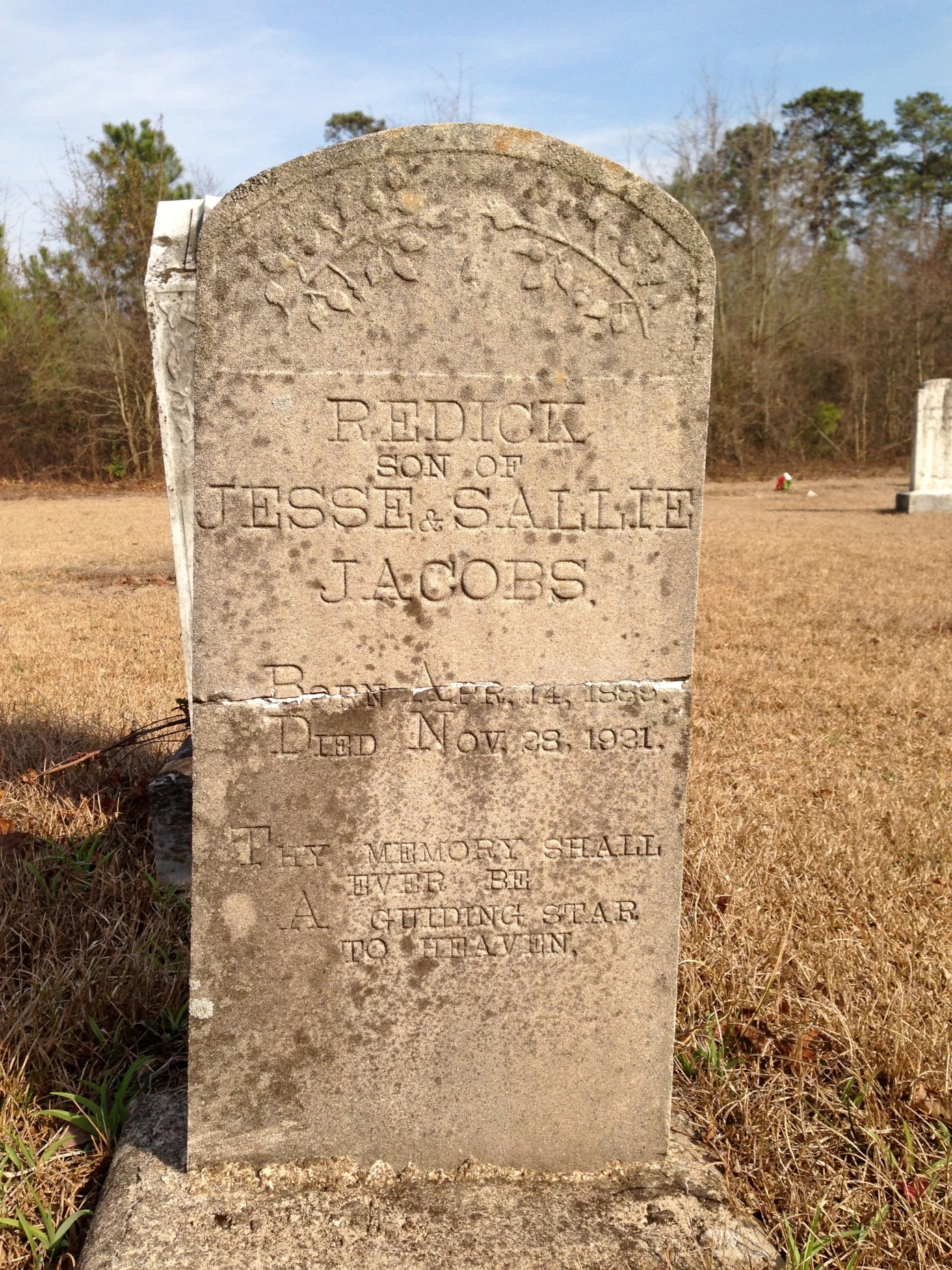
Reddick Jacobs was buried in the Congregational Church cemetery in Dudley. His patched-up headstone stands near his father’s and records his death date as 28 November 1921, but I have not yet located his death certificate.

Last night, I happened upon this brief report of a police shooting in Wilson. The victim, Howard Jacobs, died 27 November 1922.

The Johnson City Staff (Johnson City, Tenn.), 28 November 1922.

Wait. Was this the report of Reddick Jacobs’ killing? Had the reporter misheard his first name — as so often happened? Had whoever bought his headstone misremembered his death date — also common?

Coincidences notwithstanding — no. Though Reddick Jacobs’ death certificate seems to have gone unfiled, Howard Jacobs’ was recorded, and he was not the same man as Reddick.

Howard Jacob died 27 November 1922 in Wilson. Per his death certificate, he was born in December 1904 in Clinton, N.C., to Theophus Jacob [Theophilus Jacobs] and Mary I. Hobbs; was single; lived on Viola Street; and worked in farming for John Wells. His cause of death was “homicide — shot by policeman.” Jacobs was buried in Moltonville, North Carolina.

Unsurprisingly, at inquest, the policeman was cleared of any wrongdoing. I can find nothing further about Howard Jacobs’ short time in Wilson. Though he was not a son of Jesse A. Jacobs Jr., both were likely members of the same large extended Jacobs family,  free people of color now closely (but not exclusively) associated with Lumbee and Coharie Indians.

The estate of James A. Hunt.

As administratrix of her husband James A. Hunt‘s estate, Annie V.C. Hunt filed a wrongful death claim against Jefferson D. Farrior, who had shot Hunt dead in the street. She demanded a $10,000 judgment.

A.V.C. Hunt died in the midst of proceedings, and O.L. Ellis was appointed administrator in her stead. A jury determined that the estate was owed nothing.

J.A. Hunt Estate File, Wilson County, North Carolina

The notorious John Shallington.

John Shallington was hanged on 12 April 1878 in Greene County, North Carolina, for the murder of his step-daughter Serena (or Lorena) Thompson. According to news accounts, Shallington and Thompson had been in a relationship (consensual?) for two to three years, and he had shot her in a fit of jealousy. Shallington fled and was on the lam for several weeks, pursued by both black and white vigilantes before being arrested in Wilson County.

An “esteemed correspondent,” apparently enthralled with Shallington’s person and exploits, provided breathy details — his ownership during his enslavement in Wilson County; his reputation for violence, craftiness, and superhuman strength; his physical description; his impassiveness at trial. As later reported, Shallington was hanged in front of a crowd of 2000 people in Snow Hill after asking from the gallows to be baptized.

Goldsboro Messenger, 11 April 1878.

Tom Johnson is gunned down.

Wilson Daily Times, 26 December 1942.

We read about some of Tom Johnson‘s earlier troubles here. On Christmas Day, as Johnson walked down Pender Street, he encountered Milton Lucas, whom he had allegedly shot days before near First Baptist Church. Lucas shot Johnson, then turned himself in at police headquarters, but a court soon released him, finding “no probable cause.”

The family would not take him; Darden sold the body to Wake Forest.

Caught rifling through a money drawer, James Hinton lost a shoot-out with a storeowner northwest of Wilson. Though his family gave information for his death certificate, they refused to arrange with Darden Funeral Home for his burial. Following their suggestion, Darden sold the man’s body to the medical school at Wake Forest College.

News and Observer (Raleigh, N.C.), 23 September 1933.

Wilson Daily Times, 26 September 1933.

——

James Hinton [not John or Hinnant] died 21 September 1933 at Moore-Herring Hospital, Wilson. Per his death certificate, he was 45 years old; was born in Wendell, North Carolina; worked as a laborer; and lived at the Biltmore Hotel. Cause of death: “was dead from bullet wound when I saw him shot thru abdomen.” Allie P. Hinton, Wendell, was informant. Written in the margin: “was shot robbing a store.”

The obituary of Willie Knight.

Wilson Daily Times, 5 August 1941.

Brothers Avan and Calvin Melvin were arrested and charged with the murder of Willie Knight. Avan Melvin claimed he struck Knight because Knight was cutting Calvin Melvin.  Calvin Melvin claimed innocence. I have not been able to determine the outcome of the trial, which was held the month after the incident.

——

In the 1910 census of Gardners township, Wilson County: Colonel Knight, 24; wife Flora, 20; and son Willie, 1.

In the 1920 census of Gardners township, Wilson County: Colonel Knight, 34; wife Flora, 28; and children Willie, 11, Nella, 8, George, 7, Colonel Jr., 4, and Percy, 2.

In the 1930 census of Wilson, Wilson County: at 717 Vance Street, rented at $16/month, Cullan Knight, 44, farmer; wife Flora, 37; and children Willie, 21, odd jobs laborer, George, 16, baker, Cullon Jr., bakery delivery boy, Percy, 13, and Gladys, 9.

In 1940, Willie Knight registered for the World War II draft in Wilson County. Per his registration card, he was born 4 June 1908 in Wilson County; lived at 646 Wiggins Street; was married to Thelma Newman Knight; and worked for R.P. Watson Tobacco Company. The card is marked “Deceased.”

Willie Knight died 2 August 1941 on Banks Street, Wilson. Per his death certificate, he was born in June 1909 in Wilson County to Colonel Knight and Flora Thomas; was married to Thelma Knight; lived at 127 Narrowly Street; and worked as a laborer. Cause of death: “hit on head with brick fracturing skull killing almost instantly.”

The murder of Mordecai Hagans.

We first met Mordecai Hagans, born a free man of color, here, as an employee of Wilson’s Confederate hospital.

Fifteen or so years later, Hagans was murdered.

Wilson Advance, 16 July 1880.

(Josephus Daniels was editor of the Advance at the time, so it’s no surprise he thought it paramount to note that Hagans faithfully voted the white supremacist Democratic ticket. He tells us nothing of Hagans’ family, his occupation, his history — but we know this.)

Wilson Advance, 30 July 1880.

The Advance‘s follow-up was devoted almost exclusively  to the exculpation of J. Frank Eatmon, primarily via inferences from the testimony of Hagans’ “old, half-idiotic” unnamed wife, who had been severely beaten the night her husband was killed.

——

In the 1860 census of Nahunta township, Wayne County: Mordecai Hagans, 23, farm laborer, living alone.

In the 1870 census of Upper Town Creek township, Edgecombe County: farm laborer Mordecai Hagans, 37, and wife Cherry, 45.

In the 1880 census of Oldfields township, Wilson County: laborer Mordicia Hagins, about 50, and wife Cherry, about 45. [They are listed immediately after the households of J. Frank Eatmon and Pearson Eatmon’s mother Aquilla Eatmon and likely lived on the property of one or the other.]