Rest in peace, Arlean Lindsey Snead.

“Ms. Arlean Lindsey Sneed, 99, of Hampton, VA surrounded by family, departed her earthy life on Tuesday, November 25, 2025.  She was one of nine children, born on March 10, 1926, in Wilson County, to Phil and Lugenia Lindsey who predeceased her. She was a faithful follower of Jesus Christ who constantly sought God through prayer. She is survived by her children: Henry (Carol) of Hampton, VA, James (Linda) of Jackson, MS, Marvin of Elm City, NC, Veretta S. White (predeceased), ten grandchildren, a host of great grandchildren, family, and friends. In addition to her deceased parents, she was preceded in death by two brothers and five sisters.

“Her Celebration of Life is scheduled for Saturday, November 29, 2025, at 12:00 pm at Calvary Presbyterian Church, 209 Pender St., E., Wilson, NC.  Reverend Henry Sneed will deliver the eulogy.  Interment will follow in Williams Chapel Cemetery, Williams Chapel Church Road, Elm City NC.”

Funeral Program Friday.

Somebody said: “She got one for Doug in her purse.”

Somebody else said: “All the plot twists. We read it from cover to cover. Tryna add and subtract dates and ages. Also, trying to figure out who are all the extra names listed and who was left off.”

If I shared five a week, it would take me more than three years to highlight every funeral program (or as some of us like to call them, “obituary”) in my growing collection. The earliest date to the 1950s — simple, typed mimeographs that bear little resemblance to today’s full-color, multi-page, photograph-filled productions. Funeral programs are crucial resources for African-American genealogy and community history — save me one!

Image courtesy of Instagram user 25_bwb

Redux: Buckhorn Reservoir and the graves of Julia Bailey and Andrew Terrell.

Some view my insistence on independent investigations into what happened to Vick Cemetery’s headstones; the location of graves in the public right-of-way bordering Vick Cemetery; and how power poles came to be installed in Vick Cemetery as retributive.

They are wrong.

There can be no justice for the dead (or living) harmed by the City of Wilson’s decades of action and inaction at Vick Cemetery. We will never know all the names of the 4224+ dead. We will never recover their grave markers. We will never whose graves — or how many — were cracked open or crushed in the widening of Lane Street or the placement of 90-foot power poles and their attendant guy wires.

What we can determine, however, is HOW THESE OUTRAGES WERE ALLOWED TO HAPPEN and, consequently, what systems, policies, and procedures can be put into place to prevent anything like them from happening again.

Last week, I received a set of photographs that reminded me that Vick Cemetery is not unique in Wilson County and that shortcuts and conveniences (or inconveniences) and indifference and neglect have left their shameful mark elsewhere.

I’ve written of Buckhorn Reservoir and the headstones of Julia Boyette Bailey and Andrew W. Terrell before. In a nutshell, Wilson County Register of Deeds Office’s “Grave Removals” volume, which contains records of every registered disinterment and/or reinterment in the county for the past 50 or so years, contains no record of the removal of the graves of Julia Bailey, Andrew Terrell, or the 16-18 unknown others whose disinterment was publicized in 1998 ahead of the expansion of Buckhorn Reservoir.

As the headstones of Bailey and Terrell attest, the graves now lie at the edge or under the lake. There’s no record because the graves were never removed.

Al Letchworth took this photo of Terrell’s broken gravestone in 2019. It has since disappeared.

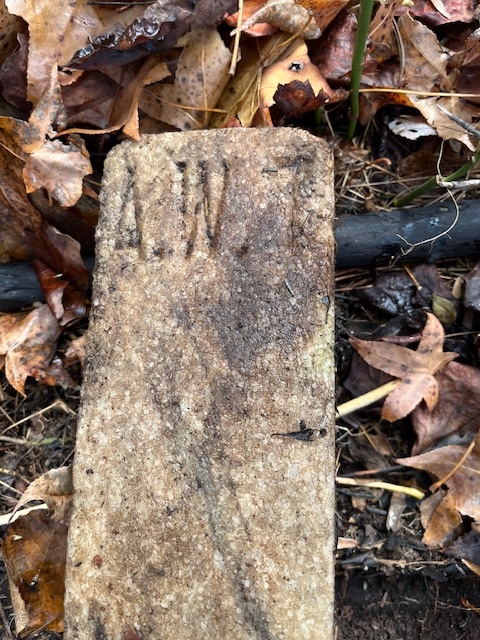
Here is Terrell’s foot marker, as photographed by Randy Marshburn last week.

And here are the grave markers of Julia Boyette Bailey, a woman who was born into slavery; grew to adulthood, married, and bore children under its yoke; and lived only four years beyond it. Hers is one of the, if not the, oldest known burials of an African-American person in Wilson County.

Buckhorn Reservoir is the primary water source for the City of Wilson. The City of Wilson is the owner of the reservoir and the dam that created it. Wilson Utilities is responsible for the reservoir’s management.

In 1998, during roughly the same period that the City of Wilson was throwing away headstones and drilling holes in Vick Cemetery to install power poles, it was on the other side of the county flooding black cemeteries to expand its reservoir. 

What failures of process allowed this to happen? How do we prevent further failure? Is the City of Wilson prepared to be transparent about — and accountable for — its errors and misdeeds, or will it continue to whistle past the (figurative and literal) graveyard?

My profound gratitude to Randy Marshburn and Al Letchworth for these photographs and their deep concern for the graves of Julia Bailey and Andrew Terrell.

Eden and Mount Lawn cemeteries, Philadelphia.

I don’t know that it’s possible to know exactly how many made the journey, but Philadelphia was a landing spot for hundreds of African-Americans who migrated from Wilson County, including my grandmother. On a quick recent trip to the area, I sought out Historic Eden Cemetery, listed as final resting place on several Pennsylvania death certificates for Wilson County natives. To my surprise, my route took me right past Mount Lawn Cemetery, which also holds burials of Wilson County migrants.

We honor our kinfolk, their lives, their struggles and triumphs. Rest in peace.


Photos by Lisa Y. Henderson, November 2025.

Giving thanks.

I am grateful for so much this year and am mindful to deliver my appreciation in real time. An extra special thanks is warranted, however, for  20 women and men, aged 83 to 100, who shared with me their time and memories of their Wilson County childhoods. I spoke with seven of my father’s Darden High School classmates; with attendees of at least seven different Rosenwald schools; with folks who stayed in Wilson their entire lives and others who joined the Great Migration out. I recorded their stories and returned transcripts for them to linger over and share with their families. I jotted notes on fascinating tidbits to research further, some of which have already made it into Black Wide-Awake.

I still have a long list of people I’d love to interview, and hope you’ll refer any elders who might want to talk. As importantly, I encourage you to capture your family’s history. Holiday gatherings are the perfect time to pull out your phone and start recording, whether video or audio. Ask. And listen.

The obituary of Hagar Vines.

Wilson Daily Times, 21 November 1942.

——

In the 1930 census of Gardners township, Wilson County: farmer Josephine Vines, 35, and her children Oscar, 18, Hagar, 16, Clyde, 13, and Artella, 7, all farm laborers.

In the 1940 census of Margate City, Atlantic County, New Jersey: Hagar Vines, 23, maid, in the household of Carl Surran. (Vines indicated she had lived in Wilson, North Carolina, in 1935.

B.W.A. Historical Marker Series, no. 33: Lincoln Theatre.

In this series, which will post on occasional Wednesdays, I populate the landscape of Wilson County with imaginary “historical markers” commemorating people, places, and events significant to African-American history or culture.

We been here.

LINCOLN THEATRE

Opened 1928 by Greek immigrant George C. Woller for an African-American audience. Featured motion pictures, musical and theatrical acts; hosted fundraisers for black schools and hospital. Badly damaged in fire in December 1932; did not reopen.

Photo by Lisa Y. Henderson, October 2025.

Laddie Springs, jazz pianist.

Who was Laddie Springs? A passing mention of his orchestra in a 14 August 1937 Journal and Guide article led me down a rabbit hole. It turns out Springs spent only a few  years in Wilson, but what a life he led!

Laddie Springs was born in Charlotte, North Carolina.

In the 1910 census of Charlotte, Mecklenburg County, N.C.: at 714 West Street, janitor Frank Springs, 36; wife Annie, 37; children Pearl, 14, Clyde, 11, and Lattie, 8; boarder Jim Stearling, 23, laborer on street car line; and mother-in-law Nancie Abernathy, 65.

In his late teens, Springs found work as a clothes presser.

1923 Charlotte, N.C., city directory.

But he was soon on the road — the beginning of a half-century of professional piano-playing on the chitlin’ circuit, in vaudeville theatres, in schools, in jazz clubs, and in private homes.

We first see him — just two years out of the laundry — heading the New Orleans Jazz Band at Bailey’s 81 Theatre on Atlanta’s Decatur Street. He was touring as part of Seals & Mitchell’s “big revue,” a variety show featuring musicians, “real dancers — who can sing,” and comedians. The 81 was a black-owned venue, but this frolic was for a whites-only audience.

Atlanta Journal, 27 November 1925.

The show was a hit, and Laddie Springs’ “famous” band was hailed as the “best in the country.”

Atlanta Constitution, 28 November 1925.

A week later, Seals and Mitchell’s chorus were in Birmingham, Alabama, with Springs fronting a different group — the Six Melody Boys.

Chicago Defender, 5 December 1925.

At the end of the year, Springs fetched up at the Booker Washington Theatre in Pensacola, Florida, with Frank Radcliff‘s Musical Comedy company.

Pensacola News Journal, 29 December 1925.

Eighteen months later, Laddie Springs leading a seven-piece orchestra. His wife Bernice Springs — I don’t know where they married — was planning “to spend a week with Ma Rainey in Chicago while she is recording and enjoying herself  riding in her $13,000 bus.” The Springses could be reached at their home at 428 East 2nd Street in the old Brooklyn neighborhood of Charlotte’s Second Ward. (The site is now under a Hilton Garden Inn.)

Pittsburgh Courier, 2 July 1927.

In 1929, the Springs’ old colleagues in the Seals and Mitchell show wrote from San Bernardino, California, that they wanted to hear from “Laddie Springs and wife.”

Saint Louis Defender, 2 March 1929.

The Springses apparently rode out much of the Great Depression in Wilson. A 1932 social column in the Journal and Guide mentioned that Laddie Springs furnished music for a home wedding and, as a member of the Carolina Stompers Orchestra, entertained guests of the Pleasure Seekers Social Club.

Journal and Guide (Norfolk, Va.), 2 April 1932.

Several months later, both Springses performed for the Moonlight Chasers club at a house on Church Street.

Journal and Guide (Norfolk, Va.), 10 September 1932.

The following month, Laddie Springs played piano at a birthday party held at the Whitney Hotel.

Journal and Guide (Norfolk, Va.), 1 October 1932.

The Carolina Stompers performed at Wilson’s Black high school in February 1933. Vocalist Catherine Wilkerson performed “Strange,” composed by Laddie Springs, which became one of the band’s signature tunes.

Journal and Guide (Norfolk, Va.), 18 February 1933.

A few weeks later, the high school’s home ec club gave a dance at “Vicks Hall,” which was probably a space in the Odd Fellows building Samuel H. Vick had built.

Journal and Guide (Norfolk, Va.), 11 March 1933.

Doris Henderson was born 14 December 1935 in Wake County, N.C., to Bessie Henderson and Laddie Springs.

Laddie and Bernice Springs separated, and he moved north to Philadelphia. Bernice Springs appears to have remained for some time in Wilson County, where she is listed in the 1940 census enumeration of the town of Elm City.

On 27 October 1940, in Wilmington, Delaware, Laddie Springs, 36, of Philadelphia, single, musician, born in North Carolina to Frank and Anna Springs, married Mildred F. Smith, 30, of Wilmington, Delaware, divorced, born in Delaware to Wesley and Alretta B. Taylor.

In 1942, Laddie Springs registered for the World War II draft in Philadelphia, Pennsylvania. Per his registration card, he was born 22 April 1904 in North Carolina; lived at 1340 North 57th Street, Philadelphia; his contact was Mildred Springs; and he worked for Pop Clede Subway Grill, Chester, Pennsylvania.

1950 Philadelphia, Pennsylvania, city directory.

In the 1950 census of Philadelphia, Pennsylvania: at 5526 Master, apartment 2, Laddie Springs, 45, orchestra musician, and wife Mildred, 42, operator in dress factory.

In 1970, Springs briefly joined Ed Ashley’s Jazz Band, which played small clubs in the Philadelphia area. The liner notes for their single album includes a brief bio of Springs, which noted that he had written “Strange” and had played duo piano with Earl Hines and Fats Waller in the 1930s.

Laddie Springs died in Philadelphia in July 1988. His obituary glosses over his early years on the road and his years in Wilson and erroneously credits him with founding the Carolina Stompers, but sheds light on his decades in Philadelphia. [Sidenote: my grandmother spent her more than four decades in Philadelphia at 5549 Wyalusing Avenue, just one block from Camphor Memorial United Methodist.]

Philadelphia Inquirer, 18 July 1988.

Image of “Strange” record courtesy of Swing Blues Jazz 78 RPM.