
What a gem!
This undated Christmas card from Camillus L. and Norma Duncan Darden features their home at 108 North Pender Street.
Image courtesy of an anonymous reader. Thank you!
What a gem!
This undated Christmas card from Camillus L. and Norma Duncan Darden features their home at 108 North Pender Street.
Image courtesy of an anonymous reader. Thank you!
The 500 block of East Nash Street is justly remembered as the 20th century epicenter of Wilson’s African-American-owned businesses. However, in the late 1800s and early 1900s, Black entrepreneurs and tradespeople also operated across the tracks. As Wilson’s downtown experiences a resurgence, let’s rediscover and celebrate these pioneering men and women.
Check in each Sunday for the latest in the Historic Black Business Series!

During its brief existence, Collins & Vick Livery Company sold buggies at this location (but perhaps in a predecessor building.)
Photo by Lisa Y. Henderson, December 2024.
In this series, which will post on occasional Wednesdays, I populate the landscape of Wilson County with imaginary “historical markers” commemorating people, places, and events significant to African-American history or culture.
We been here.

REID STREET COMMUNITY CENTER
Dedicated Dec. 1938. Expanded in 1950s. Social and entertainment hub for 50+ years. Acclaimed swim team. Venue for nationally famed gospel, R&B, and soul acts.
In this series, which will post on occasional Wednesdays, I populate the landscape of Wilson County with imaginary “historical markers” commemorating people, places, and events significant to African-American history or culture.
We been here.
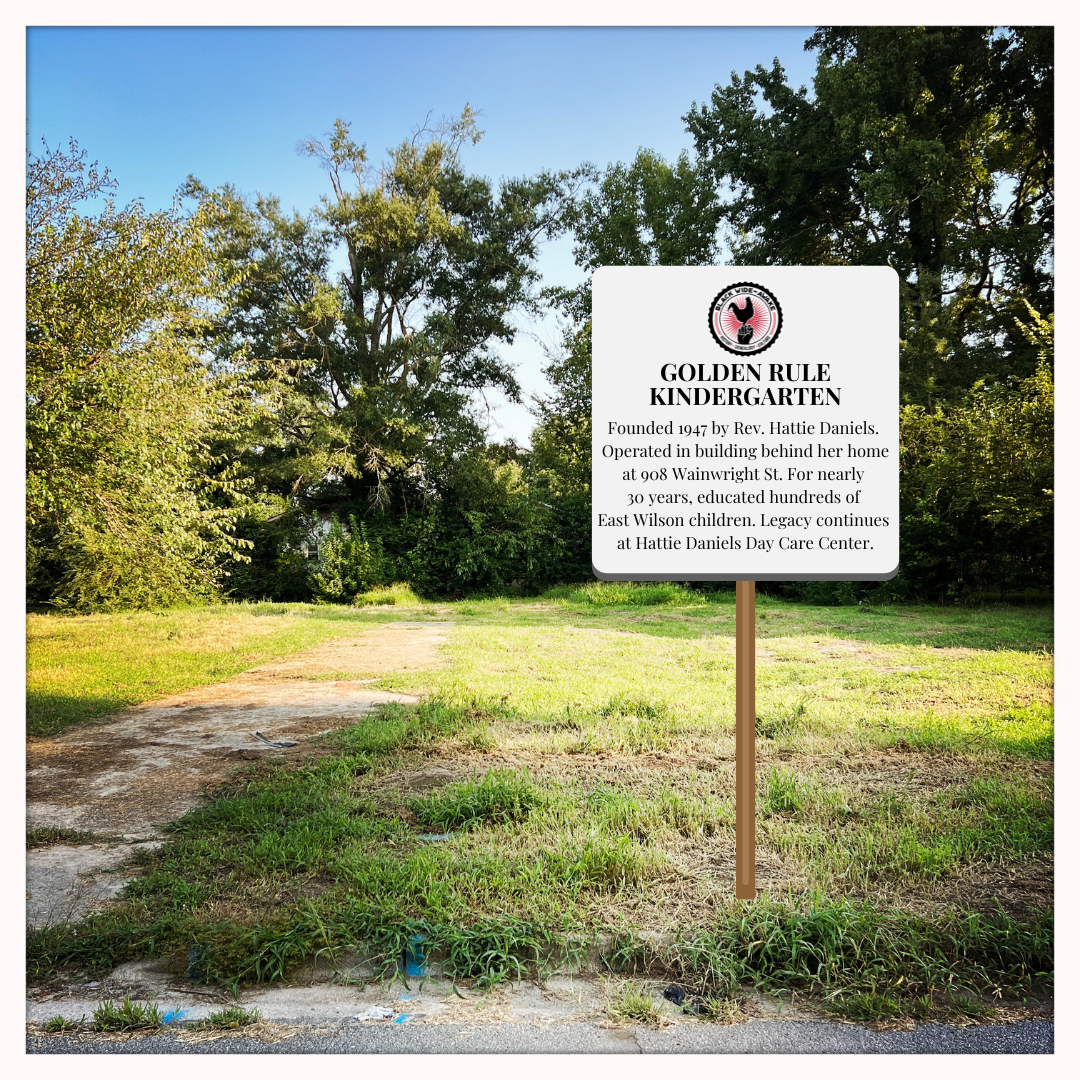
Former site of Golden Rule Kindergarten. The Daniels home, which stood in front of the school building, was recently demolished.
Founded 1947 by Rev. Hattie Daniels. Operated in building behind her home at 908 Wainwright St. For nearly 30 years, educated hundreds of East Wilson children. Legacy continues at Hattie Daniels Day Care Center.

Martha Newsome Harris Cotton (1890-1955).
——
In the 1930 census of Bailey township, Nash County, N.C.: Martha Harris, 32, widow, farmer, and children [and stepchildren] James W., 14, Walter, 12, Mary, 10, Rosa, 8, and Leroy Harris, 7.
Walter Harris died 28 September 1936 at Mercy Hospital, Wilson. Per his death certificate, he was 19 years old; was born in Wilson County to William Harris and Martha Newsome; was married to Maggie Harris; worked in farming. Martha Cotton of Bailey, N.C., was informant; he was buried in Nash County.
In the 1940 census of Town of Bailey, Bailey township, Nash County: lumber mill laborer James Cotton, 38; wife Martha, 38, maid; and son Leroy Harris, 18, lumber mill laborer.
Martha Cotton died 28 January 1955 in Wilson. Per her death certificate, she was born 1 June 1900 in Wilson County to Walter Newsome; lived in Bailey, Nash County; was married; and was buried in Rest Haven Cemetery. Mary Peppers, 121 Ward Boulevard, Wilson, was informant.
Mamie Durham died 18 February 1980 in Newport News, Virginia. Per her death certificate, she was born 1 February 1913 in Wilson County, N.C., to William Harris and Martha Newsome; was married to John T. Durham; and was buried in Rest Haven Cemetery, Wilson.
Photograph courtesy of Ancestry.com user Lawrence Brown.

Alonza G. Creech (1924-2020).
——
In the 1940 census of Wilson, Wilson County: farmer Alonza Creech, 57; wife Callie, 37; and children Alonza Jr., 15, Roger, 14, Odessa, 12, Roland, 9, and Doris, 8.
In 1942, Alonza G. Creech Jr. registered for the World War II draft in Wilson. Per his registration card, he was born 16 September 1924 in Johnston County, N.C.,; lived at 1100 East Nash Street, Wilson; his contact was Callie Horton Creech; and he worked for Glide Base, Edenton, N.C.
On 26 June 1947, Alonzo Creech, 21, of Wilson, son of Alonzo L. and Callie Horton Creech, married Geraldine Gaylord, 16, of Wilson, daughter of Jerry and Elizabeth Williams Gaylord, at the Gaylords’ home at 806 East Green Street. Missionary Baptist minister Fred M. Davis performed the ceremony.
Photo courtesy of Rodger Creech Jr.
I’ve written several times of Nina F. Hardy, the Wayne County cousin who came to Wilson around the same time as Jesse and Sarah Henderson Jacobs. In a way, she was returning home, as her grandmother Catherine Boseman Aldridge likely was born just below Elm City in what was then Edgecombe County.
Many years ago, I connected with J.M.B., the great-grandson of Jefferson Farrior, the man for whom Aunt Nina worked for decades as a cook and nursemaid. He shared dozens of photos of her at work at the Farriors’ enormous house on Woodard Circle. Last week, he sent another rare treasure — a crazy quilt Aunt Nina made shortly after his mother was born in 1945. Pieced from bright bits of synthetic fabric in florals and geometric patterns, it features intricate contrasting stitching in bold threads.

Any sewing or quilting or fabric experts out there? I am correct that these are synthetic fabrics? From the 1930s and ’40s? And the neat embroidery stitches were hand-sewn?

I appreciate J.M.B.’s return of Nina Hardy’s handiwork to her family. He has been a generous source of information about our beloved cousin.
I talked a while back about the telltale narrowing of the stretch of Bishop L.N. Forbes [formerly Lane] Street that runs past Rountree, Odd Fellows, and Vick Cemeteries. It’s the only city street I can think of that lacks curbs and gutters. Rather, rainwater drains into open ditches that run along a strip of blacktop barely wide enough for two cars to pass abreast.
And that narrow road is losing its edges.
A close look at this divot across from the Vick Cemetery parking lot reveals two layers of asphalt over a bed of sand.

Here’s a view looking across the road from the ditch running alongside the cemetery. Runoff has cut a channel through the ditch’s soft soil.

And, at the edge of the road, the opening to an animal’s burrow, large as a softball.

A few months ago, Wilson City Manager Grant Goings mocked my efforts, via Lane Street Project, to keep Odd Fellows Cemetery mowed and its woods clear. We ask, “And why do you look at the speck in your brother’s eye, but do not consider the plank in your own eye?”
Photos by Lisa Y. Henderson, November 2024.

The reverse side of this aerial photograph of downtown Wilson reveals that it was taken by the United States Army Air Service, 20th Photo Section. In the bottom left corner of the image there appears to be a date: 8-3-25. Tested against the construction of dates of the former Atlantic Coastal Line passenger station, completed in 1924 and visible here; the Wilson County Courthouse, completed in 1925 and visible here; and the former United States Post Office and former First National Bank building on Nash Street, both completed in 1927 but not even under construction here, 1925 can be confirmed.
In its lower right corner, the photo offers a rare glimpse of Wilson’s primary Black business block at, arguably, its prime in the decade before the Great Depression.

Identifiable buildings include:


William and Martha Ann Bynum Finch.
——
In the 1880 census of Cross Roads township, Wilson County: Calvin Bynum, 31, farmer; wife Pherabe, 28; and children Olive, 9, Fannie, 7, Martha Ann, 5, Joseph, 2, and Benjamin, 3 months.
On 23 January 1898, William Finch, 29, married Martha Bynum, 22, in Wilson County.
In the 1900 census of Cross Roads township, Wilson County: farmer William Finch, 39; wife Martha A., 25; children Luginia, 12, Anachy, 9, and David, 1; and aunt Lanie Finch, 54.
In the 1910 census of Springhill township, Wilson County: William Finch, 44; wife Mattie, 36; and children Anachie, 18, David, 12, John W., 10, Lafayette L., 6, Pearlie, 4, Leora, 2, and James H., 1 month.
In the 1920 census of Springhill township, Wilson County: farmer William Finch, 56; wife Mattie, 45; and children David, 20, John William, 19, Lafayette L., 15, Pearlie, 14, Leora, 12, James, 8, Willie, 6, and Lessie, 1.
In the 1930 census of Springhill township, Wilson County: farmer William Finch, 65; wife Martha, 57; and children Lafayette L., 24, James, 20, Willie, 17, Lessie, 13, and Moses, 7.
William Finch died & March 1936 in Lucama, Wilson County. Per his death certificate, he was born 1 November 1860 in Nash County; was married to Marthann Finch; worked as a farmer; and was buried in “home cem.” Johnnie Finch was informant.
In the 1940 census of Springhill township, Wilson County: Marthy Finch, 68; sons Layette, 36, Lessie, 21, and Mose, 19; daughter-in-law Eldora, 35; and grandson Robert Lee, 4.
Martha Finch died 7 February 1958 in Lucama, Springhill township, Wilson County. Per her death certificate, she was born 17 June 1873 in Wilson to Calvin Bynum and Farbee [maiden name unknown]; was the widow of William Finch; and was buried in Finch Cemetery. Pearley Finch was informant.
Photo courtesy of Ancestry.com Neshele Godfrey.