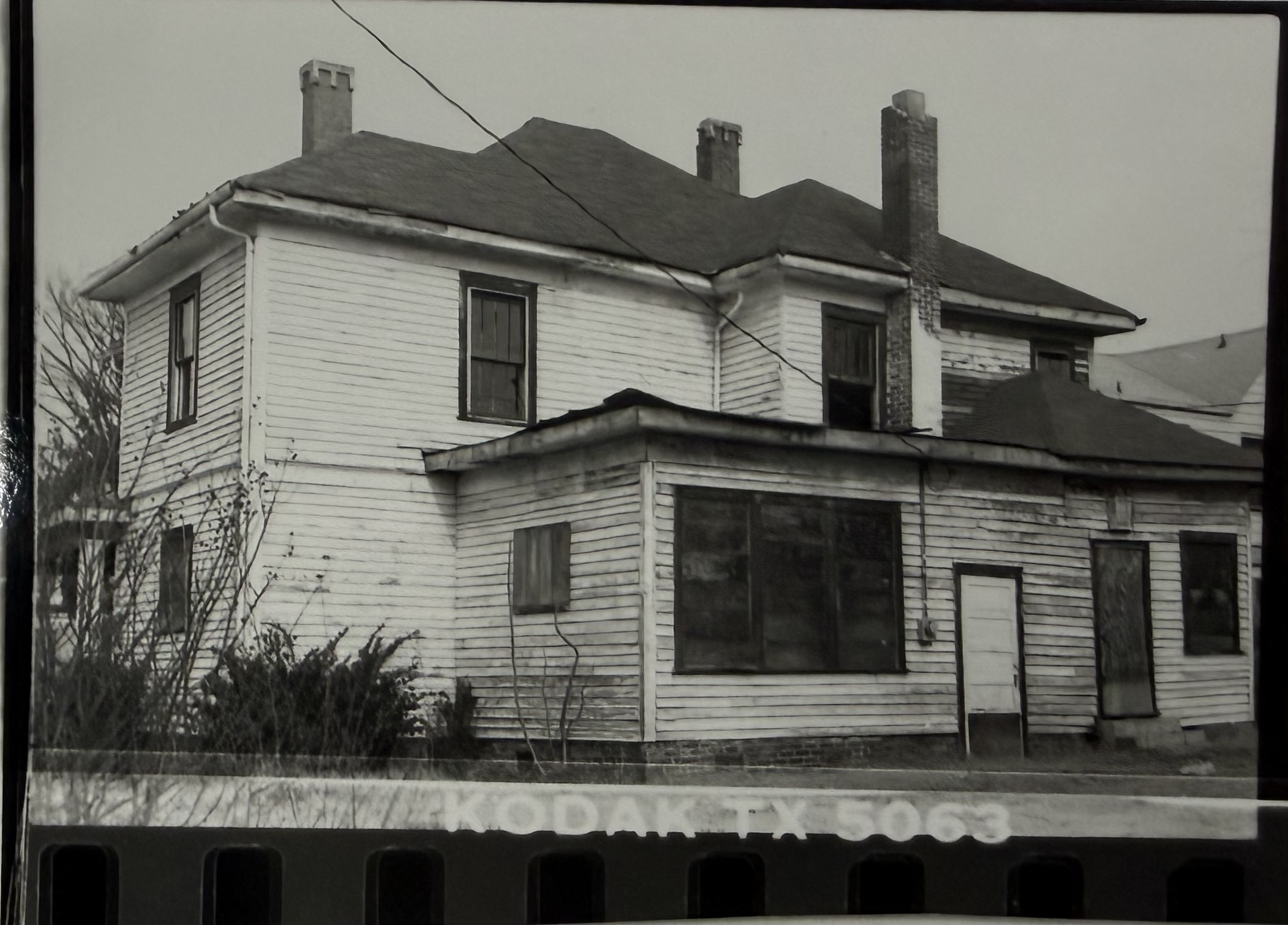
Photographs

Cemeteries, no. 38: the Joshua Barnes’ tenant cemetery.

I first mused about the cemetery on the old Joshua Barnes plantation here. As shown in this detail from the plat, the burial ground was in Lot 11 of the farm’s subdivision, a triangle of land between what are now London Church Road and Corbett Avenue. Was this where black tenants and laborers on Barnes’ farm buried, well into the 20th century? Did it start as a cemetery for the many dozens of people Barnes enslaved?

Last week, I stumbled upon a 1964 plat map of the former Lot 11, then named Raeford Rountree farm, which outlines the cemetery in greater detail and records its size as .73 acres.

This deed description comes from a 1983 quitclaim deed from Landmark Development Company of Wilson to a trustee for Living Faith Ministries, Inc. It makes clear that this cemetery was recognized for what it was.

Here’s a current aerial view of the property from Wilson County’s GIS website. I’ve encircled the rough location of the cemetery, which lies a short distance south of Impact Church.

There’s no sign of the cemetery now. (At least not from the road.)

Photograph by Lisa Y. Henderson, February 2026.

Lane Street Project: at long last, a meeting … and cautious optimism.

Castonoble Hooks and I met today with Mayor Carlton Stevens, City Manager Rodger Lentz, Assistant City Managers Albert Alston and Bill Bass, Councilmember Susan Kellum, Sarah Lowry of New South Associates, and Melissa Timo of the North Carolina Office of State Archaeology to talk about Vick Cemetery. This was a conversation more than five years in the making, and I deeply appreciate this shift in the City’s response to our concerns about Vick. 

We heard Lowry’s report on New South’s assessment of the markers unearthed in December and her and Timo’s recommendations on further action at Vick. We asked questions of them and each other and talked frankly for more than an hour and a half. It’s premature to share much of the discussion here, but I do want to say this:

The stones that a contractor unearthed in the ditch bank at Vick Cemetery were pieces of a marble box, a sort of proto-vault, that once held an ancestor. The broken marble slabs are all, beyond chemical changes in the soil, that are left of the burial. The top slab, which likely would have been engraved with the name of the deceased, was not found, and we do not know whether this was the grave of a woman, man, or child.

The accident that dislodged this box was awful, but has been transmuted for good. I am grateful to the ancestor who, by losing his or her repose, opened a path for us to move forward in our fight for respect and due care for Vick Cemetery. May we continue to walk in our purpose and always remember and honor our dead. 

Lane Street Project: I didn’t think I was shockable anymore, but here we are.

Driving into Wilson with a grin on my face, and POW! — “A Wilson man has been charged after admitting to digging up a grave at Vick Cemetery….”

You can read the sorry details here.

I immediately called Castonoble Hooks and diverted to the cemetery. The alleged perpetrator unearthed a corner of a burial vault in a grave at the edge of the ditch, but it has been recovered, and the earth tamped back down. While we were there, Public Works pulled up to shovel dirt over the remnants of the marble markers dislodged back in December. I was too shaken to even question why, but will find out.

Congratulations and gratitude, Castonoble Hooks!

Lane Street Project’s Castonoble Hooks is getting his flowers this month, and we are here for it! This past Sunday he received Mount Moriah Community Church’s Community Impact Award, one of three such honors bestowed upon him by area churches this month. We add our thanks to Cass Hooks for his dedication to the preservation and uplift of our history.

Photo courtesy of Jocelyn Drawhorn.

Where did they go?: Washington obituaries.

  • Georgia Jiles

In the 1880 census of Oldfields township, Wilson County: Wesley Tayborne, 30; wife Madora, 23; and Martha, 6 months.

The Taborns joined the exodus to Arkansas circa 1891, settling in Saint Francis County,

In the 1900 census of Telico township, Saint Francis County, Arkansas: Wesley Taborn, 47; wife Dora, 43; children Henrietta, 20, Arnie, 18, Lula, 16, Claudia, 13, Georanna, 10, Hattie, 7, and Walter, 1; and boarder Robert Lucas, 46. All were born in North Carolina except Hattie and Walter, who were born in Arkansas.

In the 1920 census of Wynne township, Cross County, Arkansas: Arlie Taborne, 45; sister Gergia, 24; daughter Hattie, 22; daughter Grattice, 2; son Herman, 2; and uncle Robert Lucas, 63. The two children were born in Arkansas; everyone else in North Carolina.

1939 Seattle, Washington city directory.

The Northwest Enterprise (Seattle, Wash.), 6 January 1940.

In the 1940 census of Seattle, King County, Washington: at 1534 – 23rd Avenue, widow Hattie B. Lewis, 43; son Herman L. Lewis, 22; sister Georgia Jiles, 45; nephew Grattis T. Scott, 22; niece Alberta Morrow, 23; and nephew Millard Morrow, 23. All but the Morrows reported they had been in Kansas City, Kansas, in 1935.

Georgia Jiles died 10 February 1956 in Seattle, King County, Washington. Per her death certificate, she was born 20 October 1896 in Wilson, N.C., to Westley Taborn and Dora Jones; was a widow; lived at 1615 – 20th Avenue; and was buried in Washelli Cemetery.

  • Mancie Gaston

In the 1900 census of Town of Elm City, Toisnot township, Wilson County: on Pender Street, barber and plasterer George W. Gaston, 44, wife Cilla, 44, a cook; and children Rosco, 18, bricklayer; John, 16, common laborer; Georgia, 15, cook; Addar, 12, nurse; Nina, 11, nurse; Mancy, 6; Lacy, 6; Augustas, 6; Boston, 1; and Dewey, 6 months.

In the 1910 census of Town of Elm City, Wilson County: on Wilson Street, barber George Gaston, 55, wife Priscilla, 53; and children Roscoe, 28, barber; John, 26, barber; Georgie, 25; Ada, 23, teacher; Nina, 21; Mancie, 17; Augustus, 16; Flossy, 16; Boisy, 14; Dewey, 9; and Lee J. Gaston, 7.

In 1917, Mancie Gaston registered for the World War I draft in Wilson County. Per his registration card, he was born 10 June 1892 in Elm City; lived in Elm City; worked as a barber for G.A. Gaston; and was single.

World War I service card for Mancie Gaston.

1922 Wilson, N.C., city directory.

Dewey Gaston, 23, son of George and Priscilla Gaston, married Mary B. Howard, 24, daughter of Mary E. Darden, on 8 March 1923 in Tarboro, Edgecombe County. Witnesses were Mancie Gaston and Fannie F. Ricks of Elm City.

Around 1930, Gaston headed west, living briefly in Albuquerque, New Mexico, before moving on to Reno, Nevada.

1931 Albuquerque, New Mexico, city directory.

In the 27 October 1932 edition of the Reno Evening Gazette, Mancie Gaston was listed as a registered voter in Washoe County, Nevada. He spent an eventful few years in the state before relocating to Seattle, Washington.

Reno Evening Gazette, 25 January 1933.

Nevada State Journal (Reno, Nev.), 4 February 1936.

In the 1940 census of Seattle, King County, Washington: at 121 Maynard Avenue [a single-room occupancy dwelling], Mancie Gaston, 47, W.P.A. laborer.

In 1942, Mancie Gaston registered for the World War II draft in Seattle. Per his registration card, he was born 10 June 1892 in Elm City, North Carolina; lived at 413 1/2 Maynard Avenue, Seattle; and worked for I.D. Dudley [white barber Isaac D. Dudley], 609 Jackson, Seattle.

At the time he registered for the draft, Gaston lived in Seattle’s Chinatown. This 12 May 1941 photo, courtesy of the Seattle Times Archives, depicts a funeral procession in the block of Maynard, between Jackson and King, that he lived in.

In the 9 June 1943 issue of The Northwest Enterprise, Mancie Gaston is listed as a paid member during a N.A.A.C.P. membership drive.

Mancie Gaston died 7 August 1946 in Seattle, King County, Washington. Per his death certificate, he was born 10 June 1892 in Elm City, N.C., to George Gaston and Priscilla Mercer; lived at 613 1/2 Jackson Street; was a widower; worked as a barber; was a veteran; and was returned to Elm City for burial.

Shout-out to Gary Redding for his daily Halifax County black history highlights!

You know I love a granular Black history, and Halifax County, N.C., Commissioner Gary Redding is pouring it in spades this Month. I’ve known Gary since he was five years old. He comes from a long line of social justice warriors, and I’m so proud of his work as an educator, lawyer, and community advocate in his home county. He is the embodiment of “servant-leader.”

Every day, Gary posts to Facebook a brief description of a Halifax County black history milestone with several attached photographs or newspaper clippings. I am struck by the vignettes themselves, but also by the similarities and differences between what happened in Halifax and Wilson Counties. Gary is building a vital archive for his community and for all of whose who believe in the power and importance of sharing our stories.

Thank you, Gary R. Redding!

Happy Valentine’s Day 2026!

We moved into 1401 Carolina Street just before my first birthday and left just before my tenth. I haven’t been inside this little brick house in nearly 50 years, but I can describe its every detail, inside and out. My deep connection to my community and its people was forged in those first ten years. Safe in the nest of my knowledge-seeking, passion-encouraging family, I flourished — a sensitive, inquisitive, observant child.

Today, Black Wide-Awake celebrates foundational love! Cheers to Beverly and Rederick Henderson and the East Wilson that made me!

Colored members of the medical staff of Lincoln Hospital.

Journal and Guide (Norfolk, Va.), 9 January 1937.

This photo collage appears in a full-page article titled “Hospital Is Built Where Monument Intended; Lincoln Hospital at Durham Has Unusual History and Record; Duke Family’s Plan To Honor Negro Slaves Changed To Erection of Much Needed Hospital.”

——

Studio shots, no. 268: the Diggs family.

Though a Wayne County native (and descendant of Celia Artis), Edgar H. Diggs spent most of his adult life in Wilson. He was well-known barber for decades at Walter Hines Barbershop and lived at 205 North Vick Street.

Diggs’ granddaughter Sheila Diggs has graciously shared photos of three generations of her family.

Sula Diggs Artis (ca. 1866-1919), probably taken in a Goldsboro, N.C., studio.

Sula Diggs Artis’ daughter Lizzie Olivia Diggs (1894-1988), circa mid-1910s. Edgar H. Diggs (1890-1970) was her brother. This photo was taken in the studio of Wilson’s Picture-Taking George W. Barnes. That’s his signature one-armed chair, and we’ve seen the window prop before, too.

Olivia Diggs Artis a few years later, with a bob and tiered, drop-waist day dress characteristic of the early 1920s. 

Edgar H. Diggs and youngest son Preston Diggs at their Vick Street home, circa late 1940s. The camera is a twin-lens reflex camera, perhaps a Rolleiflex.

Walter Preston Diggs (1928-2024).