Freedom

A second look at five generations.

I’ve obtained a clearer copy of the photograph posted here depicting five generations of women who lived on the lands of and worked for Edwin Barnes or his heirs near Evansdale.

Wilson Daily Times, 20 April 1950.

Unfortunately — and surprisingly — I’m still not able to identify the women with certainty.

Many thanks to J. Robert Boykin III for the clipping.

Barnes Primitive Baptist Church, found.

Three years ago, I asked, “Where was Barnes Church?” Today, I have an answer.

Founded just after slavery, Barnes Church was one of the earliest African-American churches in Wilson County. Its simple double-doored, gable-front building is believed to have been erected shortly after the church’s establishment.

Barnes Church circa 1960s.

My father’s classmate L. Paul Sherrod Jr. asked me to explore the little spit of woods that I knew had once been the site of the church, but in which I’d not found any traces of the nineteenth-century building. My earlier looks had been in summer, though, when I could barely get a glimpse inside the woodline.

We entered via an old driveway over the ditch and immediately spotted this stack. I was puzzled at first, as this is obviously newer brick. A walk-around, however, revealed old brick piers, the corners of a building came into view, and this broken stack may have been a later addition that vented a wood stove. Curled trips of tin roofing lay rusting underfoot.

And then I spotted this. Barnes Church burned down after it was vacated. Here was a charred length of sill beam — with a four-inch, square-cut nail.

The nail. It was not hand-wrought, but cut from a sheet, as indicating by only two sides tapering. The head would have been added by hand. The earliest machine-cut nails of this type date to about 1840.

A brick from one of the piers. It is unmarked, but probably made locally.

This sill beam, from the north side of the building, is charred but unbroken.

A section still resting on a pier.

The pollen, y’all.

Paul and Barbara Sherrod, my guides. We’ve met Mr. Sherrod here and here and here.

It’s heard to visualize, but I’m standing in front the church’s site, perhaps seven feet from its front wall.

Barnes Primitive Baptist Church did not own its building or the land on which it stood. When the landowner refused to allow the congregation to upgrade the building, members of the Sherrod family donated land for a new church a few miles south, just across the Wayne County line on Watery Branch Road. The “new” church is now occupied by Now Faith Missionary Baptist Church.

The estate of Sampson Hinnant.

Sampson Hinnant was near 60 when sold to his last enslaver in 1861. A year after freedom, he and Mary Boykin formalized their marriage. They apparently did not have children, and Hinnant died in 1878, leaving a small estate. His was one of a relative handful of estates of formerly enslaved people that entered probate in Wilson County in the decades after freedom.

Hinnant’s estate file contains only the record of the widow’s allotment paid to Mary Hinnant for one year’s support. In addition to the harvested crops on hand — potatoes, peas, wheat, “greens” — she received all their furniture, working tools, fodder, four head of cattle, five hogs, and eight barrels (of what?).

The census taker apparently missed the Hinnant household when making his rounds in 1870. Their cohabitation registration and this estate file are the only known documentation of their lives in freedom.

Estate File of Sampson Hinnant, Wilson County; North Carolina Wills and Probate Records, 1665-1998, http://www.ancestry.com.

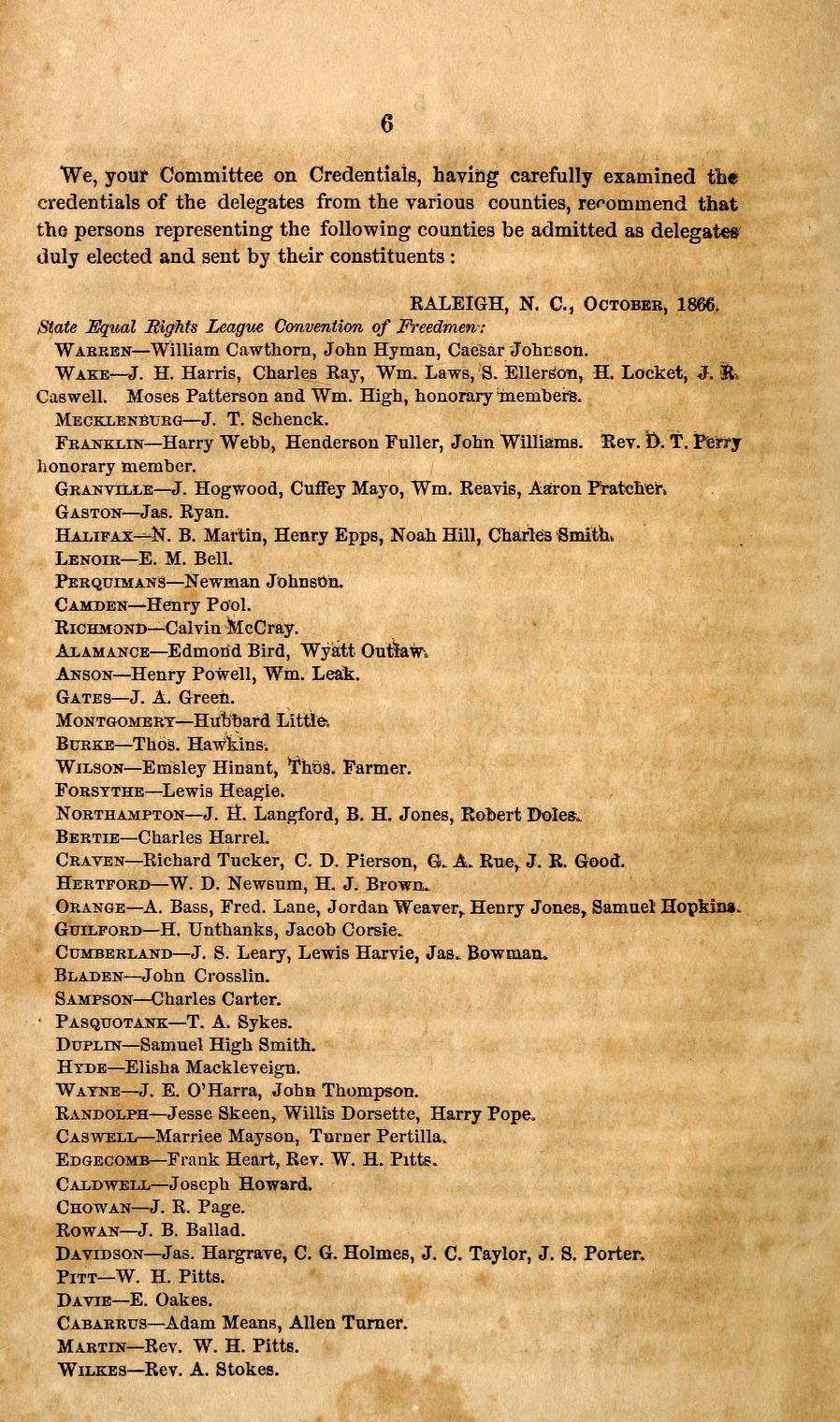
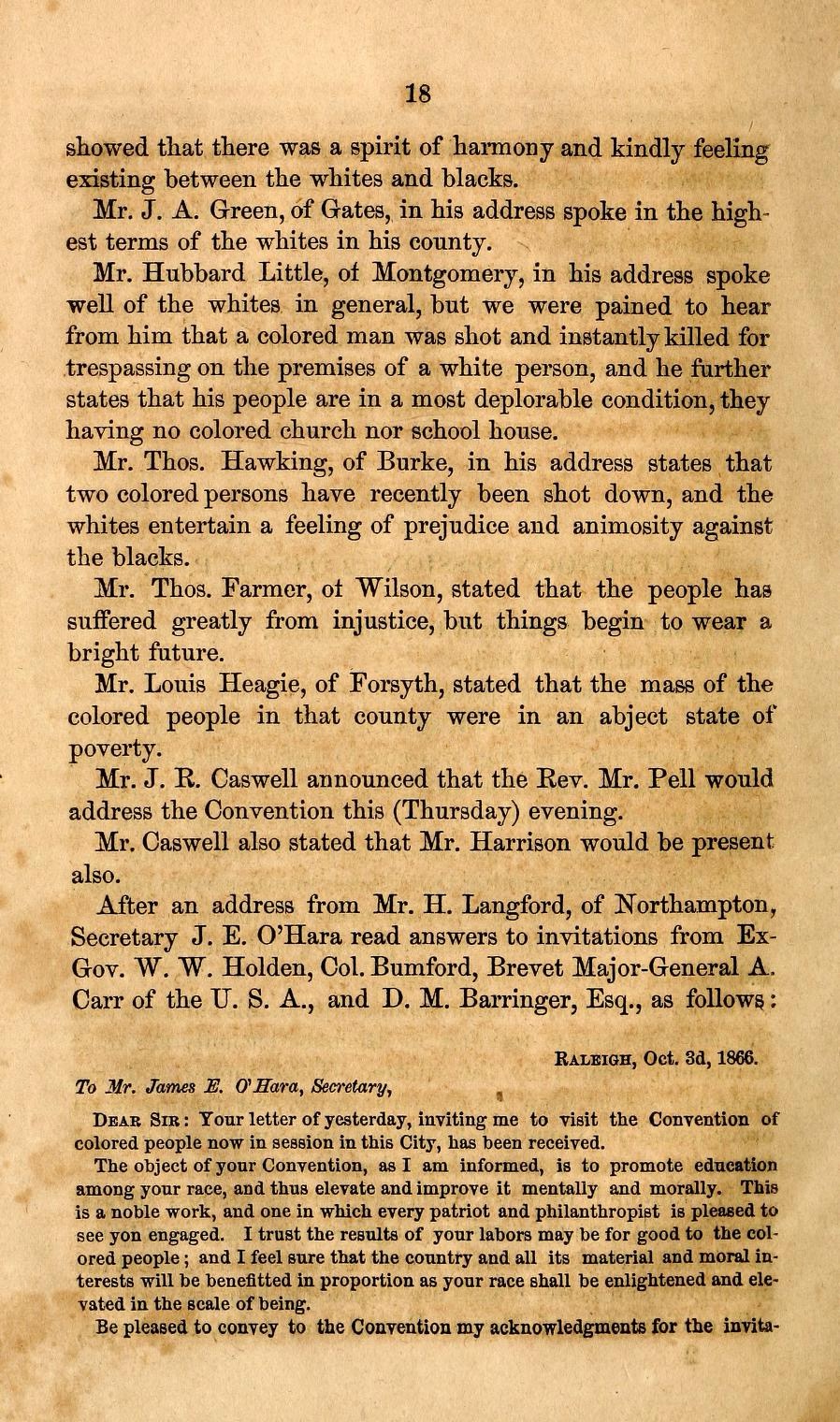
Minutes of the Freedmen’s Convention of 1866.

In October 1866, more than 100 representatives of North Carolina’s Equal Rights Leagues gathered in Raleigh for a convention. Some, like future United States Congressman James E. O’Hara of Wayne County, had been born free. Most, however, were little more than a year into emancipation.

The convention’s minutes show that Wilson County sent Ensley Hinnant and Thomas Farmer to the conference.

At the October 4 afternoon session, Thomas Farmer of Wilson spoke up to say that “the people has suffered greatly from injustice, but things begin to wear a bright future.”

——-

  • Ensley Hinnant

Ems Hinnant and Kate Reil registered their 11-year marriage with a Wilson County justice of the peace in 1866.

In the 1870 census of Oldfields township, Wilson County: farm laborer Emizel Hinnant, 30, and Harriet, 19, Tamer, 11, Henderson, 13, Mary, 7, Dennis, 8, and Joseph, 1.

On 29 February 1870, Jeff Powell, son of Calvin and Penny Powell, married Carolin Hinnant, daughter of Emsly and Ally Hinnant, at Zilla Locus‘ in Wilson County.

On 20 February 1895, Gray Hinnant, 42, of Oldfields township, son of Martha Williamson, married Tama Hinnant, 35, of Oldfields township, daughter M. and Alley Hinnant, both deceased, at the residence of Thamar Hinnant.

Henderson Hinnant died 7 August 1934 in Wilson township, Wilson County. Per his death certificate, he was 49 years old; was born Wilson County to Enzly Hinnant and Carolina Hinnant; was married to Margaret Hinnant; and lived on Route 3, Kenly.

  • Thomas Farmer

Two adult African-American men named Thomas Farmer appear in the 1870 census. It is not clear which, if either, was the conventioneer.

  • Equal Rights League

Just last week, the incomparable David Cecelski blogged about the unveiling of a state historical marker commemorating the Equal Justice League branch in the Edgecombe County’s Red Hill community in 1866. Cecelski spoke at the ceremony and, in the complete absence of information about Wilson County’s chapter, his words help us understand Hinnant and Farmer’s revolutionary work. To those who made the day possible, Cecelski said, “Through all your efforts, you remind us, at a time when we need reminding, of a time and a place when people who had next to nothing, who were only months out of slavery, and who were surrounded by a thousand perils, found the courage, faith, and determination to fight for a better world for their children and for us all.”

William Batts Sr.’s enslaved community.

We saw here the 1856 will of William Batts Sr., which dispersed 25 enslaved people among his children and grandchildren. What do we know of the 25?

  • Isaac

Perhaps, in the 1870 census of Joyners township, Wilson County: farm laborer Isaac Batts, 58, and Violet, 56.

  • Elsy and her youngest son Thomas

Hugh B. Johnston revealed the revealed the relationships between several of William Batts’ enslaved people in this cruel Emancipation anecdote. Jesse Farmer had married Batts’ daughter Polly and claimed ownership of “blind Nellie, old Clarkey, her daughter Ailsey, Ailsey’s daughter Dinah, and Dinah’s children Jim, Jerry, Hilliard, and Cindy.”

In the 1870 census of Gardners township, Wilson County: Ailsey Batts, 68, and Nellie Batts, 35, described as “idiot.”

In the 1870 census of Joyners township, Wilson County: farm laborer Thomas Batts, 27; wife Mariah, 24; and children Pricilla, 7, Joseph, 5, Henry, 5, John, 3, and Bettie, 1 month.

In the 1880 census of Toisnot township, Wilson County: farm laborer Tom Batts, 37; wife Maria, 34; children Joseph, 15, Henry, 13, John, 12, Bettie, 10, George, 8, Amos, 6, Willie, 4, Charles, 3, and unnamed, 1; and granddaughter Eliza, 1.

In the 1900 census of Wilson township, Wilson County: farmer Tom Batts, 69; wife Mariah, 60; and children Eddie, 22, Willie, 20, Blossom, 18, William, 15, Bettie, 29, and Frank, 11.

John Batts died 26 January 1927 in Wilson. Per his death certificate, he was 60 years old; was born in Wilson County to Thomas Batts and Maria Anaki [this appears to be a middle name — Anarcha, often pronounce Anaky]; was single; lived on Roberson Street; worked in farming; and was buried in Rountree Cemetery. George Batts was informant.

Bloss Batts died 9 April 1942 in the Wilson County Home, Wilson. Per her death certificate, she was 55 years old; was born in Wilson County to Tom Batts and Mariah Jones;  was married to Lizzie Batts; worked in farming; and was buried in Rountree Cemetery.

  • Amos

There were several men named Amos Batts in Wilson County in the late nineteenth century, but none were born prior to 1856.

  • Meedy

There appear to be two Meedys named in Batts’ will, one of whom was a young child. See below.

  • Young Isaac
  • Ben
  • Orren

A note in the estate file of William Batts Sr. mentions “Negro man Orren.”

On 23 August 1866, Orren Batts and Mary Batts registered their 14-year cohabitation with a Wilson County justice of the peace.

In the 1870 census of Joyners township, Wilson County: Orren Batts, 41, wife Mary, 34, and children Dennis, 16, Amos, 14, Henriet, 10, Haywood, 9, Precilla, 5, and Louisa, 3.

In the 1880 census of Toisnot: Orren Batts, 53, wife Mary, 47, and children Haywood, 19, Priscilla, 14, Louiza, 12, John, 9, Reddick, 7, and James B. Batts, 1.

Harriet Barnes died 27 August 1926 in Wilson township, Wilson County. Per her death certificate, she was 65 years old; was born in Wilson County to Orange Batts and Mary Batts; was the widow of John Barnes; was engaged in farming; and was buried in Wilson [probably, Vick Cemetery.] Roscoe Barnes was informant.

  • Haywood

In the 1870 census of Joyners township, Wilson County: farm laborer Haywood Batts, 34; wife Rodah, 27; Lucy, 17; and Alice, 4.

In the 1880 census of Toisnot township, Wilson County: Haywood Batts, 49, farmer; wife Rhoda, 36; children Alvana, 13, and Jack H., 4; and brother-in-law Amos Pender, 27.

In the 1900 census of Gardners township, Wilson County: Haywood Batts, 66, farmer, and wife Rodia, 53.

On 31 December 1903, Haywood Batts, 70, married Tempy Woodard, 55, in Toisnot township, Wilson County.

In the 1910 census of Gardners township, Wilson County: farmer Mark Barnes, 60; wife Allie, 43; children Rodie, 20, Eva, 17, William F., 13, Bertha, 10, Lucy, 7, Ida, 5, and Haywood, 2; grandchildren James, 4, and Hattie, 2; and father-in-law Haywood Batts, 77, widower.

Allie Barnes died 8 November 1917 in Gardners township, Wilson County. Per her death certificate, she was born about late 1862 in Wilson County to Haywood Batts and Rhoda Pender; was a tenant farmer; and was married. Mark Barnes was informant.

In the 1920 census of Gardners township, Wilson County: Mark Barnes, 60; wide Adeline, 49; children Bertha, 20, Lucy, 17, Ida, 15, Henry, 14, Haywood, 13, and Hattie, 12; and father Haywood Batts, 87, widower.

Haywood Batts died 27 January 1921 in Elm City, Toisnot township, Wilson County. Per his death certificate, he was 100 years old [actually, more like 85]; was born in Wilson County to Jack Batts and Venus Batts; was a widower; was a farm hand for “Mr. Banks” (!!); and was buried in the family graveyard. Jack Batts was informant. [See Venice, below.]

  • Venice and her five children
  • Harriet
  • Peter

Possibly, on 31 August 1866, Peter Farmer and Mariah Loften registered their four-year marriage with a Wilson County justice of the peace.

In the 1870 census of Gardners township, Wilson County: Peter Farmer, 34; wife Mariah, 30; and children Seth, 15, Daniel, 10, and infant, 2.

In the 1880 census of Toisnot township, Wilson County: farmer Peter Farmer, 45; wife Maria, 42; and children Adline, 17, Colonel, 13, Alsy, 10, Margaret, 8, Hardy, 5, Julius, 3, and Joshua, 1.

In the 1900 census of Cold Water township, Cross County, Arkansas: farmer Peter Farmer, 73; wife Mariah, 51; children John Farmer, 28; Margaret Bunn, 21; Isaac, 18, Eley, 17, and Louisa Farmer, 15; and grandsons Sanders, 6, and Theodrick Bunn, 5. All except the grandchildren were born in North Carolina.

Hardy Farmer died 14 April 1948 in Jackson township, Crittenden County, Arkansas. Per his death certificate, he was born 15 March 1874 in Wilson, N.C., to Peter Farmer and Mariah Pender; was married to Alice Farmer; and he worked as a farmer.

Maggie Newsome died 25 May 1955 in Memphis, Shelby County, Tennessee. Per her death certificate, she was 83 years old; was born in North Carolina to Peter Farmer and an unknown mother; was a widow; and worked as a maid.

  • Charles
  • Nelly

See Elsy/Ailsey, above.

In the 1870 census of Gardners township, Wilson County: Ailsey Batts, 68, and Nellie Batts, 35, described as “idiot.”

In the 1880 census of Toisnot township, Wilson County: farmer Lewis Robbins, 43; wife Diana, 53; children Henry, 14, Frank, 11, Alice, 9, and Jerry, 8; and sister-in-law Nellie Batts, 45, described as blind and “idiotic.”

  • Dinah and her children Jerry, Hilliard, and Sidney

See Elsy/Ailsey, above.

On 6 October 1869, Dina Batts, daughter of Charles Horne and Alecy Batts, married Lewis Robbins, son of Lewis and Mariah Scott, at Lewis Robbins’.

In the 1880 census of Toisnot township, Wilson County: farmer Lewis Robbins, 43; wife Diana, 53; children Henry, 14, Frank, 11, Alice, 9, and Jerry, 8; and sister-in-law Nellie Batts, 45, described as blind and “idiotic.”

In 1866, Jerry Farmer and Kate Sugs registered their two-year cohabitation with a Wilson County justice of the peace.

In the 1870 census of Gardners township, Wilson County: Jerry Farmer, 26, and wife Kate, 26.

In the 1880 census of Gardners township, Wilson County: farm laborer Jerry Farmer, 37, widower.

On 10 January 1884, Jerry Farmer, 39, married Annice Pender, 23, at Abram Sharpe’s. Charles Barnes, Haywood Batts, and Haywood Pender were witnesses.

Hilliard Farmer and Elva Farmer registered their two-year cohabitation with a Wilson County justice of the peace on 1 September 1866.

In the 1870 census of Gardners township, Wilson County: farm laborer Hilliard Farmer, 25; wife Ann, 24; and children Louisa, 6, Henrietta, 5, and Julia, 1 month. [Per the 1870 mortality schedule, Farron Farmer, 1, of this household, died in August 1869 of cholera infantum.]

In the 1880 census of Toisnot township, Wilson County: Hilliard Farmer, 34, farm laborer; wife Arann, 33; children Julian, 9, Tiny, 6, Roxie, 5, Willie, 3, and Henry, 1; and grandson Eddie, 11 months.

  • Hagar
  • Meedy

There are appear to be two Meedys named in Batts’ will, one of whom was a young child in 1856. See above.

In the 1870 census of Upper Town Creek township, Edgecombe County: Arthur Sharpe, 58; wife Harriet, 50; children Toney, 13, Wedley, 11, and Caroline, 25; and Meedy Farmer, 21.

In the 1880 census of Upper Town Creek township, Edgecombe County: Meedy Farmer, 30; wife Caroline, 30; and children Cromwell, 8, James, 4, and Mary, 1.

In the 1900 census of Township #8, Edgecombe County: Meady Farmer, 50; wife Caroline, 38; and children James, 22, Mary, 17, Willie, 14, Ada, 13, Alice, 12, John, 10, Lonnie, 7, and Floyd, 2.

Cromwell Farmer died 13 September 1939 in Toisnot township, Wilson County. Per his death certificate, he was born 20 January 1872 in Wilson County to Meedy Farmer and Caroline Sharpe; was married to Mary Jane Farmer; lived at Bryant Farm; and was a farmer. [Floyd Willie Farmer was his son.]

Willie Farmer died 22 February 1960 in Gardners township, Wilson County. Per his death certificate, he was born 3 February 1885 in Wilson County to Meaty Farmer and Caroline [no maiden name]; was married to Martha Farmer; and was a farmer.

Floyd Farmer died 11 March 1988 in Rocky Mount, North Carolina. Per his death certificate, he was born 11 March 1888 in Edgecombe County to Meady Farmer and Caroline Sharpe; was married to Lugene Lane; and lived in Rocky Mount.

The estate of Dr. Lewis J. Dortch (1854).

Tarborough Southerner, 4 November 1854.

The death of a slaveholder generally portended devastating disruption for the enslaved. The 650-page estate of Dr. Lewis J. Dortch provides more chilling evidence.

Nash County-born, University of Pennsylvania-trained Dortch married Nancy Jane Adams in Tarboro, Edgecombe County, in 1844. The couple settled in Stantonsburg, and Jane Dortch gave birth to three children — Sarah, Isaac, and Mary — before dying of tuberculosis in 1849. The children went to live with their maternal uncle, merchant Jesse H. Adams and his family, who were listed between Dr. Dortch and slave trader Wyatt Moye in the 1850 Edgecombe County census.

Dortch married Martha Forbes in 1853, but died intestate in October 1854. Lawyer and politician William T. Dortch of Goldsboro, North Carolina, his close kinsman, was appointed administrator of his estate, which was heavily in debt. Shortly after, Robert S. Adams — also a slave trader and Dortch’s brother-in-law — was appointed the Dortch children’s guardian and moved them to Aberdeen, Monroe County, Mississippi. (When the children petitioned for their share of their father’s 2200 acres in Wilson County, the court asked for assurances that their guardian had sufficient assets to secure the estate. Testimony established that Adams was worth a modest $30,000, but was backed by Wyatt Moye, whose estimated net worth was no less than $250,000, and W.R. Cunningham, worth no less than $100,000.)

William Dortch’s first inventory report on 11 November 1854 revealed both the complexity of L.J. Dortch’s slaveholdings and the movement of his enslaved people into short-term hires in Stantonsburg and over the county line in Nahunta district, Wayne County.

  • Boy John was hired till 1 January 1855 to W.J. Exum [of northwest Wayne County] for $4.55
  • Rody and child Rosa were hired to Jno. Wilkinson [of Stantonsburg] for the same period for $2.25
  • Sarah was hired to W.J. Exum for the same period for $2.75
  • Frank and Allen to Jesse H. Adams “to keep” for $5.45
  • “in addition to the above slaves the deceased owned the following, viz.: Wash, Beedy, Warren, George, Ned, Tom, Anderson, Gray, Primus
  • “and one half of nine slaves in the possession of Wm. T. Dortch, & owned jointly by them — whose names are Diza, Jinney, Louisa, Jim, Mary, Charles, Fanny, Nancy & Josephine.” [This appears to be the nine enslaved children and grandchildren of Wayne County free man of color Adam Winn, who were sold at auction in March 1852 to satisfy Winn’s creditors. A contemporary news account cites “Dr. Dortch” of Stantonsburg as the purchaser.]
  • “The deceased has an unsettled partnership between himself & John T. Barnes, in South Carolina, in the turpentine business — the firm own the following slaves, viz. Dance, Mintus, George and Anthony

Further inventories reflected the first sales of enslaved people, as well as the instability created by movement each year pursuant to new hire agreements:

  • “Received for equality of division in wife’s negroes on the 29th day of January 1856, one hundred & fifty-six dollars 25/100 — the following negroes formerly belonging to intestate’s wife, & received in division viz., Pompey, Fox & Judah & two children, in Jany 1856″ [Martha Forbes Dortch had been a minor when her father Alfred Forbes died in Pitt County, N.C., and only 20 years old when she married Dr. Dortch.]
  • The hires from 1 January 1855 to 29 April 1855 of Sarah to Ollin C. Sasser for $8; Beedy and child Rosetta to Orpha Applewhite for $6; George to Jonathan Bullock for $7.50; Frank and Allen to Jesse H. Adams for $2.62; and Rody and Rosa to John Wilkinson for $6 [Sasser lived in or near Goldsboro, Wayne County; Applewhite and Wilkinson in Stantonsburg; and Bullock further north in Edgecombe County.]
  • An account of the 2 April 1855 sale of 14 enslaved people: John to Drue Daniel for $1000; Frank to Ollin Coor for $390; Warren to Robert Bynum for $705; Rody to John Wilkinson for $211; Rosa to Washington Barnes for $380; Beedy and child Rosetta to Orpha Applewhite for $535; Sarah to Drue Daniel for $841; Diza to John B. Griswold for $900; Jinney, Jim, Charles, and Mary to William B. Fields for $1507; George to Josiah Howell for $491 [I have not identified Drue Daniel. Wayne County sheriff Ollin Coor lived in Goldsboro, as did John B. Griswold, William B. Fields, and Josiah Howell. (As estate administrator, William T. Dortch likely steered hires toward his Goldsboro associates.) Washington Barnes lived in Saratoga district of what is now Wilson County, and Robert Bynum in what is now Gardners township.]
  • The hire of Wash to W.K. Lane from 1 January 1855 to 1 January 1856 for $202 [Lane lived in Nahunta district, Wayne County.]
  • The hires of Ned, Primus, Tom, Anderson and Gray to John T. Barnes for that period for $1050 [John T. Barnes was soon to be sheriff of Wilson County.]
  • The sale of Primus on 1 January 1856 to John T. Barnes for $1250.25
  • On 29 January 1856, the sales of Pompey to Stephen Page for $700; Fox to Joshua Barnes for $400; and Judah and two children to Redding Moore for $1200 [Probably Stephenton Page, who was a slave trader with Robert S. Adams and Wyatt Moye; Joshua Barnes of Wilson, who dabbled in the trade. Redding Moore’s identity is not clear.]
  • The hires from 1 January 1856 to 1 January 1857 of Wash, Ned, Tom, Anderson, and Gray to George W. Barefoot for $950 and Allen to William T. Dortch for $36.50 [George and A.J. Barefoot promised to provide each with two new suits of clothes, two pairs of shoes, a hat, and a blanket, feed them well, and return them to Goldsboro at the end of the term.]
  • The hires from 1 January 1857 to 1 January 1858 of Wash, Ned, Tom, Anderson, and Gray to B.F. Arrington for $950 and Allen to William T. Dortch for $30 [Arrington was a Goldsboro dentist.]
  • The hires from 1 January 1858 to 1 January 1859 of Wash, Ned, Tom, Anderson, and Gray to S.D. Barnhill & Company for $950 and Allen to William T. Dortch for $30 [Pitt County native Stanley D. Barnhill migrated to Horry County, South Carolina, about 1850 and established S.D. Barnhill & Company, a turpentine, rosin, and timber firm. Per E.S. Barnhill, The Beatys of Kingston (1923), the company heavily supplemented its own enslaved labor with hired slaves.]
  • The hires from 1 January 1859 to 1 January 1860 of Wash, Ned, Tom, and Anderson to B.F. Arrington for $800; Allen to William T. Dortch for $30; and Gray (“badly shot, & disabled”) to Dortch for $0 [Shot?? What happened to Gray down in South Carolina?]
  • The sale on 2 January 1860 of Wash to W.T. Dortch for $1750; Tom to S.D. Barnhill for $1725; Anderson to E.S. Valentine for $1000; Allen to J.H. Adams for $1166; Ned to S.D. Barnhill for $795; and Gray (disabled) to W.T. Dortch for $265 disposed of the last of Dr. Dortch’s 34 enslaved people — except the four in South Carolina in the Barnes turpentine partnership. [I have not identified Valentine.]

Receipt for advertisement of “Adrmr’s sale of Dr. Dortch’s Negroes, (twice)”

The file contains innumerable promissory notes from Dr. Dortch’s patients such as this consolidated bill for care for Vincent Artis and his daughter, who were members of small interrelated community of free people of color in what is now the Eureka area of Wayne County:

And this one for John Artis, Vincent Artis’ neighbor and kinsman:

And a bill to William Barnes for care of an enslaved man named Napoleon:

Probate dragged on for years as the minor heirs grew up. Not uncommonly for wealthy landowners, Dr. Dortch was entangled in a web of promissory notes, and William T. Dortch fought more than 30 lawsuits for and against the estate, even as parties charged that he was too busy with his other affairs to handle his brother’s affairs effectively.

——

There were no African-American Dortches in Wilson County in 1870, but I have been able to trace forward a handful of the people Lewis J. Dortch held in bondage:

  • John (sold to Drue Daniel)
  • Rhoda and daughter Rosa (the mother sold to John Wilkinson, the daughter to Washington Barnes)
  • Sarah (sold to Drue Daniel)
  • Frank (sold to Ollin Coor)
  • Allen (sold to Jesse H. Adams)
  • Wash, born about 1830 (sold to William T. Dortch)

Probably: Washington Dortch married Winnifred Barron on 15 April 1866 in Edgecombe County.

In the 1870 census of Upper Town Creek township, Edgecombe County: cooper Washington Dortch, 39; wife Winifred, 23; children Marsilla, 5, Hetty, 2, and Charley, 5 months; and Briney Barnes, 28.

In the 1880 census of Upper Town Creek township, Edgecombe County: laborer Washington Dortch, 50; wife Winifred, 35; children Frances, 15, Hettie, 13, Charles, 10, and Bill, 7.

In the 1900 census of Toisnot township, Wilson County: farmer Washington Dortch, 68; wife Winiford, 51; children Edward, 20, Luckey T., 17, Lucresy, 15, and Andrew G., 9; and granddaughter Emma, 16.

Tom Dortch died 7 November 1939 in Yale, Sussex County, Virginia. Per his death certificate, he was born 16 September 1882 in Wilson County, N.C., to Washington Dortch and Winifred [maiden name not known]; was married to Clara Dortch; and worked as a farmer. He was buried in Sharpsburg, N.C.

  • Beedy, born about 1830, and child Rosetta, born about 1852 (sold to Orpha Applewhite)

Orpha Pike Applewhite was the recent widow of Henry Applewhite. I have found no record of her ownership of Beedy or Rosetta. However, a Bedie is recorded in the estate of her brother-in-law Council Applewhite. This Bedie, who was born about 1807, was the mother of grown children who were also enslaved by Council Applewhite. She was alive as late as 1880, when she appears in her son’s household in Goldsboro, Wayne County, as Obedience Applewhite.

However, on 31 August 1866, Wilson Hagans and Obedience Applewhite (who was not the same woman as above) registered their 19-year marriage with a Wilson County register of deeds. Wilson Hagans, who was a free man of color, was also known as Wilson Artis, and Obedience took that surname.

On 21 September 1869, Henry Peacock, son of Haywood Edmundson and Ulrsa Peacock, married Rosetta Artice, daughter of Wilson Artice and Bidy Artice, in Wilson County.

In the 1870 census of Stantonsburg township, Wilson County: farm laborer Henry Peacock, 18; wife Rosetta, 18; and children Henry, 2, and John W., 2 months.

In the 1870 census of Stantonsburg township, Wilson County: Obedience Artis, 40, and daughter Sarah J., 9.

In the 1880 census of Stantonsburg township, Wilson County: Bety Artis, 60; daughter Sarah, 20; and grandchildren Willie, 2, and Mamie Hall, 6.

On 29 December 1892, Henry Dortch, 52, of Wilson, son of Isaac Thorne and Bedie Artis, married Eliza Darden, 42, at Crawford Darden‘s in Wilson County. Free Will Baptist minister Daniel Blount performed, and Frank Woodard, Warren Darden, and Isom Sutton witnessed the ceremony.

In the 1900 census of Stantonsburg township, Wilson County: Sarah J. Artis, 39; children Mamie Hall, 20; Tommie, 16, Emma, 14, Henry, 12, Hallie, 11, Eddie, 9, Mary S., 5, and Nursie E. Artis, 4 months; and mother Bedie Artis, 77.

Sarah Jane Artis died 23 April 1930 in Stantonsburg township, Wilson County. Per her death certificate, she was born 23 December 1872 in Wilson County to Wilson Artis and Beedie Artis, both of Wilson County; she was single; and she was buried in Stantonsburg township.

  • Warren, born about 1840 (sold to Robert Bynum)

Probably: on 11 March 1869, Warren Bynum, son of Dick Rogers and Mary Rogers, married Elizabeth Applewhite, daughter of Theophilus Applewhite and Rancy Applewhite, in California township, Pitt County.

In the 1870 census of California township, Pitt County: farmhand Warren Bynum, 30; wife Bettie, 29; daughter Fanie, 1; and [mother] Raney, 60.

In the 1880 census of Farmville township, Pitt County: Warren Bynum, 38, farmer; wife Betsy, 32; and daughters Mary, 10, Fancy, 8, Marenda, 7, and Nellie, 5.

In the 1900 census of Speights Bridge township, Greene County: farmer Warren Bynum, 55; wife Sarah, 35; and daughters Elsie, 12, and Lizzie, 8.

On 7 October 1908, Warren Bynum, 65, of Greene County, married Ellen Bynum, 55, of Saratoga township, Wilson County, in Saratoga township, Wilson County.

In the 1910 census of Saratoga township, Wilson County: farmer Warren Bynum, 66; wife Ellen, 55; and niece Appie, 38. (Warren reported having been married four times.)

Warren Bynum died 16 February 1918 in Saratoga township, Wilson County. Per his death certificate, he was born in 1854 to Dick Rodgers and Mary Ellis and worked as a farmer. George Bynum was informant.

Marenda Barrett died 18 July 1919 in Farmville, Pitt County. Per her death certificate, she was born 2 July 1873 in Pitt County to Warren Bynum and Betsy Ward and worked in farming. Garfield Shirley was informant.

Mary J. Shirley died 14 September 1931 in Farmville, Pitt County. Per her death certificate, she was born 25 May 1870 in Pitt County to Warren Bynum of Wilson County and Mynie Bynum of Wilson County and was married to Buck Shirley.

  • George (sold to Josiah Howell)
  • Ned, born about 1810 (sold to Stanley T. Barnhill)

Perhaps: in the 1870 census of Conway township, Horry County, S.C.: day laborer Edward Dorch, 60, and wife Mary, 58.

  • Tom (sold to Stanley T. Barnhill)
  • Anderson (sold to E.S. Valentine)
  • Gray (sold to William T. Dortch)
  • Primus (sold to John T. Barnes)
  • Diza (sold to John B. Griswold)
  • Jinney (sold to William B. Fields)
  • Louisa, born about 1850 (remained with William T. Dortch)

Perhaps: in the 1870 census of Goldsboro, Wayne County: Louiza Dortch, 20, “h. servant,” in the household of W.T. Dortch, 46 year-old lawyer.

On 18 July 1878, Louisa Dortch married Needham Smith in Wayne County.

In the 1880 census of Little Washington, Goldsboro, Wayne County: Needham Smith, 63; wife Louisa, 30; children Henry, 9, Hattie, 6, and Julia, 4; and stepchildren Lizzie, 11, and Adam Dortch, 9.

  • Jim (sold to William B. Fields)
  • Mary (sold to William B. Fields)
  • Charles (sold to William B. Fields)
  • Fanny (remained with William T. Dortch)

Perhaps: on 17 January 1867, Fannie Dortch married Grandison Dawson in Wayne County.

  • Nancy, born about 1852 (remained with William T. Dortch)

Perhaps: on 28 March 1874, Nancy Dortch married Joseph Adams in Wayne County.

In the 1880 census of Little Washington, Goldsboro, Wayne County: cook Nancy Adams, 28, and children Georgianna, 11, David, 8, Edward, 4, and Rowena, 2.

In the 1900 census of Goldsboro, Wayne County: widow Nancy Adams, 48, and children Roena, 22, Fannie, 19, Woodley, 16, drayman, and Elijah, 13, day laborer.

Nancy Adams died 27 November 1911 in Goldsboro, Wayne County. Per her death certificate, she was 57 years old [born circa 1854]; was born in N.C. to [no first name] Dortch and Lula Winn; was married; and was buried in Elmwood Cemetery. Elijah Adams was informant.

  • Josephine (remained with William T. Dortch)
  • Dance
  • Mintus
  • George
  • Anthony
  • Pompey (sold to Stephenton Page)
  • Fox (sold to Joshua Barnes)
  • Judah and two children (sold to Redding Moore)

L.J. Dortch Estate Record (1854), Wilson County, North Carolina Estate Files 1663-1979, http://www.familysearch.org

Stephen Woodard’s enslaved, part 1.

When Stephen Woodard Sr. executed his last will and testament in 1858, he determined the fates of 72 enslaved African-Americans.

In Item 2nd, Woodard bequeathed to his son Stephen Woodard Jr. 26 enslaved people. Woodard died in 1864, and all were likely freed before his estate was distributed. Though they presumably were in Wilson County at Emancipation, I’m able to trace forward relatively few people.

  • Lazarus

In 1866, Lazarus Woodard and Pennina Woodard registered their 12-year marriage with a Wilson County justice of the peace. [Pennina presumably was enslaved by a different Woodard, as she is not among the 72 people Stephen Woodard named.]

I have not found Lazarus Woodard in census records. [In the 1870 census of Gardners township, Wilson County, George, 45, and Katie Woodard, 47, are listed with a 2 year-old boy named Lazarus. Was the child a close relative of Lazarus the elder?]

Louella Woodard died 23 October 1960 in Stantonsburg township, Wilson County. Per her death certificate, she was born 25 August 1869 in Wilson County to Lazarus Woodard and Penina Woodard; was a widow; and worked as a domestic. Lee Woodard was informant. [This appears to Paul Lee Woodard, son of Stephen Woodard Jr., suggesting a very long relationship between enslaved and former enslaver.]

  • Randol
  • Henry

Possibly, in the 1870 census of Black Creek township, Wilson County: Henry Woodard, 35, and Caroline, 18, Isom, 13, Harriet, 12, Geneva, 11, John, 7, Louisa, 3, and Daton Woodard, 1 month; and Nathan Horn, 15.

  • Harry

Perhaps: in 1866, Harry Woodard and Hannah Ward registered their 31-year marriage with a Wilson County justice of the peace.

Or: in an unspecified date in 1867, a marriage license issued for Harry Woodard, son of Lewis Shallington and Pleasant Woodard, and Dellah Woodard, daughter of Ben Woodard and Phereba Woodard. The license was not returned.

  • Little Bob
  • Jack
  • Arch

In the 1880 census of Black Creek township, Wilson County: common laborer Arch Woodard, 45; wife Sarah, 42; children Sallie, 12, Cooper, 8, Richmond, 5, and Liddia, 1; daughter-in-law Chany, 17; and stepson Joseph, 16.

  • Solomon

On 3 April 1866, Solomon Woodard and Dewey Edmundson registered their four-year cohabitation with a Wilson County justice of the peace.

In the 1870 census of Stantonsburg township, Wilson County: Solomon Woodard, 30, farmer; wife Dewry, 25; and Mary, 3.

Solomon Woodard presumably died before 1879, when his wife Dewry Woodard remarried.

  • Cooper

On 31 August 1866, Cooper Woodard and Candis Barnes registered their 7-year marriage with a Wilson County justice of the peace.

On 21 November 1868, Cezar Woodard, son of Cooper Woodard and Amy Taylor, married Jane Brooks, daughter of Maj. Martin and Rena Brooks, in Wilson County. [Was this the same Cooper Woodard?]

In the 1870 census of Stantonsburg township, Wilson County: farm laborer Cooper Woodard, 56; wife Candiss, 56; and Austin, 21, Jonas, 24, Handy, 17, and Esther Woodard, 21. Cooper claimed $225 in personal property. [The young adults in the household appear to be Cooper’s (but not Candis’, sons, plus a daughter-in-law. See Chacy, below.]

In the 1880 census of Stantonsburg township, Wilson County: farmer Cooper Woodard, 65, and wife Candis, 64.

Cooper Woodard died in 1883.

  • Mintus

See Mintus Woodard, here. There were at least three freedmen in Wilson County known as Mintus Woodard, two of whom had been enslaved by William Woodard.

  • Chacy and her child Handy

On 6 February 1869, Grey Woodard, son of Cooper Woodard and Chacey Woodard, married Jane Edmondson, daughter of Ester Edmondson, in Wilson County. [Was this the same Chacy? Was Gray’s father the Cooper Woodard above?]

On 1 January 1870, Austin Woodard, son of Cooper Woodard and Chacey Woodard, married Easter Newsome, daughter of Cezar Newsome and Jane Simms, in Wilson County. [This appears to be the Austin Woodard and Easter Woodard in Cooper Woodard’s household above.]

On 25 February 1875, Handy Woodard, 21, married Hennetta Barnes, 19, at the residence of justice of the peace G.W. Stanton in Wilson County. [This appears to be the Handy Woodard above in Cooper Woodard’s household in 1870 and thus another son of Cooper and Chacey.]

  • Jackan and her children Julia and Silvia
  • Rachel and her children Lawrence and Jim
  • Charity and her children Minger and Anzy

In 1866, Charity Woodard and Simon Woodard registered their 12-year marriage with a Wilson County justice of the peace.

  • Little Peggy 

Perhaps: on 13 March 1870, Ebonezer McGowan married Peggy Woodard, daughter of Easter Woodard, at Warren Woodard’s in Wilson County.

  • Dianna
  • Nicey
  • Old Peggy
  • Darkus

The estate of Cooper Woodard.

Cooper Woodard spent only 18 of his approximately 68 years in freedom. When he died in late 1883, his small estate went into probate, revealing that he raised hogs; grew corn, fodder, potatoes, and cotton; and owned one mule. His sole heir was his wife Candis Barnes Woodard.

——

On 31 August 1866, Cooper Woodard and Candis Barnes registered their 7-year marriage with a Wilson County justice of the peace.

In the 1870 census of Stantonsburg township, Wilson County: farm laborer Cooper Woodard, 56; wife Candiss, 56; and Austin, 21, Jonas, 24, Handy, 17, and Esther Woodard, 21. Cooper claimed $225 in personal property.

In the 1880 census of Stantonsburg township, Wilson County: farmer Cooper Woodard, 65, and wife Candis, 64.

Estate file of Cooper Woodard (1883), North Carolina, U.S. Wills and Probate Records, 1665-1998, http://www.ancestry.com.

On Black Wide-Awake’s 8th anniversary.

Eight years. 5,162 posts.

Yesterday, I received an email from Harold Finigan.

“I am the historian at the Darby PA Friends (Quaker) Meeting (est. 1682).  For the past several years, I have been researching our Meeting members’ roles in the abolitionist movement, especially the UGRR [Underground Railroad].  To date, I have confirmed 43 members that participated in this activity.

“In uncovering the members’ involvement, one can sometimes uncover the stories of the lives of the freedom seekers themselves. For obvious reasons, many of these stories were not published at the time, and most have been lost to history.

“As fugitive slave warrants may have been issued in their enslaved name, many [freedom seekers] changed identities without leaving any incriminating evidence.  Occasionally, some bits remain.

“Last week we were notified by the National Park Service that our NETWORK TO FREEDOM application had been approved.  This is an official designation that recognizes a particular person or place’s involvement in the UGRR.

“Amongst the members of our meeting were the famous abolitionists Isaac T. Hopper & Thomas Garrett, Jr. These men alone helped nearly 6,000 freedom seekers; but it was not a story associated with these two that I chose to represent the Meeting.

“Instead, I chose the story of Allen Ricketts. Allen was an eleven year-old boy in 1831 when he took his own freedom,  escaping with other family members from their enslaver near Baltimore, MD. His well-documented story chronicles the outcome of the values of the community as displayed in his finding safe harbor among them, his education at the Darby Friends School, and the support the Darby Quakers provided to rescue him from a later kidnapping [during which he] was taken to Baltimore to be sold on to the slave market in New Orleans. His Friends had 4 days to raise the equivalent of $30,000 to buy his freedom.

“You can read more about it here: https://www.swarthmore.edu/friends-historical-library/underground-railroad-and-sharon-female-academy-delaware-county

“The Darby Quaker community had a long tradition of advocacy, dating back to at least 1694,  for anti-slavery causes. They simply saw the idea of Equality & commitment to the Golden Rule as a core values of their beliefs.

“I have put a power point presentation together with the facts of the matter.  So far, I have shown it about a half a dozen times, with many descendants of Allen present. Before my contacting them, they knew nothing of the ordeal of their ancestor. I have found the experience healing and cathartic for many … to learn what their ancestor did, what he went through, and what the community sacrificed for of one of their members who wasn’t special, just a simple farmer. Nonetheless he was a member of the community and a person of dignity and worth.

“I think it is a lesson about what Equality truly means and how we should behave to one another today. Ms. Christina Sharpe is Allen’s 3rd great granddaughter.

“Your website was instrumental in helping me make that connection and reach out to her to tell her the deep history of her family. I wanted to let you know what a positive impact your labors have brought.”

Thank you, Mr. Finigan, for your kind words and, most importantly, for the vital work you do to research historic Darby Friends’ role in abolition and to link freedom seekers with their descendants.

Happy anniversary, Black Wide-Awake. May it continue to be a bridge.

Email reproduced with permission.