Farmlife

Snaps, no. 83: John W. High.

John W. High Sr.

——

In the 1880 census of Taylors township, Wilson County: farmer Peter High, 50; wife Mary, 50; sons Grant, 10, and John W., 9; and hireling William Young, 12.

On 1 October 1891, John High, 19, of Taylors township, son of Peter and Mary High, married Trecy Rowe, 17, of Taylors township, daughter of Samuel and Louisa Rowe, at Ellises Chapel, Taylors township. Noah Battle applied for the license, and Freewill Baptist minister Crockett Best performed the ceremony in the presence of Hilliard Ellis, Joshua Bunn, and William Ray.

In the 1900 census of Taylors township, Wilson County: farmer John High, 26; wife Treasy, 23; and Walter, 8, and Sam, 6.

On 8 September 1907, John High, 37, of Wilson married Flora Lucas, 19, of Wilson County, daughter of Elbert and Rosa Lucas, at Ace Thompson’s house in Selma, Johnston County, N.C. Edward Battle of Wilson was a witness.

In the 1910 census of Taylors township, Wilson County: farmer John High, 40; wife Florine, 19, farm laborer; and Lena M., 2.

In the 1930 census of Oldfields township, Wilson County: farmer John W. High, 55; wife Flore R., 34; and children Lizzie, 14, John Jr., 16, Rennie, 12, Perlia, 10, Minnie, 8, Gldyes, 7, Bessie M., 5, and Earnest T., 1; daughter Julia Wood, 20, and granddaughter Rasey M. Wood, 8 months.

In the 1940 census of Washington, D.C., John High Sr., 67, widower, is listed as a lodger in the household of James E. and Pauline Tyler.

Photo courtesy of Ancestry.com user gia707.

The death of John Henry Evans.

The cause of death on John Henry Evans‘ death certificate is fairly laconic: “brain injury due to auto accident.”

Newspaper accounts detail a more complicated story. About eight o’clock on the evening of April 11, Evans and J.D. O’Neal, on whose land he lived, were driving wagons to fertilizer to O’Neal’s farm near Lamm’s School [today, near the intersection of Interstate 95 and U.S. 264.] The men stopped on the shoulder of the road to talk to O’Neal’s brother. Both wagons were lit with lanterns. Erwin Stewart of Durham smashed into other wagons in a Graham truck and flipped over in a ditch. According to witnesses, Stewart’s truck had only one headlight working and had drifted partly on the shoulder of the road. The wagons were demolished, one mule was badly injured, and John Henry Evans was first thought dead. He was rushed to the “colored hospital.” As his death certificate notes, Evans lingered for five days before succumbing to injuries to his head.

Wilson Daily Times, 12 April 1929.

For all the carelessness hinted at in the initial report, a month later, Stewart was acquitted of a manslaughter charge in Evans’ death.

Wilson Daily Times, 17 May 1929.

The mysterious deaths of Miles and Annie Pearson.

An anonymous letter arrived at the sheriff’s office on 13 January 1922. Miles Pearson had killed his wife, it said, and fled the scene, leaving her lying the yard. The sheriff and several deputies rushed to the scene to find Annie Pearson‘s body, shot through the heart and mutilated by hungry animals. 

“Pistol shot wound through the heart. Murdered by husband”

The Daily Times reported on 14 January that the Pearsons were sharecroppers who had been on this farm, owned by Lithuanian Jewish brothers-in-law Morris Barker and Morris Popkin, just weeks. Their animals were found tied up and famished. 

… and then Miles Pearson was found in the woods, shot in the back.

Wilson Daily Times, 16 January 1922.

A Black man named Jim McCullen and two white men, prowling about the farm, found Pearson’s body stretched out behind a log with a shotgun nearby. Suddenly, it seems, everyone recalled a man and woman who’d been living with the Pearsons and were nowhere to be found. A week earlier, some said, they had briefly borrowed a horse and buggy from George Barnes, but had not been seen since.

“Pistol shot wound Murdered by unknown parties No Doctor in Attendance”

Were the Pearson murders ever solved?

Shelling corn.

In the summer of 1938, “Baker” photographed farming scenes across North Carolina for the state Department of Conservation and Development. In July, he captured in quick succession two images of a small group of white and African-American men and boys shelling corn on a farm “near Wilson.”

Close-ups of the two photographs: 

Shelling Corn near Wilson July 1938, Department of Conservation and Development, Travel Information Division Photographs 1937-1973, State Archives of North Carolina, Raleigh.

Henry Joyner, whose credit is good.

Wilson Daily Times, 24 September 1929.

——

In the 1880 census of Taylor township, Wilson County: farmer Simon Joyner, 38; wife Venus, 36; and children Mary A.F., 14, William H., 11, Dossy, 9, Jacen, 7, and Charley, 2.

On 5 January 1895, Henry Joyner, 26, of Taylors township, son of Simon and Venus Winstead, married Margaret Winstead, 27, of Taylors township, daughter of Berry and Luenda Winstead, in Taylors township.

In the 1900 census of Taylor township, Wilson County: farmer Henry Jones, 31; wife Margret, 31; and children James, 14, Lou, 10, William H., 6, Herbert, 4, Maggie, 3, and Anna, 1 month.

In the 1910 census of Taylor township, Wilson County: on Thompson Road, farmer Henry Joyner, 42; wife Margaret, 42; and children Lula, 18, William, 17, Hubbert, 15, Maggie, 13, Annie, 10, Obie, 8, Bettie, 4, Luther, 2, Theodore, 3 months, and James, 24.

In the 1920 census of Taylor township, Wilson County: farmer Henry Joyner, 52; wife Margaret, 51; and children Annie, 20, Obie, 18, Bettie, 13, Luther, 11, Theodore, 9, and Lizzie, 6; and grandson Nathan, 6 months.

In the 1930 census of Jackson township, Nash County, North Carolina: farmer Henry Joyner, 60; wife Margaret, 60; children Anne, 26, Obie, 25, Bettie, 24, Luther, 21, Lizzie, 16, and Nathan, 10; and grandchildren Josephine, 14, Rosella, 12, Edward, 10, and Elmus Eatmon, 8.

In the 1940 census of Jackson township, Nash County: Obie Joyner, 38; wife Gladys, 20; father Henry Joyner, 71; mother Margret Joyner, 70; sister Annie, 40; brother Luther, 30; nephew Curtis, 7; niece Leona Eatmon, 28; nephew Nathan Eatmon, 28; and lodger Elmus Eatmon, 19.

Henry Joyner died 13 June 1944 in Jackson township, Nash County. Per his death certificate, he was 78 years old; was born in Wilson County to Simon and Venus Joyner of Wilson County; was a farmer; was married to Margaret Joyner; and was buried in Granite Point cemetery, Wilson County. Obie Joyner was informant.

Margaret Joyner died 18 October 1944 in Jackson township, Nash County. Per her death certificate, she was 77 years old; was a widow; was born in Nash County to Berry and Lurenda Winstead of Nash County; and was buried in Granite Point cemetery, Wilson County. Obie Joyner was informant.

Thanks to J. Robert Boykin III for the clipping.

The ax slaying of Ollie Richardson.

White farmer Walter Butts split open the head of farm worker Ollie Richardson after an argument. The next day, following a preliminary hearing, a justice of the peace dismissed charges against Butts.

A guide to the article: the lighter text in the second half, beginning “A preliminary hearing …,” is the first edition version. The heavier text at the beginning, which details what happened at the hearing, was inserted later.

In a nutshell, deputy sheriffs responding to the scene arrested Butts and William Moore, an African-American material witness, who was later allowed to post bond. (After all, he was not accused of committing any crime.) Butts did not testify at the hearing the next day. Moore  testified that Butts and Richardson argued, and Richardson said he was going to straighten Butts out and advanced on Butts, but Moore did not actually see anything in Richardson’s hands. “Two Negro girls” testified to something similar. Unnamed others testified that they saw a pitchfork under Richardson’s body after he’d been brained. In other words, there was no actual testimony that Richardson had threatened Butts with a pitchfork before Butts smashed him in the skull with an ax. Nonetheless, a justice of the peace declared the incident a justifiable homicide and let Butts go.

Screen Shot 2020-08-01 at 8.35.08 PM

Screen Shot 2020-08-01 at 8.35.24 PM.png

Screen Shot 2020-08-01 at 8.35.41 PM

Screen Shot 2020-08-01 at 8.35.52 PM.png

Wilson Daily Times, 2 July 1946.

In the 1920 census of Cross Roads township, Wilson County: Frank Richardson, 28; wife Mary W., 24; and children Lonie, 7, Ollie, 5, Bettie, 3, and Earlie, 1.

In the 1930 census of Wilson Mills township, Johnston County: Frank Richardson, 40; wife Harriet, 27; and children Lonie, 17, Bettie, 16, Ollie, 14, Early, 13, Beatrice, 10, Earnest L., 11, Vernell, 8, Gertrue, 6, Dump, 5, Tobus W., 5, Odel, 6 months, and Rosevelt, 2.

On 23 September 1935, Ollie F. Richardson, 21, of Cross Roads, son of Frank and Mary Richardson, married Crematha Wiggins, 20, of Wilson, daughter of Littleton Wiggins and Annie Royal, in Wilson in the presence of Oscar Eatman, Frank Richardson and Anna H. Royal.

In 1940, Ollie Frank Richardson registered for the World War II in Wilson County. Per his registration card, he was born 20 August 1914 in Wilson; his contact was wife Crematha Richardson; and he worked for Otis Nichols, Bailey, Johnston County.

Screen Shot 2020-07-27 at 7.58.29 PM.png

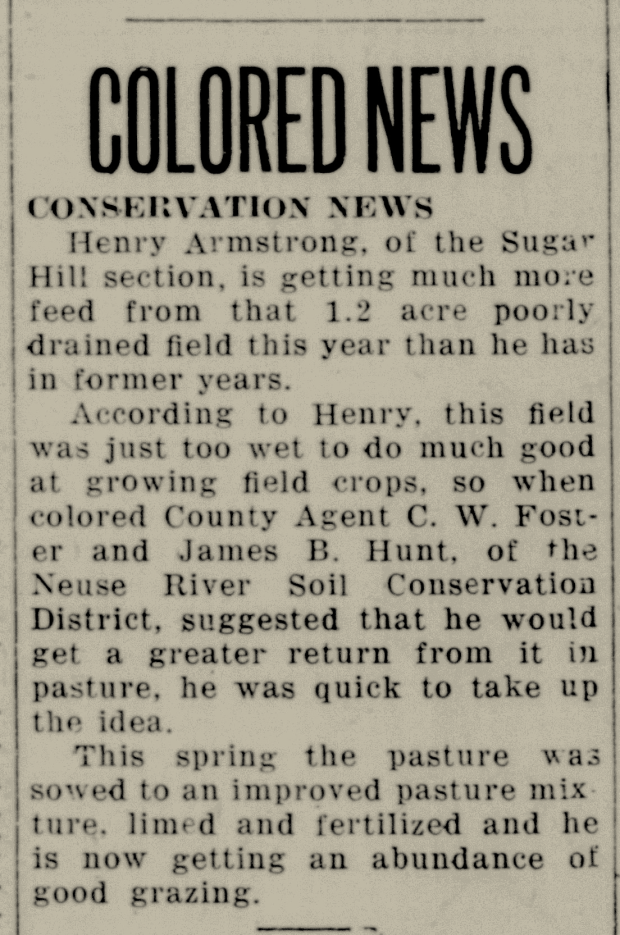
An abundance of good grazing.

202006041638552580.png

Wilson Daily Times, 27 July 1944.

——

  • Henry Armstrong — in the 1940 census of Toisnot township, Wilson County: farmer Henry Armstrong, 52; wife Minnie, 42; and children Mary, 19, Fred, 18, Rosa, 16, Clarence, 14, Nathan, 11, Daniel, 9, Louise, 8, David, 6, and Henry, 3.
  • Sugar Hill section — There is a Sugar Hill neighborhood on the western outskirts of the town of Simms and a Sugar Hill Road that runs just east of and parallel to Interstate 95 near the Nash County line. Neither is in Toisnot township. Henry Armstrong’s family’s land was east of Elm City near Edgecombe County. Can anyone pinpoint the location of Armstrong’s Sugar Hill? [Update, 7/28/2020: Jack Cherry identified Sugar Hill as a community along East Langley Road between Town Creek and Temperance Hall United Methodist Church (which is just across the line in Edgecombe County.) His great-grandfather operated a small general store and gas station at the heart of the community and lent his name to Cherry Chapel Baptist Church.]

Google Street View of the old Cherry’s Store.