
Wilson Daily Times, 8 December 1928.
Wilson Daily Times, 8 December 1928.
The Wilson Times‘ monthly supplement Wide-Awake Wilson published a guide to local Black History Month events. Proud to see Lane Street Project and Freeman Round House Museum on the list!

And here’s an option for the littles:

Sweetheart’s Cookies is baking #blackhistorymonth cookies for Casita Brewing Company, 217 South Street, Wilson. Bring your kids to the brewery Sunday, 7 February, to learn a little bit about Black History. Choose a historical figure from one of the cookies, fill in the Smart Cookie webquest form, and get a free cookie (while supplies last)! Learning is sweet!
When I first saw this stone last year, I thought it was the base of a grave marker. A closer look last week revealed a slanted edge and, when I pried it up and turned it over, I discovered this simple, but handsome, memorial for Rev. John H. Scott, a pastor of Saint James Holy Church in Stantonsburg.

Rev. Scott’s headstone was found in a half-buried pile with at least two dozen others, including his son James F. Scott. Rev. Scott was a Holiness preacher, and among the many weddings he presided over was that of my great-great-great-aunt, Sarah Henderson Jacobs, and her second husband, Rev. Joseph Silver.
——
On 28 December 1885, John Scott, 25, married Mary Jane Peacock, 17, in Pikeville, Wayne County, North Carolina.
In the 1900 census of Wilson township, Wilson County: farmer John Scott, 42; wife Mary Jane, 32; and children James, 13, Anna Bell, 6, Saloma Ann, 5, Johnny A., 3, and Sylvester, 1; and widowed mother-in-law Melinda Peacock, 60.
In the 1910 census of Weldon township, Halifax County, North Carolina: farmer John Scott, 53; wife Mary J., 46; and children James F., 22, Annie B., 16, Salomie A., 15, John A., 13, Sylvester, 11, Eliga, 9, Mary E., 7, David, 5, Sarah J., 3, and Inthe, 1.
Saloma Scott died 3 August 1915 in Wilson. Per her death certificate, she was 19 years old; single; had a “fairly good” education; and was born in Wayne County to John Scott and Mary J. Peacock. James F. Scott was informant.
James Franklin Scott registered for the World War I draft in 1917. Per his registration card, he was born 6 March 1887 in Wayne County, N.C.; lived on “Robinson” Street, Wilson; worked as a porter for Carroll Grocery Company; and was single.
In the 1920 census of Wilson, Wilson County: on Wainwright Street, farm operator John Scott, 60; wife Mary, 51; and children James, 30, wholesale company helper; Elijah, 19, David, 14, Sarah, 11, and Ianthe, 13.
Mary Jane Scott died 9 August 1921 in Wilson. Per her death certificate, she was 53 years old; was married to John Henry Scott; and was born in Wayne County to Jacob Holland and Malinda Peacock.
In the 1928 Hill’s Wilson, N.C., city directory: Scott Jno H (c; Sarah A) farmer h 1110 Woodard Ave
In the 1930 census of Wilson, Wilson County: farmer John H. Scott, 72, and wife Sarah, 34.
John Henry Scott died 18 November 1940 in Wilson. Per his death certificate, he was born 15 February 1874 in Halifax County, N.C., to Alex Scott and Cathrin [no maiden name listed]; was married to Sarah Ann Scott; lived at 311 Lane Street; and was a Holiness preacher. He was buried in Rountree [actually, Odd Fellows] cemetery.
Photo by Lisa Y. Henderson, January 2021.
This will do nicely as Black Wide-Awake’s mission statement.


Thank you, Clint Smith III.
Last week, I reported my excited discovery of the headstone of Rachel Barnes Taylor, my great-grandmother. Presumably, my great-grandfather Henry Michael “Mike” Taylor was a member of Hannibal Lodge No. 1552, Grand United Order of Odd Fellows, but his marker has yet to be uncovered.
Mike Taylor was born enslaved in far northern Nash County, North Carolina, near the start of the Civil War. Here’s what I know of his family and their journey to Wilson County.
This document filed in Nash County in 1856 is an inventory of the 106 slaves belonging to the estate of Kinchen Taylor, deceased.
Number 32 is a man named Green. Number 88 is his wife Ferribee, and numbers 89, 90 and 91, Dallas, Peter and Henrietta, were their eldest children. These 106 people were divided into lots of equal value. Most of the lots were divided among Taylor’s children, but two lots of slaves were sold. Green and Ferribee and their children were included in one of those sold lots, and it is not clear to whom they went, or if they went together.
Sometime between the dissolution of their former master’s estate in 1856 and early summer of 1870, Green and Fereby Taylor found their way to Lower Town Creek township, Edgecombe County, near present-day Pinetops. In that year, a census taker recorded their household as farm laborer Green Taylor, 52; wife Phebe, 55; and children Dallas, 19; Christiana, 14; Mckenzie, 13; Mike, 9; and Sally Taylor, 1. There is no sign of the older children – Peter and Henrietta – who had been listed with Fereby in the division of Kinchen Taylor’s slaves.
In the 1880 census of Lower Town Creek township, Edgecombe County: laborer Green Taylor, 64; wife Phoebe, 55; daughters Christiana, 24, Kinsey, 20, and Sarah, 13, as well grandchildren Nannie, 5, Carrie, 1, Lizzie, 8, Louisa, 5, and Isaiah Taylor, 2. Dallas and Mike had left the household; Mike probably was in Wilson, but he is not listed in the census.
On 21 September 1882, Mike Taylor, 20, Wilson, married Rachel Barnes, 19, of Wilson, in Wilson. Baptist minister Louis Croom performed the ceremony in the presence of W.T. Battle and Edmon Pool.
On 7 Aug 1897, Jordan Taylor Jr., 21, and Eliza Taylor, 23, were married in Wilson. Baptist minister W.T.H. Woodard performed the ceremony in the presence of Prince Smith, Annie Barnes and Michiel Taylor.
In the 1900 census of Wilson township, Wilson County: Jordan Taylor, 24; wife Eliza, 25; and son Greemond, 3, shared a household with Sallie Taylor, 27, and her son Rufus Taylor, 4. Next door: Jordan’s father Jordan Taylor, 50, and his wife of 5 years, Matilda, 40.
In the 1900 census of Wilson, Wilson County: Mike Taylor, 36, drayman; wife Rachel, 36; and children Roderick, 17, Maggie, 14, Mattie, 13, Maddie, 12, Bertha E., 8, and Hennie G., 6. Rachel and daughters Maggie, Mattie and Maddie were occupied at washing. Roderick and the youngest girls “go to school.”
In the 1910 census of Wilson, Wilson County: on Lee Street, drayman Mike Taylor, 52; wife Rachel, 51, laundress; daughters Mattie, 21, Bertha, 18, and Henny, 16, laundresses; and niece Louise, 12.
In the 1910 census of Wilson township, Wilson County: on Stantonsburg Road, odd jobs laborer Jordan Taylor Jr., 31; wife Eliza, 30, laundress; and son Greeman, 12, with Mary Parker, 69, widow, whose relationship to Jordan was described as “proctor.”
Jordan Taylor registered for the World War I draft on 12 September 1917. He reported his address as R.F.D. #6, Wilson, and his birthday as 15 December 1875. He worked as a ditcher for Sid Clark, his nearest relative was Eliza Taylor, and he signed his card with an X.
In the 1920 census of Wilson, Wilson County: at 114 Lee Street, Mike H. Taylor, 50, cook in cafe; wife Rachel, 58; son [actually, nephew] Tom Perry, 12; bricklayer Van Smith, 33, and his wife Mattie, 28.
In 1920 census of Wilson, Wilson County: at 304 Stantonsburg Street in Wilson, Jordan Taylor, 48, wife Eliza, 37, son Greeman, 22, and son(?) Dave, 13. Jordan worked as a warehouse tobacco worker, Eliza as a tobacco factory worker, and Greeman as a street boot black.
On 24 March 1922, Greeman Taylor of Stantonsburg Street, Wilson, died of consumption. He was born 2 June 1898 in Wilson to Jordan and Eliza Taylor and worked as a common laborer. He was single.
Mike Taylor died 8 January 1927 in Wilson. Per his death certificate, he was about 68 years old; was the widower of Rachel Taylor; worked as a day laborer; was born in Wilson County to Green Taylor and Ferby Taylor; and was buried in Wilson. Roddrick Taylor was informant.
Eliza Taylor died 25 May 1934 in Rose Hill, Duplin County, North Carolina. She was described as 47 years old (in fact, she was at least 10 years older), married to Jordan Taylor, and born in Wilson County to Green Taylor and Kenzie Taylor, both of Wilson County. [Her parent information is likely incorrect.]
File of Kinchen Taylor (1853), Nash County, North Carolina Estate Files 1663-1979, https://familysearch.org, original, North Carolina State Archives.
Marjorie Allen‘s headstone was found at the edge of a trash pile in Odd Fellows cemetery. She died just before her 17th birthday.

Marjorie day of Charlie & Pearl Allen Born Oct 22, 1910 Died Aug 1, 1927

The trash in this heap was likely dumped in the 1970s, when an access road still ran across Odd Fellows into Vick cemetery. It is not clear whether Marjorie Allen’s headstone is located at or near her grave or was moved and dumped here.
——
In the 1920 census of Taylor township, Wilson County: tenant farmer Charlie Allen, 51; wife Pearl, 29; and daughter Marjorie, 9.
Margarie Allen died 1 August 1927 in Wilson township, Wilson County, of “apoplexy-hemiplegia.” (In other words, a stroke and resulting paralysis.) Per her death certificate, she was born 22 October 1910 in Harnett County, N.C., to Charley Allen of Oxford, N.C., and Pearl Blue of Sampson County, N.C.
The pandemic has iced plans for formal unveilings, but Wilson County Historical Association carried through with the installation of four markers commemorating Black people, places, and events who left outsized impressions in Wilson’s history. Please look for the four — Dr. Frank S. Hargrave, Charles H. Darden, Operation Dixie, and the Wilson Normal and Industrial Institute — in East Wilson as part of your Black History Month activities.


I’m honored to have been asked to collaborate with W.C.H.A. on the selection of subjects for the 2020 markers, and I appreciate the Association’s commitment to telling the stories of all of Wilson.

This “Individual Pupil Sheet” recorded the attendance of Fredrick Green during the twenty days he was enrolled at Samuel H. Vick Elementary School in the fall of 1938. The boy was born 4 November 1931 in Wilson; his mother was Lottie McGill [actually, Lottie McPhail Green]; and he resided at 218 Narroway Street. He was in Grade 1, Section 1, until he moved out of the district on 3 October 1938.
——
In the 1940 census of Wilson, Wilson County: on Grace Street, public service laborer Henry Green, 47; wife Lottie, 40, cook; and children Cora, 12, Fred, 9, Henry Jr., 7, Edward, 2, and James, no age given.
Many thanks to Dr. Judy Rashid for sharing this document. Fred Green was her uncle.
Lane Street Project is a community initiative dedicated to the documentation and preservation of three African-American cemeteries. In so doing, we also work to highlight and celebrate the history and culture of East Wilson.
If you missed the MLK Weekend Kick-Off, you have two chances this month to join Lane Street Project’s Community Cemetery Clean-Ups! Our ancestors ARE Black History. What better way to honor their legacy?
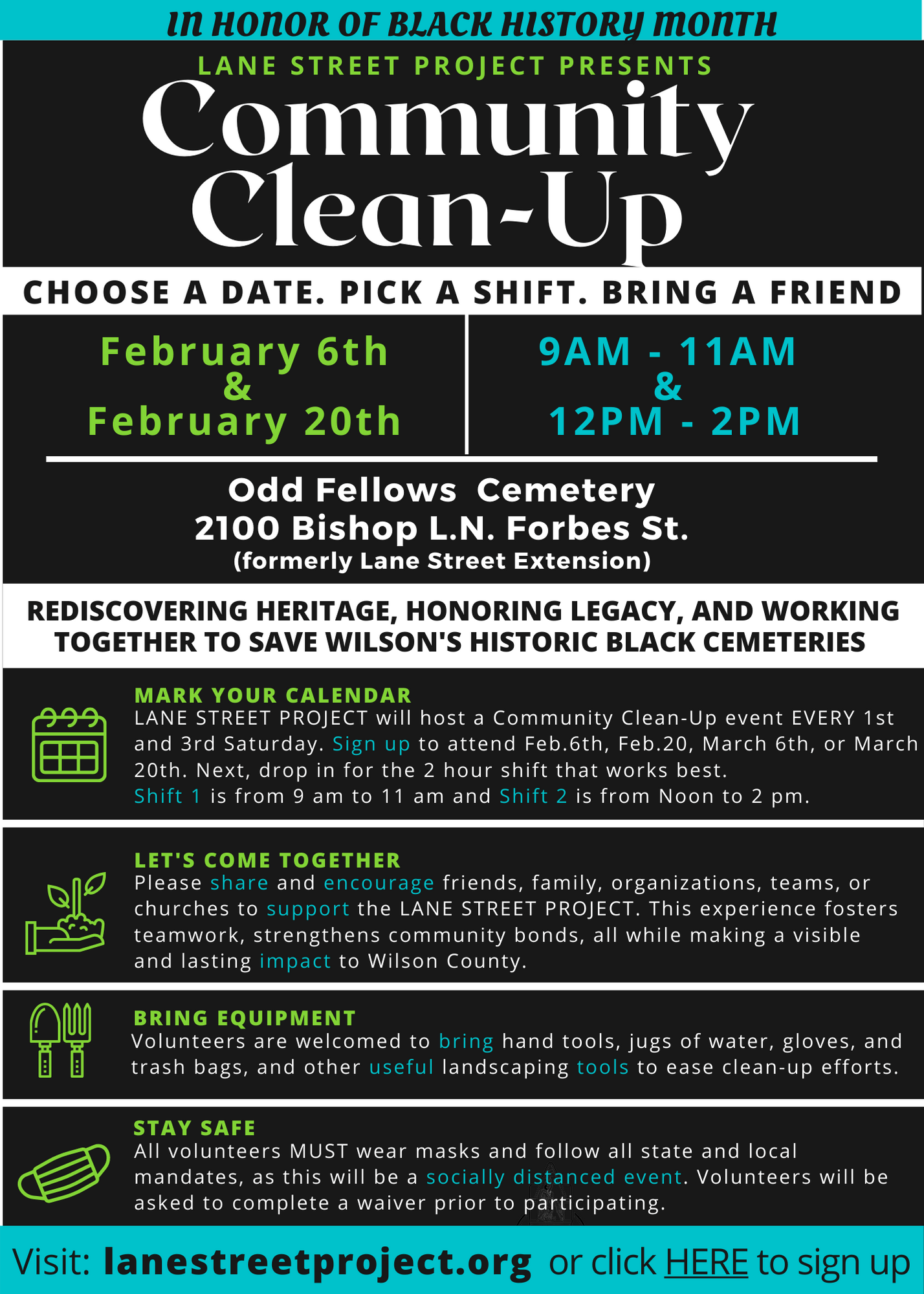
Lane Street Project invites all of Wilson to join its Community Clean-Ups at Odd Fellows Cemetery, 2100 Bishop L.N. Forbes St. Please bring hand tools, trash bags, and gloves to help clip vines and small tree limbs, rake debris, remove trash, and search for hidden headstones. Masks and social distancing required.
Last year’s Black History Month surprise was the discovery that Langston Hughes spoke at Darden High School on 10 February 1949. This year’s comes courtesy of a North Carolina State University grad student, who tipped me to Hughes’ other audience that day — the children of Saint Alphonsus Catholic School.
Hughes wrote about his “little trip down South” on his regular column in the Chicago Defender. He praised the Wilson County Negro Library, its librarian, and the itinerary she devised for him. Hughes was especially charmed by the “tiny youngsters” of Saint Alphonsus, who performed his poem “Freedom’s Plow” in its entirety. (Take a peek at Freedom’s Plow if you don’t know it. Not only does it tackle weighty subjects, it is long. I add my applause for the Saint Alphonsus scholars!)


Chicago Defender, 26 February 1946.
The final stanza of “Freedom’s Plow,” which brings a word for our time:
A long time ago,
An enslaved people heading toward freedom
Made up a song:
Keep Your Hand On The Plow! Hold On!
The plow plowed a new furrow
Across the field of history.
Into that furrow the freedom seed was dropped.
From that seed a tree grew, is growing, will ever grow.
That tree is for everybody,
For all America, for all the world.
May its branches spread and shelter grow
Until all races and all peoples know its shade.
KEEP YOUR HAND ON THE PLOW! HOLD ON!
If you know anyone who attended Saint Alphonsus in 1949 and remembers Langston Hughes’ visit, please let me know!
——