Month: August 2019

Minerva Louise Ward Artis Biggins Hanks.

After he left Wilson, Joseph H. Ward‘s close family members migrated to Washington, D.C. Once he was established in Indianapolis, Indiana, however, his mother Mittie Ward Vaughn and younger half-sister Minerva Vaughn, also known as Minerva Ward, joined him in the Midwest.

——

In the 1880 census of Wilson, Wilson County: Sarah Darden, 57, son-in-law Algia Vaughn, 23, daughter Mittie, 22, and grandchildren Joseph, 8, Sarah, 6, and Macinda Vaughn, 5 months. [Joseph “Vaughn” was actually Joseph Ward, listed with his stepfather’s surname.]

In the 1900 census of Washington, D.C: William Moody, 27, wife Sarah S., 24, and children Augustus, 5, and Crist Moody, 4, plus sister-in-law Minerva Vaughn, 10, mother-in-law Mittie Vaughn, 46, and mother Fannie Harris, 55, all born in North Carolina.

Indianapolis News, 12 December 1903.

Screen Shot 2019-08-18 at 2.50.22 PM.png

Indianapolis News, 2 January 1909.

On 11 June 1910, Minerva Ward married S. Dillard Artis, of Marion, Indiana, son of Thomas and Esther Hall Artis (who were migrants to Indiana from Wayne County, North Carolina.) Per Grant County Indiana Biographies, www.genealogytrails.com, Artis “began as janitor of the court house located in Marion, Indiana in 1900. He later accepted private contracts trimming trees, laying sod and making lawns. This work led to contracts for digging cellars, sewer and cement work, street building, and finally municipal contracting. Dillard had a cement contract connected with the $100,000 residence of J. W. Wilson, with the First Baptist Church and numerous others as well as finishing contracts on tar via roads amounting to $840,000 in 1914.” (Artis’ first wife, Asenath Peters Artis, died in December 1909.)

Indianapolis News, 18 June 1910.

Screen Shot 2019-08-18 at 2.52.09 PM.png

Indianapolis Star, 26 June 1910.

In 1911, Dr. Ward and his young son, Joseph Jr., visited his sister and mother in Marion.

Indianapolis News, 19 August 1911.

Per Google Street View, the house at 920 South Boots Street, Marion, Indiana, today.

Dillard and Minerva Artis’ social life was occasionally noted in Indiana newspapers. For example, in 1915, they were guests of Mr. and Mrs. Beverly Lafoon of Kokomo, Indiana.

Kokomo Daily Tribune, 10 April 1915.

And in 1916 they joined the J.H. Weavers of Weaver, Indiana, for dinner.

Indianapolis Recorder, 4 November 1916.

But just a few weeks later:

Indianapolis Recorder, 25 November 1916.

In the 1920 census of Chicago, Cook County, Illinois: at 486 South Wabash, Diller Artis, 44; wife Minerva, 41; mother-in-law Mittie Ward, 56; and three lodgers, John Smith, 30, and William, 49, and Anna Brown, 46. Artis was working as a railroad poster. [What happened?] Minerva claimed that she and her father were born in Indiana. [In fact, both were born in North Carolina.]

The couple apparently divorced between 1920 and 1923.  On 1 January 1923, Minerva Ward married Jonas B. Biggins in Denver, Colorado. (Dillard Artis died in 1947 in Evanston, Illinois.)

The 1935 Denver, Colorado, city directory lists Jonas B. Biggins as a Pullman porter and Minerva Biggins as a charwoman at the Custom House.

However, per Findagrave.com, Jonas B. Biggins died in 1935 and was buried in Denver. On 15 July 1936, Minerva Louise Biggins married John Q. Hanks in Greeley, Colorado. The couple is listed in the 1936 Denver directory living in the home Minerva had shared with her previous husband.

In the 1940 census of Denver, Colorado: at 1433 East 25th, owned and valued at $4000, John Q. Hanks, 49, butler; wife Minerva, 37; and son Roy, 7. [Roy was born in Illinois. Whose son was he — John’s or Minerva’s?]

In 1942, John Q. Hanks registered for the World War II draft in Denver. Per his registration card, he lived at 1433 – 25th Avenue, Denver; was born 5 February 1889 in Osage, Kansas; his contact was wife Louise Hanks; and he worked for Laurence C. Phipps, 3400 Belcaro Drive, Denver.

John Hanks died in May 1966 in Denver. I have not found a death date for Minerva Ward Artis Biggins Hanks.

A heinous charge.

Screen Shot 2019-08-18 at 10.00.52 PM.png

Wilson Mirror, 6 November 1889.

Algie Vaughan’s stepdaughter was Sarah Ward, who was about 15 in 1889. Sarah’s mother Mittie Ward had two children, Sarah and Joseph H. Ward, before she married Vaughan in 1879. This terrible incident may explain why Mittie reverted to her maiden name and Minerva used “Ward” as an adult.

——

On 6 May 1879, Algenon Vaughn, 22, married Mitty Finch, 27, in Wilson.

In the 1880 census of Wilson, Wilson County: Sarah Darden, 57, son-in-law Algia Vaughn, 23, daughter Mittie, 22, and grandchildren Joseph, 8, Sarah, 6, and Macinda Vaughn, 5 months. [Joseph “Vaughn” was actually Joseph Ward, listed with his stepfather’s surname.]

Ruby Jane Lassiter comes home.

Ruby Jane Lassiter, born 19 August 1923 in Wilson, N.C., died 30 August 1943 in Indianapolis, Indiana.

On 30 August 1943, two months after she arrived in Indianapolis (and 11 days after her birthday), 20 year-old Ruby Jane Lassiter was dead. Her family entrusted her body to Jacobs Brothers Funeral Home, and the newly digitized records of that establishment detail the arrangements to bring her home.

Screen Shot 2019-08-18 at 10.48.46 PM.png

(Plummer D. and Cary D. Jacobs, born in 1897 and 1901 in Dudley, Wayne County, North Carolina, were the nephews of Jesse A. Jacobs, Jr.)

——

In the 1930 census of Wilson township, Wilson County: at 709 Lipscomb Road, owned and valued at $1000, truck gardener Jesse C. Lassiter, 41, widower, and children Jesse C., Jr., 15, James D., 13, Ernest D., 12, Annie B., 10, Mildred P., 8, Ruby J., 7, Lesie D., 6, Harvey G., 5, and Wade, 2. [Mildred Lassiter Sherrod died six months prior to her sister Ruby, also of tuberculosis.]

In the 1940 census of Wilson, Wilson County: at 709 Lipscomb Road, WPA laborer Jessie Lassiter, 50, and children Ruby, 16, Lessie L., 15, Harvey, 14, and Wade, 12.

Many thanks to Allen County (Ind.) Public Library’s Genealogy Center, the Indiana African American Genealogy Group, and the Indiana Genealogical Society for collaborating to digitize Jacobs Brothers Funeral Home’s records and to digitalblackhistory.com for bringing this database to my attention.

The last will and testament of Jacob Taylor.

On 9 July 1860, Jacob Taylor of Wilson County penned a will that included these provisions:

  • To son William T. Taylor, two parcels totaling 224 acres on the public road from Hadley’s Mill to the Town of Wilson, near the “poor house land” and Great Branch, plus “two negro boys Raiford and Pomp“
  • To daughter Louiza Martin, wife of John H. Martin, 200 acres and “two negro boys Alfred and Deberry“
  • To Taylor and Martin, to divide or sell and divide the proceeds, “two negroes Charlotte and Frank“

The approximate location of Jacob Taylor’s farm between Hadley’s Mill and the County Poor House land.

——

Perhaps, Deberry was, in the 1870 census of Wilson township, Wilson County: farm laborer Berry Taylor, 28; wife Caroline, 26; and children Hardy, 8, Robart, 5, Loucenda, 3, and John, 5 months; plus farm laborer Berry Strickland, 18.

In the 1870 census of Wilson township, Wilson County: Pompy Taylor, 30, was listed as a farm laborer in the household of Benj’m Farmer, 48.

Likely, in the 1880 census of Stony Creek township, Wayne County: railroad worker Pompey Taylor, 40; wife Lindy, 34; and children Jack, 16, Zackary, 8, Lotty, 6, Penny, 3, and Annie, 6 months. Pompey reported that his father was born in Africa.

In the 1900 census of Stony Creek township, Wayne County: farmer Pompey Taylor, 59; wife Linda, 50; and children Annie, 19, and Jacob, 13.

In the 1910 census of Stony Creek township, Wayne County: farmer Pomp Taylor, 69, and wife Lindy, 60.

Images available at North Carolina Wills and Estates, 1665-1998 [database on-line], http://www.ancestry.com.

Vanilla Beane celebrates 100!

Jeni Hansen has graciously allowed me to share plans for the observation of the 100th birthday of her grandmother, celebrated milliner Vanilla Powell Beane, who was born in Wilson County on 13 September 1919.

Screen Shot 2019-08-16 at 8.05.02 PM.png

Screen Shot 2019-08-16 at 8.05.34 PM.png

Find more on Vanilla Beane here:

  • Articles

The Washington Post, Celebrating 3 sisters’ lives and longevity, Avis Thomas-Lester, 5 November  2011

The Washington Post, C​elebrated D.C. Milliner Marks 90th Birthday With Friends, Hats, Hamil R. Harris, 20 September 2009

Afro-American Newspapers, ​D.C. Woman Celebrates 100th Birthday with Sisters, 97, and 93, Avis Thomas-Lester and Teria Rogers, 14 November 2012

Associated Press,​ ​Dr. Height’s Hat Immortalized in Metal, Sarah Karush and Teneille Gibson, 15 June 2010

  • Videos

Hat Academy: “​Bene Millinery​”
Museum of Fine Arts: ​Dorothy Height’s Hats 360

Press contact:

Jeni Hansen
jeni@jenihansen.com​

On the occasion of his historical marker dedication, another account of Dr. Ward’s appointment.

This weekend, with his granddaughter and great-grandchildren in attendance, the Indiana Historical Bureau, the American Legion, and the Association for the Study of African American Life and History will dedicate a historical marker commemorating the lifetime achievements of Wilson native Dr. Joseph H. Ward. Though I’ve blogged about him here and here and here and here, this seemed an appropriate time to feature yet another long newspaper article detailing Dr. Ward’s accomplishments.


——

“The appointment of Dr. [Joseph H.] Ward to this position marks a decided step forward for the race. In many respects this may be regarded as the highest office to which a Negro has ever been appointed, certainly the most responsible.”

Topeka Plaindealer, 25 July 1924.

Photos courtesy of L. Bates.

Stephen Woodard’s apprentices.

Under laws authorizing the involuntary apprenticeship of poor orphans and the children of unmarried parents, county courts in antebellum North Carolina removed thousands of children from their homes to be bound to serve their neighbors. Hundreds of indentures dot the pages of Wayne County court minute books, and free children of color were disproportionately pulled into the system. Involuntary apprenticeship created an inexpensive, long-term and tractable labor supply for white yeoman farmers, many of whom could not (or could not yet) afford to purchase enslaved people.

Wayne County lost its northern tip to the newly created Wilson County in 1855. By pinpointing the locations of the farms of the men (and rare women) to whom they were indentured, we are able to identify a few free children of color as residents of the area that would become Wilson County’s Black Creek township and part of Crossroads township.

——

Stephen Woodard was born about 1790 and died in 1864. He was a wealthy farmer whose last will and testament named 75 enslaved people. In the 1850 census of North of the Neuse River district, Wayne County, Woodard’s household included 40 year-old farmhand Sollomon Woodard, who was a free man of color. In the 1860 census of Woodard’s household, then in Black Creek township, Wilson County, the same man, now known as Solomon Andrews, 50, carpenter, is listed.

The Black Creek Rural Historic District was nominated as a National Register of Historic Places in 1982 and listed in 1986. The nomination form described the residences in the district, including Stephen Woodard’s, as “a rare survivor of antebellum architecture and … excellent examples of early farmsteads in Wilson County.” Per the nomination form, Woodard built a “modest coastal cottage” between 1810 and 1820. In 1821, he inherited additional land from his father John Woodard.

Stephen Woodard Sr.’s coastal cottage, at left, attached by breezeway to a two-story, frame I-house later built for his son, Dr. Stephen Woodard Jr., possibly by carpenter Solomon Andrews. Photo courtesy of the nomination form for Black Creek Rural Historic District.

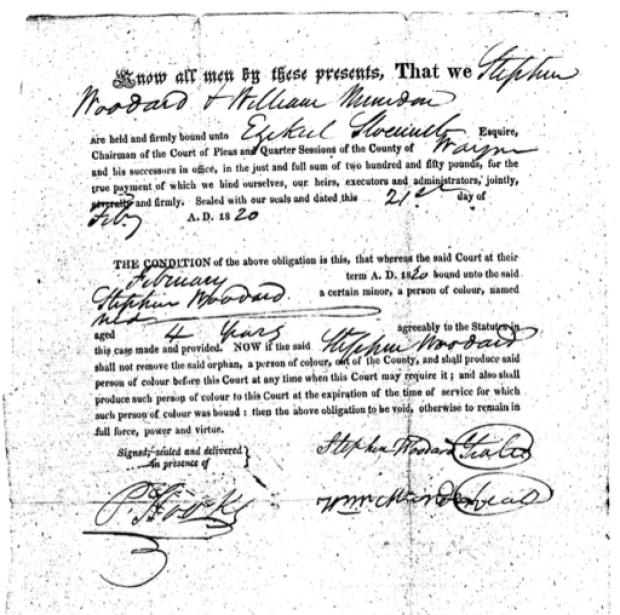
Over the span of 1820 to 1831, as he began to expand his wealth, Stephen Woodard indentured at least eight children of color:

  • Welthy [no last name given, possibly Artis], age 15, and Ned [no last name given, possibly Artis], age 4, in 1820.
  • Kinnard Samson, age 7, Liza Samson, age 12, and Jere Samson, age 2, in 1820.

Possibly, in the 1850 census of North Side of Neuse, Wayne County: Jesse Sampson, 35, day laborer, with wife Mary, 30, and children Caswell, 10, Martha, 8, Elizabeth, 6, Temda, 4, and Gabriel, 6 months.

  • William Artis, age 7, in 1822.
  • David Artist, age 15, as a farmer in 1829.

In the 1840 census of Boswells district, Wayne County, David Artis is listed as head of household consisting of two free people of color. In 1850, North Side of Neuse district, Wayne County: David Artis, 40, day laborer, wife Siry, 40, and Lafayet Artis, 3. In 1860, Nahunta, Wayne County: David Artis, 50, turpentine hand, and wife Elizabeth, 35.

  • Willie Hagans, age 9, in 1831.

Screen Shot 2019-08-13 at 9.48.47 PM.png

The indenture of four year-old Ned.

Apprentice Records, Wayne County Records, North Carolina State Archives; federal censuses.

Women are best.

While director of the University of North Carolina Press, W. T. Couch also worked as a part-time official of the Federal Writers’ Project of the Works Progress Administration, serving as assistant and associate director for North Carolina (1936-1937) and as director for the southern region (1938-1939). The Federal Writers’ Project Papers are housed at U.N.C.’s Southern Historical Collection and include Couch’s correspondence and life histories of about 1,200 individuals collected by F.W.P. members. At least two African-American residents of Wilson, Georgia Crockett Aiken and William Batts, were memorialized in this way. 

Folder 324 contains the transcript of the interview with Georgia Crockett Aiken, titled “Women are best.”

The first page is a key to the pseudonyms used in the transcript.

Georgia Aiken is mistakenly described as white. She lived at 120 Pender Street in Wilson. When her interview began, she was in her kitchen directing the work of two children who were cleaning the house. She was born in 1872 into a family of ten children, all of whom were dead except her. [The family had lived in Goldsboro, North Carolina, and Georgia’s brothers included Alexander and James Crockett.]

Georgia Aiken grew up near a school and, because both her parents were wage-earners, was able to attend through the ninth grade. She obtained a teaching certificate and started teaching in 1889 a one-room school “out in the country.” She made $25 a month for teaching seven grades and reminisced on the hardships — and reward — of serving the children of the community.

In 1908, Georgia Aiken arrived in Wilson. She started high school coursework [where? the Colored High School did not open until 1924] and received a big raise when she completed it. She taught for 48 years, all told.

She dated John Aiken for two years before they married. Aiken owned a prosperous livery stable, and the couple saved their money to build a house. When they bought the Pender Street lot, a widow lived with her children in a small house there. [A 1905 plat map shows John Aiken already owned a lot on Pender Street. Was it a different one?] John Aiken died before the house was completed [in 1914] and Georgia Aiken took over the business.

Though worried about finances, Georgia Aiken went ahead with plans to build. The livery business did well until “automobiles came in.” She sold the business at a loss and turned her attention to teaching and caring for her house.

The writer described Aiken’s kitchen in deep detail.

Her “cook stove … finished in blue porcelain” was probably much like this one, found in an on-line ad:

Aiken continued, speaking of training her helper, her standards for housekeeping and food preparation, and her preference for paying cash.

And then: “I might as well say that I voted in the last city elections and have voted ever since woman’s suffrage has come in, and I expect to as long as I can get to the polls. I would like to see some women run for some of the town offices. I think they’re just as capable as the men who set themselves up so high and mighty. I wouldn’t be the least surprised if women didn’t get more and more of the high positions in the near future. …”

And: churches and government are run by rings, and “if you don’t stand in well with these, you don’t stand a chance.”

“I believe the women do more in church work than men.”

Georgia Aiken took in boarders at her home on Pender Street and always tried to make her “guests feel at home.” “When times are good and business is stirring” — likely, she meant during tobacco market season — “I always have my house full.” In slow times, though, it was hard to meet expenses. Taxes were due and though she knew she would make the money to pay them in the fall, she hated to incur fees.

Aiken paid her helper in board and clothes only, though she wished she could pay wages. If she stayed long enough, Aiken would consider leaving her some interest in the property after her death, though her niece in New York might object. She lamented a long delay in repainting the exterior of the house, but had plans to do so.

The writer described the house’s rooms and furnishings, mentioning their wear and age. Aiken indicated her preference for “clean decent folks” as tenants. She had two baths in the house and hot water from the stove for both. She could not afford to install steam heat when the house was being built and rued the dustiness of coal.

“Helping anyone in need is being nice to anyone, and the one that helps me most during the few years that I’ve left in this life is the one I hope to remember with the most of what I leave when I’m called to the life to come.”

A summary:

Georgia Crockett Aikens died 17 August 1939 in Wilson, apparently just a few months after giving this interview. Per her death certificate, she was 67 years old, born in Wayne County to William Crockett and Rachel Powell, resided at 120 Pender Street in Wilson, and was married to John Aikens.

“Federal Writers’ Project Papers, 1936-1940, Collection No. 03709.” The Southern Historical Collection, Louis Round Wilson Special Collections Library, University of North Carolina at Chapel Hill.

In my humble estimation you stand pre-eminently above them all.

In 1936, Wilson-born pharmacist William Henry Vick wrote a letter to Kansas Governor Alf Landon, predicting that he would win the Republican nomination for president. Vick wished “to be the first Negro of New Jersey as Landon booster.” Vick’s prescience notwithstanding, Landon lost badly to Franklin D. Roosevelt.

Screen Shot 2019-08-11 at 5.51.51 PM.png

Screen Shot 2019-08-11 at 5.52.16 PM.png

Screen Shot 2019-08-11 at 5.52.25 PM.png

The Montclair Times, 28 July 1936.