

The day after Eugene Fisher drowned while swimming in the lake at Contentnea Park, the Daily Times printed an article suggesting that “Sam Vick,” i.e. Samuel H. Vick Jr., bore some responsibility for the accident.


Wilson Daily Times, 29 July 1924.
Vick immediately fired back. His grief, he stated sharply, had “been still more aggravated by the misstatement of facts concerning my part in the matter, for the facts were badly twisted and really just the opposite what really happened.” Georgia Aiken also contributed a corrective, milder in tone, but just as firm.


Wilson Daily Times, 30 July 1924.
And where was Contentnea Park? References in contemporaneous news articles reveal that (1) it was not an African-American-only park — the Kiwanis met there regularly — but rather seems to have had a section reserved for black patrons, “the negro park”; (2) it was privately owned and operated; (3) it was located above the dam on Contentnea Creek; and (4) entrance was gained via a road marked by two stone pillars. A dam spans Contentnea Creek just above U.S. Highway 301 to form what is now known as Wiggins Mill Reservoir, still a popular recreational area. With a hat tip to Janelle Booth Clevinger, here is my best guest at the park’s location:

——
- Eugene Fisher — Connecticut-born Eugene Leonard Fisher was newly arrived to Wilson at the time of his tragic death. His father Edwin W. Fisher was a manager with North Carolina Mutual and moved his wife and remaining children to Wilson between 1926, when Edwin is listed in the 1926 Durham, N.C., city directory, and 1928, when he appears in the Wilson directory. They settled into 624 East Nash Street, the house built for Dr. Frank S. Hargrave next door to Samuel Vick’s family home at 622. The Fishers appear in Wilson in the 1930 census, and Daisy Virginia Fisher (Eugene’s stepmother) died there on 25 April 1935. Per her death certificate, she and her husband were living at 539 East Nash at the time. Eugene Fisher’s younger brother Milton W. Fisher remained in Wilson into the 1940s, and his older brother Edwin D. Fisher lived there the remainder of his life.

Eugene Fisher’s death certificate reveals that he was an insurance agent for North Carolina Mutual. Fisher was living at an unspecified address on Nash Street. His father Edwin, then a Durham resident, was informant.


Eugene L. Fisher served in the United States Naval Reserve Force during World War I as a mess attendant. The Messman Branch of the Navy, which was restricted to non-white sailors, was responsible for feeding and serving officers. Fisher was assigned to U.S.S. Black Hawk, a destroyer depot ship. After his death, his brother Edwin D. Fisher of 600 East Green Street applied for a military headstone to be shipped to the “Negro Cemetery (Fayetteville Street)” in Durham. [Edwin Fisher, himself a veteran of World War I, signed as “Liaison Officer, [illegible] A.V. of World War, Sumter S.C. chap. #2.” (What does this signify?)]
- Samuel H. Vick Jr. — in the 1930 census of Wilson, Wilson County: Hines S. [Samuel H.] Vick, 62, real estate dealer; wife Annie M., 57; son Samuel H., 30, a druggist; daughter Monte L., 11; and Alferd Roberson, 78.
- Hack Jones
- Georgia Aiken
Aerial images courtesy of Google Maps.
UPDATE, 9 April 2019:
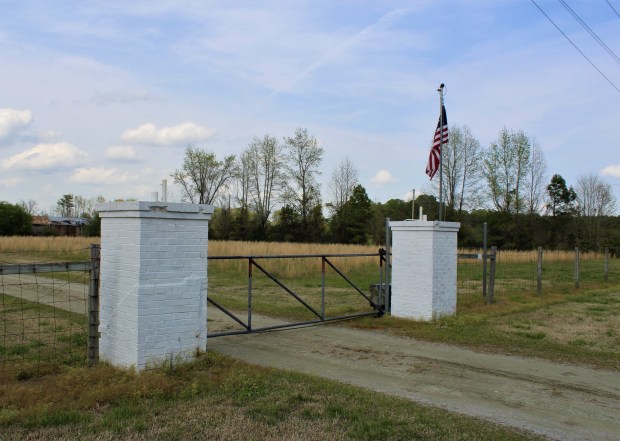

The “stone” pillars I identified above are actually brick. Until a better guess arrives though, I will stick with hypothesis that they mark the entrance to Contentnea Park. Many thanks to Janelle Booth Clevinger for this photo. — LYH
UPDATE, 11 April 2019: Per additional intel, the pillars shown above were erected in the 1960s. Thus, the location of Contentnea Park remains a mystery.